

What if the workers’ compensation check you’re counting on covers less than half of what you’ve actually lost? For many injured workers, the reality of 2026 is that standard benefits barely scratch the surface of overwhelming medical debt and lost wages. When you’re hurt on a complex job site with multiple contractors, the confusion over who is at fault can be paralyzing. You deserve a clear path to justice. Understanding third-party liability workplace accidents is the key to securing the full financial recovery you need to support your family.
I’ve spent over 25 years as a fierce advocate for the Inland Empire, and I know exactly how insurance adjusters think because I used to work for them. Now, I use that inside perspective to dismantle their stall tactics and fight for you. You don’t have to settle for a fraction of what your case is worth. This article will show you how to identify negligent parties outside of your employer, explain the legal definitions you need to know, and outline the steps to maximize your compensation. We’ll move from the uncertainty of your injury to a definitive plan for action.
Key Takeaways
- Identify the specific non-employer entities, such as equipment manufacturers or outside contractors, that you can hold accountable for your injuries.
- Learn how to pursue maximum recovery through third-party liability workplace accidents to cover damages that standard workers’ comp won’t pay for.
- Recognize the legal distinction between no-fault benefits and fault-based lawsuits to ensure you aren’t leaving money on the table.
- Follow a professional action plan to insulate your claim from the aggressive devaluation tactics used by corporate insurance adjusters.
- Leverage a strategic legal approach that turns an insurance company’s own playbooks against them to secure the justice you deserve.
What Is Third-Party Liability in Workplace Accidents?
When you’re injured on the job, you’re usually told that workers’ compensation is your only path to recovery. That’s a half-truth that protects insurance companies, not you. A Work accident often involves negligence from a party that isn’t your employer. This is where third-party liability workplace accidents come into play. These claims target outside entities whose carelessness caused your injury, such as equipment manufacturers, negligent subcontractors, or property owners.
These claims operate entirely outside the standard California workers’ compensation system. You don’t lose your right to file a lawsuit just because you’re collecting workers’ comp benefits. In fact, you can pursue both simultaneously to ensure you aren’t left with unpaid bills. Third-party liability claims allow injured workers to pursue full behavioral and financial damages unrecoverable through workers’ compensation. It’s a separate legal action designed to hold the truly responsible parties accountable for the chaos they’ve caused in your life.
The Legal Basis for Third-Party Claims
California law is clear about accountability. Under California Civil Code section 1714, every person is responsible for injuries caused to another by their want of ordinary care or skill. This legal foundation means that third parties owe a duty of care to everyone on a shared worksite. If a separate contractor leaves a hazard or a manufacturer sells a defective tool, they’ve breached that duty. We distinguish between your direct employer, who is protected by “exclusive remedy” laws, and these outside entities who have no such shield. We identify the specific failures of independent contractors and third-party entities to build a formidable case for justice.
Why Workers’ Comp Alone Is Often Insufficient
Workers’ comp is a safety net, but it’s full of holes. It caps your disability payments and offers absolutely nothing for your pain, suffering, or loss of enjoyment of life. For a severe injury that changes your future, these benefits aren’t enough to keep your head above water. Civil litigation through third-party liability workplace accidents opens the door to full wage replacement and non-economic damages. The Law Offices of Michael D. Payne acts as your shield in these complex, multi-layered claims. We know how to navigate the web of contractors on a site to find the source of the negligence. Don’t let a corporate adjuster tell you what your life is worth. We fight for the maximum recovery you deserve.
Common Scenarios for Third-Party Workplace Injury Claims
Identifying the negligent party in third-party liability workplace accidents requires more than a cursory glance at an incident report. It demands an aggressive, boots-on-the-ground investigation into equipment maintenance logs, corporate safety records, and site blueprints. In Southern California, especially on massive construction projects across the Inland Empire, multi-employer worksites are the standard. When a crane collapses or a floor gives way, the fault rarely lies solely with your boss. Often, a separate contractor or a property owner failed to maintain a safe environment, creating a hazard that should have been prevented.
Tracking fault in these chaotic environments is a high-stakes battle. We don’t just take the insurance company’s word for what happened. We dig into the evidence to find out who really cut corners. If you’ve been hurt, you need to know that motor vehicle accidents occurring while you’re on the clock are one of the most frequent paths to a third-party claim. We look for every available avenue to ensure your recovery is full and fair.
Work-Related Motor Vehicle Accidents
If you’re driving for work in Pomona or West Covina and get hit by a distracted driver, you have a claim against that driver’s insurance, not just workers’ comp. This is a classic third-party scenario. We also see cases where commercial delivery vehicles strike workers on loading docks due to poor site management or driver error. If your injury occurred while driving for a rideshare company, we apply the Uber accident attorney framework to navigate the complex insurance layers involved. Whether you were in a company truck or your own vehicle, you deserve a protector who understands these specific legal intersections.
Defective Equipment and Machinery Failures
Manufacturers often prioritize profit margins over operator safety. According to the National Safety Council, contact with objects and equipment remains one of the Top Work-related Injury Causes every year. When you’re dealing with third-party liability workplace accidents involving machinery, the manufacturer is often the target. When a tool malfunctions because of a design flaw or a missing safety guard, we pursue a strict liability path against the manufacturer. It’s vital to preserve the physical evidence of the failed tool immediately before it’s “lost” by a supervisor.
Negligence by Subcontractors and Property Owners
On shared job sites, a different subcontractor might leave a trench uncovered or fail to secure scaffolding properly. Under California premises liability laws, property owners are also responsible for warning workers about hidden dangers like toxic exposure or structural instability. In the most tragic cases, these failures lead to a wrongful death claim. If you’ve suffered because of another company’s oversight, you should contact a professional advocate who isn’t afraid to challenge powerful entities and secure the justice your family needs.
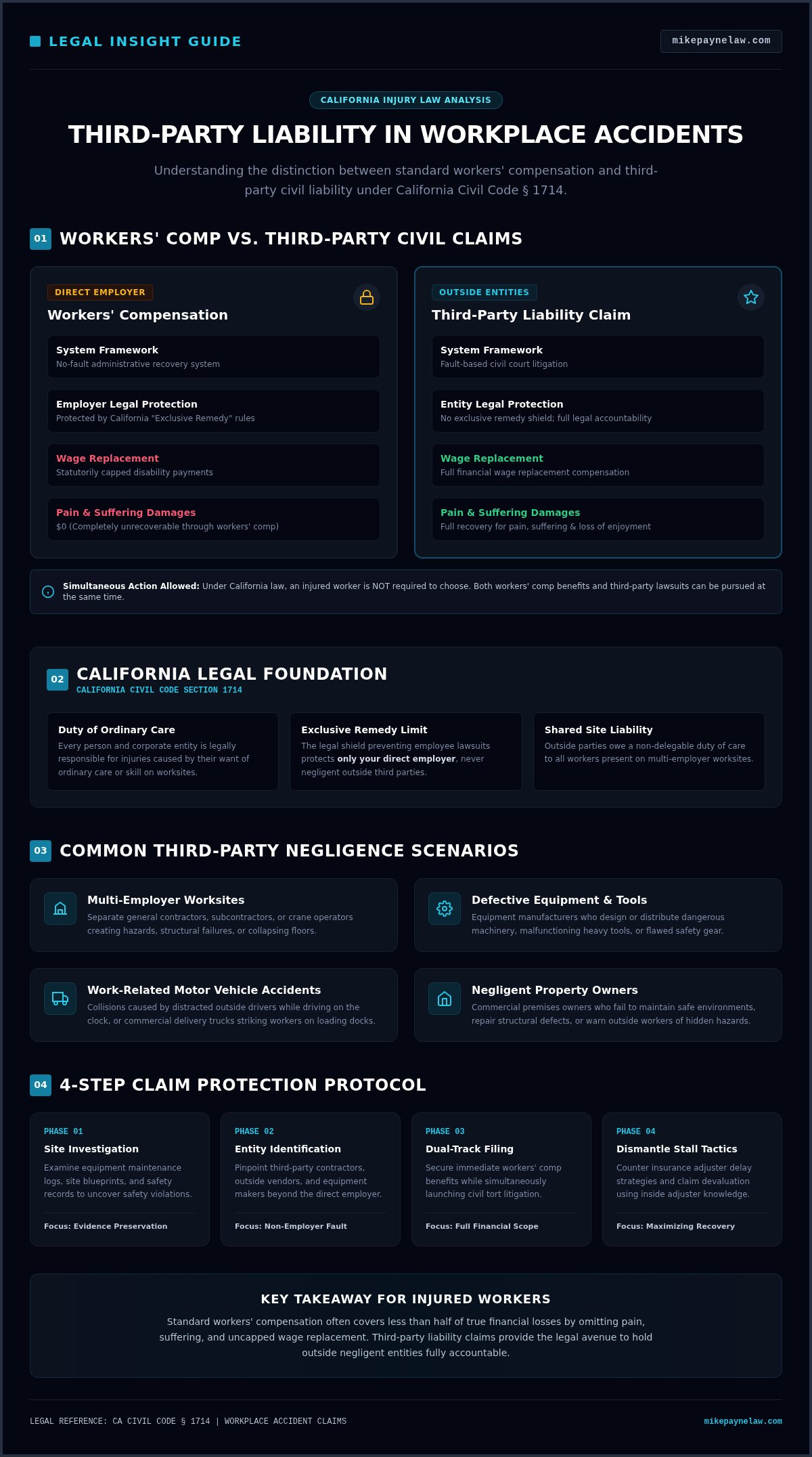
Workers’ Compensation vs. Third-Party Liability: Key Differences
Workers’ compensation is often described as a “grand bargain.” You give up your right to sue your employer in exchange for guaranteed, no-fault benefits. But for many, that bargain is a bad deal. It comes with strict compensation caps that don’t account for the full wreckage a severe injury causes. In contrast, third-party liability workplace accidents require us to prove fault, but the reward is true accountability. We aren’t limited by the state’s rigid schedules; we’re limited only by the actual extent of your losses and the negligence of the other party.
A major point of confusion involves “double recovery” and the concept of subrogation. You can, and often should, file both claims at once to create a robust financial safety net. However, you must navigate the legal process where the workers’ comp carrier seeks reimbursement from your third-party settlement for benefits they’ve already paid. Many firms fail to explain this clearly. Without an aggressive advocate, the insurance companies will fight over your settlement before you even see it. We step in as your primary shield to negotiate these liens and ensure the money stays in your pocket.
The Burden of Proof and Establishing Fault
Proving negligence is the cornerstone of a successful third-party lawsuit. Unlike workers’ comp, where you simply show you were on the clock, we must establish that a third party owed you a duty of care and breached it. This involves proving proximate cause, showing that their specific failure directly led to your injury. We utilize expert accident reconstruction and gather witness testimony to build a case that corporate adjusters cannot ignore. It’s a higher bar to clear, but it’s the only way to hold negligent corporations responsible for the chaos they’ve caused.
Available Damages: Economic vs. Non-Economic
The difference in available recovery is staggering. Workers’ comp typically covers only a portion of lost wages and basic medical care. A third-party claim allows you to pursue full lost wages and future earning capacity if you’re unable to return to your previous role. Most importantly, it covers non-economic damages like emotional distress and pain and suffering, which are completely excluded from the workers’ comp system. These amounts often vastly exceed the base medical coverage. To win these high-stakes battles, you need a Personal Injury Lawyer in West Covina who is trial-ready and knows how to value third-party liability workplace accidents correctly.
Crucial Steps Following a Third-Party Workplace Injury
The moments immediately following an on-the-job injury are chaotic, but they are also the most critical for your legal future. Corporate insurance adjusters are already moving to protect their bottom lines. They want to limit your recovery to a standard workers’ comp claim. To insulate your civil lawsuit from their devaluation tactics, you must take definitive professional action on the scene. If you are working in San Bernardino, Fontana, or Ontario, local jurisdictional realities mean that evidence can disappear quickly on fast-moving job sites. You must act as your own first line of defense before a legal advocate steps in.
Do not sign any statements or insurance waivers presented by supervisors or outside adjusters. They are looking for admissions of fault to kill your case. Instead, focus on executing a strategic checklist that secures the foundation for third-party liability workplace accidents. Your physical recovery is the priority, but protecting your right to fairness happens at the scene of the incident.
Documenting the Scene and Identifying Third Parties
You need to capture the reality of the hazard before the site is cleaned up. Use your phone to take comprehensive photographs of the specific equipment, vehicle, or structural failure that caused your injury. Look for missing safety guards or warning labels. Next, gather contact information from independent witnesses, delivery drivers, or secondary subcontractors who saw what happened. When you file the official incident report with your employer, state exactly what caused the event, and explicitly note the involvement of any non-employer entities or outside machinery.
Navigating California’s Personal Injury Statute of Limitations
Time is a brutal adversary in personal injury law. California generally allows a strict two-year window from the date of the injury to file a third-party lawsuit. Missing this deadline permanently bars you from pursuing financial justice, no matter how severe your injuries are. Early investigation is the only way to protect fading evidence and prevent witness recollections from changing under corporate pressure. If you’ve been hurt by an outside entity, you need to protect your future immediately. You should schedule a consultation with our firm to ensure all deadlines are met and your rights are fully protected.
How the Law Offices of Michael D. Payne Fights for Injured Workers
When you are recovering from a catastrophic injury, you do not need a detached corporate law firm. You need a relatable fighter who knows the local community and understands what is at stake. The Law Offices of Michael D. Payne brings over 25 years of Southern California personal injury experience directly to your side. We serve injured workers across Covina, Chino, and Baldwin Park with a combination of compassionate personal support and fierce courtroom advocacy. We stand as your primary shield against powerful corporate entities that want to sweep your injuries under the rug.
Our strategic edge comes from a deep understanding of the opposition. Principal attorney Michael D. Payne has a distinct professional history as a former insurance defense lawyer. This background reveals the exact playbooks and stall tactics that major carriers use to devalue third-party liability workplace accidents. We do not let them dictate the terms of your recovery. We use their own methods against them to secure the maximum financial compensation you need to rebuild your life.
Turning Insurance Defense Tactics Against the Insurers
Corporate adjusters are trained to shift the blame onto the injured worker or bury the claim in endless paperwork. Because we know their strategies from the inside, we anticipate and neutralize lowball settlement offers before they can derail your case. We know how they attempt to minimize non-economic damages like emotional distress. If a fair resolution is denied, we do not back down or accept a substandard outcome. Our firm maintains a relentless readiness to take third-party claims to trial. For comprehensive representation across all accident types, we apply the same rigorous approach found in our Car Accident Injury Lawyer California strategies.
Our Contingency Fee Commitment to Your Recovery
We believe that financial hardship should never stand in the way of justice. That is why our firm operates under a strict contingency fee representation structure. You pay absolutely zero upfront fees for litigation costs or attorney services. We assume all the financial risk of building your case, and we only recover our fees when we achieve a successful settlement or a winning jury verdict. This commitment ensures that our goals are completely aligned with yours. Protect your livelihood and hold the negligent parties accountable. Take the first step toward true financial recovery by scheduling a free, confidential consultation on our contact page today.
Secure the Justice and Compensation You Deserve
Standard workers’ compensation checks rarely cover the full scope of your suffering. By identifying third-party liability workplace accidents, you move beyond the rigid caps of the insurance system to pursue the full financial recovery your family needs. You’ve learned how to spot negligent contractors, defective equipment, and hazardous site conditions. Now, it’s time to turn that knowledge into a definitive legal strategy that holds every responsible party accountable for the damage they’ve caused.
Michael D. Payne brings over 25 years of local personal injury experience to your corner. As a former insurance defense attorney, he knows exactly how to dismantle the tactics adjusters use to devalue your life. We operate on a strict contingency fee structure; you don’t pay a single cent unless we win your case. There is no risk to you, only the opportunity to reclaim your future from a chaotic situation. Don’t let a powerful entity dictate your worth. Demand Justice for Your Workplace Injury-Schedule Your Free Consultation with Michael D. Payne Today. You’ve fought hard to recover physically; let us fight the legal battle for you.
Frequently Asked Questions
Can I sue my employer for a workplace accident if they have workers’ compensation?
In California, you generally cannot sue your employer directly if they provide workers’ compensation benefits due to the exclusive remedy rule. This system protects employers from lawsuits in exchange for providing no-fault benefits to injured staff. However, this rule does not stop you from pursuing a lawsuit against a negligent outside entity. If a separate company caused your harm, you can hold them accountable through a civil claim to recover damages workers’ comp won’t cover.
What is an example of a third-party liability claim in a construction accident?
A common example involves a subcontractor from a different firm leaving a trench uncovered or failing to secure scaffolding on a shared site in Pomona or Ontario. If you fall because of their oversight, that subcontractor is a liable third party. Another scenario involves a commercial driver from an outside delivery service striking a worker on a loading dock. These third-party liability workplace accidents allow you to seek full recovery beyond the limits of your employer’s insurance.
How do third-party claims affect my current workers’ compensation benefits?
Filing a third-party claim does not stop your current workers’ compensation benefits. You can collect medical care and disability payments from your employer’s insurance while simultaneously pursuing a personal injury lawsuit against the negligent third party. The third-party claim acts as a critical secondary layer of recovery. It targets non-economic damages like pain and suffering, which are never included in standard workers’ comp checks. This dual approach ensures you aren’t left with unpaid bills.
What happens if a workers’ compensation insurance company places a lien on my third-party settlement?
When a workers’ compensation carrier pays for your medical bills and lost wages, they often place a subrogation lien on any settlement you win from a third party. This means they expect to be reimbursed from your final judgment for the benefits they already provided. Negotiating these liens is a high-stakes process. We use our inside knowledge of insurance tactics to challenge these claims, ensuring the largest possible portion of the settlement stays in your pocket.
Can I file a third-party lawsuit if a defective tool caused my injury at work?
Yes, you can pursue a product liability claim against the manufacturer or distributor of a defective tool. If a saw guard fails or a ladder collapses due to a design flaw, the manufacturer is a third party that can be held strictly liable for your injuries. These cases require immediate preservation of the physical evidence. We aggressively investigate equipment records and design history to prove the tool was dangerous, securing justice for workers across West Covina and Fontana.
How long do I have to file a third-party liability lawsuit after a workplace accident in California?
California law generally gives you two years from the date of the incident to file a personal injury lawsuit against a negligent third party. This is a hard deadline, and missing it permanently bars you from recovering any financial damages. While the workers’ comp reporting deadlines are much shorter, often just 30 days, the civil statute of limitations provides a longer window. It’s vital to begin your investigation early while witness memories and evidence are still fresh.
Do I need a separate lawyer for my workers’ comp claim and my third-party lawsuit?
You don’t necessarily need two different lawyers, but you do need an advocate who understands how both systems interact. A firm that only handles workers’ comp might miss the opportunity for a much larger third-party settlement. We coordinate both paths to maximize your recovery. By managing the interplay between your benefits and your lawsuit, we protect you from insurance stall tactics and ensure every negligent party is held responsible for the chaos they caused.