

A police officer’s report is not the final word on your personal injury claim, even if an insurance adjuster treats it like the absolute truth. You might be sitting at home in West Covina or Ontario, looking at a document that completely ignores your side of the story while you struggle with physical pain and financial stress. It is a common fear that one officer’s mistake will derail your entire recovery, but in California, these reports are generally considered inadmissible hearsay in court. They are a tool, not a verdict.
I understand the frustration of feeling unheard after a chaotic collision. This guide provides a battle plan for disputing a car accident report so you can protect your right to maximum compensation. As a former insurance defense lawyer, I know exactly how the other side uses these inaccuracies to devalue your claim. You will learn the specific steps to correct factual errors, add your official statement to the record, and provide the independent evidence needed to challenge an officer’s opinion. We will move from the uncertainty of a bad report to a state of action, ensuring the insurance company sees the full picture of what really happened on the road.
Key Takeaways
- Understand that a police report is not a final verdict; you have the legal right to challenge inaccuracies that threaten your financial recovery.
- Master the strategic process of disputing a car accident report by distinguishing between simple factual amendments and complex fault supplements.
- Use a former insurance defense attorney’s “insider” knowledge to prevent adjusters from using an officer’s mistake as an excuse to deny your claim.
- Learn how independent evidence and accident reconstruction experts can override an officer’s incorrect conclusions about who caused the crash.
- Take immediate action by following specific steps to update official records with local agencies throughout the Inland Empire and West Covina.
Why an Inaccurate Police Report Threatens Your Compensation
The moment a California Highway Patrol officer or local police officer uploads a traffic collision report, the clock starts ticking on your claim. Insurance adjusters do not wait for the full story. They treat that report as the gospel truth. If the officer mistakenly places you at fault, the adjuster will use that “official” finding to justify a lowball settlement offer before you even have a chance to heal. Failing to begin the process of disputing a car accident report immediately can be interpreted by the insurance company as a silent admission that the facts presented are accurate.
In California, police reports are generally hearsay and inadmissible in a courtroom trial. However, the settlement phase is not a trial. It is a negotiation where the insurance company holds the report like a shield. If the officer swapped the names of Driver A and Driver B, or missed a stop sign violation by the other party, the adjuster will ignore your protests. They want to settle for pennies on the dollar based on a flawed document. You must act decisively to correct the record before the adjuster’s fault percentage becomes set in stone.
The Insurance Adjuster’s Perspective
Adjusters are trained to look for any reason to save the company money. They view the reporting officer as a neutral third party with no skin in the game, even if that officer spent only ten minutes at the scene and never spoke to you. Under California’s pure comparative negligence laws, an adjuster can slash your compensation by the exact percentage of fault assigned in the report. If an officer checks a box marked “unfounded” regarding your injuries or fails to note your complaints of pain, the insurance company will claim your medical treatments are unnecessary or unrelated to the crash.
The High Stakes of Fault Determination
The financial fallout of a bad report extends far beyond your immediate medical bills. An incorrect fault determination can force you to pay your own deductible and lead to skyrocketing insurance premiums for years. Most importantly, it cripples your ability to recover non-economic damages for pain and suffering. When the official record is wrong, you need a car accident injury lawyer in California who understands the insurance industry’s playbook. We do not just accept the officer’s opinion. We often utilize Traffic collision reconstruction to prove the physical evidence contradicts the written report. This aggressive intervention is vital for disputing a car accident report and forcing the adjuster to see the reality of the collision.
Identifying Common Errors in California Traffic Collision Reports
Police officers are human, and in the high-pressure environment of a Southern California crash scene, they make mistakes. Whether they are clearing a wreck off the I-10 or responding to a fender bender in a West Covina parking lot, officers often rush their paperwork. This haste leads to sloppy documentation that insurance adjusters use as a weapon against you. Before disputing a car accident report, you must scrutinize every line for inaccuracies that could derail your claim. These errors generally fall into three categories: factual, transcription, and subjective.
- Factual Errors: These are objective mistakes. The officer might list the wrong date, the incorrect time of day, or transpose digits in a vehicle’s VIN or license plate number.
- Transcription Errors: A common and devastating mistake occurs when an officer swaps the identities of “Party 1” and “Party 2.” In California, Party 1 is typically the individual the officer believes is at fault. If your names are swapped, you are suddenly listed as the cause of the accident.
- Omissions: Sometimes what is missing is more important than what is there. Officers may fail to list key witnesses who stayed at the scene or ignore road hazards like deep potholes or obscured stop signs.
- Subjective Errors: These involve the officer’s “opinion” on things they did not witness, such as estimating your speed or claiming you were distracted without any physical evidence to back it up.
Fact vs. Opinion: What Can Be Changed?
Factual errors are the easiest to fix. If the officer wrote that the weather was rainy when it was bone-dry, or listed the wrong intersection, a simple phone call to the precinct with supporting evidence often results in a quick amendment. Challenging a subjective opinion is much harder. An officer’s conclusion about fault is their professional judgment. To change this, you cannot just argue. You need new, undeniable evidence, such as dashcam footage or a different witness statement, to force a supplemental report. If you’re facing a wall of bureaucracy, speaking with an expert in motor vehicle accidents can help you identify exactly where the officer went wrong.
Common Omissions in SoCal Reports
In busy areas like Ontario or San Bernardino, officers often fail to interview every bystander. They might miss a witness who saw the other driver running a red light. They also frequently overlook environmental factors. Sun glare, faulty traffic signals, or even poor road maintenance can play a role in a crash. If an insurer refuses to acknowledge these factors because they aren’t in the report, the California Department of Insurance Automobile Claims Mediation Program can be a strategic option for resolving the dispute. Identifying these gaps is the first step in disputing a car accident report and reclaiming your right to a fair settlement.
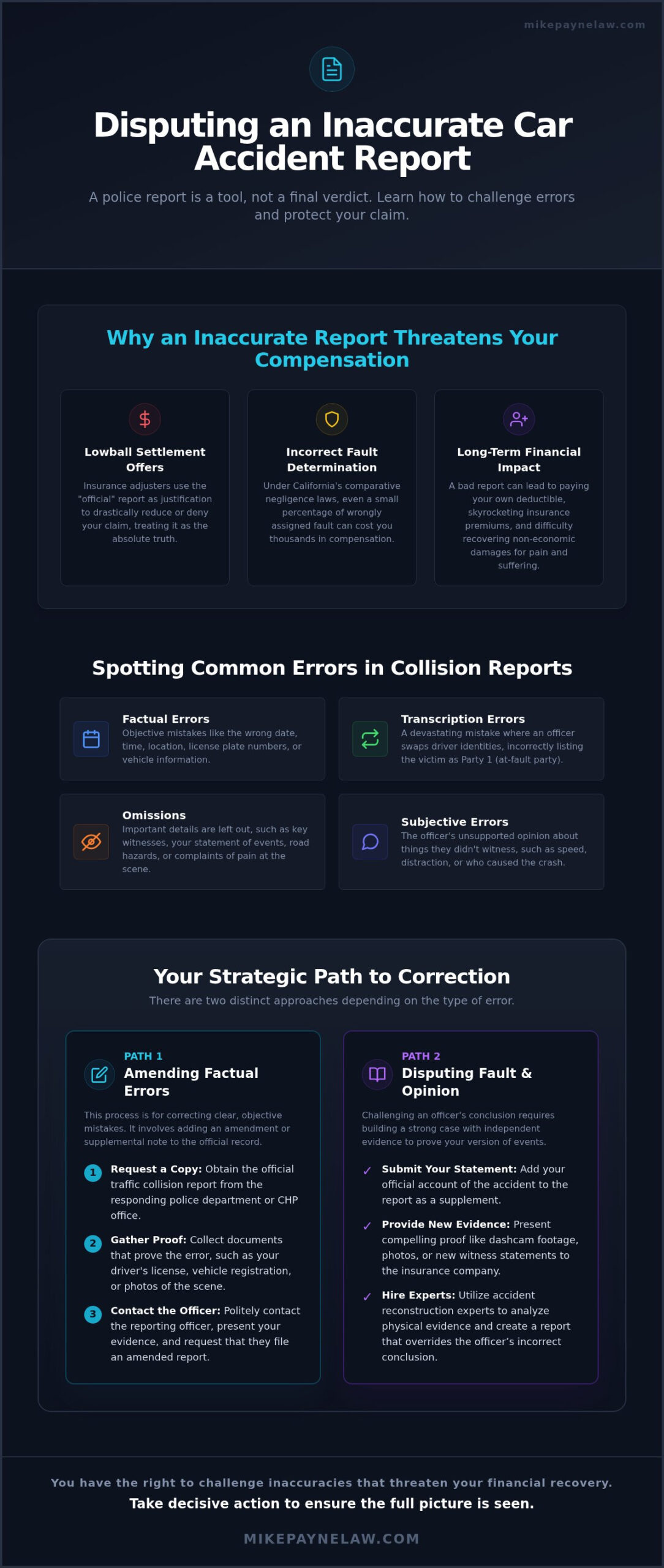
Amending vs. Disputing: The Strategic Path to Correction
Correcting an official record requires a surgical approach. You don’t just “fix” a report; you follow a specific legal path to ensure your voice is preserved. The strategy depends entirely on the type of error the officer made. You must distinguish between amending a document and supplementing a file. Amending is for objective, verifiable mistakes. If the officer listed your vehicle as a Honda when it’s a Hyundai, that is an amendment. These are binary-either the information is right or it’s wrong. Supplementing, however, is the primary vehicle for disputing a car accident report when the disagreement involves the narrative of the crash itself.
Timing is your most critical asset. If you wait months to challenge an inaccurate report, the insurance adjuster will dismiss your effort as a desperate attempt to salvage a failing claim. They want to see that you corrected the record because the truth matters, not because you’re trying to win a settlement. Acting immediately shows the insurer that you’re serious and that the officer’s version of events is fundamentally flawed.
Filing a Supplemental Statement
When an officer refuses to change their written opinion, you have the right to file a supplemental statement. This document is attached to the original report and becomes part of the official record. It’s not a place for venting frustration. It must be a cold, fact-based account of the collision. Stick to the physical realities: your lane position, the color of the traffic light, and the specific actions of the other driver. This statement is a vital component of your motor vehicle accident claim. It forces the insurance company to acknowledge that a dispute exists, preventing them from using the original report as an undisputed fact.
When the Officer Refuses to Budge
Law enforcement officers are often reluctant to admit they were wrong about a fault determination. You cannot legally force an officer to change their subjective opinion. This is the moment where a personal injury attorney in West Covina shifts the battleground. We don’t just argue with the police; we bypass their narrative. By hiring independent investigators and accident reconstructionists, we build a counter-case based on physics and forensic evidence. We prepare for a “battle of the experts” where scientific data overrides a biased or hurried police report. If the officer’s pen failed you, we let the evidence speak for itself.
Steps to Take When the Officer Gets the Facts Wrong
Finding an error in your police report is a gut-punch. It feels like the system is working against you while you are already struggling with injuries and mounting bills. To fight back, you must be methodical. Your first move is to obtain a certified copy of the report from the law enforcement agency that responded, whether that is the San Bernardino PD or the California Highway Patrol. Once you have it, go through it with a red pen. Highlight every single inaccuracy. Even a “minor” typo regarding the time of day can be used to challenge the officer’s overall attention to detail when disputing a car accident report.
Gathering Your “Dispute Toolkit”
You cannot win an argument with the police using only your memory. You need a toolkit of objective evidence to force a change. Time-stamped photos of vehicle damage are crucial; they often prove the point of impact in ways that contradict an officer’s hurried sketch. If your accident happened near businesses in Ontario or Fontana, we look for surveillance footage immediately. Most commercial security systems overwrite data within days. We also use cell phone records to shut down any false allegations of distracted driving. This physical evidence creates a “ground truth” that the insurance company cannot ignore.
Working with Local Agencies
Every agency has its own bureaucracy. The procedures for the California Highway Patrol (CHP) differ significantly from local municipal departments like West Covina or Fontana. You will likely need to contact the Records Bureau or the Traffic Division to request an amendment. When you reach out to the reporting officer, remain professional. Being aggressive or accusatory will only make them dig in their heels. State the facts clearly and provide your evidence. However, if you are disputing a car accident report over a fault finding rather than a simple typo, you should never attempt this conversation alone. A single misstatement to an officer can be used against you later.
Before you send a single email to the police department, you need a strategy. The insurance company is already looking for ways to use that report to save money. We act as your shield, ensuring that your side of the story is the one that sticks. If you are ready to fix the record and protect your compensation, contact the Law Offices of Michael D. Payne for a professional review of your case.
How the Law Offices of Michael D. Payne Challenges Fault
When you are up against a billion-dollar insurance company, a simple disagreement isn’t enough. You need a shield. At the Law Offices of Michael D. Payne, we specialize in disputing a car accident report by attacking the document from the inside out. We don’t just ask the police to change their minds; we provide them with the forensic proof that makes a correction undeniable. Our firm takes the weight of these high-stakes confrontations off your shoulders by managing every interaction with law enforcement agencies and insurance adjusters across West Covina and Ontario.
The Advantage of a Former Defense Lawyer
Michael D. Payne brings over 25 years of experience to your case, including a critical background in insurance defense. He knows exactly how defense teams and adjusters scan a police report for specific weaknesses. They look for phrases like “unfounded injuries” or “contributory negligence” to justify a claim denial. We deconstruct these reports to find the logical gaps where the officer’s narrative fails to match the physical laws of a collision. By identifying these insurance adjuster tricks early, we stop them from using a flawed document to devalue your recovery. If the report is wrong, we fight with a trial-ready mindset to ensure the truth is heard.
No Recovery, No Fee: Our Contingency Promise
Effectively disputing a car accident report often requires high-level technical support that most individuals cannot access on their own. Our firm advances all the costs necessary to hire independent accident reconstructionists and forensic experts. These professionals provide the scientific counter-narrative needed to override an officer’s hurried opinion. We believe your financial situation shouldn’t prevent you from seeking justice during a vulnerable time. That’s why we work on a contingency fee basis. You pay nothing unless we secure a successful recovery for you. We take the risk so you can focus on your healing. Ready to start? Contact us for a free consultation today and let a professional champion lead your fight for fairness.
Take Control of Your Recovery and Correct the Record
A police report is a powerful document, but it’s not an infallible verdict. Whether you’re dealing with a simple typo or a complex disagreement over fault, you have the legal right to ensure the official record reflects the truth. By gathering objective evidence and acting quickly, you can prevent insurance adjusters from using an officer’s mistake to slash your compensation. The process of disputing a car accident report requires precision and a deep understanding of how the insurance industry operates.
Michael D. Payne uses over 25 years of experience as a former insurance defense attorney to act as your primary shield. We understand the specific tactics the other side uses to devalue claims, and we fight to neutralize them. Our firm operates on a contingency fee basis, which means you pay nothing unless we secure a successful recovery for you. You don’t have to face the bureaucracy of local police departments or the pressure of insurance adjusters alone. Get a Free Case Evaluation from Michael D. Payne today. Your recovery is our priority, and we’re ready to stand as your professional champion until justice is served.
Frequently Asked Questions
Can a police report be changed after it is filed?
Yes, you can amend or supplement a report after it has been filed. Factual errors like incorrect VINs or dates are typically corrected through a straightforward amendment process. For disagreements regarding fault or narratives, law enforcement agencies allow you to submit a supplemental statement. This statement becomes a permanent attachment to the original file, ensuring your version of the crash is officially recorded for insurance adjusters to review.
Does the police report determine who is at fault for the insurance company?
No, the police report is not the final determination of fault for an insurance claim. While adjusters use it as a primary guide, they’re required to conduct their own independent investigation. In California, these reports are often inadmissible hearsay in court. Insurance companies may disregard the officer’s opinion if you provide stronger evidence, such as dashcam footage or witness statements, that contradicts the report’s initial conclusions.
What if the police report says I am at fault but I am not?
You must act immediately by disputing a car accident report through the proper law enforcement channels. An incorrect fault finding can trigger California’s pure comparative negligence rule, which reduces your compensation by your percentage of fault. We fight these findings by hiring accident reconstruction experts who use physics and forensic data to prove the officer’s subjective opinion was wrong, forcing the insurance company to reassess liability.
Can I sue the police department for an incorrect accident report?
Generally, you cannot sue a police department or an officer for a mistake in an accident report. Officers are typically protected by qualified immunity when performing their official duties. Your energy is better spent focusing on correcting the record or bypassing the report entirely. We use the discovery process in a personal injury lawsuit to bring the actual facts to light, regardless of what the initial paperwork says.
What evidence do I need to dispute an accident report in California?
You need objective, verifiable proof that contradicts the officer’s findings. This includes time-stamped photos of the scene, surveillance video from nearby West Covina or Ontario businesses, and statements from witnesses the officer ignored. Cell phone records can also disprove claims of distracted driving. Scientific data from a disputing a car accident report specialist can provide the technical leverage needed to overturn a biased or hurried police narrative.
How long do I have to dispute a car accident report?
There is no strict legal deadline for correcting a report, but you should do it as soon as possible. Waiting too long makes your challenge look like an afterthought to the insurance adjuster. While California has a two-year statute of limitations for personal injury lawsuits, the window for effectively changing an officer’s mind or adding a supplemental statement closes quickly as memories fade and physical evidence disappears from the scene.
Will a lawyer help me fix a police report?
Yes, an experienced lawyer handles the high-stakes communication with the police department on your behalf. We know the specific internal procedures for agencies like the CHP or local municipal police. Our team deconstructs the report to find logical inconsistencies that a layperson might miss. We ensure your supplemental statement is drafted professionally to maximize its impact on the insurance company’s final fault determination and your overall financial recovery.
What happens if the police never showed up to the accident scene?
If the police didn’t respond, you should file a counter report at the nearest station or online. In California, you’re also legally required to file an SR-1 form with the DMV within 10 days if there are injuries or property damage over $1,000. Without an official report, your independent evidence, like photos and witness contact information, becomes the most critical factor in proving your case to the insurance company.