

The insurance adjuster calling you isn’t checking on your recovery. They are checking the calendar. They know that every day you spend confused about your legal rights is a day closer to them paying you zero. It’s a high-stakes game where the rules are buried in the california car accident statute of limitations, and missing a single deadline means your claim is dead on arrival. You’re likely exhausted by medical appointments and frustrated by a mounting pile of bills. It’s natural to feel overwhelmed while powerful entities pressure you to settle for less than you’re worth. You deserve a protector who knows these delay tactics from the inside.
This guide will help you master the complex timelines of California injury law so you never lose your right to maximum compensation. We’ll cut through the technical jargon to explain the standard two-year filing window, the urgent six-month deadline for government claims, and how the discovery rule might protect you in 2026. You will gain a clear understanding of your specific filing deadline and the exceptions that could save your case. By the end, you’ll have a definitive plan to take action before the clock runs out on your justice.
Key Takeaways
- Understand why the two-year deadline under the california car accident statute of limitations is a non-negotiable expiration date for your injury claim.
- Identify the hidden six-month trap for accidents involving government vehicles or public property that can end your case before it begins.
- Discover how “tolling” serves as a legal pause button to protect the rights of injured minors until they reach adulthood.
- Uncover the insider delay tactics adjusters use to run out the clock and how to fight back against these predatory strategies.
- Learn why immediate action is required to preserve fading evidence and witness memories that are vital to securing maximum compensation.
What Is the California Car Accident Statute of Limitations?
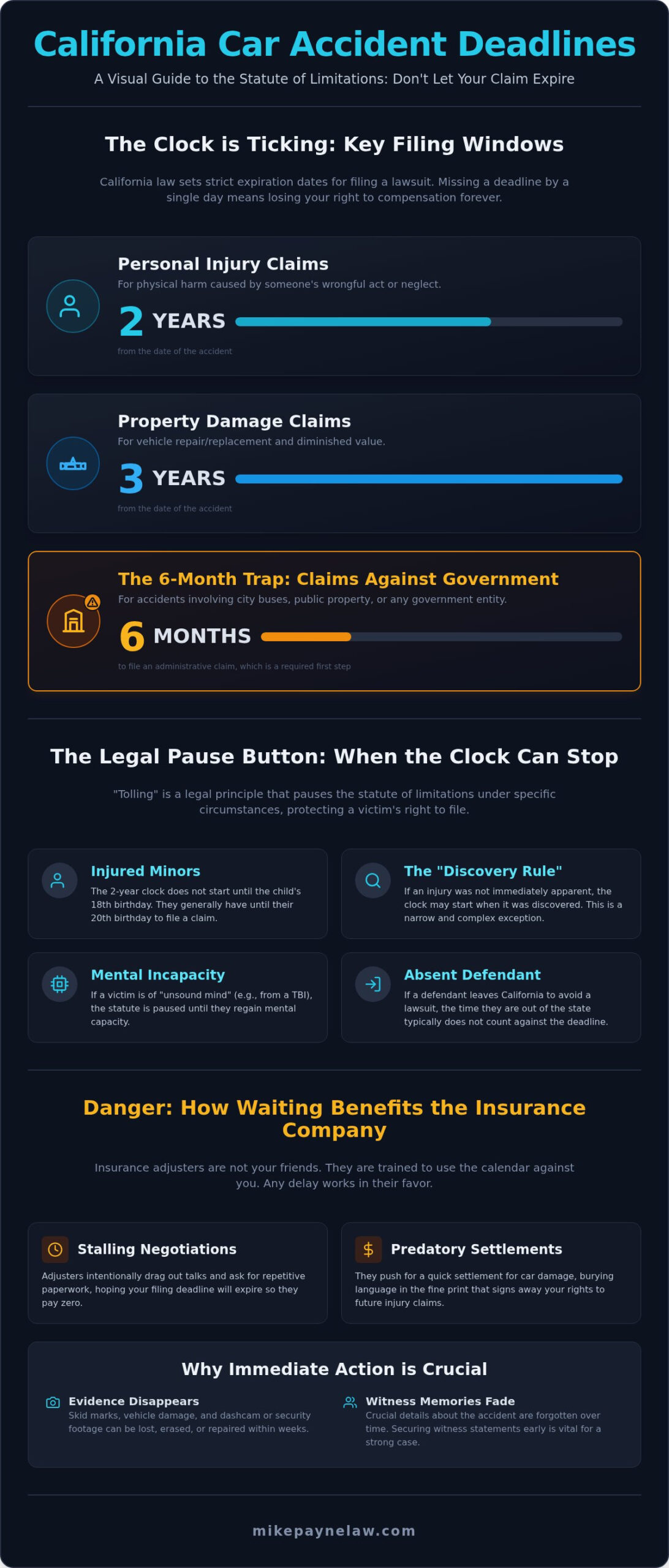
Think of the statute of limitations as a ticking clock that begins the second your vehicles collide. It is a strict legal expiration date. Once this window closes, California courts lose the power to hear your case, and the person who hit you is permanently off the hook. Insurance companies love this deadline. They will drag out negotiations for months just to watch your rights expire. For most cases, the california car accident statute of limitations provides a two-year window to file a lawsuit, but the specific countdown depends entirely on what you lost in the crash.
I spent years seeing these tactics from the other side as an insurance defense lawyer. Adjusters aren’t your friends. They are professional clock-watchers. They know that in 2024 alone, California saw 164,123 car crashes, and the system is designed to reward those who move fast and punish those who wait. If you miss the deadline by even one day, your case is dead. No judge will hear it. No insurance company will pay it.
The Personal Injury Deadline (2 Years)
If you suffered a physical injury, the law moves fast. Whether you were a driver, a passenger, or a victim in a cross-walk accident, you have exactly two years from the date of the incident to file your claim. Under California Code of Civil Procedure section 335.1, an action for injury to or for the death of an individual caused by the wrongful act or neglect of another must be filed within two years. This clock usually starts at the exact moment of impact. Evidence like skid marks and dashcam footage can disappear in weeks. If you don’t file within this window, you lose the right to recover medical costs, lost wages, and pain and suffering.
The Property Damage Deadline (3 Years)
Your car has a different timeline than your body. California Code of Civil Procedure section 338 allows three years to file a lawsuit specifically for property damage. This covers repair costs and diminished value claims, which account for the loss in resale value your car suffers just by having an accident on its record. Separating these claims is a common trap. While you might have an extra year for the vehicle, insurance adjusters often push for a “global settlement” early on. If you sign a release for your car repairs without realizing your back injury is permanent, you could accidentally waive your right to medical coverage. We see these predatory tactics every day in West Covina and Pomona.
What happens if you don’t feel the pain immediately? The “Discovery Rule” can sometimes delay the start of the clock. This applies when an injury was not immediately apparent and could not have been discovered through reasonable care. However, this is a narrow legal exception. Relying on it without a veteran advocate is a massive risk. Don’t let a hidden injury become a lost opportunity for justice.
Exceptions and Tolling: When the Legal Clock Pauses
The law isn’t always a cold, unyielding wall. Sometimes, the california car accident statute of limitations hits a pause button. This is known as “tolling.” It stops the clock from ticking when specific circumstances make it impossible or fundamentally unfair for a victim to file a lawsuit immediately. As a local fighter who has spent decades in Southern California courtrooms, I know these exceptions are often the only thing standing between a victim and total financial ruin. When we take on a case, we look for every legal lever to keep your path to justice open.
Protecting Injured Minors in California
Children are the most vulnerable victims on our roads. If a minor is injured in a crash, the law grants them special protection. The two-year countdown doesn’t begin until the child turns 18. This means an injured child generally has until their 20th birthday to file a lawsuit. While this provides a massive safety net, waiting is dangerous. Witnesses move away. Dashcam footage is deleted. If your child was hurt, you should secure motor vehicle accident representation immediately to lock down the evidence while it’s fresh.
Other situations can also freeze the clock. If a victim suffers a traumatic brain injury and is declared of “unsound mind,” the statute may be tolled until they regain mental capacity. Similarly, if a defendant leaves California to avoid a lawsuit, the time they are out of the state typically doesn’t count toward the deadline. This prevents hit-and-run drivers or negligent parties from simply hiding until the clock runs out. It’s a mechanism for fairness that we use to protect our community from those who try to escape accountability.
Delayed Discovery and Latent Injuries
Not every injury screams for attention at the scene of the crash. Internal bleeding or soft tissue damage might take weeks to manifest. The “Discovery Rule” allows the clock to start on the date you discovered, or reasonably should have discovered, the injury. However, the burden of proof is on you. You must prove that no amount of reasonable care would have revealed the injury sooner. This makes immediate medical documentation at West Covina or San Bernardino clinics essential. Without a paper trail starting near the date of the accident, insurance companies will claim your injuries happened later. If you’re unsure if your window is still open, reach out for a professional case review to see how these exceptions apply to your specific situation.
The 6-Month Trap: Claims Against Government Entities
While the standard two-year window seems generous, the rules change instantly if a government entity is involved. Under the California Government Tort Claims Act, your timeline for justice isn’t measured in years. It’s measured in months. If your crash involved a city, county, or state vehicle, you have exactly six months from the date of the accident to file a formal administrative claim. This is a non-negotiable deadline. Missing it usually means losing your right to compensation forever. I’ve seen agencies use these technicalities to shut down legitimate cases before they ever reach a courtroom, which is why immediate action is your only real defense.
Common Government Defendants in Southern California
It isn’t always obvious who you are suing at the scene of a crash. A maintenance truck might belong to Caltrans. A bus might be part of the Foothill Transit system. In our local communities, identifying the defendant is the first step in beating the california car accident statute of limitations. Common government defendants include:
- City of West Covina or Pomona police and fire department vehicles.
- Public school buses transporting students through the San Gabriel Valley.
- Municipal utility trucks or waste management vehicles owned by the city.
- Construction vehicles working on state-funded highway projects.
These cases often involve heavy vehicles that cause catastrophic damage, much like the devastation seen in fatal trucking accidents. If the driver is a public employee on the clock, the six-month rule is absolute.
The Process: Administrative Claim vs. Lawsuit
Suing the government requires a specific three-step process. First, you must file a formal notice of claim with the correct agency. This isn’t a lawsuit; it’s a mandatory administrative hurdle. Once filed, the agency has 45 days to respond. They can accept the claim, offer a settlement, or issue a formal rejection. If they reject your claim, the law gives you only six months from the date of that rejection notice to file a lawsuit in court. If the agency fails to respond at all, the timeline can shift, but waiting for them to act is a dangerous gamble. If you missed the initial six-month window, we may be able to file a “Late Claim” petition, but these are only granted in extreme circumstances like physical or mental incapacity. You need a protector who won’t blink when facing off against state power and its massive legal teams.
The Danger of Delay: How Waiting Benefits the Insurance Company
Insurance companies don’t just watch the clock; they weaponize it. Every day you wait to file a claim is a day the insurance adjuster uses to devalue your case. From an “insider” perspective, having spent years as an insurance defense lawyer, I can tell you that delay is their most effective strategy. They know that the closer you get to the california car accident statute of limitations, the more desperate you become. Desperation leads to lowball settlements. They are betting that you will get tired of the medical bills and the phone calls and eventually settle for pennies on the dollar just to find some relief.
One of the most common traps is the “Lullaby” tactic. This is when an adjuster acts incredibly friendly, checking on your health and promising that “we’ll take care of everything.” They want to lull you into a false sense of security so you don’t hire an attorney. While they are being nice on the phone, they are building a file against you. They are waiting for the exact moment when your legal window starts to close, at which point their tone will shift from compassionate to cold. By then, the damage is often done.
Countering Insurance Defense Strategies
I use my defense background to anticipate these adjuster tricks before they happen. We don’t wait for the insurer to make a move. A trial-ready Car Accident Injury Lawyer California needs months, not days, to build a high-stakes “policy limits” demand. This involves hiring accident reconstruction experts and securing early expert testimony to lock in the facts of the crash. If we wait until the two-year mark is approaching, we lose the leverage required to force a maximum payout. We hit the ground running to ensure the insurance company knows we are prepared for a fight, not just a settlement.
Preserving Evidence in West Covina and Pomona
Evidence in the Inland Empire disappears with alarming speed. If your accident occurred near the busy I-10 or 60 freeways, surveillance footage from nearby gas stations or storefronts is often purged within 7 to 10 days. Witness memories are equally fragile; details about signal colors or lane changes blur long before the legal deadline arrives. We move immediately to secure police reports from the West Covina PD or Pomona PD before they are archived or lost in the shuffle. Immediate evidence collection is the only way to secure maximum recovery because it prevents the defense from creating their own version of the truth. If you want to protect your future, you must contact us today to start the investigation while the trail is still warm.
Take Action: How Michael D. Payne Protects Your Right to Sue
Filing a lawsuit “just in time” is a recipe for disaster in California courts. A clerical error, a rejected filing, or a missed signature on the final day of the california car accident statute of limitations can end your quest for justice instantly. You need a buffer. You need a team that prepares every case as if it’s going to trial from day one. We don’t wait for the deadline to loom; we create a sense of momentum that forces insurance companies to take your claim seriously or face the consequences in front of a jury.
At the Law Offices of Michael D. Payne, we provide fierce advocacy for victims across the Inland Empire and San Gabriel Valley. Our process is designed to take the weight off your shoulders while we build a formidable case. We handle the immediate investigation, coordinate medical liens so you can focus on healing without harassment from bill collectors, and enter negotiations with the aggressive stance that only a former insurance defense attorney can maintain. We know the opposition’s playbook because we used to help write it.
Our commitment to you is backed by a signature financial assurance. We operate on a contingency fee basis, which means you pay nothing unless we win your case. There are no upfront costs and no hidden fees. We are personally invested in your recovery because our success is directly tied to yours. This approach ensures that everyone has access to high-stakes litigation, regardless of their current financial situation.
Your Local Southern California Advocate
We aren’t a detached corporate firm. We are a “boots-on-the-ground” operation with deep roots in the community. Whether your accident happened in West Covina, Pomona, Ontario, or San Bernardino, we understand the local courts and the specific needs of our neighbors. Michael D. Payne acts as your primary shield, standing between you and the powerful entities trying to minimize your pain. If you need a Personal Injury Attorney California who knows the local landscape, we are ready to pursue the most rigorous path to recovery rather than accepting substandard resolutions.
Schedule Your Free Consultation Before Time Runs Out
The 2026 legal landscape in Southern California is more competitive than ever. Insurance companies are using every tool at their disposal to run out the clock and devalue your suffering. Don’t wait until the final months of the california car accident statute of limitations to seek professional intervention. Taking action today ensures we can preserve the evidence, interview the witnesses, and secure the medical documentation necessary for a maximum recovery.
Your future shouldn’t be a casualty of a legal deadline. Contact the Law Offices of Michael D. Payne today to protect your future. We combine professional grit with a sincere, neighborly tone to guide you through this vulnerable time and lead you from a state of uncertainty to a state of action.
Secure Your Future Before the Clock Stops
The clock is the insurance company’s favorite weapon, but it doesn’t have to be yours. You now know that the california car accident statute of limitations is a strict barrier, whether you’re facing the standard two-year injury window or the urgent six-month government claim deadline. Waiting only helps the adjusters who are hoping you’ll miss your chance at justice. You deserve a protector who has seen their tactics from the inside and knows exactly how to dismantle them.
With 25+ years of Southern California legal expertise, Michael D. Payne brings former insurance defense insider knowledge to every case. We don’t just file paperwork; we build high-stakes litigation strategies designed to win. Our contingency fee promise means you pay nothing unless we win your case. Don’t let another day slip away while evidence fades and memories blur. Take the decisive step toward recovery and hold the negligent parties accountable.
Protect Your Rights-Schedule Your Free Consultation Now. We are ready to stand as your shield and fight for the maximum compensation you deserve.
Frequently Asked Questions
Can I still sue if the 2-year statute of limitations has passed?
Generally, you lose your right to sue once the two-year window closes. California courts are strict about these deadlines to ensure legal finality. However, if you qualify for “tolling” due to mental incapacity or if the defendant fled the state, you might still have a path forward. These exceptions are rare and difficult to prove without an aggressive advocate who knows how to challenge the opposition’s attempt to dismiss your case.
What is the statute of limitations for a wrongful death claim in California?
You have two years from the date of the individual’s death to file a wrongful death lawsuit in California. This deadline is governed by Code of Civil Procedure section 335.1. It is important to distinguish the date of the accident from the date of death, as the clock starts when the person passes away. Losing a loved one is devastating, and securing justice requires moving quickly to preserve evidence before the trail goes cold.
Does the statute of limitations change if a government vehicle hit me?
Yes, the timeline shrinks drastically when a government entity is involved. You must file a formal administrative claim within six months of the accident under the Government Tort Claims Act. This applies to city police cars, Foothill Transit buses, or Caltrans trucks. If the agency rejects your claim, you then have only six months from that rejection date to file a lawsuit. Missing these deadlines is a common trap that ends many cases.
What happens if I discovered my car accident injury a year after the crash?
The “Discovery Rule” may allow the clock to start on the date you realized you were injured rather than the crash date. This is common with latent internal injuries or traumatic brain injuries that don’t show symptoms immediately. However, you must prove that you couldn’t have reasonably discovered the injury sooner. Insurance companies will fight this tooth and nail, so immediate medical documentation from local clinics is your best defense to prove the timeline.
How does the statute of limitations work for a minor involved in a car accident?
For minors, the california car accident statute of limitations is paused until they turn 18. This means an injured child generally has until their 20th birthday to file a lawsuit. While this provides extra time, parents shouldn’t wait. Evidence like dashcam footage and witness statements can vanish in weeks. Taking action now ensures your child’s future is protected by a professional champion who understands the urgency of preserving high-stakes evidence.
Can an insurance company extend the statute of limitations for me?
No, an insurance company cannot legally extend the statute of limitations. In fact, adjusters often use friendly “lullaby” tactics to keep you negotiating until the deadline passes. Once the clock hits zero, they will stop taking your calls because they are no longer legally obligated to pay anything. Never trust an adjuster’s promise of a settlement if you are nearing your filing deadline; only a filed lawsuit can truly protect your rights.
Is the statute of limitations different for motorcycle or truck accidents?
The standard two-year limit applies to motorcycle and truck accidents just like passenger vehicle crashes. However, truck accidents often involve federal regulations and multiple defendants, which makes the investigation much more complex. Because evidence like “black box” data from commercial trucks can be overwritten quickly, you need to act much faster than the two-year deadline suggests. Waiting until the last minute makes it nearly impossible to build a trial-ready case.
What should I do if my car accident deadline is only a few weeks away?
You must contact a trial-ready attorney immediately to file a “protective” lawsuit. Filing a claim is a complex process that requires specific documentation; rushing it on your own often leads to fatal procedural errors. We move quickly to secure your place in the court system, preventing the insurance company from running out the clock. Every second counts when you are weeks away from losing your right to maximum compensation forever.