

Allstate calls itself the “Good Hands” company. But whose hands are those, really, when an adjuster is pressuring you to sign a quick settlement before you even know the full extent of your injuries? If you’ve filed an Allstate car accident claim and something feels off, trust that instinct. You’re not imagining it.
Here’s the reality most people don’t discover until it’s too late: Allstate is a business, and minimizing your payout protects their bottom line. Their adjusters are trained to move fast, their paperwork is designed to confuse, and their proprietary claims software is built to calculate settlements in their favor, not yours. You deserve to know exactly how that system works before you agree to anything.
That’s where this guide comes in. Attorney Michael D. Payne spent years on the other side of these cases, defending insurance companies, which means he knows their playbook from the inside out. In the sections ahead, you’ll learn the specific tactics Allstate uses to undervalue claims, the steps you can take to protect yourself, and how having a former insurance defense attorney in your corner changes everything.
Key Takeaways
- Allstate uses proprietary software called Colossus to algorithmically score your injuries — understanding how it works is the first step to fighting a lowball offer on your Allstate car accident claim.
- Adjusters are trained to move fast and make early settlement offers before you fully understand your injuries; signing too soon can permanently forfeit compensation you’re owed.
- The medical authorization forms Allstate asks you to sign aren’t routine paperwork — they can grant access to your entire medical history and be used against your claim.
- Simple steps taken immediately after a SoCal accident, from documenting the scene to seeking prompt medical care, can dramatically strengthen your position at the negotiating table.
- Attorney Michael D. Payne spent years defending insurance companies, which means he knows exactly how carriers like Allstate build their case against you — and how to dismantle it.
Navigating Your Allstate Car Accident Claim: Beyond the ‘Good Hands’ Slogan
The moment you report an accident to Allstate, a process begins that has nothing to do with your wellbeing. A claim file opens. A reserve amount gets set. And an adjuster, trained to protect the company’s financial interests, is assigned to your case. That adjuster may sound warm, patient, and genuinely helpful. That’s by design.
Allstate is a publicly traded corporation with shareholders to answer to. Their adjusters aren’t social workers; they’re claim handlers operating within a system built to minimize payouts. Understanding that distinction before your first conversation with them isn’t cynicism. It’s self-protection.
It also matters which type of claim you’re filing. A property damage claim covers your vehicle. A bodily injury claim covers your physical injuries, lost wages, and pain and suffering. These two tracks run separately, and Allstate knows that settling the property damage side quickly often pressures claimants into resolving the bodily injury side before they’re ready. Don’t let the convenience of getting your car fixed rush a decision worth far more money.
The First 24 Hours After an Accident
The first 24 hours are the most consequential, and the most dangerous. Before you speak with any adjuster, gather what you can: photos of all vehicle damage, the scene, road conditions, and any visible injuries. Get the other driver’s insurance information, and collect contact details from witnesses. If police responded, note the report number.
Then there’s the recorded statement. Adjusters often request one early, framing it as routine. It isn’t. Anything you say on that recording can be used to dispute your injuries or shift blame onto you. You have no legal obligation to provide one immediately. Politely decline until you’ve spoken with an attorney.
Common Pitfalls for Southern California Drivers
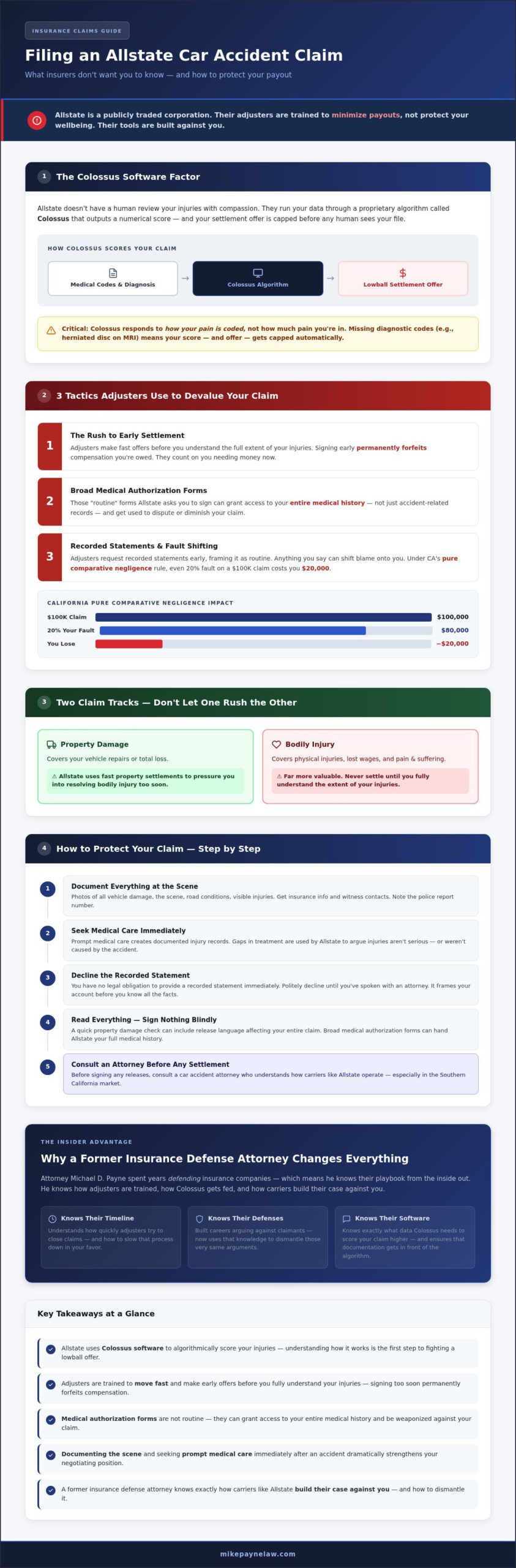
California follows a pure comparative negligence rule, which means Allstate can reduce your payout by whatever percentage of fault they assign to you. Even a 20% fault attribution on a $100,000 claim costs you $20,000. Adjusters know this, and they’ll probe for any detail that shifts blame in your direction.
Watch out for the quick property damage check, too. Accepting it can come bundled with release language that affects your broader allstate car accident claim. Read everything. Sign nothing without understanding what rights you’re waiving.
Southern California roads bring their own complications: heavy freeway traffic, distracted drivers, and multi-vehicle accidents where fault gets contested aggressively. Before you sign any releases, consult a car accident lawyer in West Covina who understands how carriers like Allstate operate in this specific market. Attorney Michael D. Payne spent years on the defense side of these cases. He knows exactly how adjusters are trained to think, and that insider knowledge is the foundation of every case he takes on.
How Allstate Evaluates Your Injury: The Colossus Software Factor
Most people assume an adjuster sits down, reviews their medical records, and makes a thoughtful judgment about what their injuries are worth. That’s not how it works. Allstate uses a proprietary software system called Colossus to generate a numerical “score” for your claim. That score drives the settlement offer you receive. And if the right data never makes it into the system, your offer gets capped before a human being ever looks at your file.
Colossus works by ingesting medical codes, treatment types, and diagnostic information, then cross-referencing that data against a database of prior settlements to spit out a value range. The adjuster isn’t overriding that number out of compassion. They’re working within it. This is why an allstate car accident claim can feel like it’s going nowhere, even when your injuries are serious and your pain is real. The algorithm simply doesn’t know what it wasn’t told.
The Importance of Medical Documentation
Colossus doesn’t respond to how much pain you’re in. It responds to how that pain is coded. Diagnostic codes tied to objective findings, such as herniated discs confirmed by MRI, nerve damage documented by a neurologist, or orthopedic injuries graded by a specialist, carry far more weight in the system than a primary care physician’s general notes about soreness or discomfort. In practical terms, a referral to an orthopedic specialist or neurologist doesn’t just get you better care; it generates the specific medical terminology that triggers higher algorithmic payouts inside Colossus.
Treatment gaps hurt you here, too. If you missed two weeks of physical therapy, the software interprets that as evidence your injuries weren’t severe. It doesn’t account for the fact that you couldn’t get childcare, or that your employer wouldn’t approve the time off. The algorithm is rigid. It rewards consistent, well-documented treatment and penalizes anything that looks like an interruption.
Beating the Algorithm
Here’s where a knowledgeable attorney changes the equation. Experienced personal injury lawyers who understand Colossus know how to build a medical record that speaks the software’s language. That means ensuring specialist referrals are in place, treatment is continuous, and every functional limitation you experience is documented in a format the system can process.
One specific strategy involves documenting what attorneys call “Duties Under Duress,” meaning the everyday tasks you’ve been forced to perform despite significant pain. Grocery shopping with a herniated disc. Driving to work after a concussion. These details, properly recorded in your medical file, can push non-economic damage scores higher because they demonstrate ongoing real-world impact.
But no algorithm accounts for the full weight of a human life disrupted. Colossus can’t measure the night you couldn’t sleep, or the promotion you had to decline because you were still in recovery. That’s where the human element matters most. Attorney Michael D. Payne spent years on the defense side of these cases, which means he knows exactly what data Allstate’s system needs and what arguments override a lowball automated offer when the numbers don’t tell the whole story. If your allstate car accident claim has already received an offer that feels wrong, it probably is. Understanding your options under California law is a critical next step before you respond to anything.
3 Tactics Allstate Adjusters Use to Devalue Your Settlement
Adjusters don’t improvise. They follow a playbook, and every move in that playbook is designed to protect Allstate’s bottom line. Understanding these tactics before they’re used on you is the difference between a fair recovery and a check that doesn’t come close to covering your actual losses.
Here are the four most common strategies you’ll face when handling an allstate car accident claim.
- The Swoop and Settle: Allstate’s adjuster calls within days of your accident, sometimes hours, with a settlement offer in hand. It sounds generous in the moment. The problem is that many serious injuries, including herniated discs, traumatic brain injuries, and soft tissue damage, don’t fully manifest for days or weeks. Once you accept that early check and sign a release, you can’t go back. That offer isn’t generosity. It’s a calculated bet that you don’t yet know what your injuries are actually worth.
- The Medical Authorization Trap: Allstate will ask you to sign a broad medical authorization form, framed as routine. It isn’t. That signature can grant them access to your medical records going back a decade or more. They’re not interested in your treatment history out of concern for your health. They’re looking for pre-existing conditions, prior injuries, or anything they can point to as an alternative explanation for your current pain.
- The Delay Game: If a quick settlement doesn’t work, some adjusters shift to the opposite approach: stalling. Requests for additional documentation, slow responses, repeated follow-up calls that go nowhere. The strategy is attrition. They’re waiting for you to get tired, get desperate, or get behind on bills. A claimant under financial pressure is far more likely to accept a substandard offer just to end the process.
- Blame Shifting: California’s pure comparative negligence rule means every percentage of fault assigned to you reduces your payout. Adjusters know this. They’ll ask seemingly casual questions designed to get you to admit you were distracted, moving too fast, or didn’t brake in time. Your own words become the evidence used against you.
The Danger of the Recorded Statement
Saying “I’m fine” to an adjuster who asks how you’re doing isn’t just small talk. It’s a statement on record. If you later require surgery for a spinal injury that wasn’t immediately apparent, Allstate’s team will point to that recording as evidence your injuries weren’t serious. You are not legally required to provide a recorded statement to the other driver’s insurer. Politely declining until you have legal representation isn’t obstruction; it’s common sense. For a deeper look at how adjusters use these conversations to build a case against you, the insurance adjuster tricks covered in our California advocacy guide lay out the full picture.
The Broad Medical Release
Allstate doesn’t need your records from ten years ago to evaluate a broken collarbone from last month. But they’ll ask for them anyway. Pre-existing conditions are one of their most reliable tools for reducing payouts. A prior back complaint from years ago becomes their argument that your current herniated disc isn’t their driver’s fault. You can protect yourself here. Work with an attorney to provide only the records directly relevant to your current injuries through proper legal discovery channels, rather than signing a blanket release that hands over your entire medical history. Attorney Michael D. Payne spent years on the defense side of these cases, so he knows exactly which records Allstate actually needs and which ones they’re fishing for. That distinction, managed properly, can protect your allstate car accident claim from being undermined by unrelated history.
Steps to Protect Your Allstate Car Accident Claim After a SoCal Auto Accident
What you do in the days immediately following a crash shapes everything that comes after. Not what you say to the adjuster. Not the forms you eventually sign. The actions you take right now, before Allstate’s team has fully mobilized, are what determine how strong your position is at the negotiating table.
Start with medical care. Even if you walked away from the scene feeling shaken but functional, get evaluated by a doctor that same day. Adrenaline masks pain. Whiplash, concussions, and soft tissue injuries often don’t announce themselves until 48 to 72 hours later. A gap between your accident date and your first medical visit becomes a weapon in Allstate’s hands. They’ll argue your injuries weren’t serious enough to seek immediate care. Don’t hand them that argument.
At the scene, document everything independently. Don’t rely on the other driver’s insurer or even the police report to capture what matters. Photograph all vehicle damage from multiple angles, road conditions, skid marks, traffic signals, and visible landmarks. If you’re near a recognizable intersection in Pomona or Ontario, those landmarks can help establish precise location context that matters when fault gets contested. Identify witnesses before they leave. Get their names and phone numbers directly, not through the other driver.
Before you speak with Allstate, consult a personal injury attorney in California who understands how carriers like Allstate operate. That conversation changes the dynamic entirely.
Local Evidence Gathering
Southern California’s busiest corridors, including the intersections along the 10 and 210 freeways in Fontana and San Bernardino, are covered by traffic and red-light cameras operated by local agencies. That footage gets overwritten fast, sometimes within 30 days. An attorney can send a preservation demand letter before that window closes. Pair that with the official police report from West Covina PD or the California Highway Patrol, and you’ve built a factual foundation that’s hard to dispute. Local geographic knowledge matters here. An attorney familiar with SoCal’s specific intersection layouts and traffic patterns can identify fault arguments Allstate’s out-of-area adjusters won’t anticipate.
Documenting Your Recovery
Keep a daily journal. Write down your pain levels, the tasks you couldn’t complete, and how your injuries affected your work and home life. Track every out-of-pocket expense: prescriptions, co-pays, transportation costs to appointments, even Uber rides when you couldn’t drive. These records translate directly into documented economic damages.
Stay off social media entirely. A single photo of you smiling at a family gathering, posted during your recovery, becomes Allstate’s evidence that your injuries aren’t as limiting as you’ve claimed. It sounds extreme. It isn’t. Adjusters actively monitor claimants’ public profiles.
Every step you take to protect your allstate car accident claim now is a step that can’t be taken back later. Attorney Michael D. Payne spent years on the defense side of these cases, and he knows exactly which gaps in your record Allstate will target. Contact the Law Offices of Michael D. Payne before you respond to anything from Allstate.
Why Michael D. Payne is Your Advantage Against Allstate
Most personal injury attorneys learn how insurance companies operate by fighting them from the outside. Michael D. Payne learned it from the inside. With more than 25 years of experience, including years spent defending carriers like Allstate, he knows how adjusters are trained, how claims are evaluated internally, and where the pressure points are in every negotiation. That’s not a marketing line. It’s a structural advantage that changes how your case gets built from day one.
When Allstate’s team looks at your allstate car accident claim, they’re running a calculation. They’re assessing how prepared your attorney is, whether your documentation is airtight, and whether you’re likely to settle fast or push back hard. An attorney who spent years on their side of the table knows exactly what that calculation looks like, and how to shift it in your favor.
The contingency fee structure means you pay nothing unless a settlement or verdict is secured. No upfront costs. No hourly billing while you’re still recovering. That promise removes the financial barrier that pushes injured people into accepting lowball offers just to end the process.
Geography matters too. Serving West Covina, Ontario, and the broader Inland Empire isn’t just a service area description. It means familiarity with local courts, local medical providers, and the specific traffic corridors where Southern California accidents cluster. An out-of-area attorney doesn’t know which local specialists carry the most credibility with San Bernardino County juries, or how to navigate the specific procedural rhythms of courts in the Inland Empire. That local fluency is part of what you’re getting.
Aggressive Representation for Maximum Recovery
Every case at the Law Offices of Michael D. Payne is prepared as if it’s going to trial. That posture matters, because Allstate’s settlement calculations shift dramatically when they believe an attorney will actually take a case to a courtroom. A carrier facing a prepared opponent with a strong medical record, credible expert witnesses, and a documented damages narrative offers more money. That’s not a theory. It’s how insurance defense strategy works, and it’s knowledge Michael D. Payne brings directly to your side of the table.
That preparation includes access to a network of local medical experts and accident reconstructionists who understand how to present findings in ways that hold up under cross-examination. When you work with this firm, you also get direct access to Michael D. Payne himself. You’re a client, not a case number handed off to a paralegal.
Start Your Recovery Today
California’s statute of limitations gives most car accident victims two years from the date of the accident to file a personal injury lawsuit. That window sounds generous until you factor in how long evidence preservation, medical documentation, and expert preparation actually take. Waiting costs you leverage. The sooner an attorney is involved, the stronger your position becomes.
If Allstate has already made an offer on your allstate car accident claim, don’t respond until you know what it’s actually worth. A free consultation gives you a professional evaluation of that offer with no obligation attached. Contact the Law Offices of Michael D. Payne for a free consultation and find out what a former insurance defense attorney thinks your case is really worth.
Your Next Move Against Allstate Starts Here
Allstate has a system. Colossus scores your injuries algorithmically, adjusters push early settlements before you understand your losses, and broad medical releases hand them ammunition to undercut your claim. Now you know how that system works. That knowledge is only useful if you act on it.
Three things matter most as you move forward. Don’t sign anything without understanding what rights you’re waiving. Keep your medical treatment consistent and well-documented. And don’t face a corporation with trained adjusters and proprietary software on your own.
Attorney Michael D. Payne spent years on Allstate’s side of these cases. He knows their playbook because he helped write it. With over 25 years of experience and a contingency fee structure that means you pay nothing unless you win, there’s no financial reason to wait. If your allstate car accident claim has already received an offer, don’t respond before getting a professional evaluation of what it’s actually worth.
Fight Back Against Allstate, Get a Free Case Review Now and find out what a former insurance defense attorney thinks your case is really worth. You’ve already been through enough. Let’s make sure it counts.
Frequently Asked Questions About Your Allstate Car Accident Claim
How Long Does Allstate Have to Settle a Car Accident Claim in California?
California law sets specific deadlines for insurers. Allstate must acknowledge your claim within 15 days of receiving it, accept or deny it within 40 days of receiving proof of claim, and issue payment within 30 days of reaching a settlement agreement. These aren’t suggestions; they’re legally enforceable obligations under California Insurance Code Section 790.03.
If Allstate is dragging its feet past these windows, that’s not an accident. It’s a pressure tactic. Document every communication with dates and times. An attorney can file a bad faith complaint with the California Department of Insurance if the carrier is deliberately stonewalling a valid claim.
Should I Accept Allstate’s First Settlement Offer?
Almost never. First offers on an allstate car accident claim are calculated to close your file quickly, before you understand the full scope of your injuries or future medical costs. Spinal injuries, traumatic brain injuries, and soft tissue damage can require months of treatment before a doctor can project your long-term prognosis. Once you sign a release, that’s it. You can’t go back for more money, even if your condition worsens.
Get a professional evaluation of any offer before you respond. What sounds fair today may cover only a fraction of your actual losses six months from now.
What If the At-Fault Driver Has Allstate but I Don’t?
You still have the right to file a third-party claim directly against the at-fault driver’s Allstate policy. As a third-party claimant, you’re not Allstate’s customer, which means they owe you even less goodwill than they show their own policyholders. Their adjuster’s job is to protect their insured’s policy, not to make you whole.
This dynamic makes legal representation especially important. You have no contractual relationship with Allstate, no built-in leverage, and no obligation to cooperate with their investigation the way their own policyholders do. An attorney levels that playing field considerably.
Can Allstate Deny My Claim If I Wasn’t at Fault?
Yes. Allstate can dispute fault, argue that your injuries were pre-existing, claim your damages are exaggerated, or deny coverage based on policy exclusions. A denial isn’t the end of the road. It’s the beginning of a fight. You can challenge a denial through a formal appeal, file a complaint with the California Department of Insurance, or pursue litigation.
California’s pure comparative negligence system also means Allstate may not outright deny your claim but instead assign you a percentage of fault to reduce their payout. Both outcomes require the same response: don’t accept their characterization without pushing back.
How Much Is an Allstate Car Accident Claim Worth?
There’s no universal number. Every allstate car accident claim is valued based on your specific economic damages, including medical bills, lost wages, and future care costs, plus non-economic damages like pain, suffering, and loss of enjoyment of life. The severity of your injuries, how well they’re documented, the policy limits involved, and California’s comparative fault rules all factor into that calculation.
What’s certain is that Allstate’s initial valuation, driven largely by their Colossus software, will almost always be lower than what a fully prepared claim can support. The gap between their first offer and a negotiated settlement is often substantial.
Do I Have to Use Allstate’s Recommended Repair Shop?
No. In California, you have the right to choose your own repair facility. Allstate may steer you toward their preferred shops, often called Direct Repair Program facilities, because those shops operate under agreements that help Allstate control repair costs. That arrangement benefits Allstate, not necessarily you.
If you choose your own shop and there’s a dispute over the repair estimate, Allstate must still pay a reasonable amount to restore your vehicle to its pre-accident condition. Get an independent estimate from a shop you trust before agreeing to any repair authorization.
What Happens If My Medical Bills Exceed the Allstate Policy Limits?
If the at-fault driver’s Allstate policy isn’t large enough to cover your losses, you have a few options. Your own underinsured motorist coverage kicks in to bridge the gap, if you carry it. You may also have a direct claim against the at-fault driver’s personal assets, though that’s often limited in practice. A thorough review of all available insurance policies, including your own, is essential in serious injury cases.
This is exactly the situation where early legal involvement matters most. An attorney can identify every available source of recovery before you settle anything, because once you resolve the third-party claim, recovering additional funds becomes significantly harder.
Is It Worth Hiring a Lawyer for an Allstate Claim?
For any claim involving injuries, yes. Allstate has trained adjusters, proprietary software, and legal teams working to minimize what they pay. You’re navigating that system alone, often while recovering physically and managing the financial stress of missed work. An attorney who understands how Allstate builds its case from the inside changes the dynamic of every negotiation.