

Could a document that helps you receive medical care now also leave you responsible for the bill later? If you’re asking what is a letter of protection for medical bills, the answer depends on more than its title. A letter may let a provider defer collection while your injury claim moves forward, but it doesn’t automatically erase the charges or guarantee payment from a settlement.
It’s understandable to want treatment without adding another financial worry. Before signing, understand who is agreeing to what, how the provider expects to be paid, and what may happen if there’s no recovery or the settlement doesn’t cover the full balance. A letter of protection is also different from health insurance or other available coverage, which may involve separate repayment terms.
This guide explains how a California letter of protection may work, who may sign it, and how bills could be addressed from a settlement. It highlights terms to review, including your potential responsibility if the claim doesn’t resolve as hoped. The Law Offices of Michael D. Payne has 30 years of Experience representing injury victims in Southern California and helping clients understand medical bills alongside their claims. Clear information can help you make a more informed decision while you focus on recovery.
Key Takeaways
- Learn what is a letter of protection for medical bills and how an agreement may let a provider defer payment while an injury claim proceeds.
- Identify who may sign the document and which treatment and charges it covers.
- Review how payment may be handled if a claim resolves, and what could happen if the recovery is insufficient or there is no recovery.
- Use a practical checklist to examine billing terms, payment conditions, and any duties the agreement places on you.
- Compare a letter of protection with potential alternatives, such as health insurance or Med Pay, and understand that each may have separate repayment terms.
What Is a Letter of Protection for Medical Bills?
Medical bills can arrive while an injury claim is still unresolved, leaving you to consider how to get care without knowing when payment may come. If you’re asking what is a letter of protection for medical bills, it’s generally a written arrangement involving an injured patient, a medical provider, and often the patient’s attorney. Depending on its wording, the provider may agree to defer collection of specified charges while the injury claim proceeds, with payment addressed later from a settlement or judgment.
The document doesn’t make treatment free. It isn’t health insurance, and it doesn’t guarantee that a claim will succeed or produce enough money to cover the bill. The written terms determine which services are covered, how payment is expected to be handled, and what responsibility may remain with you. California doesn’t have one universal letter of protection form that makes every arrangement identical.
Who is involved in a letter of protection?
The injured patient receives care and may accept obligations under the agreement. The treating provider may furnish specified services, track charges, and agree to postpone collection under the terms. An attorney may sign or provide an undertaking to address the provider’s bill from a later recovery. The exact parties and promises vary, so don’t assume the document binds only the provider and attorney. Read the entire agreement and understand every obligation before signing.
How is it different from a medical lien or lawsuit funding?
A letter of protection commonly describes a provider’s deferred-billing arrangement connected to an injury claim. Pre-settlement funding is different: a third party advances money to the injured person while a claim is pending. That advance is not payment for medical treatment under a provider’s agreement, and it may have separate repayment terms. Don’t treat funding and a letter of protection as interchangeable.
A medical lien is also a distinct concept. It may refer to a legal or contractual claim seeking payment from a recovery, and the rules depend on the lien’s source and circumstances. For example, California’s Hospital Lien Act addresses qualifying hospital liens for injury-related care. Those liens are separate from a voluntary agreement with an individual provider, even though both may affect money from a claim. The word “lien” can be used differently across agreements and jurisdictions, so the label alone doesn’t explain your duties.
Before signing, look for the specific services and charges covered, who must pay the provider, when payment is due, and what happens if there’s no recovery or the recovery falls short. A lawyer can help explain how the written terms may interact with your injury claim. The central question isn’t just what the document is called. It’s what you agree to do.
How Does a Letter of Protection for Medical Bills Work?
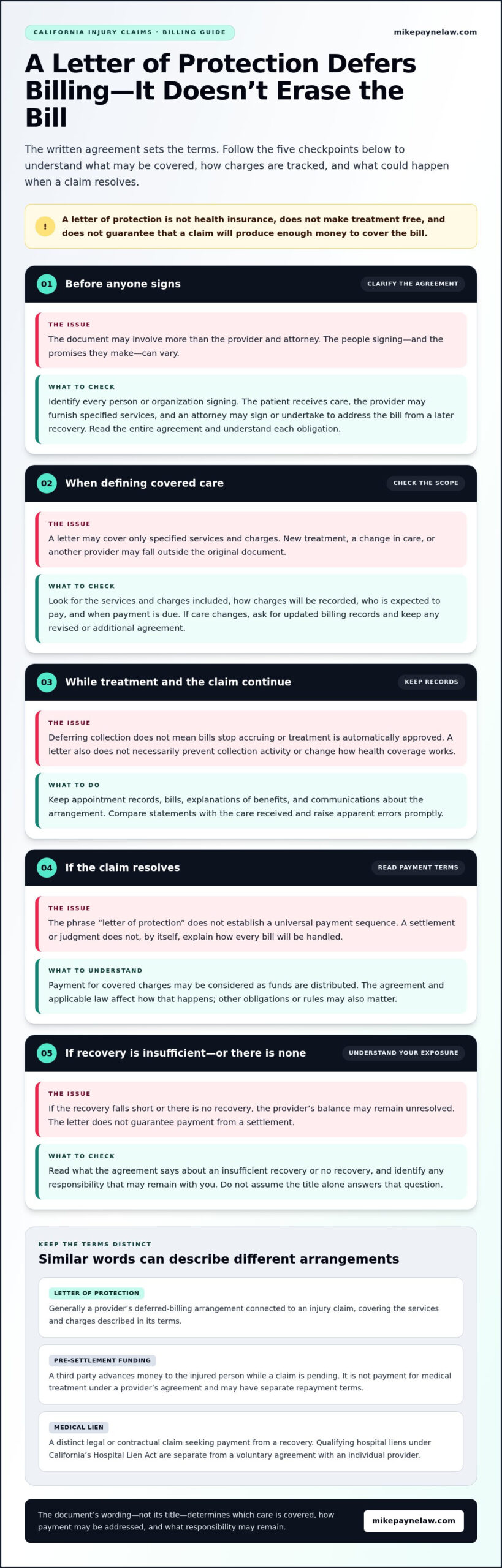
The practical answer to what is a letter of protection for medical bills depends on the agreement. A provider and an attorney may agree to defer payment for specified care while an injury claim proceeds, but that doesn’t mean bills stop accruing or treatment is automatically approved. The document’s wording controls which services and charges it covers and how payment may be addressed.
A cautious overview of the process looks like this:
- Discuss care and billing. The patient, provider, and attorney clarify what treatment is being considered and whether the provider is willing to defer payment under a written arrangement. Participation and billing options may differ by case.
- Review the proposed terms. Identify the people or organizations signing, the covered services, how charges will be recorded, and what the agreement says about payment. Resolve unclear language before signing.
- Document treatment and charges. Keep appointment records, bills, explanations of benefits, and communications about the arrangement. Compare statements with the care received, and raise apparent errors promptly.
- Continue treatment and claim evaluation. The provider may track charges as care and the injury claim progress. Insurance billing, provider participation, and collection practices can differ. Don’t assume a letter prevents collection activity or changes how health coverage works.
- Address the bills if the claim resolves. If there’s a settlement or judgment, payment for covered charges may be considered as funds are distributed. The agreement and applicable law affect how that happens.
Keep the details straight. A provider may continue to add charges for care while the claim’s value and the extent of treatment are still being evaluated. If care changes, new services are recommended, or another provider becomes involved, the original document may not cover those charges. Ask for updated billing records and keep a copy of any revised or additional agreement. An attorney can explain how the arrangement fits with the claim and other bills.
If the claim resolves, there’s no universal payment sequence that can be assumed from the phrase “letter of protection.” The agreement may describe how the provider’s charges are handled, but other obligations or applicable rules may also matter. If the recovery is insufficient, or there’s no recovery, the provider’s balance may remain unresolved. Read the document’s language about that possibility rather than relying on a verbal summary.
A letter’s effect depends on its wording and applicable law. If you’re dealing with an injury claim and need help understanding how medical bills fit into it, the Law Offices of Michael D. Payne offers a free accident case consultation to discuss your situation.
What Risks and Alternatives Should You Understand?
Signing a letter of protection doesn’t ensure that your medical bills will be paid. The agreement may defer payment while a claim is pending, but the bill remains, and the amount recovered may not cover every charge. Before accepting this arrangement, understand what you could owe, what the document requires of you, and what other billing options may be available. The answer to “what is a letter of protection for medical bills” isn’t complete without considering those risks.
Could I still be responsible for the medical bills?
Possibly. Your responsibility depends on the agreement’s language, any available recovery, and applicable law. Check whether you’re responsible for a balance if the claim produces no recovery or less than the charges, when payment is due, and whether the provider may pursue collection. Don’t assume the provider must accept a reduced amount or that an attorney’s signature removes your obligations.
Look closely at the scope of the promise. An agreement may cover only named services or a particular provider. If treatment changes, you see another provider, or additional charges arise, those items may fall outside the original terms. It may also require you to notify the provider or attorney about claim developments or follow specific billing procedures. Ask for unclear terms to be explained in writing before signing, and keep a copy of the final document.
Consider the practical effect of a shortfall. For example, if the claim resolves but the available recovery is not enough to address all outstanding obligations, the agreement may not eliminate the unpaid balance. The document and the facts matter. Don’t base your decision on a general description of how these letters work. Review the actual clauses about balance responsibility, payment timing, and collection activity.
What alternatives might be available?
A letter of protection is one possible billing arrangement, not the only route. Depending on your circumstances, you might explore health insurance, a provider’s payment arrangement, or other lawful coverage. Availability and terms vary, so an alternative shouldn’t be treated as automatic approval or as a promise that you’ll owe nothing later.
- Health insurance: Your plan may cover eligible care under its terms. If it pays for injury-related treatment, it may have reimbursement rights or a lien connected to a later recovery. Review your plan documents and any notices about repayment.
- Provider billing arrangements: A provider may offer billing or payment options outside a letter of protection. Ask for the terms in writing, including what happens if your claim remains unresolved.
- Other coverage: Depending on the accident and your policies, another form of coverage may help address medical expenses. Its scope and any repayment rights depend on the specific policy and applicable law.
Compare options by asking who pays the provider, when payment is expected, what happens if the claim doesn’t resolve, and whether repayment may be sought from a recovery. For car accident cases, California car accident injury guidance can offer context about pursuing an injury claim. An attorney can help you understand how the proposed billing terms may interact with that claim, without promising a particular outcome.
What Should You Review Before Signing a Letter of Protection?
Before signing, read the document as a set of promises, not a routine billing form. If you’re still asking what is a letter of protection for medical bills, this is where the practical answer becomes personal: the terms can define which charges are included, how payment is handled, and what duties you accept. A careful review can surface questions before they turn into a dispute.
Use this checklist to guide your review. It isn’t a substitute for advice about your specific agreement, but it can help you spot language that deserves a clear explanation.
- Identify every party. Check the patient, provider, attorney, and any other signer. Note who is making each promise and whether you are accepting personal responsibility.
- Define covered care. Look for the provider’s name, treatment dates or scope, and the charges included. Find out whether future treatment, referrals, or services from another provider require a separate written agreement.
- Understand billing and payment. Does the provider send statements to you, your attorney, or both? When does the agreement say payment is due? What does it say if the claim produces no recovery or the available recovery is limited?
- Read financial and enforcement terms. Look for balance responsibility, interest, fees, costs, assignment or lien language, collection rights, and the steps for disputing a charge. Don’t assume a term has a particular legal effect from its label alone. Ask for an explanation of how it could apply to you.
- Check your obligations. Look for requirements about giving notice, sharing information, following billing procedures, or keeping the provider informed about the claim. Make sure you understand what happens if circumstances change.
Which terms deserve close attention?
Read the operative language on treatment, billing, and payment slowly. Confirm whether additional care needs another agreement, what event makes payment due, and how the document addresses an unsuccessful or limited claim. If it mentions a lien, assignment, interest, costs, or collection, ask what the clause means in practice and have its legal effect reviewed in light of your circumstances. Don’t rely on the document’s title instead of reading its operative terms.
What records should you keep?
Save the complete signed agreement and any later amendments, along with provider communications about billing or covered care. Keep itemized bills, treatment records, insurance explanations of benefits, payment notices, and relevant claim updates together. A dated record makes it easier to compare charges with the agreement and raise questions promptly. If a crash caused your injuries, the firm’s motor vehicle accident representation addresses injury claims where medical expenses may be part of the picture.
If you’re unsure what a clause commits you to, don’t sign based on a verbal summary alone. The Law Offices of Michael D. Payne offers free accident case consultations to discuss injury claims and related medical-bill concerns. A consultation can help you identify questions about the agreement and your claim.
How Can California Injury Victims Get Clear Guidance?
A letter of protection can affect how medical charges are handled while an injury claim moves forward, but the document’s wording and applicable California law matter. There’s no single explanation that fits every agreement. The parties, covered care, billing practices, and promises in the document can all change what it means for you. Understanding those details alongside the injury claim can help you make decisions with a clearer view of potential obligations.
Legal review can connect the agreement to the facts behind your claim. Counsel may examine the document, compare it with provider bills and treatment records, and help coordinate communications about charges. That review doesn’t guarantee a claim outcome or a particular payment. It can help identify unanswered questions before you rely on an assumption about who will pay or when.
When is legal review especially useful?
Consider getting advice if a clause is unclear, several providers are involved, treatment is changing, or the likely recovery may not cover every obligation. A lawyer can assess the agreement alongside the injury claim and related medical records, and help clarify what communications may be needed. This is particularly relevant when bills, insurance notices, and provider expectations don’t seem to match.
The review should be specific to your circumstances. For example, if the agreement names one provider but your care involves another, the document may not answer how the additional charges will be handled. If a claim is disputed or its value is uncertain, it’s also important to understand how those circumstances relate to any payment promises. Don’t assume a familiar label settles the question.
This kind of guidance can be relevant to motor vehicle injuries as well as other injury matters, including slip and falls, workplace injuries, and pedestrian or bicycle accidents. An attorney can help you understand how the billing arrangement fits within the claim being pursued, without treating the letter as a promise of recovery.
What can an initial conversation clarify?
Bring the signed or proposed agreement, current bills, insurance notices or explanations of benefits, and correspondence about the claim. A clear set of documents can help focus the discussion: which charges are addressed, what terms may need clarification, and what records or communications could help track the bills. Keep copies and note questions as they arise.
The Law Offices of Michael D. Payne represents injury victims in Southern California and offers Free Accident Case Consultations. With 30 years of Experience, the firm can discuss how an agreement may relate to an injury claim and its medical-bill concerns. Se Habla Español. Hablamos Español. Learn more about the firm.
Take the Next Step With Clear Information
Before deciding on a medical-bill arrangement, make sure you understand what you’re agreeing to and how it fits your injury claim. The question “what is a letter of protection for medical bills” has no one-size-fits-all answer. The written terms and your circumstances matter. A focused conversation can help you identify what still needs clarification and plan your next step with more confidence.
The Law Offices of Michael D. Payne represents injury victims in California and brings 30 years of Experience to helping clients address medical bills and insurance concerns. Free Accident Case Consultations are available, and the firm is available 24/7. Se Habla Español. Hablamos Español.
You don’t have to sort through confusing paperwork alone. Bring your agreement and questions to a free accident case consultation with the Law Offices of Michael D. Payne. Request a free accident case consultation.
Frequently Asked Questions
Is a letter of protection a guarantee that my medical bills will be paid?
No. It may describe how payment will be addressed if a claim produces a recovery, but it doesn’t guarantee that a settlement or judgment will happen or cover every charge. The provider’s agreement and your own obligations depend on the document’s language. For example, a letter that covers one provider’s visits may not address a separate imaging bill. Read the specific payment and balance terms before relying on it.
Can I get medical treatment with a letter of protection?
Possibly, if the provider agrees to treat you under the proposed arrangement. A letter doesn’t require a provider to accept it or automatically approve treatment. Before scheduling nonemergency care, clarify whether the provider has agreed to the arrangement and which services it covers. If you need urgent care, don’t delay necessary medical attention while trying to arrange claim-related billing. Ask about billing details as soon as practical.
Who signs a letter of protection for medical bills?
The injured patient, treating provider, and attorney may be involved, but the signers and their roles depend on the document. Check whether your signature is an acknowledgment or creates direct payment duties, and whether the attorney is making a separate commitment. Also make sure the correct provider or billing entity is identified. If a representative signs for a patient, confirm that the document explains that person’s role.
What happens if my personal injury case does not settle?
If the case doesn’t settle, it may continue through another resolution process, but the medical bill doesn’t automatically disappear. Whether you still owe the provider depends on the agreement, any recovery, and applicable law. Review clauses addressing no recovery, case termination, and payment from other sources. If the claim ends without a settlement, get an updated itemized balance and a written explanation of what the provider believes remains due.
Can a letter of protection affect my settlement?
It can affect the amount of settlement proceeds available to you if covered medical charges are addressed from the recovery. The effect depends on the agreement, other obligations, and applicable law, so don’t assume a particular payment order or that every billed charge will be paid. Before approving a final distribution, compare the proposed medical-bill amounts with provider statements and ask how disputed or recently updated charges are being handled.
Is a letter of protection the same as a medical lien?
No. A letter of protection generally describes an agreement about deferred provider billing, while a medical lien may be a separate legal or contractual claim against a recovery. The source and terms matter. For instance, a hospital lien and an agreement with an individual provider aren’t automatically the same arrangement. Read the document itself and get advice about how its language and any separate lien notices may apply to your claim.
Should I sign a letter of protection before receiving treatment?
Don’t sign until you understand the obligations, covered services, and payment conditions. If a provider presents a letter before an appointment, ask for time to read it and clarify unclear language; don’t assume signing is required for every type of care. If you’re in West Covina, Pomona, Ontario, Covina, Chino, Fontana, San Bernardino, Baldwin Park, or Azusa, the Law Offices of Michael D. Payne can discuss the document alongside your injury claim and related bills.