

The insurance adjuster calling you isn’t a friend looking out for your recovery; they’re a professional negotiator working to protect their company’s bottom line. You might feel overwhelmed by legal jargon or fear that being partially at fault will strip away your right to justice. It’s a chaotic time, but you don’t have to face it alone. Understanding how to prove negligence in a personal injury case is the first step toward reclaiming control and securing the maximum compensation you deserve.
I’ve spent over 25 years fighting these battles, including time spent inside the insurance industry, and I know exactly how they try to devalue your claim. This guide breaks down the four essential elements of negligence, from duty of care to “substantial factor” causation, while providing a concrete checklist of evidence to gather right now. You’ll learn how to navigate California’s pure comparative negligence laws and the strict two-year statute of limitations. We represent clients on a contingency fee basis, which means you pay nothing unless we win. Let’s move from uncertainty to action by building a case that even the largest insurance carriers can’t ignore.
Key Takeaways
- Master the four essential legal pillars-Duty, Breach, Causation, and Damages-that you must establish to hold a negligent party accountable.
- Follow our “boots-on-the-ground” guide on how to prove negligence in a personal injury case by securing critical evidence like digital forensics and witness statements immediately.
- Learn how California’s “Pure Comparative Fault” rule protects your right to compensation even if you were partially responsible for the accident.
- Discover how 25+ years of experience and a background in insurance defense provide the “shield” you need to anticipate and defeat common adjuster tactics.
- Find out how to pursue a trial-ready claim for maximum compensation under a contingency fee basis, ensuring you never pay unless we win.
Understanding the Legal Standard of Negligence in California
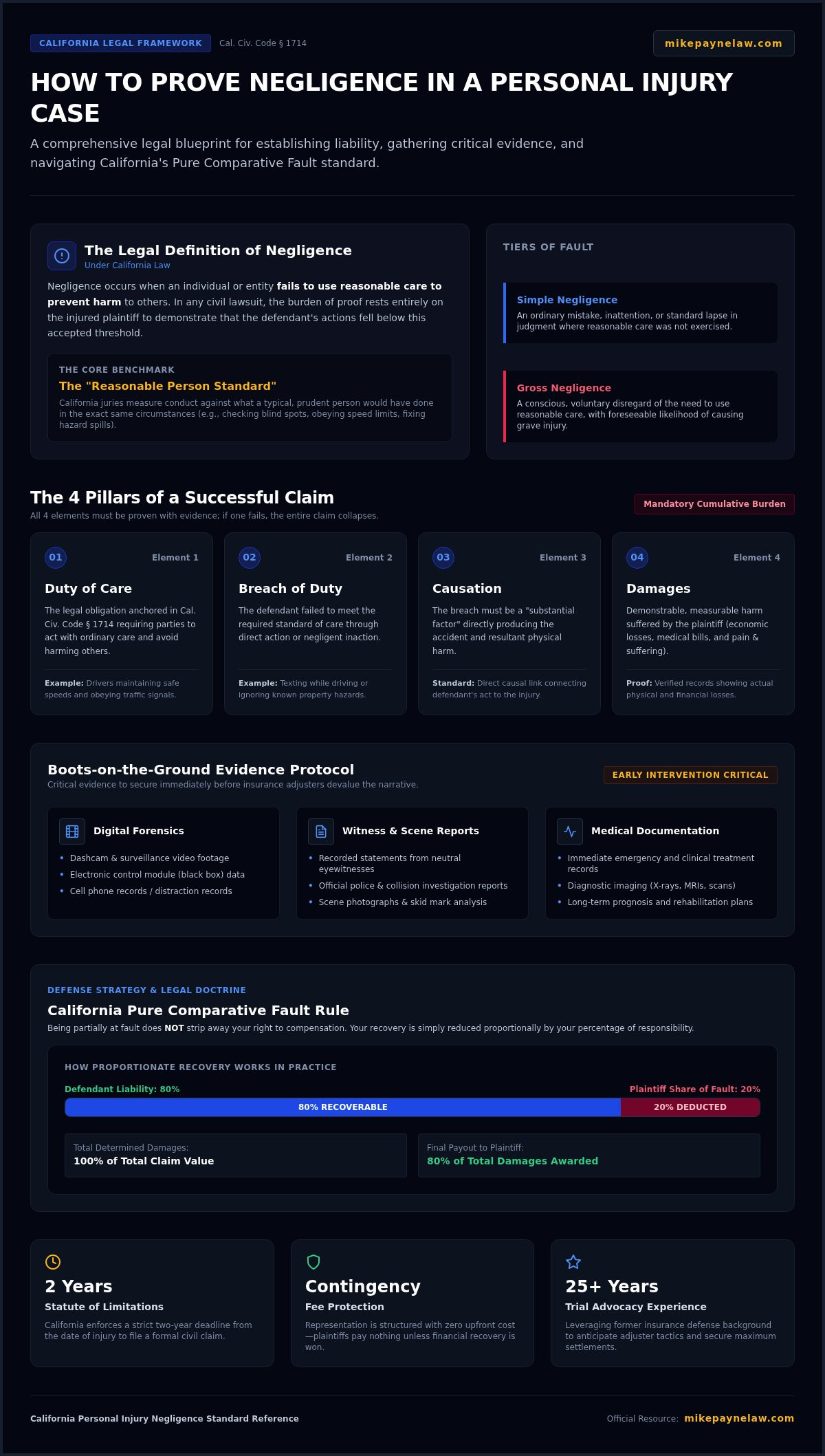
Negligence isn’t just a legal term; it’s the bridge between your injury and the recovery you need to move forward. Under California law, negligence occurs when someone fails to use reasonable care to prevent harm to others. This concept serves as the legal standard of negligence that governs every civil claim in the state. Whether it’s a distracted driver on the I-10 or a store owner ignoring a spill, the principle remains the same. If they didn’t act with the care a prudent person would have used, they are liable for the fallout.
Proving this failure is the non-negotiable foundation of your claim. In the courtroom, the burden of proof rests squarely on your shoulders. As the plaintiff, you must demonstrate that the other party’s actions fell below the accepted standard. This is why knowing how to prove negligence in a personal injury case is vital. Without a clear narrative supported by hard evidence, an insurance company will simply walk away from the negotiating table.
The “Reasonable Person” in Southern California
California courts use the “Reasonable Person Standard” to decide if a defendant was at fault. This isn’t a perfect, superhuman standard. Instead, a jury looks at what a typical, sensible person would have done in the exact same situation. In a West Covina traffic setting, a reasonable person checks their blind spots and obeys speed limits. If a driver ignores these basics, they’ve breached their duty.
There’s also a distinction between simple negligence and gross negligence. Simple negligence is a mistake or a lapse in judgment. Gross negligence is a conscious, voluntary disregard of the need to use reasonable care, which is likely to cause foreseeable grave injury. Choosing a Personal Injury Lawyer West Covina residents trust is essential for identifying these nuances and building a trial-ready case.
Why Negligence Matters for Your Settlement
If you cannot prove negligence, you don’t have a case. It’s that simple. Insurance companies aren’t in the business of handing out money because they feel bad for you. They only pay when they realize that a jury will likely hold their policyholder accountable. This applies across all practice areas, from commercial truck wrecks to premises liability claims.
Early legal intervention is critical. Evidence disappears, and memories fade. We act as your shield by immediately securing the “negligence narrative.” This involves documenting the scene and interviewing witnesses before the insurance company can twist the facts. Understanding how to prove negligence in a personal injury case allows us to push back against lowball offers and protect your right to a settlement that reflects the true cost of your recovery.
The Four Pillars of a Successful Personal Injury Claim
Proving fault in a Southern California courtroom isn’t a guessing game. It’s a technical process that requires building a solid legal foundation. To secure a win, you must establish four specific elements: Duty, Breach, Causation, and Damages. All four must be present to have a valid lawsuit. If even one of these pillars is weak, the insurance company will use it to tear your entire claim down. As your primary shield, I ensure every element of your claim is reinforced with evidence before we ever step into a negotiation room.
Experience is the difference between a lowball settlement and maximum compensation. Having spent over 25 years in the field, including time as an insurance defense attorney, I know exactly which pillar the defense will attack first. They look for any crack to avoid paying what you’re owed. We anticipate these moves and shut them down before they can gain momentum.
Duty of Care and Breach of Duty
The first step in how to prove negligence in a personal injury case is establishing a duty of care. This is the legal obligation to act with reasonable prudence to avoid harming others. In California, this is anchored in California Civil Code § 1714, which holds everyone responsible for injuries caused by their “want of ordinary care.” For example, every driver on our roads has a duty to follow traffic signals and maintain a safe speed.
Once the duty is clear, we must prove a breach. A breach happens when the defendant fails to meet that standard. If a driver speeds through an Ontario intersection or a trucker ignores their hours-of-service limits, they’ve breached their duty. A breach of duty is the moment a preventable mistake becomes a legal liability.
Causation and Actual Damages
Proving a mistake isn’t enough; you must connect that mistake directly to your physical harm. This is proximate cause. The defense often tries to claim your injuries were pre-existing or caused by a separate event. We fight back by using medical experts and accident reconstruction to prove the breach was a substantial factor in your injury. This is especially critical in complex motor vehicle accidents where multiple parties may be involved.
Finally, we must document actual damages. You can’t sue for a “near miss.” You need evidence of financial, physical, or emotional losses. This includes:
- Hospital bills and future medical costs.
- Lost wages and diminished earning capacity.
- Pain, suffering, and emotional distress.
Securing these four pillars requires a trial-ready advocate who won’t back down. If you’re struggling with the aftermath of a crash, you can reach out to our team to discuss how we can build your case on a solid foundation.
Step-by-Step: How to Gather Evidence to Prove Fault
Evidence is the ammunition in your legal battle. It’s not enough to know the other driver was at fault; you must be able to prove it with undeniable facts. In the high-stakes environment of Southern California litigation, evidence is perishable. Skid marks fade, video footage is overwritten, and witnesses’ memories blur. To win, you need a fierce, “boots-on-the-ground” approach to evidence collection that starts the moment the collision occurs. This proactive strategy is the core of how to prove negligence in a personal injury case and secure the justice you deserve.
I employ professional investigators to track down digital evidence that most people miss. This includes “black box” Event Data Recorders from commercial vehicles, dashcam footage, and nearby business surveillance. We move fast to serve spoliation letters, which legally force parties to preserve evidence. While we handle the heavy lifting, your primary job is to avoid the biggest trap: social media. Never post about your accident or your physical activities. Insurance adjusters are professional lurkers. They will twist a single photo of you smiling at a family dinner to argue that you aren’t actually in pain.
Immediate Evidence from the Accident Scene
If you’re physically able, your phone is your most powerful tool at the scene. Take high-resolution photos of vehicle positioning, debris fields, and property damage. In busy cities like Pomona or Fontana, the road is cleared quickly. Capture the skid marks and road conditions before they’re gone. You also need the official police report. If you were involved in a crash in San Bernardino County, our Fontana Police Accident Report guide explains how to secure this vital document. Finally, identify unbiased third-party witnesses. Their contact information is gold because their testimony carries significant weight with juries and adjusters alike.
Medical Documentation and Expert Testimony
Consistency in medical treatment is what “proves” the damages element of negligence. If you skip appointments or wait weeks to see a doctor, the defense will claim you weren’t truly hurt. Every medical record, MRI scan, and physical therapy note serves as a building block for your claim. In complex cases, such as fatal trucking accidents, we bring in accident reconstruction experts. Expert Testimony is the bridge between raw data and jury understanding. These professionals use physics and digital modeling to prove exactly how a breach of duty occurred. This level of detail is necessary to counter the pure comparative negligence doctrine, which insurers use to shift blame onto you and reduce your payout.
Overcoming California’s Comparative Negligence Defense
Don’t let an insurance adjuster convince you that your case is over just because you might have made a mistake. One of the most common lies told to injury victims is that being partially at fault bars them from recovery. In Southern California, this is simply not true. California follows a “pure comparative fault” rule. This means you can still recover damages even if you are 99% at fault for the incident. Your total recovery is simply reduced by your percentage of responsibility. If you’re struggling with how to prove negligence in a personal injury case, you need an advocate who knows how to keep that percentage as low as possible.
Insurance companies use comparative negligence as a weapon to devalue your claim. They want to shift the blame onto you to save their shareholders money. I’ve spent over 25 years fighting these tactics. My firm acts as the shield between you and these aggressive insurance tactics. We focus on the facts to ensure you aren’t assigned a single percentage point of blame that you don’t deserve. We work on a contingency fee basis, so you don’t pay us a dime unless we secure a recovery for you.
How Comparative Fault Impacts Your Settlement
The math of comparative fault is straightforward but devastating if handled poorly. For example, if a jury determines your total damages are $100,000 but finds you 20% at fault for the crash, your award is reduced to $80,000. This is why aggressive advocacy is non-negotiable. Every bit of fault they pin on you is money taken directly out of your pocket. As a veteran Car Accident Lawyer West Covina families trust, I look for the specific evidence, like timing of signal lights or phone records, that proves the other party was the primary cause of the harm.
Anticipating Insurance Adjuster Tactics
Recorded statements are a minefield designed to trap you. Adjusters will ask leading questions like, “Were you in a rush?” or “Could you have braked sooner?” They are looking for a tiny admission of guilt they can use to slash your settlement. Because I am a former insurance defense lawyer, I anticipate these “contributory negligence” arguments before they are even made. I know their playbook. They will also push you to sign a blanket medical release. Never sign this without legal review. They aren’t looking for your accident injuries; they are digging for pre-existing conditions to argue that the crash didn’t cause your current pain. If you’re being pressured to admit fault, contact our team immediately before you give a statement that could cost you thousands.
Why You Need a Trial-Ready Advocate to Prove Your Case
Proving negligence is a tactical war, not a simple paperwork exercise. While the previous sections outlined the technical requirements, the reality of the courtroom is far more aggressive. Knowing how to prove negligence in a personal injury case is only the first step; the second is having the grit to stand up to billion-dollar insurance companies. You need a protector who doesn’t just understand the law but knows how to weaponize it to secure maximum compensation for your recovery. At the Law Offices of Michael D. Payne, we provide that shield.
We approach every case with a trial-ready mindset. This means we prepare from day one as if we’re heading to a jury. This aggressive stance often forces insurance adjusters to offer fair settlements because they know we aren’t afraid of a high-stakes confrontation. We’ve spent decades serving the West Covina and Inland Empire communities, and we’ve built a reputation for refusing substandard resolutions. Our goal is simple: justice for the injured and accountability for the negligent.
The Advantage of a Former Insurance Defense Lawyer
Michael D. Payne brings a unique perspective to your claim with over 25 years of experience. Having spent years inside the insurance industry as a defense attorney, he knows the “defense playbook” cover to cover. He understands how they evaluate risk, how they hide evidence, and where they look for weaknesses in your narrative. This insider knowledge allows us to prepare your evidence more effectively than firms that only see one side of the courtroom.
This background is vital in modern, complex litigation. For instance, in cases requiring an Uber accident attorney, liability is often shielded by layers of corporate policy and independent contractor loopholes. We know how to pierce those shields. We handle the technical jargon and the aggressive adjusters so you can focus entirely on your physical and emotional healing. We’re relatable fighters who treat you like a neighbor while treating your adversaries like the formidable opponents they are.
Ready to Take Action? Contact Us Today
Time is your enemy in a personal injury claim. Under California Code of Civil Procedure § 335.1, you generally have only two years from the date of the injury to file a lawsuit. If your accident involved a government entity, that window shrinks to just six months. Waiting even a few weeks can result in lost evidence or missed deadlines that permanently bar your recovery. We move quickly to establish the facts and preserve your right to compensation.
The contact process is straightforward and designed to reduce your stress. We offer a free consultation to review the details of your incident and provide a clear path forward. Best of all, we represent clients on a contingency fee basis. You don’t pay us any attorney fees unless we win your case. This financial assurance means you can pursue justice without any out-of-pocket risk. Don’t let uncertainty stop you from getting the help you deserve. Contact us today and let a professional champion fight for your future.
Secure the Justice You Deserve
Proving fault is a technical battle that requires more than just a police report. It demands a trial-ready strategy that connects the four pillars of liability to the actual damages you’ve suffered. You’ve learned that evidence is perishable and that insurance adjusters will use every trick in the book to shift blame onto you. Understanding how to prove negligence in a personal injury case is the foundation, but having a professional champion by your side is what secures the outcome.
With over 25 years of experience and the unique perspective of a former insurance defense attorney, Michael D. Payne provides the shield you need during this vulnerable time. We handle the complex litigation and aggressive negotiations so you can focus on your health. We operate on a contingency fee basis; there is no fee unless we win. Stop guessing and start building your case. Contact the Law Offices of Michael D. Payne today for a free consultation. You have the power to take action, and we have the grit to see it through.
Frequently Asked Questions
What is the most important piece of evidence in a negligence case?
The most critical evidence is anything that directly links the defendant’s breach of duty to your specific physical harm. In West Covina traffic incidents, this often includes the official police report combined with digital telematics or “black box” data. However, medical records are equally vital to prove the damages pillar of your claim. Without documented medical treatment immediately following the accident, even clear fault rarely leads to a successful settlement or jury award.
Can I still prove negligence if there were no witnesses to my accident?
Yes, you can build a powerful case using physical and forensic evidence even without third-party testimony. In cities like Ontario or Chino, we frequently rely on surveillance footage from nearby businesses, dashcam recordings, and accident reconstruction experts. These experts use physics to demonstrate how the collision occurred, effectively acting as a “silent witness.” Knowing how to prove negligence in a personal injury case involves using every available data point to create an undeniable narrative of fault.
How long do I have to file a negligence claim in California?
The standard statute of limitations for personal injury in California is two years from the date the injury occurred. However, if your accident involved a government entity in San Bernardino or Baldwin Park, such as a municipal bus or a poorly maintained public road, you must file an administrative claim within six months. Failing to meet these strict deadlines permanently bars you from seeking justice. We recommend contacting a trial-ready advocate immediately to preserve your rights.
What happens if the insurance company denies the other driver was negligent?
An initial denial is a standard tactic used by adjusters to discourage you from pursuing your claim. When this happens, we escalate the matter by presenting a comprehensive demand package filled with irrefutable evidence, such as medical expert testimony and high-resolution site photos from the scene in Fontana. Because Michael D. Payne is a former insurance defense lawyer, he knows how to dismantle these denials and force the carrier back to the negotiating table for a fair settlement.
Does a police report automatically prove negligence?
No, a police report is a powerful piece of evidence, but it isn’t a final judgment of liability in a civil court. While the officer’s opinion on fault carries significant weight, insurance companies often dispute these findings to protect their bottom line. We use the report as a foundation but supplement the officer’s notes with independent witness statements and forensic data. This ensures the “breach of duty” pillar remains solid even if the defense attempts to challenge the initial report.
How does “proximate cause” differ from “actual cause” in a personal injury case?
Actual cause is the direct reason the injury happened, such as a car hitting a pedestrian in Azusa. Proximate cause is a legal limit on liability, focusing on whether the harm was a foreseeable result of the defendant’s actions. In California, we must prove the defendant’s breach was a “substantial factor” in causing your harm. This technical distinction is where many unrepresented victims lose their cases during aggressive insurance interrogations or complex legal filings.
Will I have to go to court to prove the other party was negligent?
Most personal injury cases settle before reaching a jury, but we prepare every claim as if it’s going to trial. This “trial-ready” status is the Michael D. Payne advantage. When insurance companies realize we have built a bulletproof case and aren’t afraid of a courtroom in Pomona, they are much more likely to offer a fair settlement to avoid the risk of a trial. We handle the litigation stress so you can focus on your recovery.
Can I prove negligence in a slip and fall case without a video of the fall?
Absolutely. While video is helpful, we establish liability through maintenance logs, employee statements, and photos of the hazard taken immediately after the incident. In premises liability cases across Covina, we focus on proving the property owner had “notice” of the danger and failed to act. How to prove negligence in a personal injury case often comes down to the quality of the circumstantial evidence we gather during our firm’s initial “boots-on-the-ground” investigation.