

Filing a claim doesn’t automatically raise your car insurance premium, and paying for damage yourself isn’t always the safer choice. Whether your insurance rates will go up if you file a claim depends most on fault, the type and size of the claim, and your recent claims history. A single at-fault accident can raise rates by 30% to 50% on average.
It’s reasonable to worry that reporting an accident could affect your insurance costs later. But skipping a claim when someone is injured or the damage is substantial can leave you facing a much larger burden. The key is to understand what affects your rate and compare the potential insurance payment with your deductible and possible premium changes.
This article explains how fault and claim type can affect rates, when paying for minor damage yourself may make sense, and when prompt reporting matters. These factors can help you decide what to do after an accident without assuming every claim leads to the same outcome.
Key Takeaways
- Fault is a major factor in how an accident claim can affect your premium; at-fault accidents generally have a greater impact than not-at-fault claims.
- Before paying for minor damage yourself, compare the repair estimate with your deductible and consider how a claim could affect discounts or future premiums.
- Claim type matters: at-fault auto and large liability claims can affect rates differently from comprehensive or weather-related claims.
- Accident forgiveness and policy discounts may influence the financial impact of a claim, so understand how they apply to your coverage.
- After an accident, prioritize safety and report it promptly when appropriate, especially when there are injuries or substantial damage.
How do accidents affect your insurance rate?
Fault, claim frequency, and accident severity can all affect your car insurance rate. In California, an at-fault accident generally has a greater effect on premiums than a not-at-fault accident. If you’re asking, “Will my insurance rates go up if I file a claim?” the answer depends on these factors and your insurer’s assessment.
At-Fault and Not-at-Fault Claims
An at-fault claim is one where the driver is held responsible for causing the accident; a not-at-fault claim means the driver wasn’t responsible. That distinction matters because a single at-fault accident can raise insurance rates by 30% to 50% on average.
A not-at-fault accident usually has less effect on rates, but it doesn’t guarantee your premium will stay the same. Some insurers may still raise premiums after a not-at-fault claim, particularly if several claims appear within a short period. Two drivers with similar damage, for example, may see different outcomes if one is found at fault and the other isn’t. Fault matters, but it’s only one part of an insurer’s review.
Claim Type and Frequency
Claim type describes what caused the loss, while claim frequency reflects how often claims appear in your history. Insurers use both when deciding whether to offer coverage and what premium to charge.
A car accident claim may affect your rate differently depending on fault and severity. Serious incidents, including DUI-related claims, can affect rates longer than the usual three-to-five-year surcharge period, sometimes requiring specialized high-risk solutions such as SR-22 insurance St. Charles MO. Your driving record and the size of the claim also shape the insurer’s assessment. A single loss may be viewed differently from repeated claims, even when the damage is similar.
Multiple Claims and Policy Renewal
Multiple claims are losses recorded over time, and they can lead an insurer to view a driver as higher risk. Two or three claims within a short period, such as three years, may bring a steeper rate increase or non-renewal. Two or more claims in the past three years may also put a policyholder at risk of a major increase.
Not every claim leads to the same renewal decision. Insurers consider claims history alongside fault, severity, and driving history. An accident can affect car insurance rates for three to five years on average, though the exact period varies by insurer and state. After an at-fault accident, an increase may remain for an average of three years. Serious incidents, such as DUI-related claims, can last longer. Review your renewal notice for changes to your premium, surcharges, or discounts.
Will my insurance increase after a claim?
Filing a claim doesn’t automatically raise your premium. Fault, claim amount, driving history, policy discounts, and coverage features all influence how an insurer sets your rate. There’s no single answer to “will my insurance rates go up if I file a claim?” Understanding these factors can help you assess the possible financial effect.
Insurer Factors After an Accident
Insurers review details such as fault, claim severity, the amount paid, and your claims history. They use past claims when deciding whether to offer coverage and what premium to charge.
A larger payout may affect your rate differently from a smaller loss. An insurer may also remove a safe-driving discount after an accident, changing your renewal premium even if the surcharge is limited. Check your renewal documents for separate changes to the base premium, discounts, and surcharges. This breakdown can show what changed rather than leaving you to assume the claim explains every increase.
Not-at-Fault Accident Rate Changes
A not-at-fault accident is one where you aren’t held responsible for causing the crash. It generally has less effect on rates than an at-fault accident, but your premium may still change.
Some insurers may raise rates after a not-at-fault claim, especially if several claims occur within a short period. The insurer may consider the claim’s amount and your broader record as well. If another driver caused the crash, remember that fault matters, but it isn’t the only factor that can shape the rate decision.
Accident Forgiveness and Discounts
Accident forgiveness is an insurer feature that may protect a driver’s rate after a first at-fault accident. Some insurers offer it as an add-on or loyalty benefit, but the policy terms determine eligibility and the protection it provides.
Don’t assume accident forgiveness covers every crash or claim. Check how your policy describes the feature and whether it applies to the accident. A safe-driving discount may also be removed after a crash, affecting your final premium even when forgiveness applies to a surcharge.
Deductibles, Bundling, and Continuous Coverage
A deductible is subtracted from a covered claim payment. Before filing for minor damage, compare the potential payment with your deductible and consider whether a claims-free discount could be affected. This helps you weigh the immediate benefit against possible policy costs.
Bundling home and auto insurance with one carrier often earns a discount that can offset a rate increase. Continuous coverage doesn’t erase an accident from your claims history, which insurers use when setting rates and deciding whether to offer a policy. Keep renewal notices and policy documents together to track changes in coverage, discounts, and premiums over time.
Rate effects of auto, comprehensive, liability, and home claims
Claim category helps explain how a loss may affect your premium and insurance record. Auto collisions, comprehensive losses, liability claims, and home damage can have different effects on rates.
Auto and Comprehensive Claims
At-fault auto accidents generally have a high impact on rates, while comprehensive claims usually have a lower impact. Comprehensive coverage typically addresses losses such as theft, weather damage, or falling objects, rather than a collision caused by the driver. Insurers also consider several years of driving history when setting a car insurance rate.
A collision with an animal may be handled under comprehensive coverage, depending on the policy’s classification. That classification matters because the applicable coverage and deductible affect the claim payment. For example, damage from striking an animal may be classified differently from damage caused by swerving into another vehicle. Comprehensive claims can still increase a rate, though usually not as much as an at-fault accident.
Liability and Home Claims
A liability claim involves responsibility for injury or damage to someone else, and a large payout can significantly affect insurance rates. The amount paid matters alongside the claim type and the policyholder’s claims history. A home weather claim may have a moderate effect, depending on the insurer and region.
One weather-related home claim may have a small effect on your rate, but repeated claims within a short timeframe can lead to a meaningful increase or non-renewal. A homeowner with multiple recent weather claims, for example, may face a different renewal decision from someone with one isolated loss. Claim type and frequency both shape how an insurer evaluates future risk.
How CLUE Reports Record Claims
The Comprehensive Loss Underwriting Exchange, known as CLUE, is a report that can show home or auto claims filed with an insurance company. A CLUE report can contain claims for up to seven years, and insurers may review it when someone applies for coverage.
Many insurance companies use CLUE reports, so a claim record may matter beyond the policy where it was first filed. That doesn’t mean every recorded claim has the same effect on your premium. Insurers consider the loss type, payment, and history when assessing risk. If a claim appears unfamiliar, review the report for accuracy and gather relevant policy and claim records to clarify the entry.
What the Claim Category Can Tell You
Before filing, identify whether the loss involves collision, comprehensive, liability, or home coverage. Theft, for example, points to comprehensive coverage, while a large liability payout may have a stronger effect on rates. The category is a useful starting point, but the claim’s severity and frequency also shape the insurer’s decision.
A claim may remain visible to insurers after the original policy term ends. Accurate reporting and a clear record of what happened are therefore valuable. Keep the claim type, incident details, and insurer communications together so you can explain the loss when reviewing future coverage decisions.
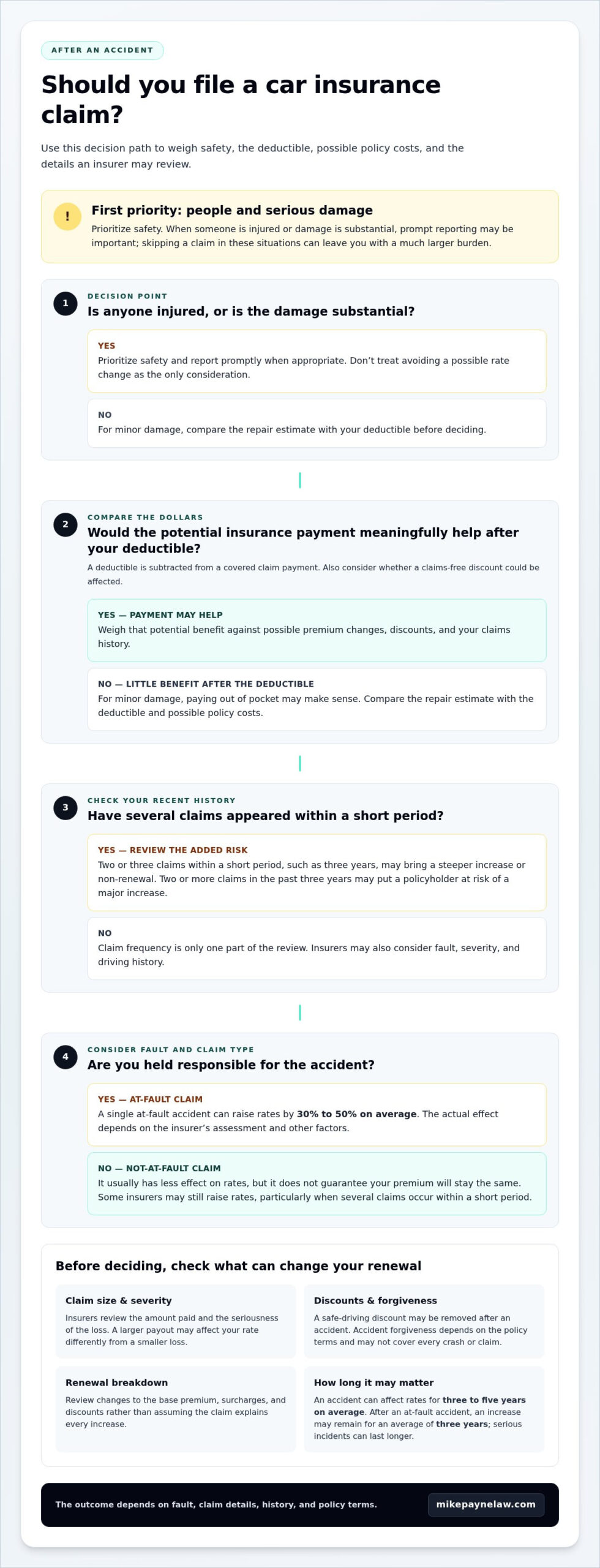
When paying for minor damage out of pocket may make sense
For a small repair, compare the estimate with your deductible and possible premium effects before deciding how to pay. If the damage costs about the same as or less than the deductible, a claim may provide little or no payment. Your claims history matters too, especially if you’ve filed other claims recently.
Compare the Repair Cost With Your Deductible
The deductible is subtracted from a covered claim payment, so the amount above it is the potential benefit. That calculation is a starting point, not the full financial comparison.
Consider possible rate changes and discounts as well. Compare the likely payment with the total cost of keeping the claim off your record. For drivers weighing whether to handle minor vehicle maintenance or repairs independently, automotive workshop guides from Ellery Books provide practical insights into vehicle mechanics and parts.
Consider Claim History and Damage Type
A minor loss can have different consequences depending on your recent claims history and the type of damage. One isolated weather claim may have a small effect on your rate, while multiple claims within a short timeframe can lead to a meaningful increase or non-renewal. A small repair after earlier claims calls for a closer cost comparison.
Weather, vandalism, and theft losses are often handled under comprehensive or home coverage, depending on the policy and damaged property. Coverage terms and deductibles determine what the insurer pays. For a stolen item, for example, compare its replacement cost with the applicable deductible to assess whether filing offers enough financial benefit to outweigh possible rate effects.
Natural Causes and Appliance Water Damage
Natural-cause damage, including weather, doesn’t have one universal effect on rates across policies and regions. A single weather-related home claim may have a small impact, while repeated losses can matter more. In California, review your policy’s coverage and deductible for the specific event rather than assuming every weather claim is treated the same.
Appliance-related water damage also calls for a careful comparison. First identify the covered repair costs and deductible, then consider whether the claim adds to your recent claim frequency. Some states have specific rules for certain inspected and certified appliance repairs, but don’t assume those rules apply in California. Keep estimates, receipts, and photos of the damage to support an accurate assessment.
Paying out of pocket may make sense when the repair is close to the deductible and preserving a claims-free history matters. For larger damage, theft, or repeated water intrusion, weigh the potential repair burden against the available coverage.
When to file an insurance claim
Report an accident promptly when it causes injuries, substantial damage, or a potential claim against you. First make sure everyone is safe, report the accident to police, exchange insurance information, and begin the claims process. Once it’s safe, notify your insurance company as soon as possible. Prompt reporting can help avoid complications and mitigate costs.
Report Serious Damage and Injuries Promptly
Injuries or major repairs change the decision because the full loss may not be clear at the scene. A vehicle can have hidden damage, and an injured person’s needs may develop after the crash. Delaying a report can make it harder to document what happened and communicate with the insurer.
Keep the accident date, location, other driver’s insurance details, photographs, and any police report together. These records help the insurance company assess the event and determine which coverage applies. If another driver may be responsible, don’t assume their insurer will handle every part of the claim without your cooperation.
Weigh Small Repairs Against the Policy
For minor vehicle damage, compare the repair estimate with your deductible and the possible effect on discounts or renewal. A repair cost close to the deductible may leave little benefit from a claim. But an initial estimate can change when a repair shop finds additional damage, so base your decision on a clear assessment rather than a quick visual check.
Claim type matters too. Collision damage and a comprehensive loss, such as theft or weather damage, may be treated differently. Accident forgiveness may affect a rate increase under the policy’s terms, but it doesn’t remove the need to report a serious crash or preserve evidence. Review your coverage and claims history together before treating a minor loss as a simple out-of-pocket repair.
Don’t Let Rate Concerns Delay a Necessary Report
Worry about a possible premium increase shouldn’t keep you from reporting an accident involving injuries, significant damage, or disputed responsibility. An at-fault accident can affect rates, but delaying a report can create separate problems with documenting the loss and moving the claim forward. Prompt notice, for example, gives the insurer a clearer record while details are fresh.
After reporting, save the claim number, note whom you spoke with, and keep copies of repair estimates and correspondence. Check your next renewal notice for a surcharge or discount change. If an accident involves injuries or a dispute over responsibility, learn about legal help after a motor vehicle accident and the options available for protecting your interests.
Law Offices of Michael D. Payne: Car Accident Representation
Law Offices of Michael D. Payne represents people injured in car accidents and helps them pursue compensation. Consider legal representation if fault is disputed, injuries need careful documentation, or the insurance company challenges your claim. A possible rate increase is a financial concern, but it shouldn’t distract from protecting your interests after a crash.
The firm also represents people injured in motorcycle and bicycle accidents, as well as slip and fall incidents. Each situation calls for a clear account of what happened, the resulting harm, and the insurance issues involved. Legal support can help you understand your options and respond when a claim is contested.
If you have questions about an accident claim, contact Law Offices of Michael D. Payne.
Make Your Next Move With Confidence
If you’re weighing whether your insurance rates will go up if you file a claim, don’t let that concern eclipse your recovery or your rights after a crash. Your situation depends on the facts, including how the accident happened and what losses followed. A clear record of events and careful attention to insurer communications can help you make informed decisions.
When injuries or disputed responsibility complicate the next steps, legal guidance can help you understand your options. Law Offices of Michael D. Payne handles car accident, motorcycle accident, and slip and fall representation, supporting people facing the consequences of an injury and an insurance claim.
Take the next step at your pace. Contact Law Offices of Michael D. Payne to discuss your situation and explore a path forward.
Frequently Asked Questions
What factors can impact my rate after filing an accident claim?
Fault, claim severity, payout, claim type, and your driving and claims history can all influence your rate. Insurers may also consider whether an accident removes a safe-driving discount or changes another policy discount. Two drivers with similar repair costs, for example, can face different renewal premiums if one has several recent claims. Review your renewal notice for surcharges and discount changes, not just the total premium.
Should You Always File a Claim?
A small repair close to your deductible may not justify a claim, but injuries, major damage, or possible responsibility for another person’s losses call for prompt attention. A dent that costs about the same as your deductible differs from a crash involving injuries or disputed fault. Consider the covered loss, deductible, and potential claim payment together. Don’t let rate concerns alone decide whether to report a serious accident.
What should I do after an accident?
First, make sure everyone is safe. Then report the accident to police, exchange insurance information with the other driver, and start the claims process. Record the date, location, vehicle details, and witness names, and preserve photos of the scene and damage if it’s safe. Keep copies of messages, estimates, and claim documents together. Reporting promptly helps create a clear record while details are fresh.
Does my insurance go up if I hit someone or if someone hits me?
If you’re found responsible for hitting someone, the claim can have a greater effect on your premium than a not-at-fault accident. If another driver hits you and you aren’t responsible, the effect is generally smaller, but your premium may still change. Your prior claims, for instance, can influence how an insurer assesses even a not-at-fault crash.
How Long Do Rate Increases Last?
A rate increase after an at-fault accident may remain for an average of three years. An accident can affect car insurance rates for three to five years on average, depending on factors such as severity, fault, driving history, and state rules. Serious incidents, including DUI-related claims, can affect rates longer than the usual surcharge period. The surcharge may also change over time if you have no additional accidents.
How long does a claim stay on my record?
A claim may remain visible in an insurance record longer than its direct effect on your premium. A Comprehensive Loss Underwriting Exchange, or CLUE, report can contain home or auto claims for up to seven years. Insurers may review the report when you apply for coverage. The rate effect follows a different timeline, so a claim’s appearance in the report doesn’t mean the same surcharge applies throughout its full reporting period.
What counts as a claim?
A claim is a request to an insurer for benefits under a policy after a covered loss. Examples include requesting payment for collision damage, theft, weather damage, or liability involving another person’s injury or property. The claim category depends on the event and the coverage involved. Keep the claim number and insurer correspondence, even if the final payment differs from your initial estimate.
How much do car insurance rates increase after filing a claim?
A single at-fault auto accident can raise insurance rates by 30% to 50% on average. Across circumstances, increases after an at-fault accident can range from 0% to 50% or more. The amount depends on severity, claim size, driving history, state rules, and insurer policies. A not-at-fault claim generally has less impact than an at-fault claim, though it can still affect the premium.