

In the wake of a fatal accident, the California legal system doesn’t just ask what happened. It asks who you are. Most families assume their right to justice is automatic, but “standing” is a strict gatekeeper that can stop a case before it even begins. You need to know exactly who can sue for wrongful death in California to protect your family’s future. The grief is heavy enough without the added weight of legal confusion or the fear that an insurance company will exploit your loss during your most vulnerable moment.
You deserve a clear path forward. It’s natural to feel overwhelmed by complex probate codes and the pressure of mounting financial stress. This guide provides a definitive look at the 2026 legal landscape, including the recent expiration of SB 447 and the specific hierarchy of eligible claimants. You will discover exactly who has the legal standing to pursue a claim and how to secure the compensation your family needs for funeral costs and lost support. We are moving from uncertainty to action to ensure you find the justice you deserve.
Key Takeaways
- Identify your legal standing under CCP 377.60 to determine if you have the priority right to lead a claim.
- Discover exactly who can sue for wrongful death in California, including the specific rights of surviving spouses, domestic partners, and children.
- Navigate the 2026 expiration of SB 447 and learn how to maximize recovery through both wrongful death and survival actions.
- Master the critical filing deadlines, including the general two-year statute of limitations and the six-month window for government claims.
- Understand how a local advocate with insurance defense experience can shield your family from aggressive tactics used by powerful entities.
Understanding Standing: The California Code of Civil Procedure 377.60
Standing is the legal backbone of your case. It refers to your specific legal right to bring a lawsuit to a California court. Without it, a judge will dismiss your case before you ever have a chance to speak, regardless of the depth of your grief. In this state, “standing” acts as a strict gatekeeper. It ensures that only those most directly impacted by a loss have the power to demand accountability from the person or company responsible.
The core statute governing this process is California Code of Civil Procedure 377.60. This law dictates exactly who can sue for wrongful death in California by creating a rigid hierarchy of eligible survivors. It’s important to distinguish this from a criminal homicide proceeding. In a criminal case, the state seeks to punish a defendant with jail time or fines. In a civil wrongful death claim, we are fighting for your family’s future. We focus on securing the financial support, funeral costs, and emotional compensation you need to survive this tragedy.
California’s rules are significantly stricter than many other states. While some jurisdictions allow extended family members like cousins or close friends to file, California limits standing primarily to the immediate nuclear family. This prevents a chaotic flood of separate lawsuits against a single defendant, but it can also feel cold to those who were deeply connected to the deceased but lack a specific legal title. As a former insurance defense attorney, I know that insurance companies will look for any technicality in CCP 377.60 to block your claim. We don’t let them.
What Constitutes a Wrongful Death in California?
A wrongful death occurs when a life is taken due to another party’s negligence, recklessness, or intentional acts. We see these tragedies daily across Southern California, from fatal car accidents in West Covina to high-speed trucking accidents on the I-15. Negligence is the failure to exercise the level of care that a reasonable person would have used under similar circumstances to prevent foreseeable harm. When a driver chooses to text or a company ignores safety protocols, they must be held responsible for the lives they destroy.
The Role of the Personal Representative
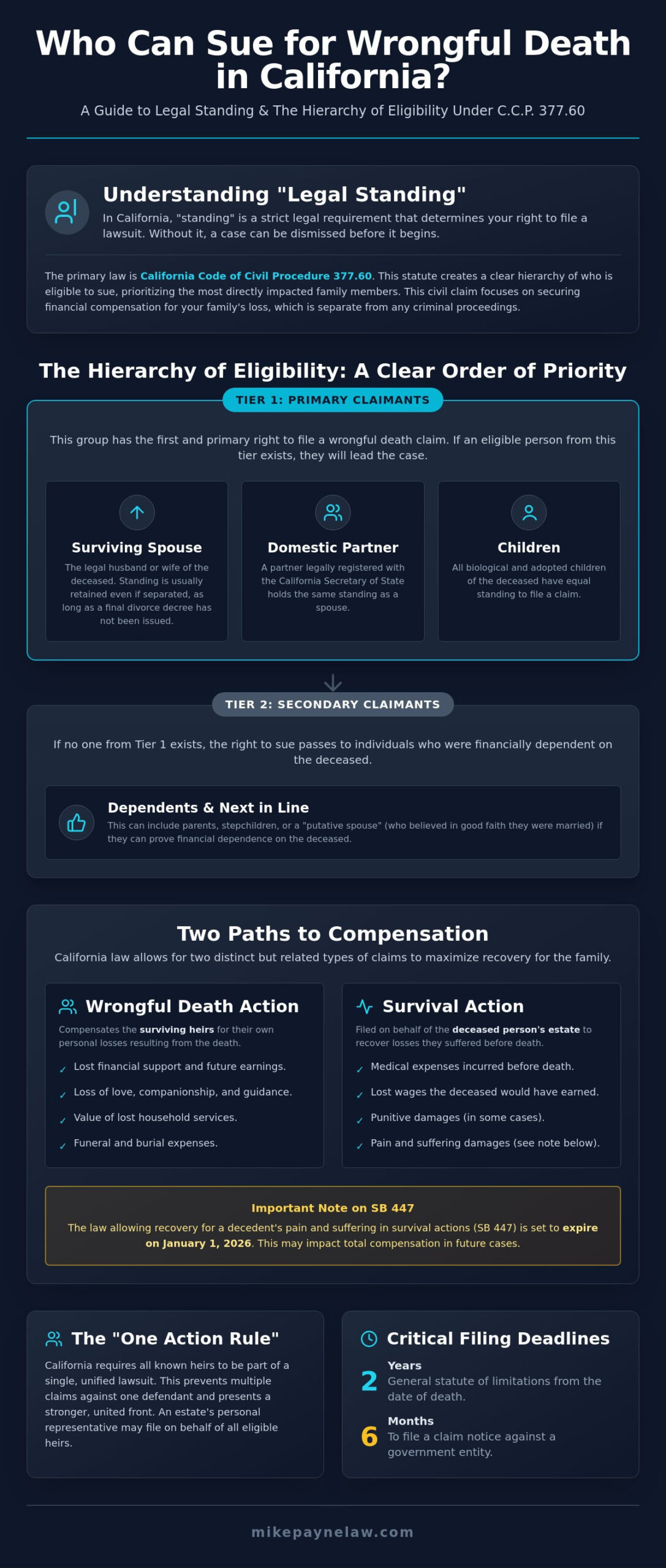
If the family is large or the estate is complex, an estate’s personal representative may file the lawsuit on behalf of all eligible heirs. California follows a “One Action Rule.” This means all known heirs must be part of a single, unified filing. This approach is often more efficient and presents a stronger, more united front against powerful adversaries. While the personal representative navigates the technical probate court requirements, we focus on the civil battle to maximize the compensation your family deserves. This unified effort ensures that every eligible family member is protected and that no one is left behind in the pursuit of justice.
For families managing estates with international business or investment interests, particularly between the U.S. and Israel, the Israel Cross Border Law Firm provides specialized legal support for navigating cross-border complexities.
The Hierarchy of Eligibility: Who Has the First Right to Sue?
California law creates a clear line of succession for survivors. If you are wondering who can sue for wrongful death in California, the answer starts with the closest immediate family members. Under California Code of Civil Procedure 377.60, the right to file follows a strict “order of priority.” This means the law looks at the first tier of relatives before moving to the next. If someone in Tier 1 exists, they generally lead the claim. If not, the legal right moves down the list to the next eligible group.
This hierarchy is designed to prevent conflict, but it can create hurdles if your family structure is non-traditional. Insurance companies often use these technicalities to delay payments or deny that you have a case. They want to see a birth certificate or a marriage license before they even talk about a settlement. We don’t let them stall. We verify your standing immediately so we can focus on holding the negligent party accountable for the life they took.
Spouses and Registered Domestic Partners
The surviving spouse or registered domestic partner sits at the top of the hierarchy. In California, a registered domestic partner has the same legal standing as a spouse. The partnership must have been legally filed with the Secretary of State to qualify. A common point of confusion involves estrangement. If a couple is legally separated but the court has not issued a final judgment of divorce, the surviving spouse usually retains their standing. We’ve seen insurers try to use family conflict to invalidate a claim. We shut those arguments down. Even if a prenuptial agreement exists, it usually governs asset distribution during a divorce, not your statutory right to seek justice after a fatal accident.
Children and Grandchildren’s Claims
The decedent’s children occupy the second tier of the hierarchy. This includes biological children and legally adopted children, referred to legally as “issue.” While minor children have an undisputed right to sue, adult children are also fully eligible. They can seek compensation for the loss of guidance, training, and financial support. Stepchildren also have a path to justice under specific conditions. To qualify, a stepchild must prove they were financially dependent on the deceased for at least 50 percent of their support. Grandchildren only gain standing if the decedent’s own children are also deceased. If you need help verifying your position in this hierarchy, seeking professional wrongful death representation is the most effective way to protect your family’s rights.
Understanding these tiers is the first step toward recovery. It moves you from a state of uncertainty to a state of action. Once standing is established, we can begin the aggressive pursuit of the maximum compensation your family needs to move forward.
Secondary Standing: When Parents and Dependents Can Sue
When the immediate tiers of the family hierarchy are vacant, the legal path widens to include secondary claimants. Determining who can sue for wrongful death in California in these scenarios requires a deep dive into the decedent’s household and financial records. If your loved one was unmarried and had no children, the right to seek justice typically passes to their parents. However, if a spouse or child does exist, parents must prove they were actually dependent on the deceased to join the action. This ensures that those who relied on the decedent for their daily survival are not left behind.
A critical protection in our state is the “Putative Spouse” rule. This protects individuals who believed, in good faith, that their marriage was valid, even if a legal technicality made the union void. We also represent minor children who may not be biological or adopted but lived in the decedent’s household for at least 180 days and relied on them for at least half of their support. These rules are designed to protect the reality of the family unit, not just the paperwork. We fight to ensure these partners and children aren’t ignored by a rigid system during their time of grief.
Financial Dependency Requirements
Proving standing as a dependent isn’t just about showing you loved the deceased. You must demonstrate that you relied on them for at least 50 percent of your financial support. Insurance adjusters will pick through your history to find reasons to deny your claim. They’ll look for any independent income that suggests you could have survived without the decedent’s help. We counter this by building a trial-ready case using tax returns, bank statements, and shared household expense records. This evidence creates a clear picture of the financial bond that was severed. Under California’s wrongful death laws, this proof is the only way for certain relatives to secure the compensation they deserve. We don’t let insurance companies rewrite your relationship to save themselves money.
Rights of Siblings and More Distant Relatives
Siblings and more distant relatives often find themselves in a difficult legal position. While you may be the “next of kin” in a social sense, that doesn’t automatically grant you legal standing in California. Siblings generally only have the right to sue if the decedent had no surviving spouse, children, or parents. This follows the rules of intestate succession, which is the state’s default plan for someone who dies without a will. If you are unsure where you stand in this complex hierarchy, it’s vital to speak with a professional who understands the specific nuances of these fatal accident cases. You can Learn more about our practice areas to see how we advocate for families in every unique situation. We don’t accept substandard resolutions for our neighbors in the Inland Empire or the San Gabriel Valley.
Wrongful Death vs. Survival Actions: Maximizing Total Compensation
Identifying who can sue for wrongful death in California is only the first step in the battle for justice. To truly protect your family’s future, you must understand the two distinct legal paths available: wrongful death claims and survival actions. These are not the same. A wrongful death claim belongs to the survivors. It’s designed to compensate you for the personal and financial void left by your loved one’s absence. A survival action, governed by CCP 377.30, belongs to the decedent’s estate. It allows the estate to recover losses the deceased suffered after the injury but before their death.
The timing of the death often dictates which claim carries more weight. If a fatal accident on the I-5 results in an instant death, the survival action is typically limited. However, if your loved one survived for days or weeks before passing, the estate can pursue significant compensation for medical bills and lost earnings incurred during that window. As of January 1, 2026, California law has reverted to stricter rules for survival actions following the expiration of SB 447. This means survival actions are now generally limited to economic losses. We use a strategic approach by filing both claims simultaneously. This dual-track litigation ensures that no stone is left unturned and every possible dollar is recovered from the insurance companies.
Types of Damages Available to Families
We fight for two categories of compensation to ensure your family can breathe again. Economic damages cover the concrete bills hitting your mailbox, such as funeral costs, burial expenses, and the loss of future financial support the decedent would have provided. Non-economic damages are more personal. They cover the loss of companionship, moral support, and the guidance a parent or spouse provides. These losses are intangible but devastating. Securing an advocate who provides aggressive Wrongful Death Representation is the only way to make an insurance company pay for the true emotional cost of their insured’s negligence.
The ‘Punitive Damages’ Exception
Punitive damages are designed to punish the defendant rather than compensate the family. In California, these are generally unavailable in a standard wrongful death lawsuit. However, they are often allowed in survival actions. There is also a critical “Felony Homicide” exception. If the death resulted from a felony for which the defendant was convicted, the heirs can seek punitive damages directly. Michael D. Payne uses his background as a former insurance defense attorney to identify instances of “willful” or “oppressive” negligence that others might miss. We know how the other side thinks. We use that knowledge to push for the maximum penalty allowed by law. If you are ready to take a stand against the entity that destroyed your peace, reach out to us at our contact page to begin building your shield.
Navigating the Legal Process in Southern California
The law doesn’t wait for your grief to subside. In California, the general statute of limitations for a wrongful death claim is two years from the date of death. If you miss this deadline, your right to seek justice is gone forever. This is why determining exactly who can sue for wrongful death in California and initiating the process quickly is so vital. We handle the heavy legal lifting in local venues like the Los Angeles County or San Bernardino County Superior Courts. This allows you to focus on your family while we focus on the fight.
Our approach is built on a “No Recovery, No Fee” promise. You don’t pay us a dime unless we win your case. This contingency fee structure ensures that every family has access to a professional champion, regardless of their current financial stress. Having a lawyer with an insurance defense background is your best shield against the tactics used by large corporations. We know their playbook. We know how they try to undervalue lives. We anticipate their moves and strike first to ensure you aren’t forced into a lowball settlement that fails to cover your long-term needs.
The Statute of Limitations in 2026
While two years is the standard, certain cases have much tighter windows that can catch families off guard. Medical malpractice claims follow specific procedural rules, and actions against government entities are even more restrictive. For a wrongful death claim against a government entity, you must file a formal administrative claim within six months of the date of death. If your loved one was lost due to a dangerous road condition or a municipal vehicle in SoCal cities like Ontario or Fontana, you must act immediately. Evidence disappears quickly. We move fast to secure dashcam footage, witness statements, and forensic data before they are lost to time. We don’t accept delays when your family’s future is on the line.
Why Choose the Law Offices of Michael D. Payne?
Experience matters when you are challenging powerful adversaries in the San Gabriel Valley and the Inland Empire. Michael D. Payne brings over 25 years of aggressive litigation experience to every case. We understand the specific nuances of local courts and how who can sue for wrongful death in California is interpreted by local judges. You aren’t just another file in a cabinet to us; you are a neighbor in need of a protector. We provide the “boots-on-the-ground” advocacy required to win. Contact our West Covina office today to secure a fighter who is personally invested in your well-being and recovery.
Take Decisive Action for Your Family’s Future
You shouldn’t have to fight this battle alone while you are grieving. We’ve explored how California law uses a strict hierarchy to decide who has the right to step forward. From understanding the nuances of CCP 377.60 to distinguishing between wrongful death and survival actions, the path to justice is paved with complex deadlines and technical requirements. Determining exactly who can sue for wrongful death in California is the first step toward reclaiming your family’s stability and securing the compensation you need for the road ahead.
Michael D. Payne is a former insurance defense attorney with over 25 years of experience. He knows exactly how the other side tries to minimize your loss. We take an aggressive approach to ensure the entities responsible for your pain are held accountable. With our “no fee unless we win” guarantee, you can secure professional advocacy without any upfront financial risk. Secure the Justice Your Family Deserves: Contact Michael D. Payne for a Free Case Review. You’ve suffered enough. Let a local champion fight for the fairness and closure your family deserves.
Frequently Asked Questions
Can a sibling sue for wrongful death in California?
A sibling can only sue for wrongful death in California if the decedent left behind no surviving spouse, domestic partner, children, or parents. Under the state’s hierarchy of heirs, siblings are further down the line of priority. If a closer relative exists, the sibling generally lacks the legal standing to lead a claim. We help families navigate these priority tiers to ensure the correct heirs are positioned to hold negligent parties accountable. Knowing who can sue for wrongful death in California is the first step in building a wall of protection around your family.
What happens if multiple family members want to file separate lawsuits?
California law enforces a “One Action Rule,” which requires all eligible heirs to join a single unified lawsuit. You cannot have multiple family members filing separate cases for the same death against the same defendant. This prevents inconsistent court rulings and ensures the defendant isn’t harassed by a flood of litigation. If an heir refuses to participate, they may be named as a nominal defendant so the case can still move forward. We coordinate these complex filings to present a powerful, united front against the insurance companies.
How is a wrongful death settlement divided among heirs in California?
Heirs typically reach a mutual agreement on the division of a settlement, but if a conflict arises, a judge will decide the split. The court doesn’t just divide the money equally; it looks at the specific losses each person suffered. This includes factors like financial dependency and the loss of emotional guidance. We fight for a distribution that accurately reflects the hole left in your life. Our aggressive approach ensures that the final resolution is fair and provides the resources you need to move forward.
Can a common-law spouse sue for wrongful death in CA?
No, you cannot sue as a common-law spouse because California does not recognize common-law marriages created within its borders. However, the “Putative Spouse” rule may offer protection if you believed in good faith that your marriage was legally valid. If you were in a registered domestic partnership, you have the same standing as a spouse. We investigate every detail of your relationship to confirm your rights. Don’t let an insurance adjuster tell you that your relationship doesn’t count; let us verify your standing instead.
What is the statute of limitations for a wrongful death claim in California?
The general statute of limitations is two years from the date of the decedent’s death. This window shrinks significantly if your claim involves a government entity, requiring a formal notice within just six months. Medical malpractice cases also follow different, often shorter, timelines. Waiting too long is a mistake that insurance companies hope you’ll make. We move quickly to secure evidence and file the necessary paperwork before these critical deadlines pass. You need a protector who understands that every day counts in a high-stakes case.
Can I sue for wrongful death if the person died instantly?
Yes, you can still file a claim even if the death was instantaneous. While an instant death might limit a survival action for pre-death pain and suffering, it has no impact on your right to file a wrongful death claim. You are entitled to seek compensation for funeral expenses, lost future income, and the loss of companionship. We focus on maximizing these survivor-based damages to ensure your family’s future is shielded from financial ruin. Our experience allows us to build a compelling case for the full value of the life taken.
Do I need a lawyer to file a wrongful death claim in West Covina?
You aren’t legally required to have a lawyer, but taking on a powerful insurance entity alone is a massive risk. Determining who can sue for wrongful death in California is just the beginning of a complex legal battle. You need an advocate who knows the nuances of the Los Angeles County and San Bernardino County courts. We use our former insurance defense background to anticipate their tactics and block lowball offers. We fight for our neighbors in West Covina and the Inland Empire with the grit they deserve.
What if the decedent did not have a will?
A will is not required to pursue a wrongful death claim in California. The right to sue is granted by state statute, not by the decedent’s personal estate plans or a will. If there is no will, the state’s laws of intestate succession determine which heirs have the legal standing to file. We handle all the technical probate requirements alongside the civil lawsuit so you don’t have to worry about the paperwork. For families looking to secure their future through proactive estate planning or business law, Massingill Attorneys & Counselors at Law provides specialized support in probate and asset protection. Our goal is to move you from a state of uncertainty to a state of decisive action.