

The moment your foot slips on a slick grocery store floor or trips over a broken sidewalk, the property owner’s insurance company has already started building a case against you. They aren’t looking to help you recover. They’re looking to protect their bottom line by minimizing your payout. Knowing exactly what to do after a slip and fall accident is the only way to level the playing field before evidence disappears and deadlines pass.
You’re likely feeling the sharp sting of a physical injury and the mounting anxiety of medical bills while you’re stuck at home missing work. It’s a chaotic, vulnerable time, and the pressure to settle quickly can be overwhelming. I’ve spent over 25 years fighting these battles, including years spent as an insurance defense attorney, so I know exactly how the other side thinks. This article provides an expert-led roadmap to help you protect your health and secure the maximum compensation you deserve for your injuries.
We will walk through the critical steps to document the scene, the medical evaluations you must prioritize, and the legal strategies needed to hold negligent parties accountable under 2026 California laws. You don’t have to face the insurance giants alone when you have a local advocate ready to fight for your recovery.
Key Takeaways
- Learn the immediate steps for what to do after a slip and fall accident, including how to identify the specific hazard and secure a formal incident report.
- Understand why seeking medical care immediately is vital for your health and how to ensure every injury is properly documented for your legal claim.
- Discover how to protect your right to compensation by avoiding common insurance company traps like recorded statements and broad medical releases.
- Gain an insider’s perspective on California premises liability laws and the evidence required to prove a property owner was negligent.
- See how Michael D. Payne’s background as a former insurance defense attorney provides a strategic advantage in securing maximum financial recovery.
5 Critical Steps to Take Immediately After a Slip and Fall
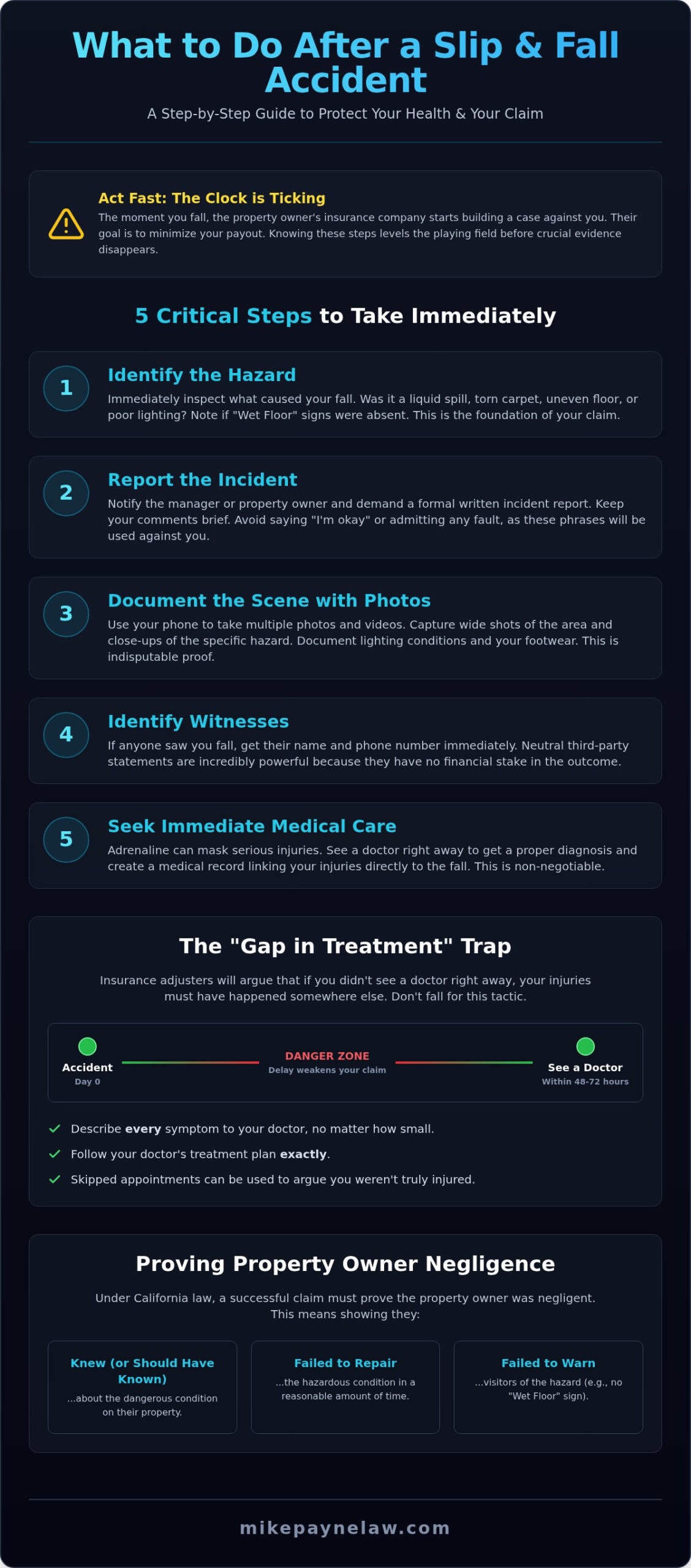
The seconds following a tumble are chaotic. Adrenaline masks pain, but your actions in these first moments determine the strength of your future claim. If you’re wondering what to do after a slip and fall accident, start by grounding yourself and observing your surroundings. You need to act like an investigator before the property owner has a chance to “clean up” the evidence. Evidence in these cases is fragile; it can be mopped away or repaired within minutes of your injury.
First, inspect the floor immediately. Was it a “transient substance” like a spilled soda, or a structural flaw? Second, report the incident to the store manager or property owner. Demand a written report but keep your comments brief. Knowing what to do after a slip and fall accident includes avoiding phrases like “I’m okay” or “I should have been looking where I was going.” These innocent remarks are exactly what insurance adjusters look for to deny your claim. As a former insurance defense attorney, I know how they’ll use your own politeness against you later.
Identifying the Hazard: What Caused Your Fall?
A successful slip and fall case hinges on proving a specific hazard existed. Look for liquid spills, leaked oil, or even loose debris. In many West Covina retail environments, hazards also include structural defects like torn carpeting, uneven floorboards, or broken stairs. Note whether “Wet Floor” signs were visible. Their absence is a direct violation of the owner’s duty of care. For a deeper look at these triggers, see our guide on the causes of slip and fall accidents.
Third, use your phone to capture the scene. Take wide shots of the area and close-ups of the hazard itself. Document the lighting conditions and even your own footwear to prove you were dressed appropriately for the conditions. These photos serve as permanent records that cannot be disputed by a manager’s later testimony. Fourth, identify witnesses before they walk away.
The Power of Witness Statements
Neutral third-party observations carry immense weight in court because these individuals don’t have a financial stake in the outcome. If someone saw you fall, ask for their name and phone number immediately. Keep it simple and non-confrontational. You might say, “I think I’m hurt, would you mind sharing your contact info in case the insurance company asks what happened?” If they are in a rush, ask if you can record a 30-second voice memo on your phone of what they saw. This preserves their fresh memory before the property owner’s legal team can influence their story. Finally, once you have this data, your fifth step is to leave the scene and seek professional medical evaluation.
Prioritizing Medical Care and Building Your Evidence Trail
Adrenaline is a powerful mask. Immediately after a fall, your body’s “fight or flight” response can hide serious injuries like soft tissue tears or concussions. If you are wondering what to do after a slip and fall accident, the most critical step for your health and your legal claim is seeking a professional medical evaluation right away. This isn’t just about feeling better. It’s about creating a contemporaneous record of your injuries.
When you speak to a doctor, don’t minimize your symptoms. Mention every ache, stiffness, or bruise, no matter how small it seems. If it isn’t in the medical chart, the insurance company will claim it didn’t happen during the fall. According to the CDC’s Facts About Older Adult Falls, injuries from falls can lead to significant long-term complications if not treated early. Follow your doctor’s prescribed treatment plan exactly. If you skip physical therapy or miss follow-up appointments, the defense will argue you failed to “mitigate your damages,” potentially slashing your compensation.
The ‘Gap in Treatment’ Trap
In my 25 years of experience, I’ve seen insurance adjusters use a “gap in treatment” to dismantle otherwise strong cases. If you wait more than 48 to 72 hours to see a doctor, the defense will claim your injuries were caused by something else entirely. They might suggest you got hurt at home or at the gym over the weekend. “Toughing it out” for a few days isn’t brave in a legal sense. It’s the fastest way to ruin your claim. Get to an urgent care or your primary physician immediately to close this window of doubt. Knowing what to do after a slip and fall accident includes understanding that every hour you wait is an hour the insurance company uses against you.
Documenting Your Economic Damages
Your recovery depends on a clear trail of economic proof. Save every pharmacy receipt, medical bill, and record of co-pays. In the Inland Empire job market, missing even a week of work can cause significant financial strain. Track your lost wages and any impact on your future ability to earn. I also recommend keeping a daily pain journal. Document how your mobility issues prevent you from enjoying your local SoCal lifestyle, whether that’s walking at Galster Wilderness Park or simply playing with your kids. This personal record links your physical suffering directly to the site of the fall. If you’re unsure how to start this process, reaching out for premises liability representation can help you organize your evidence from day one.
Avoiding the ‘Insurance Defense’ Trap
Within 24 to 48 hours of your incident, a “friendly” insurance adjuster will likely call you. They’ll sound concerned. They might even offer a check to cover your immediate medical bills. Don’t be fooled. Knowing what to do after a slip and fall accident means recognizing that every word you say to an insurance company is being recorded for one purpose: to deny your claim. As a former insurance defense attorney with 25 years of experience, I’ve seen these scripts from the inside. They are designed to extract admissions that destroy your credibility before you even file a lawsuit.
The most dangerous trap is the “medical authorization” form. Adjusters claim they need this to pay your bills. In reality, these forms give them a skeleton key to your entire medical history. They will dig through records from ten years ago to find a minor back strain or old sports injury. Then, they’ll argue your current pain is a “pre-existing condition” rather than a result of the fall. The National Safety Council provides extensive data on Older Adult Falls, highlighting how these incidents can change a life in an instant, yet insurers will try to blame your age or history instead of their client’s negligence.
Adjuster Tactics: What They Won’t Tell You
Adjusters use a “quick settlement” ruse to catch you while you’re stressed and financially vulnerable. They know that if they can get you to sign a release for a few thousand dollars now, they are shielded from paying for the surgery or long-term therapy you might actually need. They also use “comparative negligence” laws to shift the blame. They’ll ask leading questions about your distraction, your phone use, or your shoes to make it look like the fall was 50% your fault. My background as a defense lawyer is your greatest advantage because I can anticipate these moves and shut them down. You should immediately contact a legal representative to handle all insurance communication on your behalf.
Your Right to Remain Silent
Silence is your most powerful tool in the first 24 hours. There is a massive legal difference between a “statement” and an “incident report.” You are often required to fill out a basic report at the scene to notify the owner, but you are under no legal obligation to give a recorded statement to their insurance carrier. Even simple phrases like “I’m okay” or “I didn’t see the spill” can be weaponized against your case. If an adjuster calls, simply tell them you are seeking legal counsel and hang up. This protects your right to pursue full compensation for premises liability without accidentally handing the defense the ammunition they need to sink your claim.
Understanding California Premises Liability and Proving Fault
In West Covina and Pomona, property owners don’t just have a moral obligation to keep floors clean; they have a legal Duty of Care. Under California law in 2026, every business owner must use ordinary care to maintain their property in a reasonably safe condition. If they fail to fix a hazard or warn you about it, they are liable for the damages that follow. Understanding this legal framework is a vital part of knowing what to do after a slip and fall accident to ensure you aren’t left paying for someone else’s negligence.
Proving fault requires more than just showing you fell. You must prove the owner had “notice” of the danger. This is where many self-represented victims fail. Without evidence of notice, the court may dismiss your claim entirely. To secure a fair recovery, you need to understand the nuances of premises liability law and how it applies to your specific incident.
Establishing Notice: The Key to Your Case
There are two types of notice: actual and constructive. Actual notice occurs when an employee saw the spill or created the hazard themselves. Constructive notice is more common and often harder to prove. It means the hazard existed for such a long time that a reasonable owner should have discovered and removed it during a routine inspection. We often use surveillance footage from major hubs like Ontario Mills or local West Covina businesses to establish a timeline. If a spill sat on the floor for twenty minutes without a mop appearing, the owner’s “I didn’t know” defense disappears.
Common Defenses: ‘Open and Obvious’
The most frequent defense strategy is claiming the hazard was “open and obvious.” Property owners will argue that you should have seen the danger and simply walked around it. However, California law includes a “distraction” exception. If you were looking at a store’s promotional signs or searching for a product on a high shelf, your distraction was foreseeable. The owner is still responsible for the causes of slip and fall accidents on their floor, even if the spill was visible.
California operates under a “pure comparative negligence” rule. This means even if you are found partially at fault for not seeing a hazard, you can still recover damages. Your total compensation is simply reduced by your percentage of fault. If you are 20% responsible, you still receive 80% of the settlement. Don’t let a property owner’s legal team bully you into believing you have no case just because you weren’t looking at your feet every second. If you’ve been injured on someone else’s property, contact Michael D. Payne today to hold the negligent parties accountable and protect your financial future.
Navigating Your Personal Injury Claim with Michael D. Payne
Deciding what to do after a slip and fall accident often leads to a fork in the road: do you handle the insurance company alone, or do you bring in a professional champion? Many large “settlement mills” take on thousands of cases, rarely stepping foot in a courtroom. They prioritize volume over value. At our boutique firm, you receive personal attention from Michael D. Payne himself. We don’t just process files; we build relationships. With 25 years of experience, including years spent inside the insurance industry, I know that the highest settlement offers go to the lawyers who are actually prepared to go to trial.
Our firm operates on a strict contingency fee basis. This means you pay nothing upfront. We cover all the costs of investigation, expert testimony, and filing fees. If we don’t win your case, you don’t owe us a dime. This foundational trust-builder allows you to focus on your physical recovery while we handle the high-stakes legal battle. If you’re ready to take the next step, you should Contact our West Covina office for a comprehensive review of your claim.
The Litigation Process: What to Expect
Litigation is a marathon, not a sprint. It begins with a formal demand letter to the property owner’s insurance carrier. If they refuse to offer a fair settlement, we file a lawsuit to initiate the discovery phase. During this time, we subpoena maintenance records and question employees under oath. We handle all the heavy lifting, from managing deadlines to aggressive negotiations. Choosing the right representative is crucial in these moments. You can learn more about this by reading our guide on Personal Injury Lawyer West Covina: Choosing a Trial-Ready Advocate in 2026.
Maximum Recovery for Southern California Victims
True recovery means more than just paying off current medical bills. We calculate the long-term impact of your injury, including future physical therapy, lost earning capacity in the Inland Empire, and the emotional distress caused by your loss of mobility. We fight for every dollar you deserve for your pain and suffering. Our goal is accountability from negligent property owners who put our community at risk. For a broader look at how we defend your rights, see our resource on Personal Injury Attorney California: Protecting Victims in West Covina & SoCal. Knowing what to do after a slip and fall accident starts with choosing a local fighter who understands the specific needs of your community.
Take Control of Your Legal Recovery Today
The path from a traumatic injury to a successful settlement requires immediate, decisive action. By documenting the hazard and seeking medical care without delay, you’ve already laid the groundwork for a strong claim. You now understand that knowing what to do after a slip and fall accident is about more than just physical recovery. It’s about outmaneuvering insurance companies that are specifically trained to minimize your pain. You don’t have to carry this burden alone while you heal.
With over 25 years of local Southern California experience and a background as a former insurance defense lawyer, I know exactly how to dismantle the arguments used to deny your claim. We operate on a contingency fee basis, so you pay no fees unless we win your case. This is your opportunity to hold negligent property owners accountable and secure the financial resources you need for your future. Secure your free consultation with Michael D. Payne today and let a local fighter stand as your shield. You deserve a professional advocate who is personally invested in your well-being. Your recovery starts with one phone call.
Frequently Asked Questions
How long do I have to file a slip and fall lawsuit in California?
In California, you generally have two years from the date of the incident to file a lawsuit against a private property owner. This deadline is strictly enforced under California Code of Civil Procedure Section 335.1. However, if your accident occurred on government property, such as a sidewalk in West Covina or a post office, you must file an administrative claim within six months. Missing these windows can permanently bar you from seeking recovery.
Can I still recover compensation if I was partially at fault for my fall?
Yes, California follows a “pure comparative negligence” rule. This means you can recover compensation even if you were 99% at fault, though your final award is reduced by your percentage of responsibility. For example, if a court determines you were 25% at fault because you were looking at your phone, you would still receive 75% of the total damages. We fight to minimize the fault attributed to you by aggressive insurance adjusters.
What is the average settlement for a slip and fall accident in 2026?
Settlement amounts vary based on the severity of your injuries and the impact on your life. For 2026, minor injuries like sprains often settle between $10,000 and $75,000. Moderate injuries involving fractures typically range from $50,000 to $250,000. Severe cases involving surgery or traumatic brain injuries can exceed $1,000,000. We focus on calculating the true long-term cost of your medical care and lost wages in the Southern California market to maximize your recovery.
Do I need a lawyer if the insurance company already offered me a settlement?
You should always consult an attorney before accepting an early offer. Initial settlements from insurance companies are almost always lowball figures designed to make the claim disappear before you understand the full extent of your injuries. As a former insurance defense lawyer, I know they hope you will sign a release for a fraction of what your case is worth. An experienced advocate ensures you don’t leave vital compensation on the table.
What if my slip and fall happened at a government building or post office?
Claims against government entities follow much stricter rules and shorter deadlines. You must file a formal administrative claim with the specific agency within six months of the accident. This applies to falls at public schools, city parks, or local government offices in Pomona or Ontario. If the agency rejects your claim, you have a limited time to file a lawsuit. Navigating these bureaucratic hurdles requires immediate professional intervention to protect your legal rights.
How much does it cost to hire a slip and fall attorney in West Covina?
Hiring the Law Offices of Michael D. Payne costs nothing upfront. We work on a contingency fee basis, meaning our compensation is a pre-negotiated percentage of the final settlement we secure for you. We advance all litigation costs, including expert witness fees and filing expenses. If we don’t win your case, you don’t owe us a dime. This allows you to pursue justice without any personal financial risk during your physical recovery.
What happens if there were no witnesses to my accident?
You can still win your case without witnesses by relying on physical evidence and expert analysis. We look for surveillance footage from nearby businesses, analyze the property maintenance logs, and use medical records to prove the mechanics of your fall. Knowing what to do after a slip and fall accident includes taking photos of the hazard immediately. This visual proof often serves as a more reliable witness than a bystander’s memory in a courtroom.
Is the property owner always liable for a fall on their premises?
No, a property owner is not automatically liable just because you fell. Under California Civil Code § 1714(a), you must prove the owner was negligent by showing they knew, or should have known, about the hazard and failed to fix it. This is known as “notice.” If the hazard was created by another customer seconds before you fell, the owner might not be liable. We specialize in proving that property owners failed their duty of care.