

What if the settlement figure you found online has little to do with what your family’s claim may be worth? If you’re asking “what is my wrongful death case worth in california 2026,” the answer depends on the losses your family can prove, the evidence connecting the death to another party’s conduct, and the insurance coverage available.
It’s understandable to look for a number after a devastating loss. But averages and broad settlement ranges can’t account for your family’s relationship with the person who died, their financial contributions, disputed fault, or which relatives may have a legal claim. A case’s value must be assessed on its own facts, not promised in advance.
This article explains which economic and personal losses California law may consider, how records and incident evidence can support a claim, and why insurance and claimant eligibility may affect expectations. It also offers a practical way to organize the information for an individualized review. With more than 25 years of experience, Michael D. Payne helps Southern California families examine evidence and pursue a fair result without relying on guesswork.
Key Takeaways
- There’s no reliable figure that fits every family. A case’s value depends on provable losses and the limits on potential recovery.
- If you’re asking “what is my wrongful death case worth in california 2026,” focus on financial support, household services, and the loss of a loved one’s companionship.
- Disputed fault and available insurance can affect potential recovery, but they don’t define the full value of your family’s loss.
- Organize records about responsibility, eligible claimants, family losses, coverage, and deadlines to support a practical assessment.
- Michael D. Payne’s former insurance-defense experience informs an individualized review of your family’s next steps, without promising a result.
What determines what a wrongful death case is worth in California?
Losing someone close to you brings questions no online calculator can answer. If you’re asking “what is my wrongful death case worth in california 2026,” there’s no reliable figure that applies to every California family. A case-specific assessment weighs legally recognized losses against the evidence, the strength of the liability claim, available insurance, and the rules that govern recovery.
An assessment is different from an insurer’s offer or a court’s award. An insurer may dispute responsibility, the losses, or the amount supported by the evidence. A court may reach a different result after considering the facts and applicable law. Case value is an informed evaluation, not a guaranteed outcome.
Why online wrongful death settlement averages can mislead
Families’ circumstances differ. The person’s financial contributions, the services they provided at home, and the nature of each family relationship can affect which losses may be claimed and how they’re documented. The available evidence and any dispute about who caused the death matter, too.
A publicized result doesn’t show whether another family’s circumstances match yours. It isn’t a promise or a reliable forecast. Without comparable facts, a settlement figure can create expectations that have little connection to your family’s potential claim.
What California law means by wrongful death damages
A wrongful death claim is a legal action brought by eligible survivors for losses they experience because of a person’s death. In California, eligibility and financial value are separate questions: being allowed to bring a claim doesn’t determine how much it may be worth.
California law generally allows a surviving spouse or domestic partner, children, and, in certain circumstances, grandchildren to bring a claim. If there are no qualifying close relatives, other people may be eligible under inheritance rules or based on financial dependence. Eligible claimants may seek damages for financial support and household services the person would have provided, as well as the loss of companionship, comfort, affection, society, and moral support. The specific facts and current law control what can be claimed.
For a closer look at the firm’s California wrongful death representation, families can learn how an individualized investigation assesses evidence, liability, and legally recognized losses. A careful evaluation starts with the details of your family’s situation, not a number taken from someone else’s case.
Which family losses can affect a California wrongful death claim?
California wrongful death damages may reflect both financial contributions and the personal relationship survivors lost. No single category captures a person’s importance to a family. The claim must connect each requested loss to an eligible claimant, applicable law, and supporting evidence.
How financial support and household services are evaluated
Financial losses may include support the deceased provided and contributions they reasonably would have provided in the future. An assessment can consider income, employment history, work benefits, and the family’s financial arrangements. Pay records, tax documents, and employment information may help establish that history. Qualified analysis may help estimate future contributions where appropriate.
Household services matter, too. A person may have cared for children, prepared meals, maintained the home, or helped relatives with everyday needs. Evidence about those routines can help show what the family lost. Earnings alone don’t measure a person’s value, and a lower income or unpaid household role doesn’t erase the support they gave.
Funeral and burial expenses may also be considered when legally recoverable and supported by records such as itemized bills and receipts. Whether a particular expense belongs in the claim depends on the circumstances and current California law.
How California considers the family relationship and loss
Eligible relatives may seek compensation for the loss of companionship, comfort, affection, society, and moral support. In plain terms, these are the daily bonds and guidance that made the person part of family life. They aren’t calculated by assigning a price to grief. The law considers legally recognized losses supported by the facts.
Claimant eligibility requires careful legal review. The relationship, family circumstances, and California’s rules determine who may pursue damages. Photographs, messages, shared plans, testimony from people who knew the family, and accounts of regular routines may help describe the relationship. These materials provide context, not a formula for measuring love or sorrow.
If you’re trying to understand what is my wrongful death case worth in california 2026, focus on the specific losses each eligible relative can document. A thoughtful review can distinguish financial contributions from personal losses and identify evidence that may support each. The Law Offices of Michael D. Payne provides California wrongful death representation for families seeking a case-specific assessment.
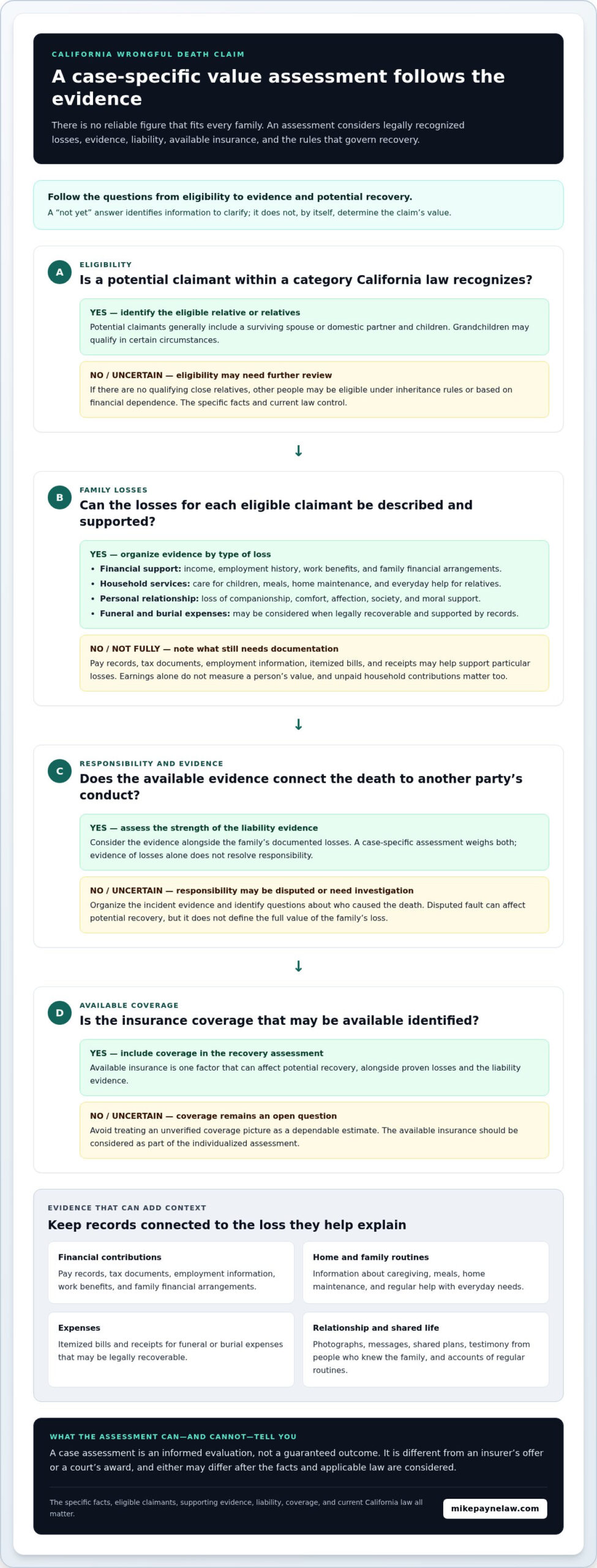
How fault, insurance, and related claims can change case value
Even well-documented family losses don’t settle every question. The claim must also establish who caused the death, how the law treats any fault by the deceased, and what coverage may be available. These issues can affect the amount that may be recovered, but insurance limits don’t measure the loss your family experienced.
How disputed fault can affect a California claim
California generally applies comparative negligence principles in wrongful death cases. If evidence shows the deceased shared responsibility, a factfinder may reduce recoverable damages in proportion to that fault, rather than automatically barring a claim. The impact depends on the evidence and how the law applies to the specific case.
Responsibility may be disputed or shared. A crash report can document initial observations, while witness accounts, photographs, vehicle records, and expert analysis may help clarify how an incident occurred. These materials may challenge an insurer’s version of events or identify additional potentially responsible parties. No single report should be treated as the whole story.
Coverage and related legal claims
Available insurance is a practical recovery consideration. A policy may limit what an insurer will pay, but it doesn’t define the family’s legally recognized losses or guarantee a particular recovery. A careful review considers potential responsible parties and applicable policies before drawing conclusions about what compensation may be available.
A wrongful death claim is brought by eligible survivors for their own losses. A survival action is distinct: it is brought on behalf of the deceased person’s estate for claims the person could have pursued if they had survived. The claims may involve different damages and parties, so they shouldn’t be treated as interchangeable.
How these factors differ:
- Proven damages: Evidence supports the family’s legally recognized financial and personal losses.
- Liability questions: Disputes over responsibility or the deceased’s share of fault may affect whether and how much can be recovered.
- Potential coverage constraints: Available policies may limit practical recovery, even when documented losses are greater.
If the death involved a commercial truck, investigating the incident may require examining evidence connected to more than one potentially responsible party. The firm represents families in fatal trucking accident cases. For anyone asking “what is my wrongful death case worth in california 2026,” evaluating damages, fault, insurance, and any related estate claim together provides a more grounded picture than considering any one factor alone.
What evidence helps assess a California wrongful death case?
Evidence turns a family’s questions into a case-specific assessment. It helps show what happened, who may be responsible, which relatives may bring a claim, and what losses can be documented. You don’t need a perfect file before seeking guidance. Preserve what you can, and don’t let paperwork distract from immediate family needs.
A practical review follows this order:
- Establish responsibility: Gather available incident records and identify potential witnesses.
- Identify eligible claimants: Clarify family relationships and who may have a legal right to bring a claim.
- Document losses: Collect records of financial support, household contributions, and family relationships.
- Assess coverage: Identify insurance policies that may apply and potential responsible parties.
- Review deadlines: Confirm the filing period and any special claim requirements promptly.
Documents that can help establish financial losses
Potentially useful records include tax returns, pay statements, employment and benefit information, and documents showing regular financial contributions. Household calendars, messages, or other records may help describe recurring tasks such as caregiving, transportation, or home maintenance. These materials can support different parts of the assessment, but no single record captures everything a person contributed.
Estimating future support may require careful analysis of work history, expected earnings, benefits, and household services. It isn’t simply a matter of multiplying a current paycheck by a number of years. Preserve records when practical, but don’t put off urgent family responsibilities to search for every document.
Evidence that may establish responsibility and insurance
Incident or police reports, photographs, available video, vehicle or property records, and witness contact information may help investigators piece together what happened. Medical records or an autopsy report may also be relevant, depending on the circumstances. Expert investigation can help explain complex issues, but no single report or opinion automatically proves liability or determines a claim’s value.
More than one person or organization may have contributed to a death, and multiple insurance policies may need review. Keep any policy or insurer correspondence you already have. An attorney can assess what additional records may be needed and how they relate to responsibility, damages, and possible coverage.
Act promptly on deadlines. California’s general deadline for a wrongful death lawsuit is usually two years from the date of death. Claims involving a government entity can require an administrative claim within six months. Exceptions may apply, so have the specific dates and circumstances reviewed without delay.
If you’re asking “what is my wrongful death case worth in california 2026,” an organized evidence review can clarify what supports the claim and what remains uncertain. Contact the Law Offices of Michael D. Payne to discuss a case-specific review.
How a California wrongful death lawyer can help your family assess next steps
After a loss, it can be hard to know which questions to tackle first. A wrongful death lawyer can review responsibility, who may be eligible to bring a claim, the available evidence, legally recognized losses, and insurance together. That fuller picture helps families understand what is known, what needs investigation, and what steps may be time-sensitive.
What to expect from an individualized case review
A case review begins with the circumstances of the death and the family’s situation. Counsel may examine incident records, relationships among potential claimants, financial and household contributions, and available coverage. The goal is an evidence-based assessment, not a promised settlement or verdict.
Early conclusions can change. Witness accounts may develop, records may reveal additional facts, and insurance questions may take time to resolve. Michael D. Payne brings more than 25 years of experience, including a former insurance-defense background. That perspective can inform how evidence and insurer positions are examined, but it can’t guarantee a particular result.
The firm represents wrongful death clients on a contingency-fee basis and advances litigation costs. The fee arrangement is set by agreement and doesn’t guarantee that a claim will recover compensation. Families can review the firm’s wrongful death legal representation to learn more about its approach.
How to take a practical next step in Southern California
Keep records you already have, such as insurer correspondence, employment documents, incident information, and receipts related to the loss. You don’t need to collect everything before asking questions. Avoid signing a release or settlement document in haste. Its effect may depend on which claims and people it covers, so understand the terms before deciding.
The Law Offices of Michael D. Payne represents families in Southern California, including West Covina, Pomona, Ontario, Covina, Chino, Fontana, San Bernardino, Baldwin Park, and Azusa. If you’re still asking, “what is my wrongful death case worth in california 2026,” a case-specific discussion can help clarify which facts matter and what remains uncertain. You don’t have to resolve every legal question on your own. Contact the Law Offices of Michael D. Payne to discuss your family’s circumstances and possible next steps.
Take the Next Step Toward Clarity
There’s no one number that can answer “what is my wrongful death case worth in california 2026” for every family. A meaningful assessment depends on the losses California law recognizes, the evidence supporting them, questions of fault, and available insurance. Records can help show financial contributions and the personal relationships your family has lost, but no online average can predict a specific result.
Michael D. Payne represents families in wrongful death cases throughout Southern California. He brings over 25 years of experience and a former insurance-defense background to reviewing liability, evidence, eligible claimants, and coverage. That perspective can help clarify the issues, but it isn’t a promise of a settlement or verdict.
You don’t have to sort through every question alone. Discuss your family’s wrongful death case with Michael D. Payne and learn what possible next steps may fit your circumstances. Your family deserves a careful, individual review and steady support as you decide how to move forward.
Frequently Asked Questions
What is the average wrongful death settlement in California?
There’s no dependable average that can predict what a particular California family may recover. Published settlement figures may combine cases with very different losses, evidence, liability disputes, and insurance coverage. A number from another case isn’t a promise or a reliable estimate for yours. To understand what is my wrongful death case worth in california 2026, focus on your family’s documented losses and the facts that support the claim.
How is a wrongful death settlement calculated in California?
California doesn’t use a single formula to calculate every wrongful death settlement. An assessment considers legally recognized financial losses, such as lost support and household services, and personal losses, including companionship and moral support. Evidence, disputed responsibility, comparative fault, eligible claimants, and available coverage can all affect the outcome. The analysis may change as records are gathered and the facts become clearer.
What damages can family members recover in a California wrongful death case?
Eligible survivors may seek compensation for financial support the deceased would have provided, the value of household services, and the loss of companionship, comfort, affection, society, and moral support. Funeral and burial expenses may also be recoverable when allowed by law and supported by evidence. The specific damages depend on who is legally eligible and the circumstances of the case. A separate survival action may address claims belonging to the estate.
Does a wrongful death settlement include the deceased person’s pain and suffering?
Generally, no. A wrongful death claim seeks compensation for losses suffered by eligible surviving family members, not the deceased person’s pain. A survival action is a separate claim brought on behalf of the estate. For survival actions filed on or after January 1, 2026, the deceased person’s pre-death pain and suffering will generally not be recoverable under the current rule described in this article. The claims and filing date matter.
Can multiple family members recover compensation in a California wrongful death case?
Yes, multiple eligible family members may have claims arising from the same death. California generally requires eligible claimants to join in one wrongful death action, rather than file separate lawsuits over the same death. Eligibility depends on the family relationship and applicable law. A surviving spouse or domestic partner and children may qualify; other relatives or dependents may qualify in certain circumstances. A careful review can clarify who should be included.
How do insurance policy limits affect a wrongful death case’s value?
Insurance limits can affect how much compensation may be practically available from a particular policy, but they don’t measure the family’s losses or automatically establish the claim’s value. The review may need to identify multiple potentially responsible parties and applicable policies. The Law Offices of Michael D. Payne represents families in West Covina, Pomona, Ontario, Covina, Chino, Fontana, San Bernardino, Baldwin Park, and Azusa, and assesses coverage alongside evidence and liability.
How long do I have to file a wrongful death lawsuit in California?
The general deadline is two years from the date of death, but exceptions can change the time limit. A claim involving a government entity generally requires an administrative claim within six months. Medical malpractice and other circumstances may have different rules, and the deadline can depend on when relevant facts were discovered. Don’t rely on a general deadline to assess your situation. Have the dates and claim type reviewed promptly.