

A loved one’s death does not automatically end the injury claim they could have brought. To understand what a survival action in California can cover, start with this rule: it seeks losses the person sustained before death, such as medical expenses and lost wages. The claim belongs to the deceased person’s estate, not to family members pursuing a wrongful death claim for their own losses.
One question matters especially now: can the estate recover the person’s pain and suffering? According to the California Legislature, starting January 1, 2026, California survival actions no longer allow recovery for a decedent’s pain, suffering, or disfigurement. The date the action was filed can therefore affect which damages may be available.
When you are sorting through these claims while grieving, the legal distinction can feel like another burden. This article explains what a survival action covers, who may bring it, and how it differs from a wrongful death lawsuit. It also explains how the filing date affects pain-and-suffering damages and how a survival claim may proceed alongside a wrongful death claim.
Key Takeaways
- Separate losses the deceased person suffered before death from losses family members experience because of the death; the two claims serve different purposes.
- Check the filing date when assessing whether a survival claim can include damages for pre-death pain, suffering, or disfigurement.
- Identify the estate’s personal representative or successor in interest to determine who can bring the claim.
- Review how evidence, applicable deadlines, and possible damages shape the case and whether a related wrongful death claim may also apply.
What’s the Difference Between a Wrongful Death Lawsuit and a Survival Action in California?
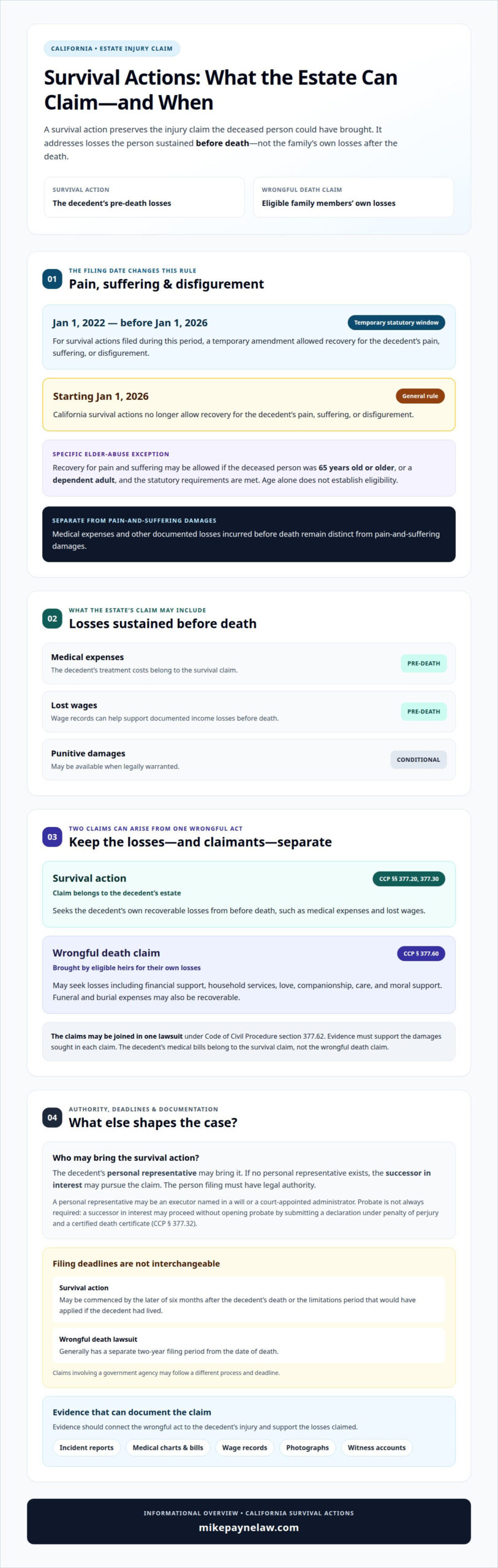
California law treats these as separate claims, even when one wrongful act caused the death. The question “What is a survival action in California?” turns on whose losses the claim addresses: it preserves the claim the decedent could have brought if they had lived, under Code of Civil Procedure sections 377.20 and 377.30. A wrongful death lawsuit is an independent claim under section 377.60, brought by eligible heirs for losses they personally suffer. The claims can be joined in one lawsuit under section 377.62.
The damages reflect that distinction. A survival action can seek losses the decedent incurred before death, such as medical expenses and lost wages. Punitive damages may also be available when legally warranted. A wrongful death claim can seek eligible family members’ losses, including financial support, household services, love, companionship, care, and moral support. Funeral and burial expenses may also be recoverable. The decedent’s medical bills belong to the survival claim, not the wrongful death claim.
For families asking “What is a survival action in California?”, the timeline can help make the distinction concrete. If someone survives a crash before dying in a hospital, the estate may pursue the person’s medical expenses and lost wages through a survival action. Eligible family members may separately seek compensation for their own losses through a California wrongful death claim. Evidence must support the damages sought in each claim.
Recovery is generally handled through the estate, though probate may not always be necessary. Heirs receive distributions through the estate process under applicable inheritance rules; they do not automatically receive the award directly as wrongful death claimants.
To support a survival action, evidence should connect the wrongful act to the decedent’s injury and document losses before death. Useful records may include incident reports, medical charts and bills, wage records, photographs, and witness accounts. For example, hospital records can document treatment after a collision, while payroll records can support a claim for lost wages.
Timing can also shape damages. California’s temporary statutory amendment allowed recovery of a decedent’s pain, suffering, or disfigurement in survival actions filed on or after January 1, 2022, and before January 1, 2026, according to the California Legislature. Starting January 1, 2026, those damages are no longer recoverable in survival actions, according to the California Legislature. The filing date therefore matters when evaluating the estate’s claim.
Does a survival action cover the decedent’s pain and suffering?
The answer depends on the lawsuit’s filing date and the type of claim. According to the California Legislature, a temporary statutory amendment allowed recovery of a decedent’s pain, suffering, or disfigurement in survival actions filed on or after January 1, 2022, and before January 1, 2026. That temporary window has closed. Starting January 1, 2026, California survival actions no longer allow recovery for those damages, according to the California Legislature. Medical bills and other documented losses incurred before death remain distinct from pain-and-suffering damages.
There is a specific elder-abuse exception. According to the California Legislature, recovery for pain and suffering may be allowed when the deceased person was 65 years old or older, or a dependent adult, and statutory requirements are met. The age threshold alone does not establish entitlement. The claim must also satisfy the applicable legal requirements for elder or dependent adult abuse.
Filing deadlines require careful attention. A survival action may be commenced by the later of six months after the decedent’s death or the limitations period that would have applied if the decedent had lived. The deadline can therefore depend on when the injury occurred and the limitations period for the particular claim. A wrongful death lawsuit generally has a separate two-year filing period from the date of death. Claims involving a government agency may follow a different process and deadline.
Probate isn’t always required to bring a survival action. Under Code of Civil Procedure section 377.32, a successor in interest can proceed without opening probate by submitting a declaration under penalty of perjury and a certified death certificate. That declaration identifies the successor and supports their authority to pursue the decedent’s claim. The appropriate county filing and required documents depend on the case’s procedural posture.
Preserve medical records, bills, and incident evidence while the filing dates are assessed. Those materials can document the injury and financial losses, even when pain-and-suffering damages aren’t available. For help understanding how timing affects a survival action’s deadlines and damages, review the claim’s filing history and supporting records promptly.
Who may bring a California survival action
California Code of Civil Procedure section 377.30 identifies who may pursue a survival action. The decedent’s personal representative may bring it, or the successor in interest if no personal representative exists. The claim belongs to the decedent’s estate, not automatically to every relative. The person filing must have legal authority to continue the injury claim.
A personal representative may be an executor named in a will or a court-appointed administrator. That representative acts for the estate and pursues the cause of action the decedent held before death. For example, if a driver dies after a collision, the representative may bring the decedent’s claim for documented pre-death losses. The estate’s claim remains distinct from relatives’ individual claims for their losses.
When no personal representative exists, a successor in interest may bring the claim. California Code of Civil Procedure section 377.11 defines that person as an estate beneficiary or another person who succeeds to the cause of action. Under section 377.32(a), the successor must file an affidavit or declaration under penalty of perjury. That filing establishes their status for the lawsuit.
If the decedent left no will, California Probate Code sections 6401 and 6402 govern inheritance. The surviving spouse and children are often among the people who inherit, depending on the family and estate. That inheritance may determine who succeeds to the survival claim. Kinship alone does not make someone the authorized filer.
A wrongful death claim follows a different path under Code of Civil Procedure section 377.60. Eligible heirs seek their own losses, such as lost household services, rather than the estate’s injury claim. One person may qualify to pursue both claims, but each requires the proper legal standing. The survival action may also include punitive damages when the decedent could have recovered them and the legal requirements are met. The representative or successor must support the claim with evidence of the wrongful act, injury, and recoverable losses.
How California survival actions work
California Code of Civil Procedure section 377.20 keeps a decedent’s existing cause of action alive after death. The case focuses on losses the injured person sustained before dying, not losses family members experience afterward. The personal representative or successor in interest pursues that claim. This distinction matters because a personal injury lawsuit doesn’t become a family member’s personal claim simply because the injured person has died.
The value of a survival claim depends on evidence connecting the wrongful act to the decedent’s injury and documenting the resulting losses. Medical records can show treatment, bills can establish expenses, and employment records can support wages lost before death. The timeline matters, too. Hospital records may establish the period between a collision and death, while billing statements show treatment costs during that period.
Punitive damages require a separate legal basis. Under Civil Code section 3294, they may be available if the defendant acted with malice, oppression, or fraud. They aren’t automatic compensation for a tragic outcome. Evidence must support the required conduct. In qualifying elder or dependent adult abuse claims, Welfare and Institutions Code section 15657 also provides a distinct framework for enhanced remedies.
California permits a survival action and wrongful death claim arising from the same wrongful act to proceed together under Code of Civil Procedure section 377.62. That can place the estate’s pre-death losses and family members’ own losses in one lawsuit, while keeping their legal purposes distinct. A family’s financial support losses belong to the wrongful death claim, not the decedent’s survival claim.
Before resolution, account for medical liens that may attach to survival action proceeds under Code sections 14124.72 through 14124.79. Liens can affect the amount remaining for the estate after recovery. A careful claim analysis therefore tracks liability evidence, pre-death damages, potential punitive damages, and liens separately. Discuss how to assess a California survival claim when these issues overlap.
Law Offices of Michael D. Payne
Law Offices of Michael D. Payne helps families assess how an injury claim may continue after a loved one’s death. For families in West Covina, Pomona, Ontario, Covina, Chino, Fontana, San Bernardino, Baldwin Park, and Azusa, legal guidance can clarify how an estate’s claim relates to family members’ separate losses. The firm handles personal injury and wrongful death matters arising from incidents such as car accidents, motorcycle collisions, bicycle crashes, and slip and falls.
Relevant records, the cause of death, and the person authorized to act for the estate can all affect the claim. If you’re weighing these issues after a fatal accident, contact Law Offices of Michael D. Payne to discuss your circumstances.
Take the Next Step With Clarity
Understanding what a survival action in California means for an estate is only part of the decision. The next step is to assess the available records, the circumstances of the injury, and who is authorized to act. This groundwork can help families approach difficult legal decisions with a clearer understanding of what needs attention.
Law Offices of Michael D. Payne represents people in car accident, slip and fall, and motorcycle accident cases. If one of these incidents led to a death, the firm can discuss how its representation may relate to the family’s situation. A consultation can help identify relevant questions and records for moving forward.
Contact Law Offices of Michael D. Payne to discuss your circumstances. You don’t have to sort through the next step alone.
Frequently Asked Questions
What Damages Can Families Recover?
In a wrongful death claim, eligible family members can seek compensation for losses they personally experienced because of the death. For example, a spouse or other eligible claimant may document lost financial support or household services, while family members may describe lost companionship and care. Funeral and burial expenses may also be claimed. Evidence should connect each requested category to the family’s own loss.
What Does a Survival Action Let the Estate Recover?
The estate can pursue losses the decedent incurred before death, supported by records tied to the injury. For example, itemized hospital statements can help distinguish treatment costs from unrelated expenses, while employer records can support wages lost during recovery. Keep dates and amounts organized by category. Punitive damages require evidence supporting the applicable legal standard, not simply proof that the injury was serious.
How Long Do You Have to File?
A California survival action may be commenced by the later of six months after the decedent’s death or the limitations period that would have applied if the decedent had lived. The injury date and the applicable deadline can affect the calculation. Do not assume the date of death alone determines the filing deadline; identify both dates and assess which period applies.
Should the Family Bring Both Claims?
Both claims may be appropriate when the decedent had personal injury losses before death and eligible family members suffered separate losses because of the death. California allows related survival and wrongful death claims to be joined in one lawsuit. For example, the estate may pursue documented expenses from before death while family claimants seek compensation for their own losses. Each claim still needs its own legal basis and supporting evidence.
What Deadlines Apply, and Does a Government Agency Change Things?
Yes. A written claim against a California government agency generally must be presented within six months after the claim arises. This requirement differs from the filing period for a court lawsuit. Identify whether a public agency may be responsible, such as when an incident involves a government-controlled location, because the claim process and timing can change.
What Is a Survival Action Under California Law?
A survival action preserves a legal claim the injured person held before death, allowing an authorized representative to pursue it afterward. It focuses on the decedent’s own losses, not the family’s separate harm. For instance, when someone dies after receiving injury treatment, the estate may pursue supported claims arising from that treatment period. The claim remains distinct from relatives’ wrongful death claims.