

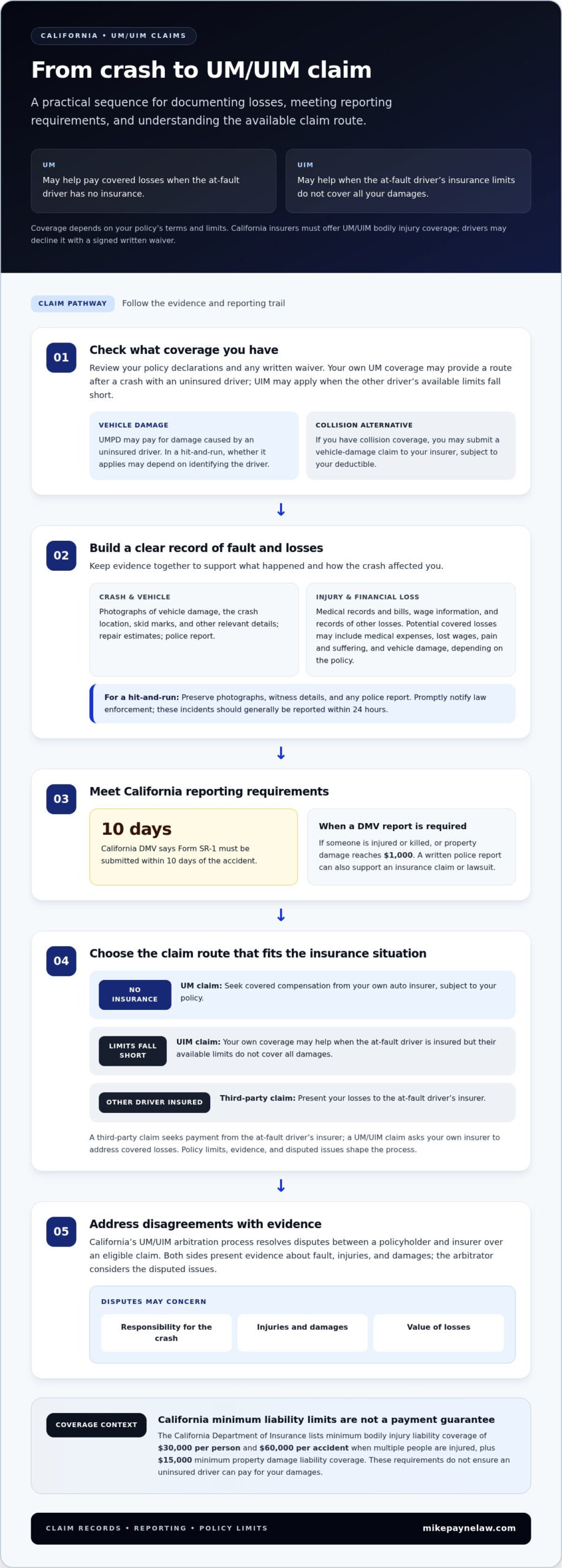
A crash with an uninsured driver doesn’t automatically leave you without a path to compensation. If you’re wondering, “What if the other driver has no insurance in California?”, your own uninsured motorist (UM) coverage may help pay covered losses. If the other driver has insurance but the policy doesn’t cover all your damages, underinsured motorist (UIM) coverage may help, subject to your policy’s terms and limits.
It’s understandable to worry about medical bills, missed work, vehicle damage, and how an insurance claim will unfold. California drivers may decline UM/UIM coverage in a written waiver, so review your policy to see what coverage you have. Without it, you may still pursue the at-fault driver, though collecting payment can be difficult. This guide explains how UM and UIM claims work, what losses may be covered, how fault can affect recovery, and what evidence can support a claim, so you can better understand your options.
Key Takeaways
- Your own UM coverage may provide a path to compensation when the at-fault driver has no insurance; UIM coverage may help when their policy falls short.
- California Department of Motor Vehicles says Form SR-1 must be submitted within 10 days of the accident.
- California’s minimum bodily injury liability coverage is $30,000 per person, according to the California Department of Insurance.
- Organize evidence of fault, injuries, and financial losses to support your claim and understand what compensation may be available.
What Is Uninsured Motorist Coverage?
Uninsured motorist (UM) coverage may help pay covered losses when an at-fault driver has no insurance. Underinsured motorist (UIM) coverage may help when the at-fault driver’s insurance is insufficient.
Uninsured and Underinsured Coverage
UM coverage lets you make a claim with your own insurance company after a crash with an uninsured driver. UIM coverage applies when the at-fault driver has insurance, but their available limits don’t cover all your damages. California Insurance Code Section 11580.2 requires insurers to offer UM/UIM coverage with bodily injury liability policies. Drivers may decline it by signing a written waiver, so review your policy declarations and any waiver, or discuss your auto policy options with an agency like Verdant Insurance to ensure you have sufficient protection.
Uninsured Motorist Property Damage
Uninsured motorist property damage coverage (UMPD) may pay for vehicle damage when an uninsured driver causes a crash. In a hit-and-run, whether UMPD applies may depend on whether the driver is identified. If you have collision coverage, you may instead submit a vehicle-damage claim to your insurer, subject to your deductible.
Bodily Injury Limits and Requirements
UM/UIM bodily injury coverage may help with injury-related losses, subject to your policy’s limits and terms. California insurers must offer this coverage in an amount equal to the policyholder’s bodily injury liability limits. You can decline it with a signed written waiver. What your policy covers matters: the available compensation depends on its terms, not simply on the other driver’s lack of insurance. Whether reviewing local policies or exploring comprehensive coverage options through The Lewis Agency Central Texas insurance, establishing adequate liability and uninsured motorist limits beforehand helps protect against unforeseen losses.
Injury and Vehicle Damage Payments
UM/UIM coverage may pay for medical expenses, lost wages, pain and suffering, and vehicle damage, depending on the policy. Does California uninsured motorist coverage pay for injuries and vehicle damage? After an accident, keep photographs and claim records, and complete required reporting. California Department of Motor Vehicles says Form SR-1 must be submitted within 10 days of the accident.
Filing a UM/UIM insurance claim
A UM/UIM claim asks your own insurer to address covered losses involving an uninsured or underinsured driver. Your policy limits, evidence, and any disputed issues shape the process.
UM/UIM Claim Routes
A UM/UIM claim seeks covered compensation from your auto insurer; a third-party claim seeks payment from the at-fault driver’s insurer. If the other driver is insured, you can present your losses to that company. If not, your own UM coverage may provide another route. Keep medical records, wage documents, photographs, and the police report together to support the facts and losses in your claim.
UM/UIM Arbitration
California’s UM/UIM arbitration process resolves disputes between a policyholder and their insurer over an eligible claim. Both sides present evidence about fault, injuries, and damages, and the arbitrator considers the disputed issues. Arbitration may matter when the insurer contests responsibility or the value of your losses. A lawyer can organize records and present evidence relevant to the policy limits and the specific disagreement.
Do I have to report a California car accident to police or the DMV? A DMV report is required if someone is injured or killed, or property damage reaches $1,000. California Department of Motor Vehicles says Form SR-1 must be submitted within 10 days. A written police report can also provide evidence for an insurance claim or lawsuit.
For a hit-and-run UM claim, promptly notify law enforcement; these incidents should generally be reported within 24 hours. Preserve photographs, witness details, and any police report. Identifying the vehicle or driver can matter, especially for a property-damage claim, which has separate coverage requirements.
If someone dies in the crash, surviving family members may bring a wrongful death claim under California Code of Civil Procedure § 377.60. An attorney can assess the UM/UIM claim, clarify disputed limits, and help document financial losses. For support with motor vehicle accident representation, legal guidance can help you understand the evidence and claims involved.
What If the Other Driver Has No Insurance in California?
If an uninsured driver caused the crash, document fault and your losses, then consider the available claim routes. California’s minimum liability insurance requirements don’t ensure that an uninsured driver can pay for your damages.
Minimum Liability Requirements
California requires drivers to show financial responsibility, commonly through auto liability insurance. California Department of Insurance says minimum bodily injury liability coverage is $30,000 per person and $60,000 per accident when multiple people are injured. California’s minimum property damage liability coverage is $15,000. These minimums describe required coverage, not a promise that an uninsured driver has money available to compensate you.
Evidence of Liability and Damages
Evidence helps establish who caused the crash and how it affected you. Photograph vehicle damage, the crash location, skid marks, and other relevant details. Gather medical records, bills, wage information, and repair estimates to document your losses. A written police report can support an insurance claim or personal injury lawsuit. Clear records can also help address disputes about fault or the value of damages.
Alternative Liability Sources
The uninsured driver may not be the only potential source of liability. Depending on how the crash happened, a vehicle owner, manufacturer, mechanic, or government entity may have contributed. For example, a vehicle defect or negligent repair could matter if it played a role. California law also recognizes possible owner liability when someone knowingly lets an unlicensed driver use their car. Identify potential causes and preserve related evidence.
Immediate Post-Crash Steps
After an uninsured driver hits you, prioritize safety, seek medical attention, and notify law enforcement. Photograph the scene, vehicle damage, and visible skid marks, and preserve the other driver’s information and witness details. Report the crash to your insurer and ask about your uninsured motorist coverage. These steps create a useful record as you assess responsibility and the financial losses caused by the collision.
Compensation for economic and non-economic losses
A crash can bring medical expenses, lost income, repair bills, and lasting personal harm. Potential compensation depends on the claim route, documented losses, and applicable policy limits.
Compensation for Injured Drivers
Injured drivers may seek economic losses, such as medical expenses and lost wages, and non-economic damages for pain and suffering. UM/UIM coverage may address these losses under the policy’s terms and limits when the at-fault driver is uninsured or underinsured. Organize bills, treatment records, wage information, and notes about lasting effects. These records help connect the injury to the crash and show its financial and personal impact.
For example, medical records can document treatment, while employer records can support a claim for missed income. Ongoing care or limits on daily activities can also show how an injury affects you beyond the initial expenses.
Additional Compensation Sources and Limits
Other parties may share responsibility for a collision, creating another possible source of compensation. Depending on the facts, a vehicle owner, manufacturer, mechanic, or government entity may have contributed. Evidence of a defective part, negligent repair, or another party’s role can help identify a separate claim. Preserve relevant records and connect each potential contribution to the crash and your losses.
Policy limits cap what an insurer may pay under the applicable coverage. California Civil Code Section 3333.4 limits an uninsured driver’s recovery of non-economic damages, which can affect a claim when the injured person was uninsured.
Can I use collision coverage if the other driver is uninsured, and what deductible applies? Yes. You can submit a vehicle-damage claim through your own collision coverage and pay the deductible stated in your policy. The amount depends on your policy.
Organize your injury records, income documentation, and policy information before evaluating compensation. For help assessing a crash-related claim, explore motor vehicle accident representation.
Law Offices of Michael D. Payne: Car Accident Representation
Law Offices of Michael D. Payne represents people dealing with injuries, insurance disputes, or questions about an uninsured driver’s responsibility. Consider car accident representation when fault is contested, your losses are substantial, or your insurer disputes a UM/UIM claim. Legal help can clarify relevant evidence, policy terms, and potential sources of compensation.
Gather information that helps explain your claim, including the crash report, photographs, medical records, repair documents, and insurance correspondence. A clear record helps focus discussions on what happened and how the collision affected you. The firm also represents people in motorcycle and bicycle accident claims.
Contact Law Offices of Michael D. Payne to discuss your accident and potential next steps.
Move Forward With a Clear Plan
If you’re asking what to do if the other driver has no insurance in California, consider the full picture before deciding how to proceed. An early offer or the insurer’s position may not reflect how an injury affects future care, work, and daily routines. Review the documented impact before responding, and record new developments as your recovery continues.
The right approach depends on your policy, available evidence, and whether another person or entity contributed to the crash. A focused review can identify unanswered questions, losses that need documentation, and issues to address in communications with the insurer. Law Offices of Michael D. Payne represents clients in car accidents, slip and falls, and motorcycle accidents. The firm works to pursue evidence-based claims and help clients consider issues that could affect their next decision.
For a thoughtful next step, discuss your accident claim with Law Offices of Michael D. Payne. Move forward with a clearer understanding of the options and questions that deserve attention.
Frequently Asked Questions
Can You Sue the Uninsured Driver?
Yes. You can sue an uninsured driver if evidence supports that their negligence caused your injuries. California Civil Code § 1714 states that people are responsible for injuries caused by failing to exercise ordinary care. A personal injury lawsuit generally must be filed within two years from the accident date, according to California Legislative Information. A judgment can establish legal responsibility, but collecting payment is a separate challenge.
How long does a UM claim take?
A straightforward UM claim may settle in a few months, while a complex claim involving serious injuries could take a year or more. The process depends on issues such as whether fault is disputed, how fully injuries and financial losses are documented, and how much investigation the insurer conducts. Keep records organized as treatment continues, so new medical information and expenses can be added to the claim.
Who pays for car repairs if the at-fault driver has no insurance in California?
Collision coverage can pay for vehicle repairs, subject to your policy’s deductible. Preserve repair estimates and photos, then compare the available claim route with your policy terms. The coverage limit and deductible affect the amount paid directly to you.
Can I sue an uninsured driver in California, and can I collect a judgment?
You can sue a driver whose negligence caused your injury, but collecting a judgment depends on whether the person has reachable assets or income. A lawsuit may not be practical if the driver lacks resources to pay. California’s personal injury lawsuit deadline is generally two years from the accident date, according to California Legislative Information, so timing matters.
Can an uninsured driver in California be held liable for damages or face license penalties?
Yes. A driver can be responsible for crash injuries caused by failing to use ordinary care, even if they lack insurance. California Civil Code § 1714 addresses responsibility for injuries caused by that failure. Separately, a first offense for driving without insurance may carry a fine of $100 to $200. Lack of insurance alone does not establish who caused the collision.
What evidence should I collect after a California accident with an uninsured driver?
Build a clear record of the crash and its consequences. Keep the police report, original photos, witness names and contact details, medical records, repair estimates, and receipts for accident-related expenses. While details are fresh, write down what happened, including where each vehicle was and what occurred just before impact. Keep copies together so you can respond consistently to insurer questions.