

Could a cracked sidewalk, slick floor, or poorly lit stairwell make a property owner responsible for your injury? If you’re asking, “was your injury caused by a dangerous condition in ontario,” the answer depends on more than the fact that you got hurt. The hazard, who controlled the property, what they knew or should have known, and whether the condition caused your injury can all matter.
It’s understandable to worry that an owner will deny responsibility, especially if the hazard is repaired or witnesses leave before you can document what happened. Under California law, property owners generally must use ordinary care, but not every unsafe-looking condition meets the legal standard for a dangerous condition. The details matter.
This article explains the basic premises-liability framework, what evidence may help establish the condition and its connection to your injury, and practical ways to preserve important details. It also explains why claims involving public property can follow different rules. With more than 25 years of experience and a background in insurance defense, Michael D. Payne understands the arguments insurers may raise. A careful investigation can help clarify what happened and what options may be available.
Key Takeaways
- A hazard may create an unreasonable risk, but an injury alone doesn’t establish that a property owner is legally responsible.
- To assess whether your injury was caused by a dangerous condition in ontario, consider who controlled the property, whether they knew or should have known about the hazard, and how it caused the injury.
- Photographs, video, incident reports, witness details, and relevant communications may help preserve important facts before the scene changes.
- After an incident, seek appropriate care, report what happened, document the scene safely, and keep records related to your treatment.
- A premises-liability lawyer can investigate the property and available evidence, then assess the claim’s strengths, uncertainties, and possible defenses.
What counts as a dangerous condition on property in Ontario, California?
A hazard may matter when it creates an unreasonable risk of harm to someone using the property with due care in a reasonably foreseeable way. But an injury alone doesn’t prove that a property owner is liable. The condition, how it arose, and whether a person could reasonably see or avoid it all matter. A minor defect or ordinary inconvenience may not meet California’s legal standard.
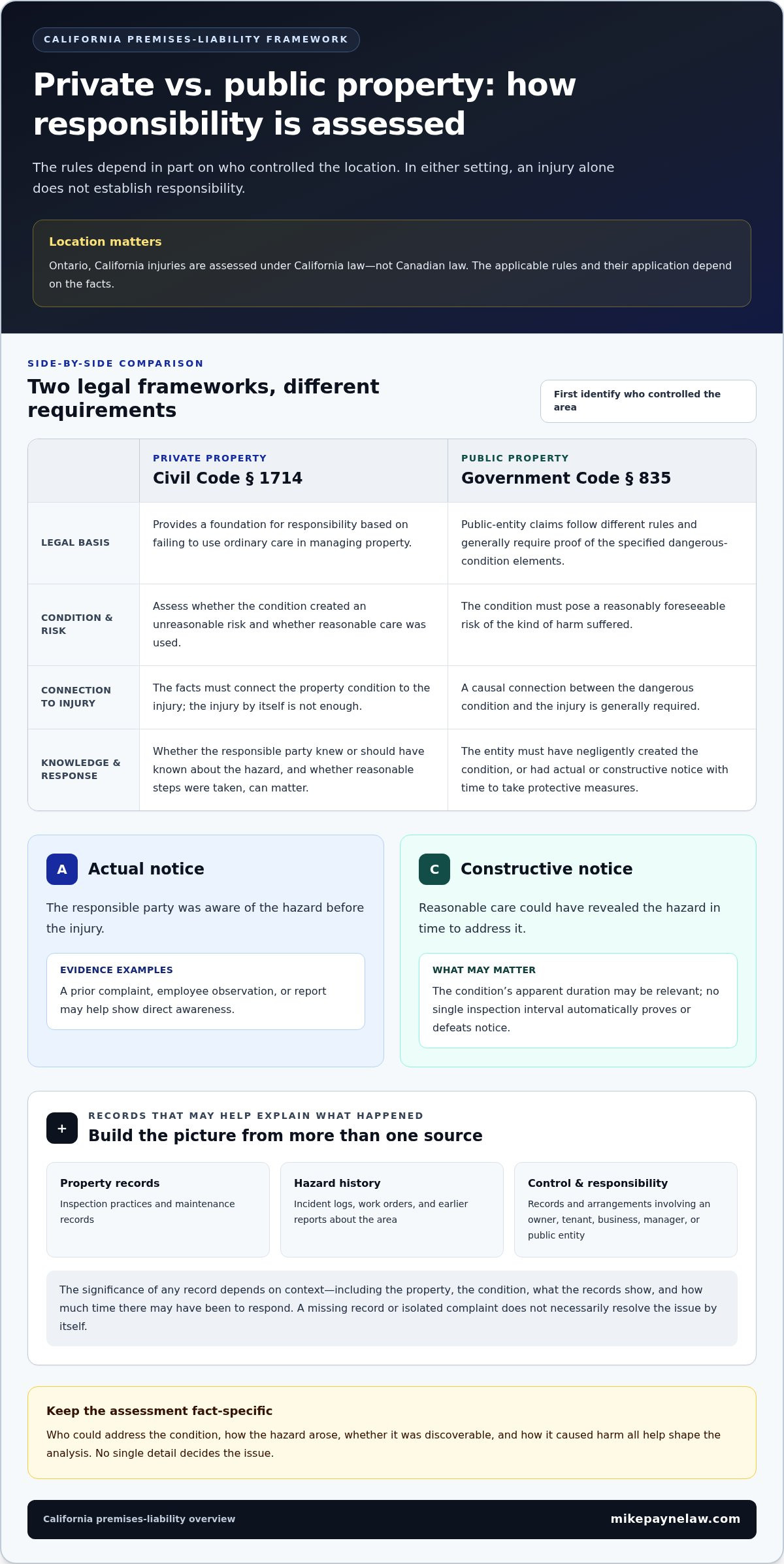
California law applies to an injury on property in Ontario, California. This is not a question of Canadian law, despite Ontario’s name. California Civil Code section 1714 provides a foundation for property-related negligence claims, while the precise rules and their application depend on the facts. The general overview of Premises liability can provide background, but it can’t determine whether a particular California claim meets the legal test.
Courts consider whether the condition posed a substantial risk, not simply whether someone fell or was hurt. Visibility matters, but a hazard that is easy to see isn’t automatically irrelevant. A person’s ability to recognize and avoid it, the way the area is normally used, and the surrounding circumstances can all affect the analysis. The key question is whether the risk was unreasonable in context.
- A spill near a busy entrance may present a different risk from a spill in a clearly marked, restricted area.
- A broken step or uneven walkway may be more concerning if its placement or appearance makes it difficult to notice.
- Inadequate lighting may affect whether people can see and safely use stairs or a walkway.
These examples don’t mean every spill, defect, or temporary hazard supports a claim. The facts must connect the condition to an unreasonable risk and the injury. The premises-liability claims handled by an attorney may require careful review of both the property and the circumstances of the incident.
How can a property condition become unreasonably dangerous?
Look beyond the name of the hazard. Its setting, visibility, duration, and the area’s ordinary use can change the level of risk. For example, a small spill in a place people regularly walk may pose more concern if it blends into the floor and remains there. A broken step may pose a greater risk where people must use it and have little room to avoid it. No single detail decides the issue.
Who may have responsibility for the property?
Ownership alone may not identify who controlled or maintained the hazard. A tenant, business, property manager, or another party may have responsibility depending on control, maintenance duties, and the arrangement between the parties. California standards are fact-specific, so an attorney may need to examine records and the relationship between the parties before assessing responsibility. Identifying who could address the condition is an important part of evaluating a claim.
How do California dangerous-condition claims establish responsibility?
A dangerous-condition claim is not decided by the injury alone. The analysis considers who controlled the area, whether the condition created an unreasonable risk, whether the responsible party knew or should have known about it, whether reasonable steps were taken, and whether the condition caused the harm. If you’re asking, “was your injury caused by a dangerous condition in ontario,” these questions help frame the investigation, but California law and the specific facts determine the legal test.
For claims involving private property, California Civil Code section 1714 provides a foundation for responsibility based on a failure to use ordinary care in managing property. Claims involving public property are governed by different rules, including California Government Code section 835. A public-entity claim generally requires proof of a dangerous condition, a causal connection to the injury, a reasonably foreseeable risk of the kind of harm suffered, and either negligent creation or actual or constructive notice with time to take protective measures. The distinction matters. Identifying whether a business, owner, landlord, or government entity controlled the location can shape which rules apply.
What does notice of a dangerous condition mean?
Actual notice generally concerns whether the responsible party was aware of the hazard before the injury. A prior complaint, employee observation, or report may help show direct awareness. Constructive notice asks whether reasonable care could have revealed the hazard in time to address it. The condition’s apparent duration may be relevant, but no single inspection interval automatically proves or defeats notice.
Other useful evidence may include inspection practices, maintenance records, incident logs, work orders, and earlier reports about the same area. These materials can help show what inspections occurred and whether the hazard could reasonably have been discovered. Their significance depends on context: the type of property, the condition, what the records show, and how much time there may have been to respond. A missing record or an isolated complaint does not necessarily resolve the issue by itself.
How must the condition connect to the injury?
Evidence that a hazard existed is not the same as evidence that it caused or contributed to an injury. The account of how the incident happened, photographs, witness observations, and the location and nature of the injuries may all help establish that connection. Medical records can document the harm and treatment. Medical causation may need careful assessment, particularly if the property owner disputes whether the incident caused a particular condition.
Responsibility may also be disputed if the defense argues that the injured person didn’t use reasonable care or could have avoided the hazard. California’s comparative-fault rules may affect how responsibility is assessed, but their application requires a fact-specific review. A thorough premises-liability case assessment can examine control, notice, causation, and likely defenses together, rather than treating any single fact as decisive.
What evidence can help explain an Ontario property injury?
Details can disappear quickly after an incident. A spill may be cleaned, a broken fixture repaired, or a work area changed. If you’re asking, “was your injury caused by a dangerous condition in ontario,” timely, accurate documentation may help explain what was present, where it was, and how the incident unfolded. Evidence can also help show who controlled the area, whether anyone knew about the hazard, and what injury or losses followed. It doesn’t guarantee a claim, but it gives an investigation reliable facts to work with.
Put safety first. Don’t delay necessary medical care to take pictures, and don’t trespass, enter a restricted area, or confront staff to obtain evidence. If you can document the scene safely, capture the condition as you found it and preserve what you collect.
Which details should an injured person record?
As soon as you’re able, write down the date, approximate time, precise location, lighting, weather, and what you observed. Note how the incident happened in your own words while the details are fresh. If the hazard changes before you can document it, record what you remember and when you made the note. Keep the account factual, and distinguish what you saw from what someone else told you.
Photographs and video may show context that a close-up alone misses. If it’s safe, take wider views of the surrounding area as well as closer images of the condition. Preserve original files, avoid editing them, and note when and where each was captured. Also keep:
- Names and contact details for witnesses, if they’re willing to provide them.
- A copy or reference number for any incident report, along with the date and the person you reported it to.
- Relevant communications with the property owner, manager, or business, including messages and written responses.
Keep medical visit and treatment records, receipts, and other documents related to the injury and its effects. They may help describe the harm and resulting losses, while scene evidence can help establish the condition and circumstances. Each record has limits; its value depends on what it shows and how it fits with the rest of the evidence.
Why can property and maintenance records matter?
Inspection logs, work orders, repair records, and prior complaints may help clarify whether a hazard was reported, observed, or addressed, and who was responsible for maintaining the area. Surveillance footage may also capture the condition or incident, but it may not exist and could be overwritten or deleted. Prompt preservation efforts can matter. A premises-liability investigation may include examining relevant records and identifying who controlled the location.
Keep your own copies of documents and original image files in a safe place. Don’t guess about missing details or alter records to make them seem clearer. A straightforward timeline, supported by materials gathered safely, can help an attorney evaluate what happened and identify questions that still need answers.
What should you do after an injury caused by a property hazard?
After an injury, focus first on your health, then preserve what you can safely document. If you’re wondering, “was your injury caused by a dangerous condition in ontario,” a clear record of the incident and your response can help an attorney assess the facts. It won’t establish liability by itself, but it can help prevent important details from being lost.
- Seek appropriate medical care. Follow medical advice and keep records of visits, treatment instructions, and related expenses. Tell your provider what happened and describe your symptoms accurately.
- Document the scene if it’s safe. Photograph the condition without disturbing it or putting yourself at risk. Write down what you remember in your own words while the details are fresh.
- Report the incident. Notify the property owner, manager, or appropriate staff, and ask how to obtain a copy or reference for any incident report. Stick to what you observed.
- Preserve records. Keep photographs, communications, witness details, medical records, and any incident-report information together. Save original files and copies of messages.
- Get California-specific legal guidance promptly. Different rules may apply depending on whether the property is private or public. An attorney can assess the facts and any applicable claim procedures or deadlines.
Reporting an incident creates a record that it was reported. It doesn’t, by itself, prove fault or guarantee compensation. Be accurate and measured in what you say. You don’t need to guess about what caused the hazard or accept someone else’s conclusion before the facts are reviewed.
How can you document the incident without increasing risk?
Don’t return to a dangerous area or delay needed care to get a photograph. If you can safely take pictures, capture the condition and its surroundings without moving objects or changing the scene. Note the date, time, and location, then write a factual account in your own words. Avoid speculation about the cause, and don’t sign a statement you don’t understand.
What if the property owner or insurer disputes responsibility?
A denial is not a final determination of liability. Preserve letters, emails, texts, and notes of conversations, including dates and the names of people involved. Avoid making public claims about fault that go beyond what you know. An attorney can examine the evidence and evaluate disputed issues. For examples of hazards that may contribute to falls, see causes of slip-and-fall accidents.
The Law Offices of Michael D. Payne represents people in premises-liability matters in Ontario. Information about the firm’s contact options is available here.
How can a premises-liability lawyer assess an Ontario dangerous-condition claim?
A lawyer’s review connects the incident details to the questions that matter under California law. If you’re asking, “was your injury caused by a dangerous condition in ontario,” counsel can investigate the location, identify who controlled or maintained it, and examine records about the hazard. The goal is not to assume fault. It’s to determine what the evidence supports, what questions remain, and what issues may be disputed.
What questions help evaluate the claim?
An assessment may look at who handled inspections, maintenance, and repairs, and whether that responsibility was shared or assigned through an agreement. Counsel may also examine what evidence could show when the hazard appeared, whether anyone reported or observed it, and what steps followed. The answers can help clarify notice and whether a reasonable response was possible under the circumstances.
The injury evidence matters too. Medical records, treatment history, and other documentation may help evaluate whether the condition caused or contributed to the reported harm and what losses resulted. A lawyer may compare those records with the incident account, photographs, witness information, and available property documents. Gaps or inconsistent details don’t automatically decide a case, but they should be identified and assessed rather than ignored.
A case review weighs more than potential strengths. It also considers uncertainty, causation, damages, and possible defenses, including disputes about the condition, notice, responsibility, or how the injury occurred. Michael D. Payne brings more than 25 years of attorney experience and a former insurance-defense background to evaluating how an insurer may analyze or challenge a claim. That perspective can help anticipate arguments, but it cannot guarantee a particular result.
What happens when you seek legal guidance?
The discussion can begin with a straightforward account of what happened, where it occurred, what injuries followed, and what documents or images you have. You can also raise questions you can’t yet answer. Counsel may then identify what additional information could clarify control, the hazard’s history, or the connection between the condition and the injury. The assessment is based on available facts, not assumptions.
If representation is appropriate, the firm’s contingency-fee arrangement and advancement of litigation costs are subject to the agreed terms. Review those terms so you understand how fees and costs apply to your matter. Legal guidance can help you understand the evidence and possible next steps without promising a settlement, verdict, or claim value.
If you were injured on property in Ontario, a case discussion can help identify what questions need answers.
Take the next step with a clearer picture
If you’re still asking, “was your injury caused by a dangerous condition in ontario,” you don’t have to resolve every unanswered question on your own. A careful review can help identify what evidence may still be available, who may have controlled the property, and what issues need further investigation. Taking that step doesn’t commit you to a particular outcome. It gives you a chance to understand your options and make an informed decision.
The Law Offices of Michael D. Payne represents people in premises-liability matters across Southern California, including Ontario, West Covina, Pomona, Covina, Chino, Fontana, San Bernardino, Baldwin Park, and Azusa. Michael D. Payne brings more than 25 years of attorney experience and a former insurance-defense perspective to evaluating disputed claims. Every situation is different, and no result can be promised. Clear guidance can help you understand the issues and decide how to move forward.
Contact the Law Offices of Michael D. Payne to discuss your premises-injury situation.
Frequently Asked Questions
What is considered a dangerous condition on someone else’s property?
Under California law, a condition may be dangerous if it creates an unreasonable risk of harm in the circumstances. A loose handrail, an obscured floor spill, or a walkway obstruction might warrant investigation, but none automatically establishes liability. The analysis can turn on who controlled the area, whether the responsible party had notice, and whether the condition caused the injury. The surrounding facts matter more than the hazard’s label.
Can I bring a claim if the property owner says they did not know about the hazard?
Possibly. An owner’s denial of actual knowledge doesn’t end the investigation, because evidence may show whether reasonable inspection could have uncovered the condition. For example, a maintenance log, earlier complaint, or record of repeated repairs could provide context. None proves notice on its own. The condition’s apparent duration, the property’s inspection practices, and the available records all need careful review under the California standard that applies.
What if I was partly responsible for my injury on the property?
Partial responsibility doesn’t automatically mean you have no claim. California comparative-fault rules may affect how responsibility and recovery are evaluated, but their application depends on the evidence and current law. Be candid about what you were doing, what you could see, and how the incident happened. Avoid deciding your case based only on an owner’s or insurer’s suggestion that you should have avoided the hazard.
How soon should I report an injury caused by a dangerous condition?
Report it as soon as reasonably practical, once it’s safe to do so, and keep a copy of the report or details such as the date, recipient, and any reference number. A prompt report can help preserve an accurate account, but it doesn’t establish fault. Don’t assume one reporting process applies to every property. Filing requirements and deadlines can depend on the parties and claim type, so seek California-specific advice promptly.
What evidence should I preserve after a slip or fall in Ontario, California?
Keep original photos or video, witness contact details, incident-report information, relevant messages, and medical records. A brief personal timeline can help distinguish what you observed from what you learned later. Record where and when the incident occurred, especially if the location has multiple entrances or similar-looking areas. Evidence may change or disappear, but don’t trespass, confront anyone, or postpone medical care to collect it.
Does an injury on a business property automatically make the business liable?
No. An injury on business premises does not by itself show that the business acted negligently or is legally responsible. A review may examine who controlled the specific area, what made it hazardous, whether the business had notice, what action was reasonable, and whether the condition caused the injury. A store may lease its space or share maintenance responsibilities, so documents and witness accounts can help clarify control.
Is Ontario law different from California law for a property injury?
This article addresses Ontario, California, so California law applies to the discussion, not the law of Ontario, Canada. The shared name can lead to search results about a different jurisdiction with different legal rules. If your injury happened elsewhere, get guidance based on that location rather than relying on California information. For incidents in Ontario, West Covina, Pomona, Covina, Chino, Fontana, San Bernardino, Baldwin Park, or Azusa, the location and property type help determine which California rules to examine.