

What if the right answer depends on which insurance company is calling? After a crash, it’s natural to feel pressure to answer quickly and move your claim forward. Before deciding, ask yourself: should I give a recorded statement to the insurance company that contacted me? A request from your own insurer may involve different obligations than one from the other driver’s insurer. An incomplete or mistaken answer may also affect how the insurer evaluates your claim.
You deserve a chance to understand the request before responding. This article explains how to identify who’s asking and why, what to clarify before agreeing to a recorded statement, and how to avoid guessing about details or injuries that may still be unfolding. You’ll also learn when speaking with a car accident attorney may help you assess the request and understand your options. Don’t panic or assume every request has the same rules. Pause, clarify your obligations, and make an informed decision.
Key Takeaways
- Ask who is requesting the statement and what they need it for. The answer can affect your obligations and options.
- If you’re wondering, “should I give a recorded statement to the insurance company,” first distinguish your own insurer from the other driver’s insurer and review any relevant policy duties.
- Memory gaps, unclear answers, and injuries that have not fully emerged can complicate how an insurer evaluates your account.
- Before agreeing to an interview, write down the adjuster’s name, company, contact details, claim number, and stated purpose.
- Consider legal guidance if fault is disputed, your injuries are serious or evolving, or you’re unsure what your policy requires.
Should I Give a Recorded Statement to the Insurance Company After a Crash?
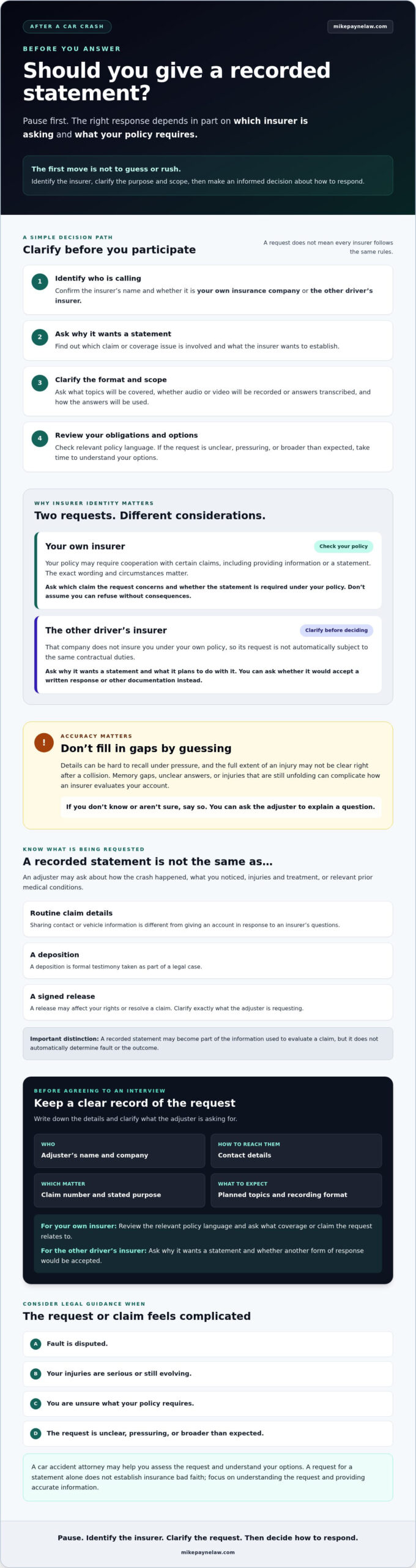
Short answer: pause, identify which insurer is asking, and understand the request before responding. The answer to “should I give a recorded statement to the insurance company” depends in part on whether the request comes from your own insurer or the other driver’s insurer, and on what your policy requires. Don’t assume every request has the same purpose or that you must answer immediately.
A recorded statement is an account of the crash given in response to an insurer’s questions while the conversation is recorded or documented for claim investigation. It may become part of the information used to evaluate the claim, but it does not automatically determine fault or the outcome.
It’s also different from routine claim details, such as sharing contact or vehicle information; a deposition, which is formal testimony taken as part of a legal case; and a signed release, which may affect your rights or resolve a claim. Before participating, clarify what the adjuster is requesting and how your answers will be recorded or used. For policyholders managing residential or commercial property claims alongside or separate from vehicle damage, you can read more about how public adjusting advocates help navigate insurer reviews.
What does an insurance recorded statement involve?
An adjuster may ask questions while audio or video is recorded, or your answers may be transcribed. Topics can include how the crash happened, what you noticed, your injuries and treatment, and relevant prior medical conditions. The format and purpose can vary by insurer and claim.
You may not know the full extent of an injury right after a collision, and details can be hard to recall under pressure. If you don’t know or aren’t sure, say so rather than guessing. You can ask the adjuster to explain a question or clarify whether the conversation is being recorded.
Insurance companies should handle claims fairly. The concept of insurance bad faith concerns unfair or dishonest conduct by an insurer, but a request for a statement alone doesn’t establish that kind of conduct. Focus on understanding the request and giving accurate information.
Why does the identity of the insurer matter?
Your own insurer: Your policy may require cooperation with certain claims, including providing information or a statement. Review the policy language and ask the adjuster which claim the request concerns, what topics it will cover, and whether the statement is required under your policy. Don’t assume you can refuse without consequences.
The other driver’s insurer: That company does not insure you under your own policy, so its request is not automatically subject to the same contractual duties. The circumstances still matter. Ask why it wants a statement and what it plans to do with it before deciding how to respond.
If the request feels unclear, pressuring, or broader than you expected, take time to understand your options. Attorney Michael D. Payne has over 25 years of experience, including prior work as an insurance defense lawyer, and can help assess a motor vehicle accident statement request without promising a particular result.
Your Own Insurer or the Other Driver’s Insurer: Why the Difference Matters
Before answering, find out whose claim the adjuster is investigating. The company may be contacting you as its policyholder, or it may represent the other driver. That distinction can affect what your policy requires and what choices you have. If you’re asking, “should I give a recorded statement to the insurance company,” start by confirming the insurer’s name and the purpose of the request.
Your own insurer
Your auto policy may include a duty to cooperate with certain claims. The exact wording and circumstances matter, so review your policy rather than assuming every request is required or optional. Ask whether the statement concerns coverage, fault, injuries, or another issue, and what topics the adjuster plans to cover.
The other driver’s insurer
This adjuster works for the company evaluating its insured’s claim. A request from that insurer is not automatically governed by the cooperation language in your own policy. You can ask questions and consider getting advice before responding. Ask whether the company would accept a written response or other documentation instead.
If your own insurance company requests a statement
Check the policy language and identify which coverage or claim the request relates to. For example, a request about your own coverage may raise different issues from questions about how the collision happened. Ask what the insurer needs to establish and whether it can explain the scope in writing.
Keep your communications accurate. If you don’t remember a detail, don’t guess. If your injuries or responsibility for the crash are disputed, consider getting legal advice before the interview. A recorded account may be transcribed for later reference. Veritext explains the process in its overview of recorded statement transcription.
If the other driver’s insurance company requests a statement
Ask who the adjuster represents, why the company wants your account, whether the call will be recorded, and what information it seeks. You can also ask whether it will consider written answers or existing documents instead. A request is not an instruction to speak immediately, especially if the questions or purpose are unclear.
California law and policy terms can affect the right response, so get advice about your circumstances rather than relying on a blanket rule. If you’re exploring legal support after a crash, learn more about motor vehicle accident representation.
Could a Recorded Statement Hurt Your Car Accident Claim?
A recorded statement can become part of an insurer’s claim evaluation, so unclear or incomplete answers may raise questions later. That doesn’t mean one statement automatically decides who was at fault or what a claim is worth. Its effect depends on the circumstances and the full evidence.
Timing and accuracy matter because an early account may not capture everything you remember or everything you later learn about your injuries. If you’re asking, “should I give a recorded statement to the insurance company,” consider whether you can answer the questions precisely and whether you understand what’s being asked. California’s Department of Insurance describes duties after an accident, including that an insurer may ask for a written or recorded statement.
Common pitfalls when answering an adjuster
It’s easy to feel pushed to give a definite answer. Don’t estimate speed, distance, or timing if you don’t remember precisely. Say what you recall and make clear when you’re uncertain. If a question assumes a detail you don’t agree with, correct the premise or ask the adjuster to rephrase it before you answer.
Injuries can be difficult to describe soon after a collision, before medical evaluation and treatment continue. Avoid overstating or minimizing symptoms, and don’t present an early impression as a final diagnosis. Be truthful and precise. Don’t guess, exaggerate, or conceal information.
Does a statement determine fault or compensation?
No single statement automatically decides fault or compensation. It is one item in a broader claim investigation, which may consider other accounts, records, and available evidence. A difference between an early answer and later information may prompt questions, but its significance depends on the facts. No one can reliably predict how a particular statement will affect liability, damages, or settlement value without assessing the whole claim.
Before answering, you can ask the adjuster to clarify a question, explain why it’s being asked, or give you time to check information you don’t know. If you later realize you misstated something, don’t try to quietly change your story. Ask how to correct the record and consider getting legal advice.
For broader context about pursuing an injury claim after a collision, review this guide to motor vehicle accident representation. If fault is disputed, your injuries are still developing, or a question feels confusing, a lawyer can help assess the request and your options without scripting your testimony or predicting an outcome.
What to Do Before You Answer an Insurance Adjuster
Don’t let a call catch you unprepared. If you’re weighing “should I give a recorded statement to the insurance company,” use this checklist to understand who’s asking, what they need, and whether you’re ready to respond. Preparing means organizing what you know, not rehearsing answers or changing your account.
- Identify the adjuster. Record their name, insurance company, phone number, email or other contact details, claim number, and stated reason for contacting you.
- Confirm whether the conversation will be recorded. Ask which insurer the adjuster represents and whether they plan to record, transcribe, or otherwise document your answers.
- Clarify the request. Ask what topics they intend to cover and whether they believe your participation is required. If your own insurer is calling, review your policy and ask which policy duty or claim the request relates to.
- Request time to review. You can ask for the request and its purpose in writing, then take time to review relevant policy language before deciding how to proceed.
- Organize what you know. Review available notes and documents, and make a factual timeline if helpful. Separate what you personally remember from what you learned later. Note medical visits and updates, but don’t draw conclusions beyond what you know.
Questions to ask before agreeing to be recorded
Be direct: “Which insurance company do you represent?” “Will this be recorded?” “What subjects do you plan to ask about?” “Is this required under my policy, and what provision applies?” These questions help you understand the request without committing to an interview on the spot. If an answer is unclear, ask for clarification or time to review it.
How to respond if you choose to participate
Listen to the full question, then answer only what was asked. If you don’t know or remember a detail, say so rather than filling the gap with a guess. If the question includes an assumption that doesn’t match your recollection, calmly correct it or ask the adjuster to restate it. Avoid speculation, sweeping medical conclusions, and claims about events you didn’t personally observe.
Keep your account truthful and precise. Preparation should help you find records and distinguish what you know from what you’re unsure about, not make your answers sound polished. If fault, coverage, or your injuries are disputed, legal advice may help you assess the request before responding.
If you have questions about a California motor vehicle claim or an adjuster’s request, you can contact the Law Offices of Michael D. Payne to discuss your situation.
When a California Car Accident Lawyer Can Help With an Insurance Statement
Legal advice may be useful if fault is disputed, your injuries are serious or still developing, you’re unsure what your policy requires, or an adjuster is pressuring you to respond before you understand the request. You don’t have to sort through every issue alone. A lawyer can help you understand what’s being asked and consider your options before you speak.
That guidance isn’t about scripting testimony or changing your account. It’s about helping you give truthful answers with a clear understanding of the request and any relevant policy obligations. Whether to participate depends on the facts, the policy language, and applicable California law.
What an attorney can review before a statement
Counsel can examine the adjuster’s request, relevant policy terms, and available claim information, such as correspondence or records you already have. This review can help clarify who is requesting the statement, what issue the insurer is investigating, and whether you should seek more information before responding. If you’re exploring your options, review the firm’s car accident legal services.
Attorney Michael D. Payne has over 25 years of experience and previously worked as an insurance defense lawyer. That background provides familiarity with insurer processes, but it doesn’t predict how an insurer will handle a specific claim or guarantee a particular result.
How to take the next step without added pressure
Gather the adjuster’s communications, claim number, and relevant policy documents before discussing your situation with a lawyer. You don’t need to have every record or answer ready. A conversation can help identify what information may matter and what questions you may want answered before deciding how to proceed.
The firm handles cases on a contingency fee basis, subject to its agreement with the client. The terms can vary by agreement, so ask for and review the written fee agreement to understand how it applies to your case. No fee arrangement guarantees a recovery.
If you’re still asking, “should I give a recorded statement to the insurance company,” and want to discuss your California motor vehicle claim, contact the Law Offices of Michael D. Payne. You can share the request and ask about your options without committing to representation.
Make an Informed Choice Before You Speak
If you’re still asking, “should I give a recorded statement to the insurance company,” first identify which insurer is asking and why. Your own policy may include cooperation duties, while a request from the other driver’s insurer raises different considerations. Clarify the request, review relevant policy language, and don’t guess about details or injuries you’re unsure of.
Advice can be especially helpful when fault is disputed, your injuries are serious or changing, or you feel pressured to respond. Attorney Michael D. Payne brings more than 25 years of legal experience and a former insurance defense background to understanding insurer processes. The firm handles cases on a contingency fee basis, subject to the written agreement. Ask the firm to explain its specific terms.
If you’d like to discuss your car accident claim and the statement request, contact Michael D. Payne. Get clarity on your options, then decide on your next step with greater confidence.
Frequently Asked Questions
Do I have to give the other driver’s insurance company a recorded statement?
Generally, California law doesn’t require you to give the other driver’s insurer a recorded statement. You’re not that insurer’s policyholder, so you typically don’t have the same contractual cooperation duty you may owe your own insurer. Still, ask what the adjuster wants and why. Before responding, consider whether the request relates to disputed fault, injuries, or another issue, and seek legal advice if you’re unsure how to proceed.
Can my own insurance company require a recorded statement after a car accident?
Your policy may require you to cooperate with your insurer, and that can include providing a statement for certain claims. The exact obligation depends on your policy language and the circumstances. Ask which coverage or claim the request concerns, what topics the adjuster plans to cover, and whether the request is required under your policy. Review the policy or get legal guidance before deciding how to respond.
What happens if I refuse to give an insurance company a recorded statement?
The consequences depend on which insurer is asking and what your policy requires. Refusing a request from your own insurer could jeopardize coverage for a claim if your policy requires cooperation. The other driver’s insurer generally can’t rely on a cooperation clause in your policy, but declining to speak may affect how it investigates your claim. Don’t assume refusal is always consequence-free. Clarify the request and consider advice first.
Should I give a recorded statement before seeing a doctor?
Prioritize getting medical care, and don’t make broad conclusions about your injuries before they’ve been evaluated. If an insurer asks for a statement before you see a doctor, explain that you haven’t had a medical assessment and avoid guessing about diagnosis, treatment, or recovery. Ask which insurer is calling and whether the request is required under your policy. Your obligations may depend on the policy and claim involved.
Can I correct a mistake in a recorded statement?
Contact the adjuster as soon as you notice a mistake, clearly identify the inaccurate answer, and provide the correction truthfully. Ask how the insurer will document the change, and keep a copy of your request and any response. Don’t assume the original recording will be erased or replaced. If the error concerns an important detail, disputed fault, or your injuries, consider speaking with a lawyer before making a correction.
Can an insurance adjuster ask about my previous injuries or medical history?
An adjuster may ask about prior injuries or medical conditions when investigating an injury claim. Answer truthfully, but don’t guess or offer broad conclusions beyond what you know. If you don’t understand why a question is being asked or how much information is requested, ask the adjuster to clarify its purpose and scope. You can review the request with a lawyer, particularly if your medical history or current injuries are disputed.
Should I speak to a lawyer before giving a recorded statement?
Consider speaking with a lawyer first if fault is disputed, your injuries are serious or evolving, policy duties are unclear, or you feel pressured to answer. If you’re wondering, “should I give a recorded statement to the insurance company,” an attorney can review the request and help explain your options, not script your testimony. Attorney Michael D. Payne has over 25 years of experience and a former insurance defense background. The firm represents accident clients in West Covina, Pomona, Ontario, Covina, Chino, Fontana, San Bernardino, Baldwin Park, and Azusa.