

Being uninsured doesn’t automatically erase every injury claim. California’s Prop 213 generally bars an uninsured driver from recovering non-economic damages, such as pain and suffering, but economic losses like medical bills and lost income may still be recoverable. The driver’s share of fault also matters: California’s comparative negligence system can reduce compensation according to the injured person’s percentage of responsibility.
If you’re hurt in a crash, it’s understandable to worry that having no insurance means you have no options. The rules are more specific than that. Understanding how Prop 213 treats your role in the crash and the type of losses you’re claiming can help clarify what may be available.
This article explains how Prop 213 affects economic and non-economic damages, what it means for passengers, and which exceptions may matter, including cases involving employer-owned vehicles or vehicle defects. It also shows how the law’s limits interact with California’s fault-based system, so you can better understand what a claim may involve after an accident.
Key Takeaways
- Uninsured drivers may still pursue economic losses, while compensation for pain and suffering can be restricted.
- Passengers generally aren’t subject to the same limits as uninsured drivers, and a convicted drunk driver may affect whether an exception applies.
- Employer-owned vehicles and vehicle defects can raise important exceptions that change which damages may be pursued.
- California’s comparative fault rule can reduce an award based on the injured person’s share of responsibility, separately from limits on damage types.
- Understanding insurance status, the vehicle’s use, the cause of the crash, and fault can help clarify the options in an injury claim.
Limits on non-economic damages
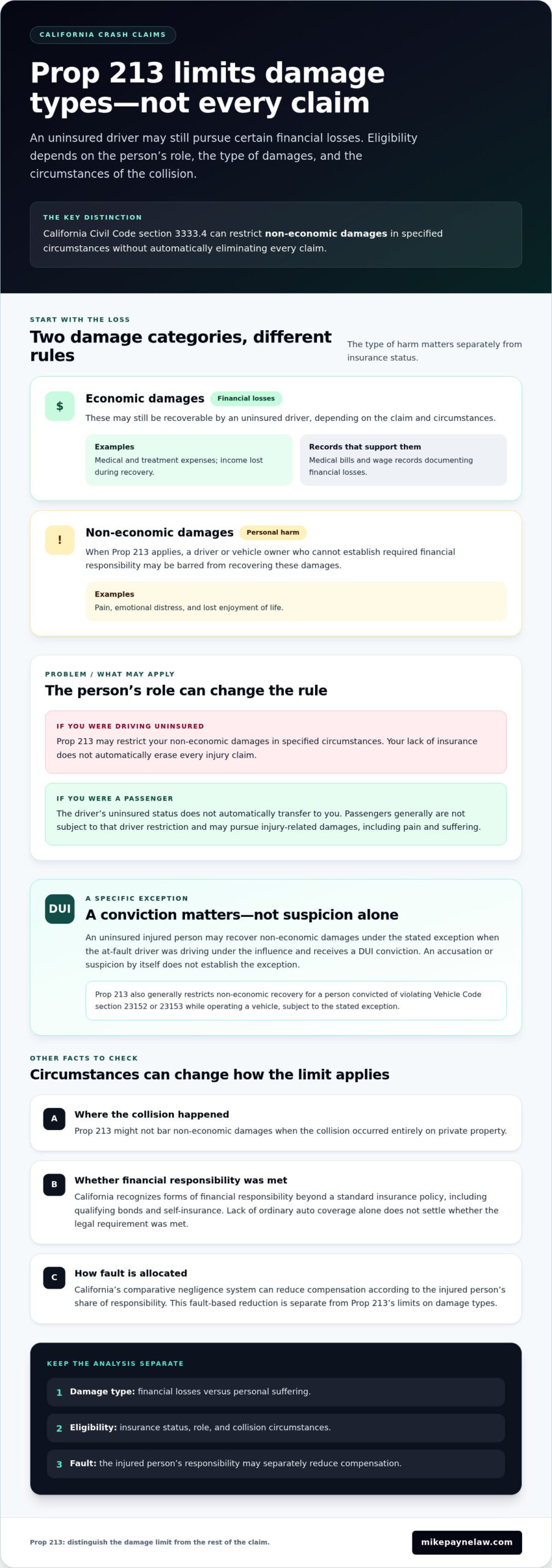
California Proposition 213, also known as the Personal Responsibility Act of 1996, was passed by California voters in 1996, according to the California Secretary of State. The law limits certain people’s ability to recover non-economic damages after a motor vehicle collision. These damages address personal harm, including pain, emotional distress, and lost enjoyment of life. They differ from economic damages, which cover financial losses such as treatment expenses and lost income.
California Civil Code section 3333.4 sets out the restriction. In specified circumstances, a driver or vehicle owner who cannot establish financial responsibility required by California law cannot recover non-economic damages arising from a motor vehicle collision. The rule focuses on the claimant’s eligibility for particular damages. It doesn’t automatically eliminate every claim. Insurance status, the person’s role, and the collision circumstances all matter under Prop 213.
For example, an uninsured driver injured in a collision may pursue documented medical expenses and income lost during recovery. Pain and suffering are treated differently when Prop 213 applies. That distinction matters when assessing an injury claim: bills and wage records support economic losses, while medical evidence and personal testimony can describe the injury’s effect. The same crash can involve potentially recoverable financial losses and restricted non-economic damages.
Driving under the influence creates a separate statutory restriction. A person convicted of violating Vehicle Code section 23152 or 23153 while operating a vehicle generally cannot recover non-economic losses under the initiative, subject to the stated exception. An uninsured injured person may recover non-economic damages under that exception when the at-fault driver was driving under the influence and receives a DUI conviction. A suspicion or allegation alone is not a conviction. The parties’ conduct and the case outcome matter.
What are the deadlines for filing a California car accident claim affected by Prop 213? Prop 213 concerns recoverable damages, not a separate filing deadline. The applicable deadline depends on the claim and defendant, so identifying those details early matters.
Other facts can change how the restriction applies. For instance, Proposition 213 might not bar non-economic damages when a collision occurred entirely on private property. California financial-responsibility rules also recognize forms beyond a standard insurance policy, including qualifying bonds and self-insurance. A driver’s lack of ordinary auto coverage does not, by itself, resolve whether the legal requirement was met. The relevant coverage, vehicle, and circumstances must be considered together.
Keep the distinction clear: economic damages address financial harm, while non-economic damages address personal suffering. California Civil Code section 3333.4 can restrict the second category without eliminating the first. That separation is central to understanding what an uninsured driver may pursue, and why Prop 213 analysis must distinguish damage type from insurance status.
Does Prop 213 Apply to Passengers of an Uninsured Driver?
A passenger injured in a crash involving an uninsured driver isn’t subject to the driver’s non-economic damages restriction under Prop 213. The passenger may pursue compensation for injuries and pain and suffering. That distinction matters because the driver and passenger have separate claims, even when they were riding in the same vehicle. The driver’s lack of insurance doesn’t automatically transfer to the passenger or decide the passenger’s eligibility.
For example, if an uninsured driver loses control and injures a passenger, the passenger can pursue documented treatment expenses and non-economic losses. Records can help connect the collision to the injuries: keep medical documents, bills, and notes about how symptoms affect daily activities. The passenger’s evidence supports their own claim. Prop 213’s treatment of the driver doesn’t remove the passenger’s ability to pursue damages.
Can a driver recover damages if the other driver was uninsured? Yes. The other driver’s lack of insurance alone does not bar an injured person from pursuing a claim. The injured person’s own insurance status, the other driver’s responsibility, and available coverage are separate issues.
A specific exception may also matter when the injured person was driving uninsured. Under California Civil Code section 3333.4, an uninsured victim may recover non-economic damages when the at-fault driver was driving under the influence and receives a DUI conviction. The conviction is a key condition. An accusation or suspicion by itself doesn’t establish the exception. Prop 213 also restricts non-economic recovery for a person convicted of violating Vehicle Code section 23152 or 23153 while operating a vehicle, subject to the stated exception.
Keep the passenger rule distinct from the DUI exception. A passenger isn’t subject to the uninsured driver restriction described here. An uninsured person who was driving may need to establish that the at-fault driver was under the influence and received a DUI conviction. In either case, identify the person’s role, the available evidence, and the damages being claimed. That separates the passenger’s position from a driver’s argument under Prop 213.
Take care when communicating with insurers. Your own insurer usually requires cooperation under the policy, but the at-fault driver’s insurer has no right to demand a recorded statement from you. Preserve relevant messages and documents, and be accurate about what you remember. If you do not know an answer, do not guess. A recorded account can become important evidence about the collision, your role, and your injuries.
For an injury claim involving an uninsured driver, car accident representation can help examine the evidence, insurance coverage, and any DUI conviction. A careful review can clarify how the passenger rule or Prop 213 exception relates to the claim.
Can Uninsured Drivers Receive any Compensation?
Yes. An uninsured driver may still seek economic damages after an accident, including medical expenses and lost income. The restriction on non-economic losses does not automatically erase every claim. The injured person’s coverage, the other driver’s responsibility, and the circumstances of the crash all affect what compensation may be available.
The estimated financial effect on insurers also helps explain the law’s purpose. The Rand Institute for Civil Justice estimated that Proposition 213 could reduce insurers’ personal injury compensation costs by 10%. That estimate concerns insurer costs overall, not a guaranteed change in any individual claim. For an injured driver, the practical question remains which losses can be claimed and what evidence supports them.
Driving a borrowed vehicle can change the insurance analysis. A driver may establish financial responsibility through their own auto policy, even when the accident happened in another car. For example, a California motorist driving her father’s vehicle was treated as a permissive user under his policy. The vehicle owner’s policy, permission to drive, and the driver’s own coverage can all matter.
Policy wording deserves close attention. The California Supreme Court described Proposition 213 as a poorly drafted, ambiguous statute in Hodges, 21 Cal.4th at 119. A policy may also include exclusions or terms about regular use of another vehicle. Courts have distinguished principal use from casual or incidental use, so the relationship between the driver, vehicle, and policy language matters. An attorney reviewing the policy can identify which provisions may affect the claim.
Be deliberate when speaking with insurers. Your own insurer usually requires cooperation under the policy, but the at-fault driver’s insurer has no right to demand a recorded statement from you. Keep crash details, treatment information, and wage-loss records accurate and consistent. Do not guess about speed, distance, or symptoms when answering questions.
How does Proposition 213 compare with California’s minimum auto insurance requirements? California’s financial-responsibility rules determine how a driver can establish required responsibility; Proposition 213 limits certain damages after a collision. Vehicle Code section 16021 recognizes options beyond insurance, including a bond or qualifying self-insurance.
How does Prop 213 apply to drivers with suspended or revoked licenses? A suspended or revoked license and financial responsibility are separate issues. The license status alone does not answer whether the law restricts non-economic damages; coverage and the circumstances of the collision remain central.
Driving without insurance can also bring separate penalties. California uninsured drivers may face a fine between $100 and $200 for a first offense, or between $200 and $500 for a later offense. A collision may also lead to a one-year license loss. After license reinstatement, an uninsured driver may need an insurer to file an SR-22 for the following three years. These consequences are distinct from the damages available in an injury claim.
Exceptions to Proposition 213
Prop 213’s pain-and-suffering restriction does not apply identically to every injured person or every claim. A passenger in an uninsured vehicle, for example, isn’t treated like the uninsured driver and may pursue non-economic damages. An injured person under 18 years old also falls outside the described restriction, including a minor riding in an uninsured vehicle. The person’s role, age, and connection to the vehicle can change the analysis.
Employment can create another important distinction. An employee injured while driving an employer’s uninsured vehicle need not establish financial responsibility under Proposition 213, as addressed in Hodges v. Superior Court, 71 Cal.App.4th 982. When an employer-owned vehicle is insured, an injured employee may also pursue pain-and-suffering damages. The relevant facts include who owned the vehicle, whether the employee was working, and what coverage applied.
Some claims focus on what caused the injury, not only the driver’s insurance. The California Supreme Court held that Proposition 213 does not apply to product-liability actions. If a vehicle defect caused an injury, an injured person may seek non-economic damages from a responsible vehicle or parts manufacturer, even if uninsured. That is different from a negligence claim alleging that another driver caused the crash.
A collision that occurs entirely on private property raises a separate question: does the statute apply? The location and circumstances matter. A crash on private land may require a different analysis from one on a public road, particularly when the claim concerns vehicle use or operation.
What steps can an injured person take to challenge a Prop 213 denial of damages? Identify the specific exception, then gather evidence supporting it, such as passenger status, age, employment records, vehicle ownership, insurance documents, or proof of a defect. Ask the insurer to explain the legal and factual basis for its denial, and present the supporting evidence through the claim or court process.
The person claiming an exception must prove it applies. Build the record around the issue that could change the rule: employment records for an employer-owned vehicle, passenger evidence for a rider, or inspection and repair evidence for a defect claim. For a private-property crash, preserve photographs, location details, and witness accounts showing where the collision occurred. Simply asserting an exception does not establish eligibility.
Other claims may remain available even when an injured driver cannot recover pain and suffering. Surviving family members retain their own wrongful-death claim for losing a loved one in a crash. In Nakamura v. Superior Court, 83 Cal.App.4th 825, the California Court of Appeal held that Proposition 213 does not prohibit a plaintiff from seeking punitive damages. The type of claim and the evidence supporting it remain central.
How Prop 213 interacts with California’s fault-based system
California uses comparative negligence to assign responsibility after a motor vehicle accident. An injured person’s compensation is reduced by their share of fault. Prop 213 adds a separate question: which types of damages an uninsured driver may recover. Fault and insurance status can both affect a claim, but they do different work.
Start by separating the two issues. Comparative negligence measures each person’s role in causing the crash. The damages restriction concerns whether an uninsured driver can recover non-economic losses, such as pain and suffering. An insurer cannot treat an uninsured driver’s share of fault as the sole reason to reject every category of damages. Economic and non-economic losses require separate analysis.
For example, an uninsured driver assigned 60% fault may recover 40% of an eligible $50,000 economic-damages award, or $20,000. The percentage reflects comparative responsibility, not an additional penalty for lacking insurance. If the driver is barred from non-economic recovery under the statute, that restriction remains separate. The key takeaway: fault reduces eligible damages; insurance status can limit which damage categories are eligible.
The other driver’s conduct matters, too. If the uninsured driver was not fully responsible, California’s comparative negligence system still accounts for the other driver’s share. Vehicle damage, witness accounts, photographs, and collision details can help establish how responsibility should be divided. A disputed fault assessment can affect economic damages even when the eligible damage categories are clear.
Coverage and financial responsibility also need careful review. A driver using a borrowed vehicle, for example, may have coverage through a personal policy or qualify under the vehicle owner’s policy. That evidence could affect whether the statutory restriction applies. Do not assume that the word “uninsured” on an initial claim summary resolves the legal issue. The policy, permission to use the vehicle, and circumstances of the accident may all matter.
Keep the analysis in two stages: identify the damage categories the injured person may pursue, then assess how comparative fault affects recovery. An insurer’s fault percentage does not answer whether an exception applies. Likewise, an exception to the damages restriction does not erase the injured person’s share of responsibility. Both questions can shape the final claim.
A lawyer reviewing a motor vehicle claim can compare the fault evidence with the insurance and damages issues. If an insurer assigns responsibility or limits recovery, organize the crash evidence and policy documents before responding. For help evaluating a California motor vehicle accident claim, take the next step with a focused review of those issues.
Law Offices of Michael D. Payne: Car Accident Representation
Law Offices of Michael D. Payne represents people injured in car accidents, including claims complicated by Prop 213. When an insurer disputes fault, questions whether financial responsibility was established, or limits non-economic damages, the firm can assess how those issues affect the claim. That includes reviewing relevant insurance documents, crash evidence, and records supporting claimed losses.
Consider seeking legal guidance when the insurer’s position doesn’t account for an exception, treats fault as the only issue, or overlooks evidence of your injuries. A clear review can help you understand the arguments and documentation relevant to your case. For support with an injury claim, contact Law Offices of Michael D. Payne.
Take the Next Step With a Clear Claim Strategy
After a crash, the details you preserve can shape how the insurer evaluates responsibility, coverage, and your losses. Keep relevant policy documents, medical records, wage information, and communications together. Write down what you remember about the collision while those details are fresh. That organized record can help clarify how Prop 213 applies and where an insurer’s position may need a closer look.
Law Offices of Michael D. Payne handles car accident representation, as well as slip and fall and motorcycle accident matters. If an insurance decision leaves you unsure about your next move, a focused legal review can help you understand the issues and prepare a response grounded in the available evidence.
Contact Law Offices of Michael D. Payne to discuss your injury claim. You deserve a clear path forward, and taking the next step can help you move toward it with greater confidence.
Frequently Asked Questions
What Is Prop 213?
Prop 213 is California’s Personal Responsibility Act of 1996, a state initiative affecting certain damages after motor vehicle accidents. Its rules focus on whether a person can recover non-economic losses, with financial responsibility, driver status, and the circumstances of the crash shaping the analysis. For example, a passenger’s position differs from that of an uninsured vehicle operator. The statute’s application depends on the person and claim involved.
Who is Affected by Proposition 213?
California drivers and vehicle owners who cannot establish legally required financial responsibility are among those affected. The law also addresses drivers convicted of specified DUI offenses and people whose injuries were proximately caused by a felony or immediate flight from one, when duly convicted. Passengers, injured minors, employees driving employer-owned vehicles, and people pursuing product-liability claims can face different rules. First identify the injured person’s role and claim type.
Does Prop 213 block me from getting money if I didn’t have insurance?
No. Lacking insurance does not automatically eliminate every possible recovery. A person may still pursue eligible economic losses, and coverage under another policy can affect the analysis. For instance, someone injured while driving a borrowed car should examine both their own policy and the owner’s policy. Keep treatment bills, wage records, and policy documents together. These records help distinguish financial losses from damages subject to statutory restrictions.
Was Prop 213 Ever Challenged in Court?
Yes. In Yoshioka v. Los Angeles Superior Court, a constitutional challenge to the initiative was considered in 1997, and the court upheld the challenge’s contested provisions. The California Second District Court of Appeals also upheld the limits on pain-and-suffering damages for uninsured motorists, drunk drivers, and fleeing felons. These decisions show that courts have reviewed the law’s reach, while individual claims still turn on their specific facts.
What Is Prop 213 and Should You Talk to the Insurance Company After a Crash?
It’s a California law that can restrict non-economic damages in specified motor vehicle claims. After a crash, communication duties differ by insurer: your own policy usually requires cooperation, while the other driver’s insurer has no right to demand your recorded statement. Keep messages and letters, and avoid guessing about facts you don’t remember. If you’re asked for a recorded account, understand who is requesting it and why.
What is California Proposition 213 (The Personal Responsibility Act of 1996)?
It’s a voter-approved California initiative known as the Personal Responsibility Act of 1996. Its motor vehicle provisions address recovery of non-economic losses in specified situations, while a separate provision, California Civil Code section 3333.3, concerns injuries proximately caused by a person’s felony or immediate flight from it, when that person is duly convicted. The precise provision matters because the conduct and claim involved determine which rule applies.
What is the proper method to adjudicate Prop 213 issues?
Resolve the specific legal and factual issues without treating one damages category as the entire case. California Code of Civil Procedure section 437c, subdivision (f)(1), does not permit summary adjudication of a single item of compensatory damages when that ruling wouldn’t dispose of an entire cause of action. The evidence should address the person’s role, financial responsibility, applicable exception, and claimed losses. Those issues frame how the case proceeds.
What is California Proposition 213?
California Proposition 213 is the state’s Personal Responsibility Act of 1996, approved by voters in 1996. It limits recovery of non-economic losses in specified motor vehicle situations, rather than imposing one blanket rule on every person involved in a crash. To understand its effect, separate the injured person’s role, insurance or other financial responsibility, type of damages, and any applicable exception. Those details guide the claim analysis.