

The insurance company wants you to believe that if they can’t see your injury on an X-ray, it simply doesn’t exist. They’ll ignore the sleepless nights, the missed family milestones, and the constant hum of anxiety that has become your new normal. You deserve more than a cold calculation from a computer program designed to save a corporation money. By looking at pain and suffering settlement examples, you can begin to see that your invisible injuries have a very real, compensable value.
I’ve spent over 25 years as a shield for the injured, and I know that your suffering deserves both validation and fair compensation. This guide shows you exactly how California courts value non-economic damages in 2026. You’ll gain a realistic estimate of your claim’s value and a clear strategy to dismantle insurance “lowball” offers. We’ll walk through how current laws, including the 2026 MICRA caps and the latest rules on survival actions, affect your path to justice and your recovery.
Key Takeaways
- Understand how California law classifies physical pain and emotional distress as non-economic damages that are just as compensable as your medical bills.
- Review real-world pain and suffering settlement examples to see how different injury severities translate into financial recovery in 2026.
- Learn why California courts reject rigid “calculators” in favor of jury instructions that rely on common sense to determine a fair settlement.
- Discover the specific documentation strategies, like the “Pain Journal,” that provide the evidence needed to defeat insurance company lowball offers.
- See how Michael D. Payne’s experience as a former insurance defense attorney provides an “inside” advantage in maximizing the value of your claim.
What is Pain and Suffering in a California Injury Claim?
You are more than a collection of medical receipts and repair estimates. When an accident upends your life, the damage isn’t just financial; it’s deeply personal. In the California legal system, these human costs are known as non-economic damages. While economic damages cover the bills you can scan and email to an adjuster, pain and suffering covers the life you’ve lost since the moment of impact. The insurance company wants to reduce your existence to a line item on a spreadsheet. I am here to make sure they see the person behind the file.
Understanding the legal definition of pain and suffering is the first step in reclaiming your life. Under California law, this category is broad and designed to address the totality of your experience. Unlike medical malpractice claims, which have specific caps in 2026, most personal injury cases in California have no set limit on non-economic damages. This means your compensation is limited only by the strength of the evidence we present. When reviewing pain and suffering settlement examples, it becomes clear that these awards are meant to compensate you for the human cost of an accident that never should have happened.
Physical Pain and Discomfort
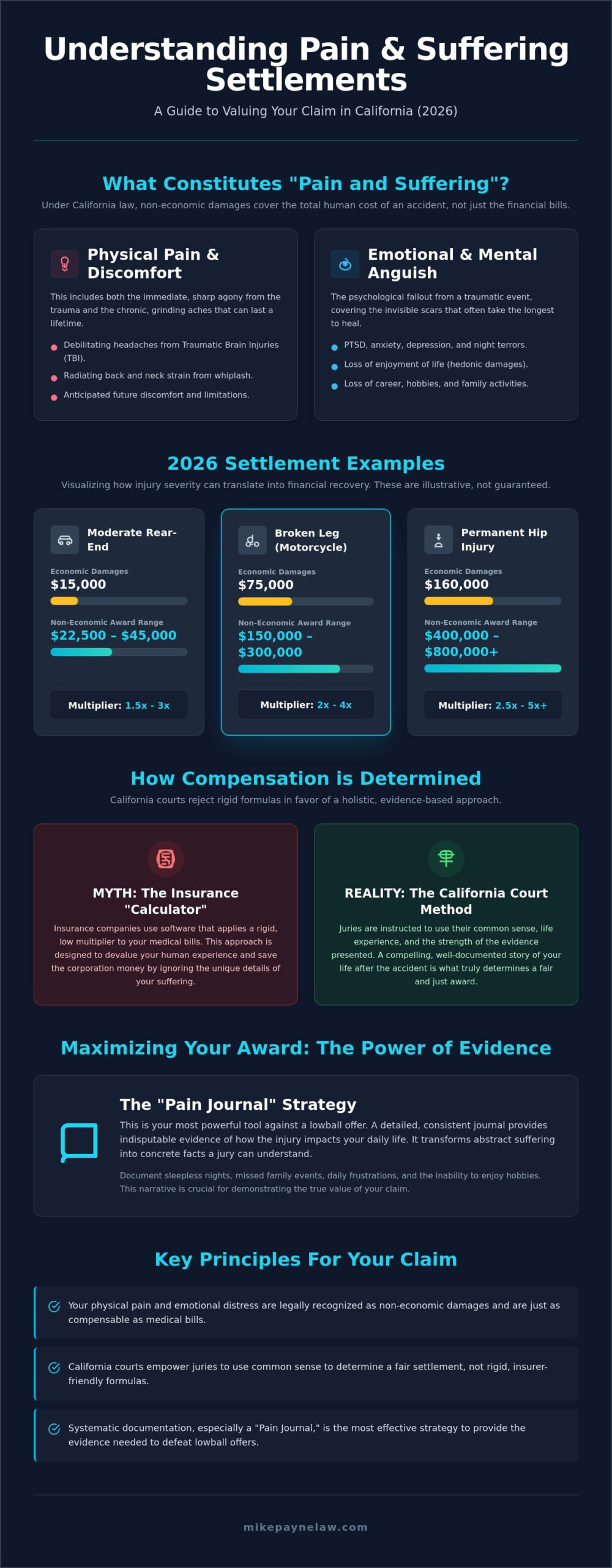
Physical suffering is the most direct form of non-economic damage. It encompasses the sharp agony felt during the initial trauma and the dull, grinding ache of chronic conditions that follow. Many of my clients suffer from “invisible” injuries that don’t always scream for attention on a standard X-ray. Traumatic brain injuries (TBI) can cause persistent, debilitating headaches, while the whiplash from rear-end collisions can lead to years of radiating back and neck strain. Physical suffering includes both the immediate agony of the impact and the anticipated discomfort you’ll face every morning for the rest of your life.
Emotional Distress and Mental Anguish
The scars you can’t see often take the longest to heal. Emotional distress covers the psychological fallout of a traumatic event, including PTSD, night terrors, and the heavy weight of depression. We also fight for “loss of enjoyment of life,” also known as hedonic damages. This compensates you for the inability to participate in the activities that once gave your life meaning, like playing with your children or pursuing a hobby. For those injured at construction worksites, the trauma often includes the devastating realization that a career they spent decades building has been cut short. This mental anguish is a real loss, and California law demands that it be treated with the same weight as a broken bone.
Pain and Suffering Settlement Examples: Real-World Scenarios
Every injury case in West Covina or Pomona is a unique narrative of resilience. While insurance companies try to standardize your trauma using software, the reality of your recovery cannot be boiled down to a single digit. Looking at pain and suffering settlement examples helps provide a baseline, but your specific circumstances, the clarity of the defendant’s liability, and the skill of your advocate will ultimately define your result. I have seen how a well-documented claim can turn a lowball offer into a settlement that truly reflects the disruption of your life.
| Injury Scenario | Economic Damages (Medical/Wages) | Non-Economic Award Range |
|---|---|---|
| Moderate Rear-End (I-10) | $15,000 | $22,500 – $45,000 |
| Broken Leg (Motorcycle) | $75,000 | $150,000 – $300,000 |
| Permanent Hip Injury (Slip & Fall) | $160,000 | $400,000 – $800,000+ |
Consider a severe motorcycle accident in San Bernardino. A rider may face $75,000 in surgeries and physical therapy. However, the “multiplier” applied for their pain and suffering often ranges from 2 to 4 times that amount because of the grueling nature of bone-healing and the loss of mobility. Juries are directed by California Civil Jury Instructions (CACI) No. 3905A to use their common sense to reach a reasonable amount, rather than following a strict mathematical formula. If you are unsure where your case falls, you can contact my office for a personalized evaluation.
Soft Tissue Injury Settlement Example
Soft tissue injuries, like whiplash from an I-10 collision, are often dismissed by adjusters as “minor.” We prove them wrong by documenting the daily limitations. If you can’t lift your toddler or manage household chores without radiating pain, that is a compensable loss. Consistent physical therapy records serve as the backbone of these pain and suffering settlement examples, proving that your “invisible” pain required months of professional intervention and lifestyle adjustments.
Catastrophic Injury and Long-Term Disability
In cases involving fatal trucking accidents or permanent paralysis, the non-economic damages frequently dwarf the medical bills. We utilize life care planners to project the next thirty or forty years of suffering, ensuring the settlement covers a lifetime of mental anguish and lost independence. These high-stakes cases require an aggressive approach because the insurance company will fight hardest when the potential payout is highest.
How California Courts Calculate Pain and Suffering
California law doesn’t provide a rigid math problem to solve for your trauma. Unlike the clear cut structures used for medical bills or lost wages, there is no fixed “calculator” required by the state. Instead, the legal system relies on the human element. When a case goes to trial, jurors are guided by CACI No. 3905A. This specific instruction tells them to use their common sense to determine a fair and reasonable amount. It’s a subjective process that demands a compelling narrative of your struggle. While Personal injury settlement statistics show broad averages, your specific result depends on how effectively your story is told to those jurors.
By examining pain and suffering settlement examples, we see two primary methods used during negotiations: the Multiplier Method and the Per Diem Method. Insurance companies prefer these because they provide a veneer of objectivity to an emotional experience. However, these methods are often just starting points for a much more aggressive negotiation. In 2026, the average personal injury settlement in California ranges between $21,000 and $26,000, but these figures are often skewed by minor claims. For serious injuries, the calculation must be far more rigorous to ensure you aren’t left footing the bill for a lifetime of care.
The Multiplier Method: The Adjuster’s Shortcut
Insurance adjusters often rely on software like Colossus to devalue your experience. They assign a multiplier, usually between 1.5 and 5, to your total economic damages. Factors like clear liability or egregious conduct by the defendant push this number toward the higher end of the scale. My background as a former insurance defense lawyer is your greatest asset here. I’ve seen how they manipulate these formulas to save the company money. I know exactly which levers to pull to “break” their software’s lowball estimate and force a valuation that reflects the true depth of your suffering. We don’t just accept the multiplier; we challenge the assumptions behind it.
The Per Diem Method: A Daily Accounting of Pain
The Per Diem method assigns a specific dollar value to every day you live with the consequences of an accident. This timeline starts from the date of the injury and continues until you reach “Maximum Medical Improvement” (MMI). In many pain and suffering settlement examples, your actual daily wage serves as a baseline for this value. This approach is exceptionally effective for long-term recoveries because it highlights the relentless, day-to-day grind of living with chronic pain. It transforms an abstract legal concept into a concrete, daily accounting of what has been taken from you, making it much harder for a jury to ignore.
Proving Your Pain: Evidence That Maximizes Your Award
A successful claim isn’t built on vague complaints; it is built on undeniable evidence. While looking at pain and suffering settlement examples gives you a target, hitting that target requires a mountain of proof. Insurance adjusters are trained to look for any reason to deny your experience. If you have gaps in your medical treatment, they’ll claim you weren’t actually in pain. If your medical records only list “back pain” without describing how it prevents you from sleeping, they’ll offer the bare minimum. We don’t give them that opportunity. We document your struggle with clinical precision and human emotion.
One of the most powerful tools in our arsenal is testimony from “Before and After” witnesses. These are the friends, family members, and coworkers who have seen the change in you firsthand. They can testify that before the accident, you were the life of every gathering, but now you’re withdrawn and struggling with chronic fatigue. This human perspective often carries more weight with a jury than a hundred pages of medical jargon. It validates that your suffering is real and that it has fundamentally altered your relationships and your personality.
The Power of the Pain Journal
A “Pain Journal” is your daily record of life after the accident. Defense counsel will search for any inconsistency to use against you, so your entries must be honest and specific. Instead of simply writing “my back hurts,” focus on functional limitations. Explain how the pain stopped you from performing a specific task. If you want to see how these details affect your claim, request a case review today to discuss your specific injuries. Use these three prompts to guide your daily entries:
- What specific activity did I try to do today that was limited or prevented by my pain?
- On a scale of 1 to 10, how much did this pain interfere with my ability to concentrate or interact with my family?
- Did I experience any emotional symptoms today, such as anxiety about my recovery or frustration over my physical state?
Expert Testimony and Medical Records
Medical records are the foundation, but they are rarely enough on their own. We often bring in neurologists or psychologists to explain the science behind your subjective pain. If your injuries prevent you from returning to your career in Ontario or Fontana, a vocational expert can testify to the long-term financial impact of your physical limitations. Michael D. Payne uses his over 25 years of trial experience to weave this expert testimony into a narrative that a jury can understand. We don’t just show them the injury; we show them the lifelong consequences. This aggressive approach ensures that your settlement reflects the true depth of your loss, just like the results seen in the most successful pain and suffering settlement examples.
Why You Need a Trial-Ready Advocate in West Covina
Your recovery is not a transaction. Many high-volume law firms operate as “settlement mills,” pushing clients to accept the first offer just to keep their case numbers moving. This approach leaves money on the table and leaves you without the resources you need for long-term healing. You deserve an advocate who treats your case with the urgency it demands. I don’t just settle cases; I prepare every file as if it is headed for a courtroom. This readiness is the only way to force an insurance company to pay what you are truly owed.
My perspective is unique because I spent years as an insurance defense attorney. I have seen the “inside” of their strategy rooms. I know exactly how adjusters look at pain and suffering settlement examples to find ways to devalue your claim. This experience allows me to anticipate their tricks and strike back before they can lowball you. When you hire my firm, you aren’t just getting a lawyer; you are getting a shield against corporate greed. We work on a contingency fee basis. You pay nothing unless we recover money for your suffering.
Aggressive Representation for Southern California
We provide a boots-on-the-ground approach for the Inland Empire and San Gabriel Valley. Whether your accident happened in West Covina, Ontario, or San Bernardino, we understand the local courts and the specific needs of our community. Insurance companies keep track of which lawyers actually go to trial. If they know your attorney is afraid of the courtroom, their offers will stay low. Because we are willing to litigate, we often secure settlements that far exceed the initial estimates. You will have direct access to me throughout your case, ensuring your voice is never lost in a sea of case managers.
Get a Free Case Evaluation Today
Starting your path to justice shouldn’t be a financial burden. We offer a clear, no-risk process to evaluate the strength of your claim. To make our first meeting as productive as possible, please bring any accident reports, photos from the scene, and your current medical notes. We will review the latest pain and suffering settlement examples relevant to your specific injuries and build a strategy to fight back. Don’t let a corporate adjuster decide what your life is worth. Contact the Law Offices of Michael D. Payne for a fierce advocate who is personally invested in your victory.
Take Control of Your Recovery
Your trauma is not a spreadsheet error. It’s a fundamental change in your quality of life that requires a relentless advocate to correct. We’ve explored how pain and suffering settlement examples serve as a benchmark for what you can recover in California. By using specific evidence like functional limitations and expert testimony, you can move past the lowball offers and toward a result that truly honors your struggle. You now have the strategy to ensure your invisible injuries are seen and valued by the court.
Michael D. Payne brings over 25 years of personal injury experience to your corner. As a former insurance defense attorney, he knows exactly how the other side tries to devalue your pain. He uses that inside knowledge to serve as your shield and your primary protector. You pay nothing unless we win your case. Don’t wait for an insurance adjuster to offer a fair price; they aren’t on your side. Fight for the compensation you deserve; schedule your FREE consultation with Michael D. Payne today. You have the right to be whole again, and we are ready to help you get there.
Frequently Asked Questions
Is there a calculator for pain and suffering settlements in California?
California law does not provide a formal mathematical formula or an official calculator for these damages. Juries are instead instructed to use their judgment and common sense to reach a fair amount. While insurance adjusters often use the multiplier method as a starting point, we focus on the specific human impact of your injury to push for a valuation that reflects your actual experience.
How much is the average pain and suffering settlement for a car accident?
The estimated average for personal injury settlements in California ranges between $21,000 and $26,000 in 2026. This figure is a broad average and can be misleading because it includes many minor claims. Serious injuries involving surgery or long-term disability typically result in much higher awards when looking at pain and suffering settlement examples from similar cases in the Inland Empire.
Can I claim pain and suffering if I was partially at fault for the accident?
Yes, you can still recover damages under California’s pure comparative negligence rule. Your total compensation is simply reduced by your percentage of fault. If a jury determines you were 20% responsible for the incident, you are still entitled to recover 80% of your total damages. We fight to minimize the fault attributed to you to maximize your final recovery.
What is the statute of limitations for filing an injury claim in California?
You generally have two years from the date of the injury to file a personal injury lawsuit under California Code of Civil Procedure section 335.1. This deadline is absolute. However, if your claim involves a government entity, such as a city bus or a poorly maintained public road, you must file a formal administrative claim within only six months of the accident.
Do I have to pay taxes on my pain and suffering settlement?
Most personal injury settlements for physical injuries or physical sickness are not taxable under federal or state law. This includes the portion of the settlement designated for pain and suffering. However, if your settlement is purely for emotional distress without any underlying physical injury, that portion may be considered taxable income. You should always consult with a tax professional regarding your specific award.
Additionally, for those concerned about how medical debt might lead to property encumbrances during a lengthy legal battle, you can learn more about Fridman Legal and their guide on how liens on a home function.
How do I prove emotional distress without physical injuries?
Proving emotional distress without a physical injury is challenging but entirely possible under California law. We rely on intensive documentation, including records from mental health professionals, testimony from expert witnesses, and detailed accounts from friends or family. This evidence must demonstrate how the trauma has caused significant interference with your daily life, sleep patterns, and ability to function in social or professional settings.
What happens if the insurance company denies my pain and suffering claim?
Insurance companies often deny the non-economic portion of a claim as a tactic to force a quick, low settlement. If an adjuster refuses to acknowledge your suffering, we stop negotiating and move toward litigation. Filing a lawsuit signals that we are prepared to take the case to a jury. This aggressive stance often forces the insurer to reconsider their position and offer a fair settlement.
Does hiring a lawyer really increase the pain and suffering award?
Statistics consistently show that injury victims represented by an attorney receive significantly higher settlements than those who navigate the process alone. Services such as Car Crash Money Atlanta emphasize the importance of matching victims with the right legal expertise to ensure no part of their claim is overlooked. A lawyer understands how to counter defense tactics and present pain and suffering settlement examples that justify a higher demand. We know how to build a strategic narrative that forces the insurance company to pay for the full scope of your trauma.