

The first total loss offer an insurance adjuster hands you is almost never fair; it is a calculated payout designed to protect corporate profits. When a collision shatters your routine and leaves you wondering, “My car was totaled, now what?” California drivers are thrown into an immediate, high-stakes battle. It is completely overwhelming to manage painful crash injuries and confusing 10-day DMV salvage rules while staring at an automated valuation report that threatens to leave you underwater on your auto loan.
You do not have to accept an adjuster’s undervaluation as the final word. In this guide, you will discover the exact legal, financial, and negotiation steps to take after a vehicle total loss in California to secure full fair compensation. We break down how California’s Total Loss Formula works, show you how to force insurers to pay mandatory sales tax and registration fees, and provide a clear roadmap from the tow yard to your final check disbursement.
Key Takeaways
- Learn how California’s statutory Total Loss Formula determines when an insurer must write off your vehicle instead of paying for repairs.
- If you are asking “my car was totaled now what California,” follow an immediate post-crash checklist to secure vital vehicle evidence and meet strict 10-day DMV deadlines.
- Discover how to push back against automated valuation software and legally force adjusters to include mandatory sales tax and transfer fees in your payout.
- Protect your finances from underwater auto loans and lease balances by coordinating your settlement with gap insurance before accepting an initial check.
- Avoid signing premature property damage release waivers that insurance companies use to compromise unresolved collision injury claims.
How California Law Defines a Totaled Vehicle: The Legal Formula
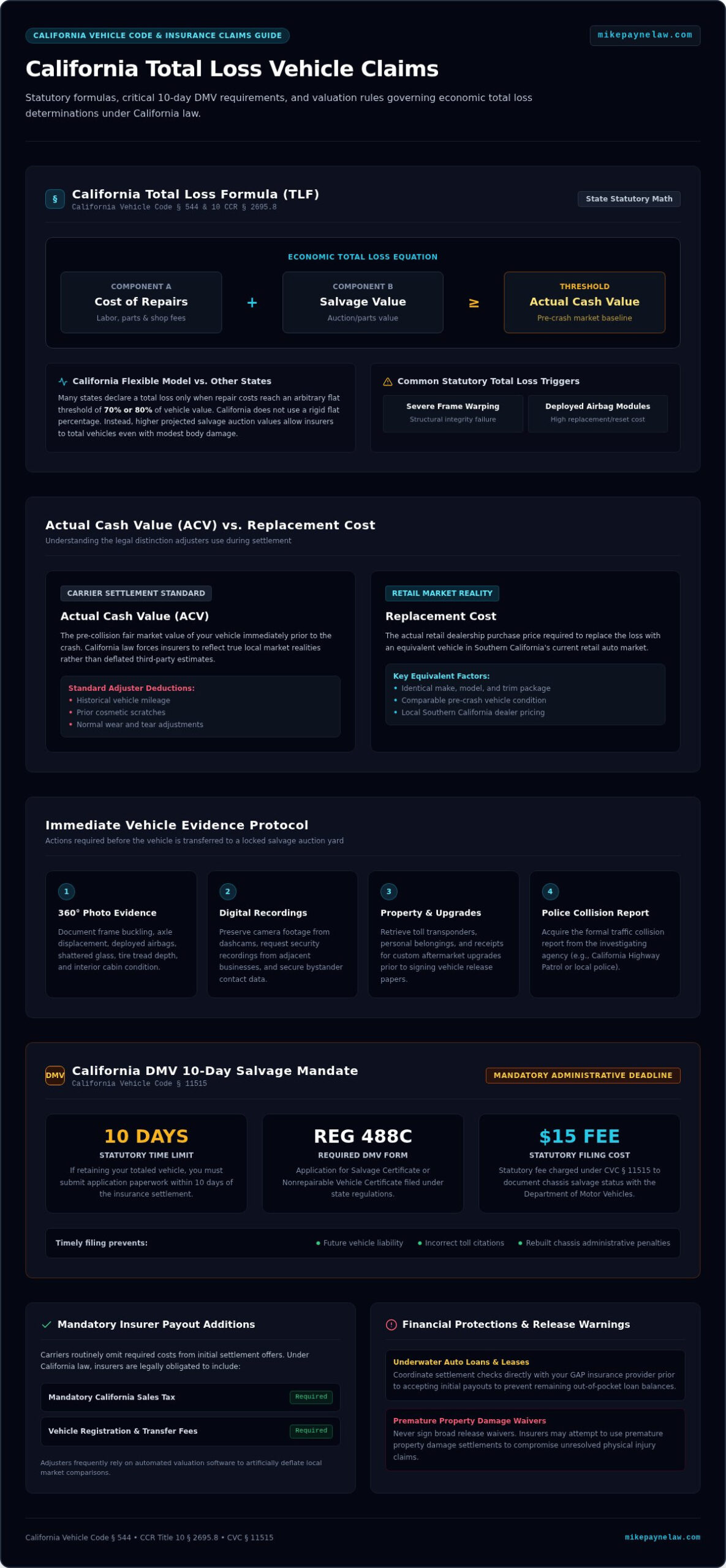
When you stand beside a wrecked car and wonder, “my car was totaled now what california,” the answer starts with state statutory math. California does not use a rigid, flat percentage to determine a write-off. Instead, insurance adjusters must apply the California Total Loss Formula (TLF) under California Vehicle Code § 544 and California Code of Regulations Title 10, § 2695.8. Understanding this formula stops the insurance company from controlling the narrative.
The Total Loss Formula (TLF) Explained
Under California law, a carrier designates a vehicle as an economic total loss using a specific equation:
Cost of Repairs + Salvage Value ≥ Actual Cash Value (ACV)
Many states use an arbitrary threshold, such as declaring a total loss only when repairs hit 70% or 80% of the vehicle’s value. California’s approach is more flexible, but it gives adjusters room to manipulate numbers. If an adjuster predicts high salvage auction value for your wrecked parts, they can total your vehicle even with relatively modest body damage. Knowing what is a total loss under state law helps you spot when an insurer writes off a vehicle simply to avoid paying unpredictable supplemental repair bills. Severe frame warping or deployed airbag modules almost always trigger a statutory total loss under this framework.
Actual Cash Value (ACV) vs. Replacement Cost in California
Adjusters frequently blur the line between what it costs to buy another car and what they legally owe you. They count on your confusion to save money on your claim.
- Actual Cash Value (ACV): The pre-collision fair market value of your vehicle immediately before the crash. Insurers aggressively reduce this baseline by citing historical mileage, prior cosmetic scratches, and normal wear and tear.
- Replacement Cost: The actual retail dealership price required to purchase an equivalent make, model, trim, and condition in Southern California’s current retail auto market.
Carriers settle on ACV, not replacement cost. However, California law forces insurers to reflect true local market realities, not deflated third-party estimates. If a severe crash caused your vehicle loss alongside physical trauma, our firm provides aggressive motor vehicle accident representation to ensure both your vehicle and medical recoveries reflect your actual losses.
Immediate Steps to Take After Your Car Is Totaled in California
The minutes and days following a severe wreck move fast. If you are standing in a tow lot asking yourself, “my car was totaled now what california,” taking decisive action now directly controls the settlement check you receive later. Do not leave your financial recovery to an insurance adjuster whose primary goal is protecting carrier profits. Follow this sequential protocol immediately.
Documenting the Vehicle and Gathering Scene Evidence
Before your car gets moved to a locked salvage auction yard, secure undeniable physical proof of its pre-crash worth and post-crash damage:
- Capture 360-Degree Photos: Document exterior structural frame buckling, axle displacement, deployed airbag modules, and shattered glass. Photograph tire tread depth and interior cabin condition to prove the vehicle was well-maintained.
- Preserve Digital Recordings: Secure dashcam files, pull footage from nearby businesses, and collect contact details from independent bystanders immediately.
- Retrieve Personal Property: Clear out all personal belongings, toll transponders, and receipts for custom aftermarket upgrades before signing any vehicle release.
Navigating DMV Form REG 488C and the 10-Day Rule
California imposes strict administrative duties following a total loss settlement. In accordance with California DMV regulations, if you decide to retain your totaled vehicle, you must apply for a Salvage Certificate using Form REG 488C within 10 days of the insurance settlement. The state charges a $15 statutory fee under California Vehicle Code § 11515. Submitting this documentation on time protects you from future vehicle liability, incorrect toll citations, and administrative penalties if the chassis is ever rebuilt.
Reviewing Police Traffic Collision Reports
Obtain the formal traffic collision report from the investigating agency, whether it is the California Highway Patrol, the West Covina Police Department, or local municipal stations in Pomona and Ontario. Examine the investigating officer’s diagram, statements regarding road conditions, and preliminary fault assessments. Check that the officer recorded the correct vehicle trim, mileage tier, and factory packages. Adjusters use errors in police reports to justify lower payouts.
When physical injuries accompany sudden vehicle destruction, balancing medical appointments with insurance paperwork becomes overwhelming. Having an experienced advocate in your corner changes everything. For comprehensive guidance on protecting both your health and your legal rights, consult the Law Offices of Michael D. Payne to review your options.
Disputing Lowball Offers: How Insurers Undervalue Totaled Vehicles
If you just received an initial settlement offer and are wondering, “my car was totaled now what california drivers should do next,” do not cash that check. First offers are rarely fair market assessments; they are calculated opening bids designed to save the carrier money. With inside knowledge of former insurance defense tactics, we know exactly where adjusters cut corners. While California Vehicle Code § 544 sets the framework for total loss determinations, insurance carriers routinely skew the underlying data in their favor.
The Flaws Inside CCC ONE and Mitchell Valuation Reports
Insurance companies do not calculate vehicle value by hand. They rely on third-party valuation software like CCC ONE or Mitchell to generate automated figures. These systems contain systematic biases:
- Unjustified Conditioning Deductions: Adjusters often mark your car’s seats, paint, or mechanical parts as “fair” or “poor” to slash value, ignoring proper maintenance history.
- Mismatched Comparables: Valuation reports frequently pull stripped-down base trims or former rental fleet vehicles located hours away instead of matching your local trim package.
- Hidden Adjustments: Carriers apply vague “projected dealer discounts” to lower comparable listing prices, assuming you could negotiate thousands off an asking price.
Demand the complete valuation report printout immediately. Auditing the line items is the only way to catch these artificial deductions.
Mandatory Reimbursement for Sales Tax and Registration
Many adjusters conveniently leave statutory add-ons off their initial valuation sheets. California Code of Regulations Title 10 § 2695.8 strictly mandates that total loss payouts must include applicable local sales tax, prorated vehicle license fees, and DMV transfer fees. Across Los Angeles County and San Bernardino County, local sales tax rates often exceed 9% or 10%. On a $25,000 baseline valuation, an adjuster who omits sales tax and transfer fees is shortchanging you by well over $2,500.
Constructing an Airtight Counter-Offer Dossier
You cannot defeat automated software with frustration; you defeat it with hard evidence. Build a counter-offer package that leaves the adjuster no room to maneuver:
- Pull 3 to 5 active dealer listings for your vehicle’s exact make, model, trim, and mileage within a 75-mile radius.
- Compile receipts for recent mechanical upgrades, new tires, transmission service, or custom modifications completed within the last 12 months.
- Submit a formal written dispute package citing California insurance regulations and requiring a written response.
Loans, Leases, and Salvage Retention: Complex Financial Scenarios
A totaled vehicle becomes a financial emergency the moment an outstanding bank loan or active lease enters the picture. When you face this crisis and ask, “my car was totaled now what california lenders expect,” understand that your bank cares only about the principal balance on the contract. Resolving these intertwined accounts demands a clear strategy before you sign over your title.
Handling Negative Equity and the Role of Gap Insurance
This financial gap is where guaranteed asset protection (Gap) insurance becomes essential. Gap coverage pays the difference between your comprehensive or collision settlement and the remaining lease or loan balance. To activate this protection, immediately request a certified loan payoff statement from your lender and submit the primary insurer’s formal valuation breakdown to your Gap administrator. When replacing your vehicle, reviewing comprehensive, collision, and gap endorsements with an established provider like SI Insurance can help prevent similar coverage shortfalls in the future.
Deciding to Keep Your Totaled Vehicle (Owner Retention)
California permits you to retain a totaled automobile through owner retention. It is a viable path if the damage is mostly cosmetic or you have the resources to rebuild it yourself. The process works under strict parameters:
- Salvage Deduction: The insurer calculates what your car would yield at an auto auction and deducts that exact salvage value from your cash payout.
- 10-Day DMV Mandate: You must surrender your existing pink slip and apply for a California Salvage Certificate within 10 days of your claim settlement.
- Revived Salvage Certification: Before that vehicle can legally return to California roads, it must pass a rigorous California Highway Patrol verification along with official state brake and light inspections.
If you are managing complicated property write-offs alongside crash injuries, do not negotiate with aggressive adjusters alone. Contact our legal team to protect your financial interests and demand every dollar you are owed.
Why Total Loss Claims Require Comprehensive Legal Representation
The kinetic force required to crush a vehicle’s frame does not stop at sheet metal; it transfers directly into the human body. When drivers ask, “my car was totaled now what california laws say about my rights,” they often focus exclusively on replacing transportation. That focus is a dangerous trap. Adjusters frequently rush property settlements to close files quickly before the full extent of physical trauma becomes apparent.
The Link Between Total Loss Crashes and Catastrophic Injuries
Modern vehicle crumple zones and side airbags deploy only under severe collision forces. That violent impact regularly produces disc herniations, nerve damage, and concussions that take days or weeks to manifest fully. Never sign a general liability release while undergoing medical evaluation, diagnostic scans, or physical therapy. California law treats property damage and bodily injury claims separately. You can settle your vehicle valuation without forfeiting compensation for mounting medical bills and lost earnings. Exploring dedicated motor vehicle accident practice areas ensures you do not surrender valuable rights prematurely.
The Advantage of Former Insurance Defense Insight
Insurance companies are massive corporations focused on protecting their bottom line. Adjusters follow strict internal playbooks to stall payouts, dispute injury causation, and minimize financial reserves. Retaining a battle-tested West Covina car accident attorney strips away that corporate advantage. Attorney Michael D. Payne brings over 25 years of courtroom litigation experience and invaluable insight as a former insurance defense lawyer. He knows the software algorithms, evaluation checklists, and negotiation tactics carriers use to suppress payouts. Our firm operates strictly on a contingency fee basis with a no-recovery, no-fee guarantee, ensuring aggressive representation without upfront financial strain.
Taking Action Across Southern California Communities
Securing fair compensation requires decisive action from the start. We proudly protect injured victims throughout West Covina, Pomona, Ontario, Chino, Fontana, and San Bernardino. Do not let an aggressive adjuster dictate the value of your wrecked car or dismiss your physical pain. Visit our contact page today to schedule a comprehensive evaluation of your case.
Take Control of Your Total Loss and Injury Settlement Today
Navigating the aftermath of a catastrophic crash is overwhelming, but you don’t have to face corporate claims departments alone. When you find yourself asking, “my car was totaled now what california drivers should do,” remember that you hold significant statutory rights. California’s Total Loss Formula, strict valuation guidelines, and mandatory sales tax reimbursements exist to ensure you receive true fair market value, not an automated lowball figure.
Most importantly, never let an adjuster rush a property payout to erase unresolved crash injuries. At the Law Offices of Michael D. Payne, we bring over 25 years of courtroom litigation experience to protect crash victims across Southern California. Having worked as a former insurance defense lawyer, attorney Michael Payne understands the exact playbooks carriers use to suppress settlements. We operate on a strict contingency fee guarantee, so you pay zero legal fees unless we win compensation for your case. Demand Full Justice for Your Crash and Injuries-Contact Michael Payne today and let a battle-tested advocate fight for every dollar you deserve.
Frequently Asked Questions
What is the formula for a totaled car in California?
California uses the statutory Total Loss Formula (TLF) rather than a fixed percentage. Under California Vehicle Code § 544, an insurer declares a total loss when the cost of required repairs plus the vehicle’s salvage value equals or exceeds its pre-crash Actual Cash Value (ACV). If estimated mechanical and body repairs combined with salvage parts value outweigh the fair market replacement baseline, the insurer legally writes off the vehicle instead of paying repair shops.
Can I negotiate my car’s total loss payout with an insurance company in California?
Yes, initial total loss offers are negotiable. If you are asking “my car was totaled now what California drivers can do to push back,” start by rejecting automated valuation reports. You can dispute flawed dealer comparables, challenge unjustified conditioning deductions, and submit proof of recent maintenance or new tires. Providing three to five local dealer listings for identical vehicles within 75 miles forces adjusters to recalculate the actual market baseline.
Does California insurance pay sales tax on a totaled vehicle?
Yes, California law strictly requires insurers to pay applicable sales tax and transfer fees. Under California Code of Regulations Title 10 § 2695.8, settlement figures must include local sales tax matching where the vehicle is garaged, such as Los Angeles or San Bernardino County. Insurers must also reimburse prorated DMV registration and title transfer fees. If an adjuster omits these mandatory costs from your settlement breakdown, demand a revised valuation sheet immediately.
What happens if I owe more on my car loan than the insurance total loss settlement?
Your auto lender receives the insurance payout directly up to the remaining loan balance. If your loan balance exceeds the vehicle’s Actual Cash Value, you face negative equity and remain legally responsible for paying the difference out of pocket. However, if you purchased Gap insurance when buying or financing the vehicle, that supplementary policy covers the shortfall. Always notify your Gap carrier immediately to avoid defaulting on outstanding principal loan balances.
Can I keep my totaled car and fix it myself in California?
Yes, California allows owner retention if you wish to repair or keep the vehicle. The insurance company simply deducts the vehicle’s projected salvage auction value from your final cash settlement. You must apply for a California Salvage Certificate with the DMV within 10 days of settlement and pay a $15 statutory fee. Before driving the car again legally, you must complete official California brake and light inspections to receive a revived title.
How long does an insurance company have to settle a total loss claim in California?
Under California Fair Claims Settlement Practices Regulations, insurers must acknowledge your claim within 15 days. Once you submit complete documentation and proof of claim, the insurer has 40 calendar days to accept or deny liability. If the claim requires more time, the adjuster must provide written updates every 30 days explaining the delay. Once a total settlement agreement is finalized, the insurer must issue payment within 30 days without unreasonable delay.
Will signing a total loss vehicle settlement release affect my personal injury claim?
Not if you sign a property-damage-only release. If you wonder “my car was totaled now what California injury victims should watch out for,” beware of broad liability releases. Insurance adjusters sometimes slide full liability waivers into vehicle settlement documents to extinguish ongoing bodily injury and pain-and-suffering claims. Settle your vehicle loss separately, and never sign release paperwork while receiving medical treatment without consulting an experienced car accident attorney in West Covina or Pomona.