

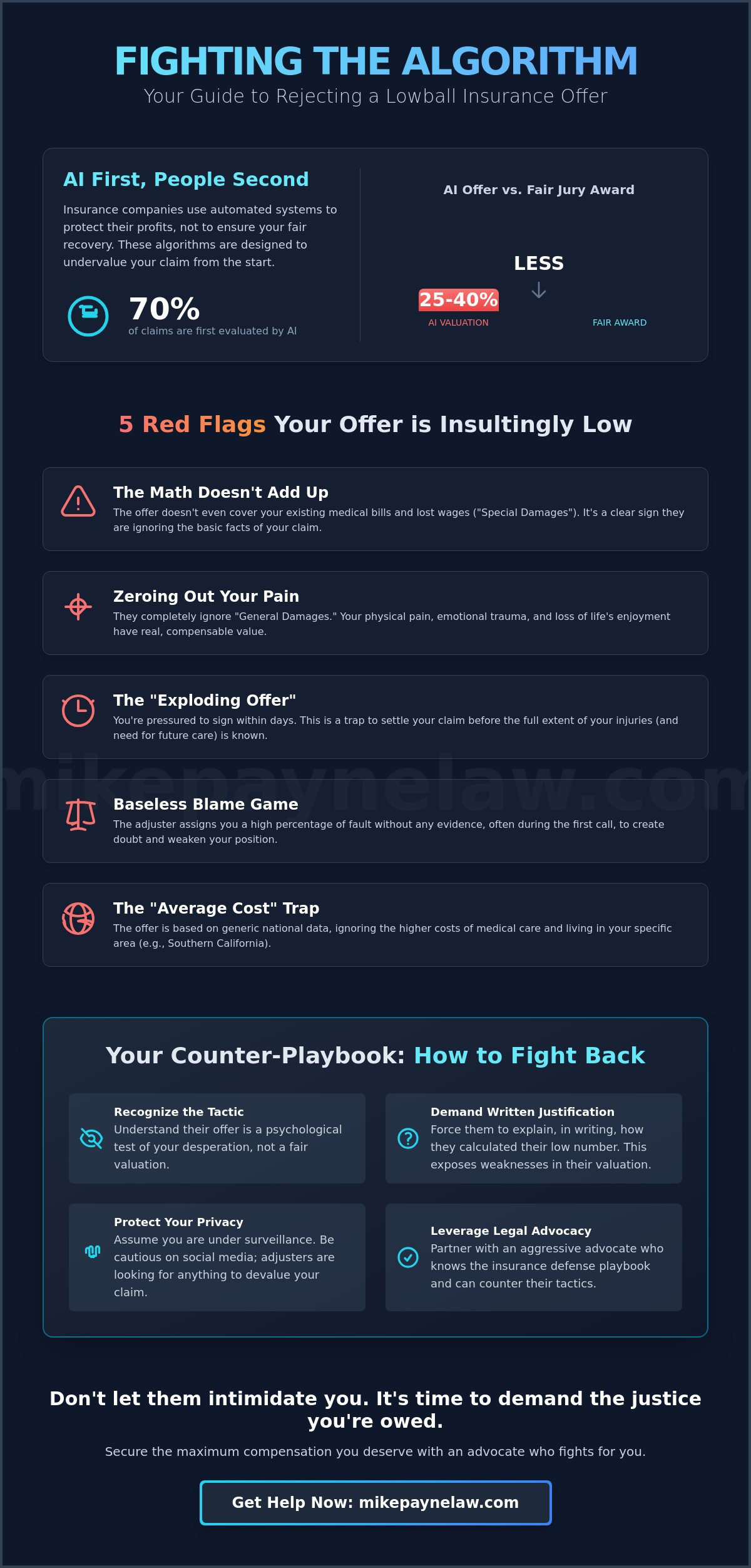
Did you know that approximately 70% of personal injury claims are evaluated by AI before a human adjuster even opens your file? These cold algorithms are programmed to protect corporate profits, often undervaluing legitimate injuries by 25% to 40% compared to jury awards. It feels like a slap in the face when you’re buried under medical bills and the insurance company treats your recovery like a line item on a spreadsheet.
You’re likely feeling the intense pressure to accept whatever they offer just to find some relief. You might even fear that rejecting it means walking away with nothing. We understand that frustration. If you’ve received a lowball insurance offer what to do is pivot from victim to advocate. You deserve a settlement that covers every current and future medical cost, validating that your injuries are real and significant.
This article provides the exact steps to reject an unfair settlement and leverage aggressive legal tactics to secure the maximum compensation you deserve. We’ll show you how to dismantle the adjuster’s playbook and execute a clear plan to fight back without being intimidated by their tactics. It’s time to stop playing by their rules and start demanding the justice you’re owed.
Key Takeaways
- Recognize that an undervalued settlement is a psychological test designed to exploit your financial stress and gauge your desperation.
- Identify critical red flags, such as offers that ignore “General Damages” like pain and suffering or fail to account for your future medical needs.
- Discover the truth behind the “Final Offer” myth and learn how to protect your claim from invasive surveillance and social media monitoring.
- Master the immediate response to a lowball insurance offer what to do to regain control, including the necessity of demanding a written basis for their valuation.
- Leverage the strategic advantage of boutique legal advocacy to counter aggressive adjuster tactics with insider knowledge of insurance defense playbooks.
What is a Lowball Insurance Offer and Why Does it Happen?
A lowball insurance offer is a settlement proposal that falls significantly below the true value of your damages, pain, and future medical needs. It isn’t a mistake or a simple clerical error. It is a calculated psychological test designed to gauge your level of desperation. When you’re facing a lowball insurance offer what to do starts with recognizing that the adjuster is looking for a weakness. They want to see if the weight of your mounting bills will force you to accept pennies on the dollar before you understand the full scope of your claim.
In California, adjusters frequently exploit the state’s pure comparative negligence rules. Under this system, you can recover damages even if you’re partially at fault, but your payout is reduced by your percentage of responsibility. Adjusters often assign you an arbitrary, high percentage of fault during the first phone call without any evidence. They do this to create immediate doubt. They want you to believe your case is weak so you’ll accept their first low number. Knowing how to handle a lowball insurance offer what to do involves challenging these baseless fault assignments with cold, hard evidence.
Insurers use these tactics because they work on unrepresented claimants. Common reasons for these low offers include:
- Testing your knowledge: They want to see if you know what your “General Damages,” like emotional distress, are actually worth.
- Financial exhaustion: They wait for your medical bills to pile up, hoping you’ll settle just to stop the collection calls.
- Algorithmic bias: Many offers are generated by software that ignores the human element of your suffering.
The Economics of the First Offer
Insurance companies are for-profit corporations that prioritize quarterly earnings over your physical recovery. Their “take it or leave it” tone is almost always a bluff intended to intimidate you. In Southern California, the high cost of living means medical care and daily expenses are significantly higher than national averages. A generic settlement offer that ignores these local economic realities is inherently unfair. If an insurer refuses to acknowledge these costs or fails to investigate properly, they may be engaging in insurance bad faith.
Why Initial Offers Arrive So Quickly
Adjusters often reach out within days of an accident. This “quick cash” trap is a deliberate attempt to get you to sign a release before you consult a personal injury lawyer West Covina. They want you to settle before you reach Maximum Medical Improvement (MMI), which is the point where your doctors know the full extent of your long-term needs. A lowball offer is a tactical maneuver to minimize corporate liability.
5 Red Flags Your Settlement Offer is Insultingly Low
Identifying a lowball offer is the first step in reclaiming your power. Insurance adjusters often use a friendly tone to mask predatory tactics, hoping you’ll accept a check before you realize the true cost of your recovery. If you’ve received a proposal that feels like an insult, it probably is. When facing a lowball insurance offer what to do begins with recognizing these five critical red flags:
- The math doesn’t add up: The offer fails to cover your current “Special Damages,” such as the actual medical bills sitting on your kitchen table or the wages you’ve already lost.
- Zeroing out your pain: The adjuster completely ignores “General Damages.” Your physical pain, emotional trauma, and loss of enjoyment of life have real value that must be compensated.
- The “exploding offer”: You’re being pressured to sign a release within days of the accident. This is a tactic to lock you out of future claims before you know if you need surgery.
- Baseless blame: The company suggests you’re partially at fault without providing a shred of evidence or a police report to back it up.
- The “Average Cost” trap: The offer is based on national “average” costs rather than the specific, high-quality medical care required in West Covina or Ontario.
If any of these signs appear, stop talking to the adjuster and consider discussing your case with an advocate who understands these corporate games.
Ignoring Future Medical Needs
A settlement is final. You cannot “settle twice.” If you sign a release today and discover you need a $50,000 spinal fusion next month, that cost comes out of your own pocket. Adjusters use software like Colossus to dehumanize your claim, stripping away the individual nuances of your injury to fit a corporate profit model. These programs often undervalue injuries by 25% to 40% because they don’t account for your specific path to Maximum Medical Improvement (MMI).
Disputing Clear Liability
In California, insurers love to shift 10% or 20% of the fault onto you. This “comparative negligence” tactic is a direct attempt to save the company thousands of dollars. When an insurer denies clear evidence of their client’s negligence, they may be acting in “Bad Faith.” We use concrete evidence, like the Fontana Police Accident Report, to shut down these unsupported liability claims and force the insurer to acknowledge the truth of what happened on the road.
The Adjuster’s Playbook: Insider Tactics Used to Devalue Claims
The insurance adjuster isn’t your friend. They are a professional negotiator trained to minimize the company’s financial exposure. To them, your injury is a file number that needs to be closed for the lowest possible amount. Understanding the “playbook” they use is essential when you’re deciding on a lowball insurance offer what to do. They rely on specific tactics to make you feel like their undervaluation is the best you can get.
One of the oldest tricks in the book is the “Final Offer” myth. When an adjuster tells you an offer is final, they are almost always bluffing. They use this language to create a sense of urgency, hoping you’ll panic and sign. In reality, “final” is simply a starting point for someone who knows how to push back. They also engage in “Medical Record Fishing Expeditions,” demanding your medical history from 10 years ago. They aren’t looking to help you; they are looking for any minor pre-existing condition to blame for your current pain.
They are also watching you. Adjusters frequently monitor social media or even hire private investigators to conduct surveillance. If you post a photo at a family gathering or are seen carrying groceries, they will use that as “proof” that your injuries aren’t serious. Michael D. Payne understands these moves because he spent years as an insurance defense lawyer. He knows exactly how they build these traps, and he knows how to dismantle them from the inside.
How Insurance Defense Lawyers Think
Adjusters perform a constant “litigation risk” calculation. They ask themselves: “If we don’t pay this, will this person actually take us to court?” If you don’t have a trial-ready attorney, their math stays the same. A “claims processor” is just there to move paper and offer low numbers. A “litigation adjuster” only steps in when they realize you are a legitimate threat. Having an advocate who has sat in their chairs changes the entire equation. They only pay the maximum when they know the alternative is an expensive, losing battle in front of a jury.
The “Delay, Deny, Defend” Strategy
Time is the adjuster’s greatest weapon. They know your bills are piling up and your stress is rising. By dragging out the process, they hope to wear down your resolve until you accept whatever they offer just to make the pressure stop. They also try to trick you into recorded statements using these three common phrases:
- “We just need a quick statement to get your check processed.”
- “Can you just explain the accident in your own words for our records?”
- “I just need to clarify a few minor details before we wrap this up.”
Never fall for these traps. Insurance adjusters are trained to protect the bottom line, not your recovery. When you receive a lowball insurance offer what to do is stop providing them with ammunition and start building your counter-offensive.
What to Do After Receiving a Lowball Insurance Offer
Receiving an insultingly low offer is a pivotal moment in your claim. It’s where the insurance company tries to capitalize on your uncertainty. If you’ve received a lowball insurance offer what to do is follow a disciplined, aggressive strategy to reclaim the narrative. Don’t let their tone or the pressure of medical bills force you into a mistake. You need to transition from being a target to being a formidable opponent.
- Step 1: Stay Calm and Decline. Never accept or sign anything on that first call. A verbal “yes” can be used against you later. Simply state that the offer is insufficient and you will be responding formally.
- Step 2: Request the Basis in Writing. Force the adjuster to justify their low numbers. Under California law, insurers must explain their reasoning. This exposes the flaws in their logic and provides a target for your counter-argument.
- Step 3: Document Everything. Gather every medical bill, lost wages documentation, and witness statement. Evidence is the only currency adjusters respect.
- Step 4: Draft a Formal Counter-Demand. This isn’t a casual email. It’s a fact-based argument that outlines the full extent of your damages, backed by the evidence you’ve collected.
- Step 5: Consult a Professional. Bringing in a Personal Injury Attorney California signals to the insurer that you’re ready for a high-stakes fight.
Calculating Your True Case Value
Your case is worth more than just the total of your current medical receipts. You must account for loss of enjoyment of life, chronic pain, and emotional distress. Never trust an online “settlement calculator” for serious injuries. These tools are generic and fail to account for the specific complexities of Southern California claims. In high-stakes cases, we utilize medical and vocational experts to prove exactly how an injury will impact your ability to earn a living and live your life for years to come.
The Power of the Counter-Demand Letter
A professional demand package is your primary weapon. It must include a comprehensive breakdown of all damages and a clear deadline for a response. We use the California Statute of Limitations as a strategic clock, reminding the insurer that their time to resolve this cheaply is running out. We also employ Policy Limit Demands. This tactic can put the insurer on the hook for excess verdicts if they refuse to settle for the policy maximum when liability is clear. If you need a partner to execute this plan, contact us today for a professional evaluation of your counter-demand strategy.
Taking the Fight to Them: Why You Need an Aggressive Advocate
When you are up against a multi-billion dollar insurance company, you need more than just a lawyer. You need a shield. Many “mega-firms” in Southern California operate like factories, processing thousands of cases with a focus on quick turnarounds rather than maximum value. A boutique firm offers a different experience. We provide the personalized, high-stakes advocacy required to dismantle the corporate playbook we discussed in earlier sections. If you are struggling with a lowball insurance offer what to do is choose a representative who views your recovery as a mission, not a file number.
This is the “Payne Advantage.” Michael D. Payne spent years as an insurance defense lawyer. He knows exactly how adjusters calculate risk and where they hide the money you deserve. He uses that insider knowledge to anticipate their next move before they even make it. This aggressive approach is fueled by a commitment to justice for our neighbors. We understand that behind every claim is a person trying to put their life back together.
Financial fear should never stop you from seeking justice. We work on a contingency fee basis. This means you can afford a top-tier truck accident lawyer Los Angeles with zero upfront costs. We take on the financial risk of the litigation so you can focus on your physical therapy and family. We only get paid when we secure a recovery for you. This alignment of interests ensures that we are always fighting for the highest possible settlement.
Personalized Representation for SoCal Victims
For over 25 years, we have served the communities of West Covina, Pomona, and Ontario. We are local professionals who understand the specific needs of our community. If your injuries are so severe that you cannot travel to our office, we employ a “boots-on-the-ground” approach. We will come to your home or hospital room to begin building your case. You are never just a number here. You are a client who deserves a champion. Contact us today for a professional evaluation of your claim.
The Final Word on Settlements
The most important thing to remember is that you hold the power. The insurance company cannot force you to accept an unfair offer. You have the right to say no and the right to demand a trial. Michael D. Payne treats every case as if it is going to trial. This trial-ready mindset is exactly what forces adjusters to increase their offers. They pay more when they know the alternative is facing us in a courtroom. Don’t let them lowball your future. Let us fight for your maximum recovery.
Demand the Justice You Deserve
A lowball insurance offer is a corporate strategy, not a final verdict on your case’s value. You’ve learned that adjusters use psychological pressure and cold algorithms to test your resolve during a vulnerable time. By recognizing red flags and demanding a written basis for their low numbers, you flip the script on their delay tactics. When you are faced with a lowball insurance offer what to do is stop negotiating alone and bring in a champion who understands the opposition’s internal playbook.
Michael D. Payne provides a unique advantage as a former insurance defense lawyer with over 25 years of personal injury experience. He knows exactly how to dismantle the arguments adjusters use to devalue your suffering. We treat every case with the urgency it deserves and prepare every file as if we are heading to trial. You don’t have to worry about upfront costs because we operate on a contingency basis; there is no fee unless we win your case.
Don’t settle for less than you deserve. Contact the Law Offices of Michael D. Payne today for a free consultation. You have the power to fight back, and we are ready to stand as your primary shield. Let’s secure the maximum compensation you need for a full recovery.
Frequently Asked Questions
Is the first insurance settlement offer usually the best?
No, the first offer is almost never the best; it is a strategic lowball designed to see if you’ll settle quickly for less than you deserve. Insurance companies use these initial numbers to minimize their financial liability before you understand the full scope of your injuries. Accepting it immediately often means leaving thousands of dollars on the table that you’ll need for long term recovery.
How long do I have to respond to a lowball offer in California?
While there isn’t a specific legal deadline to respond to an offer, you must file a lawsuit within the two year California statute of limitations for personal injury. If you wait too long, you lose your right to sue, which destroys your leverage. Additionally, California law requires insurers to accept or deny a claim within 40 days of receiving all necessary proof of loss.
Can I still hire a lawyer if I already received an offer from the insurance company?
You can absolutely hire a lawyer after receiving an offer, provided you haven’t signed a release or accepted the payment. In fact, this is often the best time to bring in an advocate. An attorney can review the proposal and help you decide on a lowball insurance offer what to do next to secure a much higher settlement that reflects your actual damages.
What happens if I reject a settlement offer and the insurance company won’t budge?
If the insurer refuses to negotiate fairly, your next step is filing a formal lawsuit. This moves the case from the claims department to the litigation department. Often, the mere act of filing a suit and showing you’re trial ready forces the insurance company to reconsider their position. They would rather settle than face the high costs and risks of a jury trial in Southern California.
Does the insurance company have to pay for my future medical treatment?
Yes, the insurance company is legally responsible for all damages resulting from the accident, including projected future medical expenses. This includes physical therapy, future surgeries, and ongoing medication. To recover these costs, we work with medical experts to provide a detailed plan that proves exactly what your future treatment will cost. Never settle until these future needs are fully documented and included in the demand.
How do I know what my car accident claim is actually worth?
Determining the true value of your claim requires adding up your “Special Damages” and your “General Damages.” Special damages are concrete costs like medical bills and lost wages. General damages account for pain, suffering, and emotional distress. While the average California settlement falls between $3,000 and $75,000, your specific medical records and the long term impact on your life will dictate the final number. To see how these calculations are handled by professionals across different jurisdictions, you can explore Car Accident Legal Representation and gain insight into the documentation required for a successful claim.
Will my case have to go to court if I reject a lowball offer?
Rejecting a lowball offer doesn’t automatically mean you’ll end up in a courtroom. Most personal injury cases settle before a trial begins. However, you must be prepared to go to court to get the best result. When an insurance company knows your lawyer is trial ready and isn’t afraid of a fight, they are much more likely to offer a fair settlement to avoid a verdict.
What is the “Pure Comparative Negligence” rule in Southern California?
California’s pure comparative negligence rule allows you to recover compensation even if you were partially at fault for the accident. Your final settlement is simply reduced by your percentage of responsibility. For example, if your damages are $100,000 but you are 20% at fault, you can still recover $80,000. Adjusters often try to inflate your fault percentage to save money, which is why having an aggressive advocate is vital.