

Can you bring your own claim when your spouse’s injury changes the life you shared? In California, loss of consortium claims for spouses may address more than missed plans. They can focus on concrete changes to companionship, affection, support, care, and intimacy. But the claim has boundaries, and it is tied to the injured spouse’s case.
It is understandable to wonder whether private changes in a relationship count as legal harm, or whether raising them could affect your spouse’s injury claim. The key is to describe your own losses clearly and show how they connect to the injury. A consortium claim is distinct from the injured spouse’s claim, but it depends on that underlying case succeeding.
This guide explains who may qualify under California law, which relationship losses may be considered, and what evidence can help show how life changed before and after the injury. It also explains how the claim differs from lost income or caregiving expenses, why fault and filing deadlines matter, and what to discuss with an injury lawyer. Careful evidence gathering can help present both claims clearly, without treating your experience as an afterthought.
Key Takeaways
- Learn who may bring loss of consortium claims for spouses in California and how a claim connects to the injured spouse’s case.
- Identify relationship changes that may matter, from companionship and affection to shared routines and intimacy.
- Understand how a spouse’s non-economic relationship losses differ from medical bills, lost income, and caregiving expenses.
- Build a factual timeline of changes and consider records such as messages, calendars, photographs, and medical information.
- Understand how eligibility, coordinating claims, evidence, and filing deadlines may affect a case.
What Does a Loss of Consortium Claim for a Spouse Mean in California?
A loss of consortium claim addresses relationship harm a spouse experiences after their partner is injured because of someone else’s alleged wrongdoing. It recognizes that an injury can change the life two people share, not just the injured person’s health. California law treats this as a claim for non-economic harm. It is not a way to recover the injured spouse’s medical bills, lost wages, or other financial losses.
At a glance: The injured person’s claim seeks damages for their own injuries and losses. A consortium claim belongs to the spouse and concerns changes to their relationship. The spouse’s claim is separate, but it depends on the underlying injury case. Compensation is not automatic.
The claim is connected to the case over the injury itself. For example, a spouse’s claim may arise alongside a case involving a motor vehicle accident injury or an injury on someone else’s property. The injured person’s case addresses the alleged harm and responsibility for it. The spouse must also show how the injury affected their relationship. For a general legal overview of the concept and its history, see Loss of Consortium: Legal Definition and History.
Who may bring a California spouse consortium claim?
When an injured partner survives, California generally allows a person who was legally married to them when the injury occurred to bring a spouse’s consortium claim. A person in a registered domestic partnership may also have rights under California law. The legal status must meet applicable requirements. Living together or having a close, committed relationship alone does not establish eligibility. The relationship’s legal status and the underlying case need to be considered based on their specific facts.
What relationship changes can the claim address?
The focus is the change in the couple’s relationship after the injury, not simply the seriousness of the diagnosis. California’s civil jury instruction on loss of consortium identifies relationship interests that may be relevant, including companionship, affection, comfort, care, assistance, protection, society, and moral support. The details matter. A spouse might describe how injury-related limitations disrupted shared routines or reduced the injured partner’s ability to take part in family and social life.
Intimacy may also be affected, but a particular change in sexual relations is not required to describe other relationship losses. Couples may notice changes in how they divide ordinary household responsibilities or spend time together. Those changes can help explain the relationship’s before-and-after picture, but they do not turn the consortium claim into a request for wages, financial support, or the separate value of nursing services. The point is to explain honestly and specifically how the injury altered the companionship and support the spouses shared.
How California Loss of Consortium Claims Connect to the Injury Case
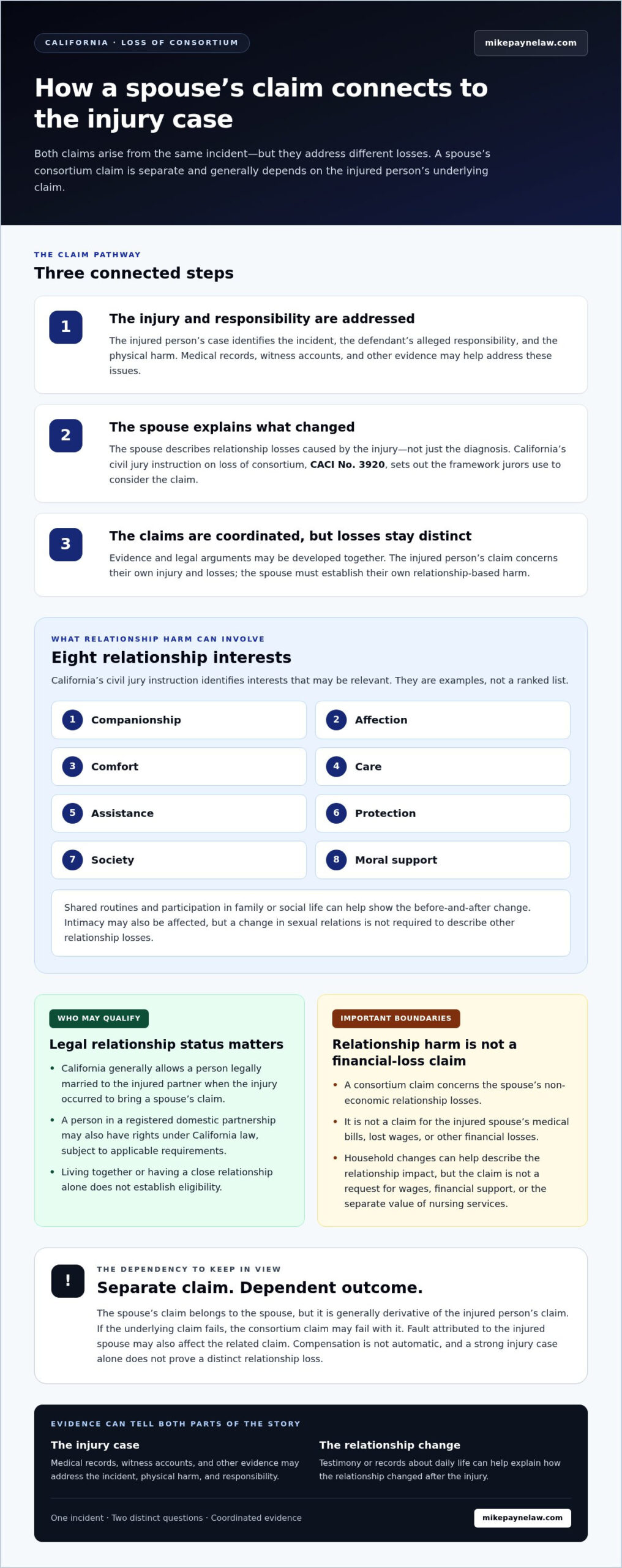
A spouse’s claim follows a path alongside the injured person’s case. Both arise from the same incident, but they ask different questions: Was the defendant legally responsible for the injury, and did that injury cause a distinct loss in the couple’s relationship? California treats consortium as a separate claim belonging to the spouse, yet it is generally derivative. In practical terms, it depends on the underlying injury claim. The spouse’s allegations alone do not establish liability or guarantee recovery.
- The injury and liability are alleged. The injured person’s case identifies the incident, the defendant’s alleged responsibility, and the resulting physical harm. Medical records, witness accounts, and other evidence may help address these issues.
- The spouse describes relationship losses. The spouse explains what changed in the relationship because of the injury. The California civil jury instruction on loss of consortium, CACI No. 3920, sets out the framework jurors use to consider the claim.
- The claims are presented in a coordinated way. Evidence and legal arguments may be developed together, while each person’s losses remain distinct. This can help show how the injury affected both the injured person and the shared life of the couple.
How the spouse’s claim differs from the injured person’s claim
The injured person may seek damages for bodily harm, treatment, and other losses they personally sustained. The spouse’s claim concerns relationship-based harm, such as a loss of companionship or support. Both may be tied to the same collision, fall, or other incident, but the spouse must establish their own loss. Evidence can overlap: treatment records might show the injury’s effects, while testimony or records about daily life can help explain the relationship changes that followed.
Cornell Law’s overview of loss of consortium describes the intangible benefits of a relationship. California law and the facts of the individual case determine how a claim is assessed. A strong underlying injury case does not, by itself, prove that the spouse experienced a compensable relationship loss.
Why the underlying claim and timing matter
Because consortium is generally derivative under California law, the spouse’s claim depends on the legal viability of the injured person’s claim. If the underlying claim fails, the consortium claim may fail with it. Any fault attributed to the injured spouse may also affect the related claim. These are reasons to coordinate the evidence and legal analysis rather than treating the two claims as unrelated.
Timing deserves careful attention, too. The applicable filing deadline can depend on the claim’s circumstances, including the type of defendant and underlying case. Do not assume one deadline applies to every situation. The Law Offices of Michael D. Payne can review the incident, parties, and claim type promptly and explain how to protect and present both claims consistently. If you are weighing loss of consortium claims for spouses, a case-specific discussion can help clarify how the claims fit together. The firm gathers evidence for injury cases and can discuss relevant questions through a consultation.
Which Losses May Count, and How Is Consortium Different From Other Claims?
California loss of consortium damages focus on how an injury changed the relationship, not on a fixed checklist or calculation. The effect might show up in ordinary moments: less time spent together, a partner unable to offer familiar support, or shared activities that have stopped. A jury evaluates the evidence and circumstances of the couple’s relationship. There is no reliable formula or dollar estimate that fits every case.
Potential losses can involve different parts of a shared life:
- Companionship and shared activities: Injury-related limits may reduce the couple’s ability to socialize, travel, take part in hobbies, or enjoy everyday routines together.
- Affection and intimacy: A spouse may describe changes in closeness, affection, or sexual relations, if those changes occurred. No particular type of loss is required to show that the relationship was affected.
- Care, assistance, and support: The injury may affect the emotional support spouses give one another or the injured spouse’s ability to contribute to shared household responsibilities.
These examples describe relationship harm. A consortium claim generally does not compensate the spouse for lost financial support, time away from work, or the value of nursing services. Those are different kinds of losses and may need to be addressed through other parts of the case.
Loss of consortium versus the injured spouse’s pain and suffering
Pain and suffering describes the injured person’s own physical discomfort and emotional distress. Consortium describes the spouse’s loss in the relationship. Their experiences can overlap in the evidence, but the claims focus on different people and different harms.
| Claim | Claim focus | Claimant |
|---|---|---|
| Personal injury, including pain and suffering | The injured person’s physical and emotional effects of the injury | The injured spouse |
| Loss of consortium | The injury’s effect on companionship, affection, support, and other relationship interests | The uninjured spouse |
For example, the injured person might describe pain that prevents them from joining a family outing. The spouse might explain how losing that shared activity changed their companionship. The same event can help illustrate both perspectives, but it does not make the harms identical. California legal outcomes depend on the facts. The Daily Journal’s California legal coverage provides broader context on litigation in the state.
Loss of consortium versus wrongful death
A consortium claim concerns relationship changes while the injured spouse survives. If the injury results in death, the legal framework changes. Eligible family members may bring a wrongful death claim under California law, which addresses losses resulting from the death rather than an ongoing relationship affected by a surviving spouse’s injury. The claims have different legal requirements, so one should not be treated as a substitute for the other. In a fatal incident, a California wrongful death claim may be relevant to discuss with the firm.
How Can a Spouse Document Relationship Loss After an Injury?
Relationship changes can be deeply personal, and broad statements like “everything is different” may not show what changed in daily life. A clear, honest record can help explain the impact. Focus on specific examples and how they connect to the injury, not on making the story sound more dramatic than it is.
Build a clear record of what changed
Write a factual timeline comparing life before the injury with what followed. Note when routines changed, what activities stopped or became difficult, and how shared responsibilities or communication shifted. For example, describe a weekly activity you used to do together, when it changed, and how your spouse’s injury affected participation. Record what you personally observed, and distinguish it from what you believe or were told.
Examples of records that may help provide context include:
- Calendars or activity records showing changes to shared plans and routines.
- Messages or personal notes that reflect changes in communication or support.
- Photographs that help illustrate shared activities before and after the injury.
- Medical and recovery information that may explain physical limitations or changes in daily functioning.
These materials may offer useful context, but no record guarantees a particular result. Keep original files when possible, preserve dates and surrounding context, and do not edit, stage, or selectively alter evidence. Protect private information, especially personal messages and medical details. Discuss privacy with your attorney before sharing sensitive records.
Connect relationship changes to the underlying accident
Organize relevant records in chronological order: incident information first, followed by treatment and recovery details, then records showing how the relationship changed over time. This sequence can help distinguish the effects of the injury from other life events. The injured spouse and the uninjured spouse may both offer testimony about what changed. Friends or family members familiar with the couple may also provide context, while respecting the couple’s privacy.
For loss of consortium claims for spouses, relationship evidence must be understood alongside the underlying injury case. The Law Offices of Michael D. Payne gathers evidence and works with investigators and expert witnesses to develop injury cases and present the spouse’s distinct relationship losses. For a collision-related injury, the firm’s motor vehicle accident representation may be relevant. Property-related injuries can involve premises liability.
A simple preparation checklist can help you get organized before discussing the case:
- Write a dated account of major changes without guessing or exaggerating.
- Gather original records and note where each item came from.
- Keep relationship examples separate from medical bills, lost income, or other financial losses.
- Identify questions about privacy, evidence, and how the spouse’s claim fits with the injury case.
To discuss how to organize relationship evidence and coordinate it with the injury case, contact Payne.
What Should Spouses Consider Before Pursuing a California Consortium Claim?
Before deciding whether to pursue a claim, understand how your eligibility, your spouse’s underlying injury case, and your own relationship losses fit together. California law is fact-specific. Payne can assess how the rules may apply, coordinate the claims, and identify evidence that may be useful. No one can reliably predict a claim’s value or outcome without evaluating the circumstances.
Questions to raise in a consultation
A focused conversation can help turn uncertainty into practical next steps. Consider asking:
- How might California law apply to my relationship status and my spouse’s injury claim?
- How should we describe the relationship changes separately from my spouse’s bodily injury losses?
- Which records or testimony may help explain what changed, and how should we protect sensitive information?
- How can the spouse’s claim be coordinated with the underlying injury case?
- Which deadlines may apply to these particular claims, and how will they be identified?
Bring a brief timeline of the injury and the relationship changes you have noticed, along with relevant records you already have. You do not need to disclose every private detail in an initial conversation. Ask how personal information will be handled and what evidence is relevant. For loss of consortium claims for spouses, careful evaluation can help distinguish a spouse’s own relationship harm from the injured person’s losses.
A supportive next step for Southern California spouses
Michael D. Payne provides personalized representation for injury matters, including motor vehicle accidents and premises liability cases. The firm gathers evidence and works with investigators and expert witnesses to develop the underlying injury case and assess the spouse’s distinct losses. The firm has 30 years of Experience and is available 24/7. Hablamos Español. Se Habla Español.
If the injury followed a car crash, the firm’s California motor vehicle accident representation may be relevant to the underlying case. The firm offers Free Accident Case Consultations to discuss the incident, available information, and questions about coordinating a spouse’s claim. The firm’s No Fee Guarantee means we do not charge a fee unless we win. It does not promise a particular result or recovery. Case value and outcome depend on the facts.
Request a Free Accident Case Consultation with Payne to discuss your situation.
Take the Next Step With Clarity
Putting a name to relationship changes can feel difficult, especially while your household is adjusting to an injury. You do not need to have every answer before asking what options may fit your situation. A case-specific conversation can help you identify the questions that matter, understand how your concerns relate to the injury claim, and decide what to do next.
For loss of consortium claims for spouses, the goal is to present a truthful account of how the injury affected the relationship, without overstating or minimizing the changes. Your experience deserves careful consideration. Payne can discuss your circumstances and help you understand possible next steps, without promising a particular outcome.
Request a Free Accident Case Consultation to discuss your situation and move forward with greater clarity. The firm serves injury victims in West Covina, Pomona, Ontario, Covina, Chino, Fontana, San Bernardino, Baldwin Park, and Azusa. You do not have to sort through these questions alone.
Frequently Asked Questions
Can a spouse file a loss of consortium claim in California?
Generally, yes. California generally permits a person legally married to the injured partner at the time of injury to pursue a consortium claim. A registered domestic partner may also qualify under California law. Being engaged, living together, or sharing a long relationship alone does not establish this legal status. Eligibility is only one issue. The spouse must still meet applicable requirements and connect the claimed relationship harm to the underlying injury case.
Does a loss of consortium claim depend on the injured spouse’s case?
Yes. The claim is generally derivative, meaning it depends on the injured spouse’s underlying case and the legal basis for holding someone responsible for the injury. The uninjured spouse must still establish their own relationship loss. A viable injury claim does not automatically prove it. If liability or another essential part of the injured person’s case fails, that may also defeat the related consortium claim.
Can a spouse bring a consortium claim if the injured person was partly at fault?
Potentially. California’s comparative fault rules can allow a claim to proceed even if the injured spouse shares responsibility for the incident. However, a fault percentage assigned to the injured spouse may proportionally reduce damages available on the related consortium claim. The spouse’s own lack of fault does not erase this issue. How responsibility is divided depends on the evidence and circumstances of the incident.
What evidence can help support a spouse’s loss of consortium claim?
Evidence should help show the relationship before the injury and the changes afterward. For example, a spouse might preserve invitations or records showing a regular shared activity they no longer attend together, then note when that changed. People who have observed the couple over time may offer relevant context. Keep records genuine and in their original form, and discuss sensitive material with the firm before sharing it.
Is loss of consortium the same as pain and suffering?
No. Pain and suffering concerns the injured person’s own physical discomfort and emotional distress. Loss of consortium concerns the other spouse’s relationship-based harm. The same incident, such as an injury preventing a couple from attending a family gathering, may help explain both experiences. But each claim belongs to a different person and must be evaluated for its own losses, without treating one spouse’s account as proof of the other’s.
What happens to a loss of consortium claim if the injured spouse dies?
If the injured spouse dies, the legal analysis changes. A consortium claim involving a spouse who survives an injury is not simply the same as a wrongful death claim. California wrongful death law provides a separate framework for eligible claimants and losses after a death. The effect on any pending claims can depend on the case’s procedural posture, so seek prompt legal guidance rather than assuming one claim automatically replaces another.
How long does a spouse have to file a loss of consortium claim in California?
For many negligence-based injury cases, the general deadline is two years from the incident under California Code of Civil Procedure section 335.1. But the applicable period can depend on the defendant and claim type, and different rules may apply in some cases. That matters for incidents in West Covina, Pomona, Ontario, Covina, Chino, Fontana, San Bernardino, Baldwin Park, and Azusa. Payne can assess the deadline promptly as part of a case consultation.