

After a crash or fall, you may be dealing with medical care, missed income, questions about responsibility, and calls from insurers. If you’re searching for an abogado de lesiones in Southern California, knowing what to document and what decisions may come next can make the process easier to navigate. A clear timeline and organized records give you a practical starting point for understanding your options.
An injury lawyer can review the circumstances, identify evidence that may matter, communicate with insurers, and explain how a claim could proceed. This guide covers what to preserve, what to ask before choosing representation, and how responsibility and losses may be evaluated. It also explains contingency fees and litigation costs so you can review the financial terms before deciding how to move forward.
At the Law Offices of Michael D. Payne, attorney Michael D. Payne brings more than 25 years of experience, including prior work as an insurance defense lawyer. The firm represents injured people across Southern California, uses a contingency-fee arrangement, and advances litigation costs. The written agreement sets out the specific terms. Here’s what to expect, without promises about the outcome.
Key Takeaways
- An injury claim may depend on who was responsible, what harm can be documented, available insurance coverage, and applicable deadlines.
- Preserve photos, witness details, reports, medical records, and expense records. These details can help an abogado de lesiones assess a claim.
- Contingency fees and litigation costs are separate. Review the written agreement to understand how each is handled.
- Before speaking with a lawyer, organize a brief timeline, key contacts, records, and insurer communications, without delaying medical care.
- When evaluating representation, consider relevant experience, clear communication, fee transparency, and attorney involvement. Michael D. Payne brings over 25 years of experience, including a background in insurance defense.
What Does an Injury Lawyer Do for Southern California Clients?
An injury lawyer helps someone hurt because of another party’s conduct understand and pursue a legal claim. The lawyer reviews how the injury happened, considers who may be responsible, examines evidence of harm and available insurance coverage, and explains legal options and deadlines. An abogado de lesiones can also handle insurer communications and, when appropriate, pursue negotiations or a lawsuit.
A lawyer doesn’t diagnose injuries or provide medical treatment; healthcare professionals do that. An insurance adjuster evaluates a claim for the insurer, while your lawyer represents your interests. Legal representation can help organize and present a claim, but it can’t guarantee a settlement, a particular amount, or a court result. This neutral overview of a personal injury lawyer offers a starting point for understanding this area of practice.
Which injury cases may call for legal help?
Legal questions can arise after car, truck, motorcycle, bicycle, or pedestrian collisions, as well as workplace injuries and injuries on someone else’s property. Each claim depends on its facts: what happened, who may have contributed, the nature of the harm, and what evidence is available. For collision-related concerns, learn more about motor vehicle accident representation.
Not every injury requires a lawsuit or legal representation. But if the facts or consequences are difficult to sort out, a lawyer can explain the issues and possible next steps without replacing medical care or making decisions for you.
When does a local injury claim become more complicated?
A claim may need closer review when the parties dispute who caused the incident, injuries are serious, several people or businesses may be involved, or an insurer challenges important parts of the claim. For example, a collision near a busy intersection in Ontario may involve competing accounts. A fall in Pomona may raise questions about property conditions and responsibility.
These circumstances can affect what evidence matters and how a claim should be presented. People in West Covina, Pomona, Ontario, and nearby communities can seek guidance when the situation is unclear. An abogado de lesiones can assess the available information and explain options. Getting advice doesn’t automatically mean filing a lawsuit.
How an Injury Lawyer Builds and Pursues a Claim
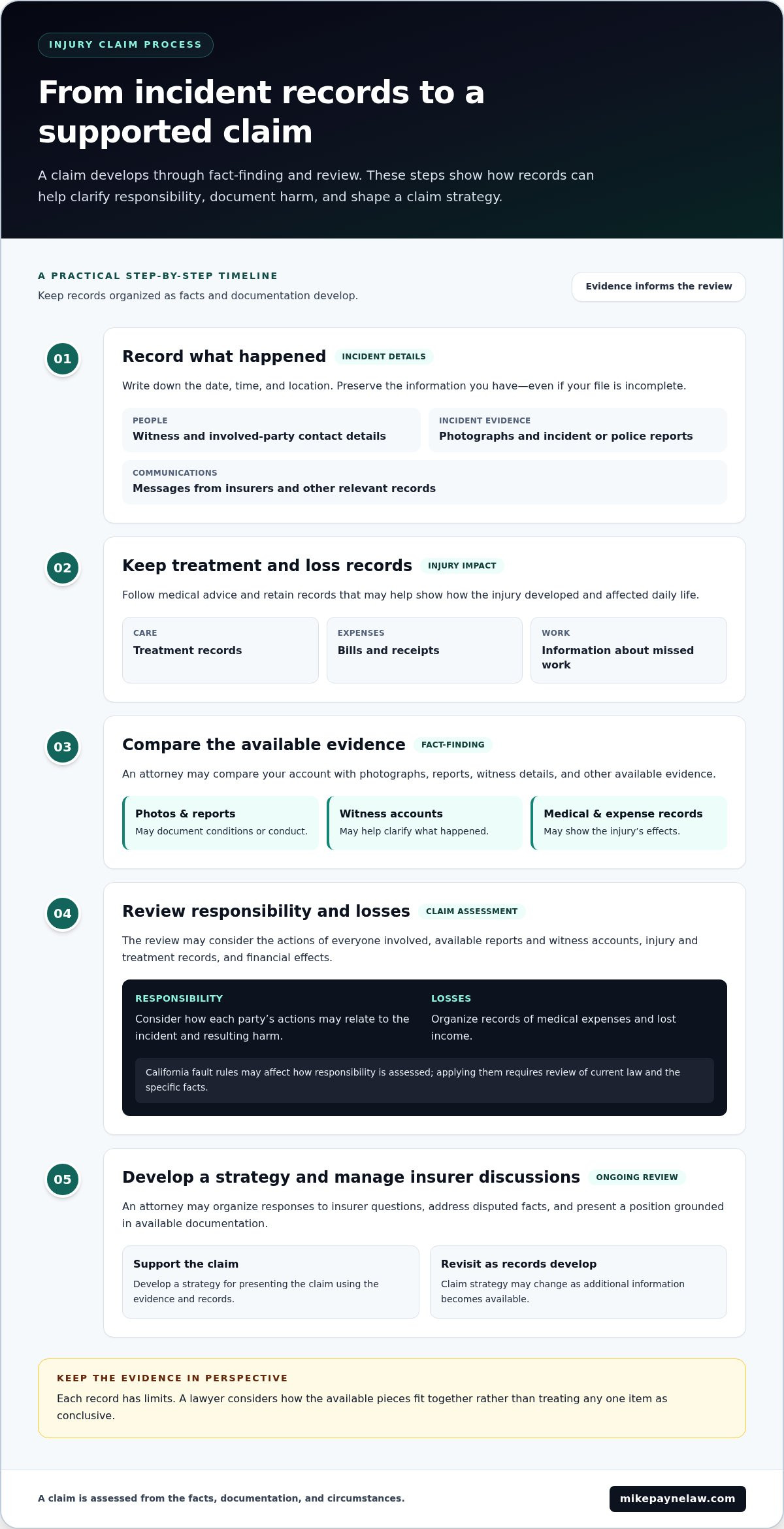
A claim develops through fact-finding and review, not a single conversation. An abogado de lesiones starts with your account, then helps identify evidence that may clarify responsibility, document the injury, and support a practical claim strategy.
What information helps an attorney assess an injury claim?
Begin by preserving what you have. Write down the date, time, and location. Save contact details for witnesses and other involved parties, along with photographs, incident or police reports, and insurer messages. An incomplete file is still useful. Your first account is a starting point, not a final evaluation of the claim.
Follow medical advice and retain relevant treatment records, bills, receipts, and information about missed work. These documents can help show how the injury developed and affected daily life. An attorney may then:
- Compare your account with photographs, reports, witness details, and other available evidence.
- Review how each party’s actions may relate to the incident and the resulting harm.
- Organize treatment and expense records to assess the losses being claimed.
- Develop a strategy for presenting the claim and responding to insurer questions.
Different records can help establish different parts of a claim. Photographs or reports may document conditions or conduct, witness accounts can clarify what happened, and medical and expense records can show the injury’s effects. Each piece has limits, so a lawyer considers how the records fit together rather than treating any one item as conclusive.
How does an attorney evaluate fault and losses?
The review may include the actions of everyone involved, available reports and witness accounts, injury and treatment records, and financial effects such as medical expenses or lost income. California fault rules can affect how responsibility is assessed, so applying them requires careful review of current law and the specific facts. For broader context, see this overview of injury practice areas.
Insurer communication is also part of claim management. An adjuster may request records or ask questions while evaluating a claim. A lawyer can help organize responses, address disputed facts, and keep discussions grounded in the available documentation. The goal is to present a position supported by the evidence, not to assume every insurer interaction is improper.
Claim strategy depends on the evidence and circumstances, and it may change as records develop. If you’re unsure how your documents fit together, you can contact the Law Offices of Michael D. Payne to discuss your situation. A contingency fee is tied to recovery, with specific terms set out in the written agreement.
Injury Lawyer Fees, Case Costs, and Realistic Expectations
Cost concerns are understandable, especially when an injury has disrupted your income. In a contingency-fee arrangement, the lawyer’s fee is tied to a financial recovery under the terms you agree to. This arrangement means you don’t pay an hourly attorney fee as the work proceeds, but it doesn’t eliminate every expense or guarantee a recovery.
What does a contingency fee mean?
The written agreement explains how the attorney’s fee is calculated and what happens under different outcomes. Payne uses a pre-negotiated contingency fee and advances litigation costs. Those costs are separate from the attorney’s fee. Read the agreement carefully, including its explanation of costs and any repayment terms, before signing. Ask for clarification about anything you don’t understand.
For a general explanation, Cornell Law School’s Legal Information Institute defines a contingency fee as an arrangement in which payment depends on the outcome of a case. Your signed agreement controls the specific terms of your representation.
How do hourly and contingency arrangements differ?
The comparison below describes general billing structures, not a quote. Actual terms vary by lawyer and agreement.
| Billing structure | How it generally works |
|---|---|
| Hourly billing | The client is charged for legal work based on time spent, under the agreed rate and billing terms. |
| Contingency arrangement | The attorney’s fee is tied to a financial recovery under the written agreement. Litigation costs are separate and should be addressed in that agreement. |
Can a lawyer guarantee how much a claim will recover?
No responsible estimate can turn uncertainty into a promise. Evidence, disputed liability, the nature and course of injuries, available insurance coverage, and legal issues can all affect a claim. The time needed to resolve it can also vary as facts develop and the parties respond.
Past results, including broad firm-wide figures, don’t predict what will happen in an individual case. A careful abogado de lesiones can explain the strengths, open questions, and risks shown by the available information, then adjust the strategy as new evidence emerges. The goal is an informed assessment, not an unrealistic guarantee.
How to Prepare Before Speaking With an Injury Lawyer
You don’t need a perfect file before seeking guidance. Get urgent medical care and make any necessary reports first. Then gather what you can. A brief, organized account helps an abogado de lesiones understand what happened, identify missing details, and explain possible next steps.
What should you gather before an initial legal discussion?
Start with a short timeline: when and where the incident happened, what you remember, and what followed. Add names and contact information for witnesses or other involved people, along with any photographs, incident or police reports, and insurance details or messages. Keep records as they become available, including treatment documents, bills, receipts, and notes about missed work.
If the incident happened in Los Angeles or San Bernardino County, note which agency or organization created a report and save any report number or request information you have. Don’t delay medical care or a necessary report to collect paperwork. Missing documents don’t prevent you from seeking guidance; an attorney can help identify what else may be useful.
What questions help clarify representation and communication?
Use the first discussion to understand how representation would work. Ask who will handle the case and provide updates, how you can expect to receive communication, what the written fee agreement says, and how advanced litigation costs are addressed. You can also ask about possible stages, such as evidence review, insurer discussions, or litigation if needed. For car-crash matters, read about motor vehicle accident representation.
Save this checklist:
- Write a brief timeline and note the incident location.
- Collect available photos, report details, and witness contacts.
- Gather insurance information and save insurer communications.
- Keep treatment records and injury-related expense documents as they arrive.
- Prepare questions about attorney involvement, updates, fees, costs, and possible case stages.
Bring what you have, not what you wish you had. To discuss an injury claim with Payne, contact the firm.
Choosing an Injury Lawyer in Southern California: A Clear Next Step
Choosing representation isn’t about finding someone who makes the boldest promise. Look for a lawyer who can explain how your facts will be evaluated, what evidence may matter, and what steps could follow. A clear strategy should account for the type of injury claim, disputed issues, and information still needed. If you’re looking for an abogado de lesiones, consider experience, communication, personal attention, and whether you understand the fee agreement.
What should local clients look for in an injury lawyer?
Look for experience relevant to the incident and notice whether the lawyer explains the process in plain language. Clear answers matter. So does knowing who will handle your case and how you’ll receive updates. Before signing, make sure the fee agreement explains attorney fees and case costs in understandable terms.
Michael D. Payne has more than 25 years of experience and previously worked as an insurance defense lawyer. That background can inform his review of an insurer’s position, but it cannot predict an individual outcome. Payne provides personalized representation and direct attorney involvement. The firm serves Southern California communities including West Covina, Pomona, Ontario, Covina, and nearby areas.
How can a reader take the next step?
You don’t need to have every detail settled. Be ready to share where and when the incident happened, what injuries you’re dealing with, and whether an insurer has contacted you. Relevant records or photographs may help explain the situation, but missing paperwork shouldn’t stop you from asking questions.
A useful first conversation should help you understand the issues to consider, possible next steps, and how communication and fees would work. You can take time to review the information and decide what feels right. No lawyer can promise a particular recovery or timeline, and a careful discussion should make that clear.
If you want to discuss your situation with Payne, contact the firm. Share what you know, ask about the issues that remain unclear, and decide how you want to proceed.
Take the Next Step With Clear Information
A well-prepared injury claim starts with a clear account of what happened and records that help document the harm. An injury lawyer can assess responsibility, evidence, insurance issues, and possible next steps, but no lawyer can guarantee a recovery or timeline. Before choosing an abogado de lesiones, understand who will handle your case and what the written fee agreement says about attorney fees and litigation costs.
Michael D. Payne has more than 25 years of experience representing injured clients, including prior work as an insurance defense lawyer. The firm uses a contingency-fee arrangement and advances litigation costs; the written agreement explains the specific terms. That experience can inform claim evaluation, while each case remains unique.
If you’re ready to talk through what happened, share the incident details, your injuries, and any insurer contact. Discuss your situation with Michael D. Payne and learn what steps may make sense. The firm serves injured clients in West Covina, Pomona, Ontario, Covina, Chino, Fontana, San Bernardino, Baldwin Park, and Azusa.
Frequently Asked Questions
What does an injury lawyer do?
An injury lawyer reviews how an incident happened, considers who may be responsible, evaluates available evidence, and advises you about pursuing a claim. The lawyer may communicate with insurers and help organize records of medical treatment, expenses, and other losses. The strategy depends on the specific facts and evidence. Legal representation cannot guarantee a settlement, judgment, or particular recovery, and it doesn’t replace medical care.
When should I contact an injury lawyer after an accident?
You can seek guidance when fault is disputed, injuries are significant, multiple parties may be involved, or an insurer requests information you’re unsure how to handle. Get necessary medical care promptly and preserve relevant records and communications. Don’t rely on one general deadline for every case: California filing periods and exceptions depend on the type of claim and circumstances, so the applicable rules need to be considered for your situation.
How much does an injury lawyer cost in California?
With contingency-fee representation, the attorney’s fee depends on a successful financial recovery under the written agreement. Litigation costs are separate, and the agreement should explain how they are handled. Payne uses a pre-negotiated contingency fee and advances litigation costs. Review the written terms carefully before retaining counsel, including how fees and costs are addressed.
Can I handle an injury claim without a lawyer?
Some people handle straightforward claims themselves, but disputed fault, serious injuries, multiple parties, or complicated insurance coverage can make legal guidance useful. Consider the evidence, the issues involved, and whether you’re comfortable organizing claim documents and communicating with insurers. Hiring a lawyer doesn’t guarantee a higher recovery. An abogado de lesiones can review the available facts and explain options, helping you make an informed decision about representation.
What should I bring to an injury lawyer consultation?
Bring what you have: a short timeline of the incident, photographs, witness contact details, available incident or police reports, insurance correspondence, and medical or expense records. These materials can help explain what happened and how the injury has affected you. You can still seek guidance if some documents are missing. Don’t postpone necessary medical care or risk a legal deadline while trying to assemble a complete file.
How long does an injury claim take in California?
There’s no single timeline for every claim. Treatment, disputed responsibility, evidence gathering, negotiations, and whether litigation becomes necessary can all affect how long resolution takes. A lawyer can explain what may influence the pace as facts develop, but shouldn’t promise a specific timeline. A filing deadline is different from the time it takes to resolve a claim; current California rules and exceptions should be considered for your case.
Does a contingency fee mean I pay nothing if my case is unsuccessful?
Not necessarily. The attorney’s fee and litigation costs are distinct, and the written agreement controls the specific obligations if there’s no financial recovery. Payne advances litigation costs, but don’t assume how those costs are repaid or handled without reviewing the contract. Before signing, ask for a plain-language explanation of both the fee and cost provisions so you understand the terms.
The firm serves injured clients in West Covina, Pomona, Ontario, Covina, Chino, Fontana, San Bernardino, Baldwin Park, and Azusa. Contact Payne to discuss your injury claim.