

Can you bring an inadequate lighting slip and fall claim if darkness made a hazard hard to see? Poor lighting alone doesn’t prove a property owner is liable. But if dim or broken lights concealed a dangerous condition, and the owner knew or reasonably should have known about it, the lighting may be important evidence.
It’s understandable to worry that the property owner will say you weren’t watching your step. California’s comparative fault rules mean that being partly responsible doesn’t automatically prevent recovery, though it may affect compensation. The key questions are how the fall happened, whether the property was reasonably safe, and what the owner knew or should have known.
This guide explains how lighting, hidden hazards, and notice can factor into a California claim, and what photos, witness accounts, incident reports, and maintenance records may help show what happened. Because the scene can change and records may not be kept indefinitely, document what you can promptly and safely. The Law Offices of Michael D. Payne represents people in slip and fall and premises liability matters. Attorney Michael D. Payne’s experience, including his former work for insurance companies, can help assess how the other side may challenge a lighting claim.
Key Takeaways
- An inadequate lighting slip and fall claim depends on how visibility contributed to the hazard and whether the property owner used reasonable care.
- Actual and constructive notice are different. The surrounding facts help show whether the owner knew or should have known about the unsafe condition.
- Lighting controls, maintenance records, witness accounts, and medical documentation may help clarify what happened, but no single item proves a claim on its own.
- After a fall, prioritize safety and medical care, report the incident accurately, and keep a copy of any written report.
- A premises liability lawyer can evaluate causation, injuries, and possible defenses, then take steps to review records and preserve relevant evidence.
When Can Inadequate Lighting Contribute to a Slip and Fall Claim?
A fall in a dark area deserves careful review, not an automatic yes-or-no answer. An inadequate lighting slip and fall claim depends on more than whether a space seemed dim. Consider what made the area dangerous, whether the lighting made that hazard difficult to see, and whether the conditions contributed to the fall and resulting injury.
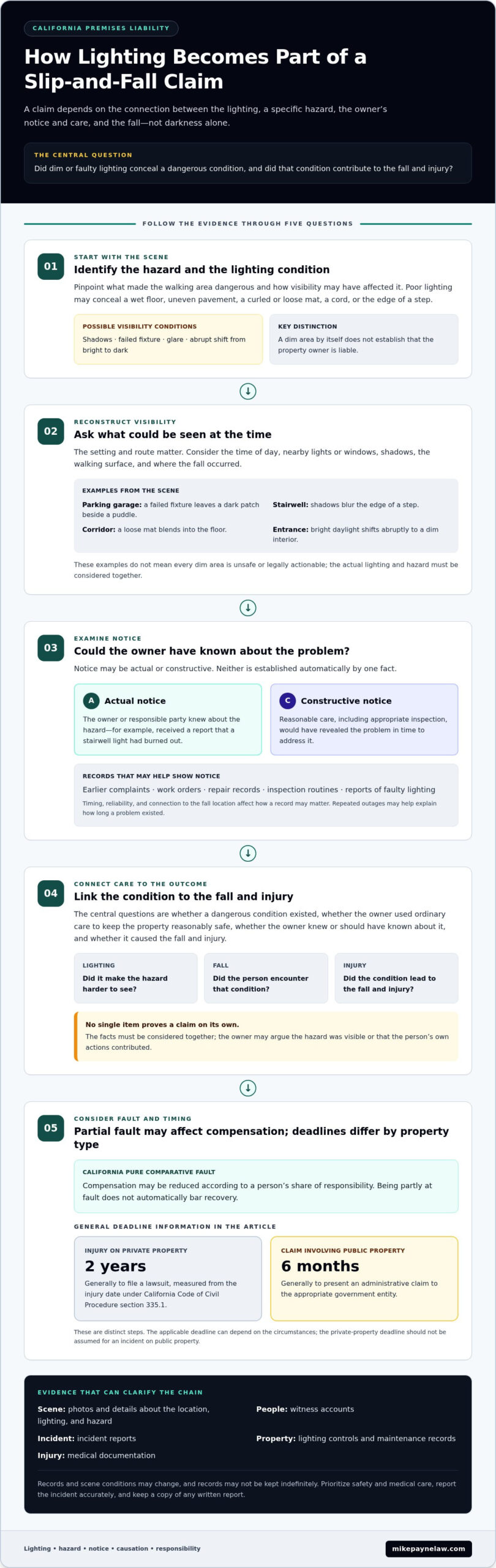
Lighting may be inadequate when shadows, a failed fixture, glare, or an abrupt shift from bright to dark makes a walking surface or hazard hard to see. Poor visibility can conceal a wet floor, uneven pavement, a curled or loose mat, a cord, or the edge of a step. The same lighting can pose different risks depending on the location and the hazard, so the specific scene matters.
Poor lighting may become relevant to a premises liability claim when it obscures a dangerous condition, reasonable care could have addressed the risk, and the evidence connects that condition to the fall and injury. Dimness alone doesn’t establish responsibility. A claim needs a factual link between the lighting, the hazard, and what happened. A general overview of a slip and fall injury can explain the type of incident, but each fall requires an individual assessment.
Where poor lighting can hide a walking hazard
Imagine walking through a parking garage where a failed fixture leaves a dark patch beside a puddle. In a stairwell, shadows may blur the edge of a step; in a corridor, a loose mat may blend into the floor. At an entrance, a sudden transition from bright daylight to a dim interior can make a change in floor level harder to notice. Outdoor walkways may also have uneven patches of light.
These examples don’t mean every dim area is unsafe or legally actionable. The question is whether the actual lighting and hazard created a risk that could reasonably have been addressed.
Why the fall’s location and circumstances matter
Details help explain what a person could see at the time. The time of day, nearby lights or windows, shadows, and the route taken can all shape the account. The hazard matters too: a dark patch over a raised edge presents a different question from a clear, unobstructed floor in a dim room.
Other conditions may also contribute. A spill, damaged surface, or obstruction can combine with poor visibility, so consider the full setting and the common causes of slip and fall accidents. Pinning down where the fall occurred and what was on the walking surface can help clarify whether lighting played a meaningful role.
What Must Be Shown in a California Inadequate Lighting Claim?
A dark area by itself doesn’t establish that a property owner is liable. In California, the central questions are whether a dangerous condition existed, whether the owner used ordinary care to keep the property reasonably safe, whether the owner knew or should have known about the condition, and whether it caused the fall and injury. The facts must be considered together, rather than treating one detail as decisive.
A California inadequate lighting claim turns on whether a dangerous condition existed, the owner had actual or constructive notice, reasonable care was lacking, and the condition caused the injury. For an inadequate lighting slip and fall claim, that means connecting the lighting to a specific hazard and explaining how the darkness made it harder to see before the fall. The National Safety Council’s statistics on slips, trips, and falls offer broader safety context, but they don’t prove what happened at a particular property.
Notice, maintenance, and reasonable care
Actual notice means the owner or responsible party knew about the hazard, such as receiving a report that a stairwell light had burned out. Constructive notice asks whether reasonable care, including appropriate inspection, would have revealed the problem in time to address it. Neither is established automatically by one fact.
Earlier complaints, work orders, repair records, inspection routines, and reports about faulty lighting may help show notice. A record of repeated outages, for example, could help explain how long a problem existed. Maintenance logs may show when a fixture was last checked or repaired. The importance of any record depends on its reliability, timing, and connection to the location of the fall.
How California law treats fault and deadlines
Causation matters. Evidence should help show that poor lighting obscured the hazard, that the injured person encountered it, and that this led to the fall and injury. The owner may argue the hazard was visible or that the person’s own actions contributed. California follows pure comparative fault: a person’s compensation may be reduced according to their share of responsibility, but partial fault doesn’t automatically bar recovery.
Deadlines also deserve prompt attention. For an injury on private property, California Code of Civil Procedure section 335.1 generally provides two years from the injury date to file a lawsuit. A claim involving public property generally requires an administrative claim to the appropriate government entity within six months. These are distinct steps, and the applicable deadline can depend on the circumstances. Don’t assume the private-property deadline applies to an incident on public property.
Because notice, causation, fault, and deadlines are fact-specific, a premises liability attorney can review how they fit together. Attorney Michael D. Payne brings over 25 years of experience, including a former insurance defense background that is relevant to evaluating possible challenges. The Law Offices of Michael D. Payne represents clients in communities including West Covina, Pomona, Ontario, Covina, Chino, Fontana, San Bernardino, Baldwin Park, and Azusa.
Which Evidence Can Strengthen or Weaken a Poor-Lighting Claim?
Evidence is most useful when it answers separate questions: What did the scene look like? Did someone know about the lighting problem? Did it contribute to the fall? What injuries followed? An inadequate lighting slip and fall claim may draw on several kinds of proof, but no single photo, report, or record settles every issue.
| Evidence | What it may help establish | Limitations |
|---|---|---|
| Scene photographs or video | The hazard’s position, nearby fixtures, shadows, and the route through the area. | Images taken later may not show the lighting, hazard, or conditions as they were at the time of the fall. |
| Lighting controls and fixture information | Whether lights were switched off, controlled by a timer or sensor, or reported as faulty. | Settings or fixture condition may have changed after the incident; the information needs context. |
| Incident reports | When the incident was reported, what was recorded, and who received the report. | A report may omit details or reflect only what the person completing it observed. |
| Witness accounts | What others saw before or after the fall, including visibility and the hazard’s condition. | People may remember events differently or have had limited views. |
| Maintenance and inspection records | Past complaints, inspections, repairs, or recurring lighting issues relevant to notice. | A record’s meaning depends on its timing and connection to the location and fixture involved. |
| Medical documentation | The injuries reported, treatment received, and effects documented by clinicians. | Medical records address injury and care, not by themselves how the fall happened or who was responsible. |
Document the scene and preserve records
If it’s safe, photograph the hazard, surrounding floor, nearby light fixtures, shadows, and the route you took. Take more than one angle, and don’t move or touch anything just to improve a picture. Write down the date, time, exact location, and weather if relevant. Note any changes you observe afterward, such as a replaced bulb or repaired surface. Later photographs can still help, but record when they were taken and what may have changed.
Surveillance footage and maintenance records may not be retained indefinitely. Make a prompt written request identifying the location and incident date, then save your request and any response. OSHA’s lighting requirements apply to covered construction settings. They aren’t a universal standard for every property or a substitute for evaluating the facts of a fall.
Use reports, witnesses, and medical records carefully
Report what happened accurately. Keep a copy of any written incident report, and note who received it and when. If witnesses are willing, record their names and contact details. Don’t coach anyone or ask them to change or align their account.
Seek medical evaluation for injuries and follow clinicians’ advice. Prompt records can document symptoms and treatment, while diagnosis and care decisions belong to medical professionals. Scene evidence, prior-notice records, accounts of the fall, and medical documentation can each clarify a different part of the event. No single item needs to prove everything.
What Should You Do After a Fall in a Dimly Lit Area?
Start with your health and safety, not paperwork. Once you’re out of immediate danger, take practical steps to document what happened and preserve information that may help explain the fall. You don’t need to determine fault on the spot. Stick to what you know and avoid filling gaps with guesses.
- 1. Get to a safe place and seek medical care. If you’re seriously hurt or can’t move safely, ask someone nearby for help. Get prompt medical attention for injuries, even if symptoms seem manageable at first, and follow the treating professional’s guidance.
- 2. Report the incident accurately. Tell the property manager, owner, or staff what happened, where you fell, and what you noticed about the lighting and walking surface. Ask for a copy of any written report, or note who took it and when.
- 3. Preserve the scene details. If it’s safe and appropriate, take photos of the area, hazard, nearby lights, and route you walked. Write down the date, time, precise location, and weather if relevant. Note any changes you later observe. Don’t edit photos to make conditions appear different.
- 4. Save names and communications. Record witness names and contact details without suggesting what they should say. Keep emails, letters, call notes, report copies, and any claim number together. Save original messages and documents.
- 5. Organize injury and expense records. Keep medical paperwork, receipts, and records of missed work in one place. These materials can help document the injury’s effects. Leave diagnosis and treatment decisions to clinicians.
- 6. Pause before making commitments. If an insurer asks for a recorded statement or sends a release, understand what it covers and how it may affect a claim before agreeing or signing. Be truthful and concise in communications. Don’t speculate about details you don’t know or accept blame just to provide an answer.
Prioritize health and make a clear record
While the incident is fresh, write down what you remember in plain language: where you were going, what you could see, what you encountered, and how you fell. Separate what you personally observed from what someone later told you. Organize records by date so details are easier to follow as medical care and communications continue.
Be careful with insurers and early statements
Keep a simple log of calls, letters, claim numbers, and deadlines an insurer communicates. If you’re uncertain how a statement or release could affect your situation, seek legal guidance before responding or signing. An attorney can assess the available evidence and next steps through California premises liability representation.
Attorney Michael D. Payne has over 25 years of experience and previously worked as an insurance defense lawyer. That background can help identify how an insurer may challenge an inadequate lighting slip and fall claim. To discuss your circumstances and possible next steps, contact Payne.
How Can a California Premises Liability Lawyer Assess Your Claim?
A lawyer’s review can help turn a confusing fall into a clearer set of questions. In an inadequate lighting slip and fall claim, counsel may assess whether a specific hazard existed, how the lighting affected visibility, what the property owner knew or should have known, and whether the conditions contributed to the fall and injuries. The review also considers how the other side may dispute those points.
What an initial case review can clarify
The review may begin with your account and any scene photographs, incident reports, witness information, maintenance records, and medical documents available. Counsel can compare what those materials show with what remains unknown. For example, a photo may capture a damaged step but not establish how long it was there or whether the lighting made it difficult to see. Identifying those gaps helps guide what information may be worth pursuing.
An attorney can also assess causation and possible comparative-fault arguments. The property owner or insurer may claim the hazard was visible, the lighting was adequate, or another factor caused the fall. Those positions should be considered against the full record, not accepted as fact. A case review can identify factual strengths, weaknesses, and questions that need further investigation, but it can’t guarantee a particular outcome.
Payne provides slip and fall legal representation as part of its premises liability work. Attorney Michael D. Payne has over 25 years of experience, including prior work as an insurance defense lawyer. That background can inform how he evaluates an insurer’s likely arguments and the evidence that may answer them.
Choosing a next step without added uncertainty
Preserving relevant evidence may be important, especially if records or footage could be lost or conditions have changed. Depending on the case, an attorney may review available records, seek relevant information, and take steps to preserve evidence. The purpose is to build a fact-based assessment, not promise that any one document or legal strategy will establish liability.
The firm uses a contingency fee arrangement: attorney fees depend on a successful financial recovery, and the firm advances litigation costs. The specific terms are governed by the fee agreement. This approach means clients pay attorney fees only if a successful recovery is achieved, while keeping the focus on the facts, legal issues, and potential next steps.
If you’re unsure whether the lighting, hazard, or available records support further action, a conversation can help you understand what needs closer review. Contact the firm about your premises liability claim to discuss your circumstances with Payne.
Take the Next Step Toward Clarity
The scene may change, and questions about responsibility can become harder to answer as time passes. You don’t have to decide alone whether the lighting, the hazard, or the property owner’s response warrants further action. A thoughtful legal review can help you understand what your evidence shows and what questions remain.
An inadequate lighting slip and fall claim deserves a careful, fact-based assessment. Michael D. Payne brings over 25 years of experience and a former insurance defense perspective to evaluating how an insurer may challenge a claim. The firm works on a contingency fee basis and advances litigation costs. These arrangements don’t guarantee a recovery, but they can help you explore your options without letting uncertainty make the decision for you.
Take a measured next step. Talk with Michael D. Payne about your fall and your options. Payne represents people in West Covina, Pomona, Ontario, Covina, Chino, Fontana, San Bernardino, Baldwin Park, and Azusa. Discuss your circumstances with the firm to make an informed choice about what comes next.
Frequently Asked Questions
Can I file a slip and fall claim if the only problem was poor lighting?
You may have a claim to investigate, but dim lighting alone doesn’t automatically make a property owner responsible. The key is whether the lighting made a dangerous condition hard to detect and whether the available facts support a connection to your fall and injury. A dark stairwell with a broken step raises different questions from a dim room with a clear, level floor. The specific setting matters.
What must I prove in a California inadequate lighting slip and fall claim?
You generally need evidence of an unsafe condition, a basis for finding the property owner failed to use reasonable care, and a connection between that condition and your injury. Notice can matter if the owner didn’t create the hazard. Evidence that a light was out may be relevant, but you’d also need to consider how the darkness affected visibility and whether encountering the hazard caused the fall.
How do I prove the property owner knew about broken or inadequate lighting?
Look for records that may show awareness or reveal how long the problem existed. A maintenance ticket reporting a failed fixture, a tenant’s dated email, or a repair request can help establish actual notice. Inspection logs or recurring repair entries may help assess whether reasonable inspections should have uncovered the issue. A single complaint or missed inspection doesn’t decide liability; its timing and relationship to the fall location matter.
Can I still recover compensation if I was partly responsible for my fall?
Yes, partial responsibility doesn’t automatically prevent recovery under California’s pure comparative fault system. Any compensation may be reduced based on your share of responsibility. An insurer might argue that you were distracted, while other evidence may show that a hazard was difficult to see. Don’t assume an accusation settles the issue. How fault is assessed depends on the evidence and circumstances of the incident.
What evidence should I collect after falling in a dark parking lot or stairwell?
If it’s safe, photograph the area from where you approached and where you fell, including light fixtures, stairs, signs, and visible hazards. Keep original files, note when each image was taken, and save messages or requests sent to the property manager. Write down witness contact details and note whether nearby businesses or building staff may have incident footage. Don’t trespass or put yourself at risk to collect evidence.
How long do I have to file a California slip and fall claim?
For an injury on private property, the general deadline to file a personal injury lawsuit is two years from the injury date under California Code of Civil Procedure section 335.1. If the fall involved government property, an administrative claim generally must be filed with the responsible entity within six months. These deadlines involve different procedures, and exceptions may apply. Identify who owns or controls the location and get legal guidance promptly.
Does a property owner have to repair a burned-out light immediately?
There isn’t one universal repair deadline for every burned-out light in every property. The assessment can depend on the location, how the darkness affects safety, what the owner knew or reasonably should have discovered, and what steps were practical in the circumstances. A dark stairway may present a different risk from a decorative light in a low-traffic area. Records of reports, inspections, and interim warnings may help clarify the response.
How can a slip and fall attorney help evaluate an inadequate lighting claim?
An attorney can assess how the lighting, hazard, notice, and your injuries fit together, then identify records or witnesses that may clarify disputed facts. Michael D. Payne’s former insurance defense experience can inform his assessment of potential insurer arguments. Payne represents people in West Covina, Pomona, Ontario, Covina, Chino, Fontana, San Bernardino, Baldwin Park, and Azusa. A review can identify issues, not guarantee an outcome.