

Black box data in a truck accident lawsuit can help show what a truck was doing just before and during a crash. Depending on the system, records may include speed, braking, steering, and other vehicle information. This evidence can help reconstruct the collision, but it should be preserved promptly because continued use of the truck may overwrite data.
It’s understandable to want clear answers when a crash causes serious injuries and accounts conflict. Electronic records can offer useful details, but they are only part of the picture. Physical evidence, witness accounts, and other records may also help explain what happened.
This article explains what truck black boxes may record, how data can be lost, and how experts use it to reconstruct a crash and support a legal claim. It also discusses how this evidence may factor into verdicts and settlements, without suggesting that any past result predicts the outcome of another case.
Key Takeaways
- Learn what a truck’s event data recorder may capture and how those details can help clarify the moments surrounding a crash.
- Understand why electronic records may be overwritten and why prompt preservation can matter.
- See how driver logs and inspection records can add context to electronic data and help test competing accounts.
- Explore how black box evidence has contributed to past truck accident verdicts and settlements, while recognizing that each case turns on its own evidence.
What Is a Truck’s Black Box?
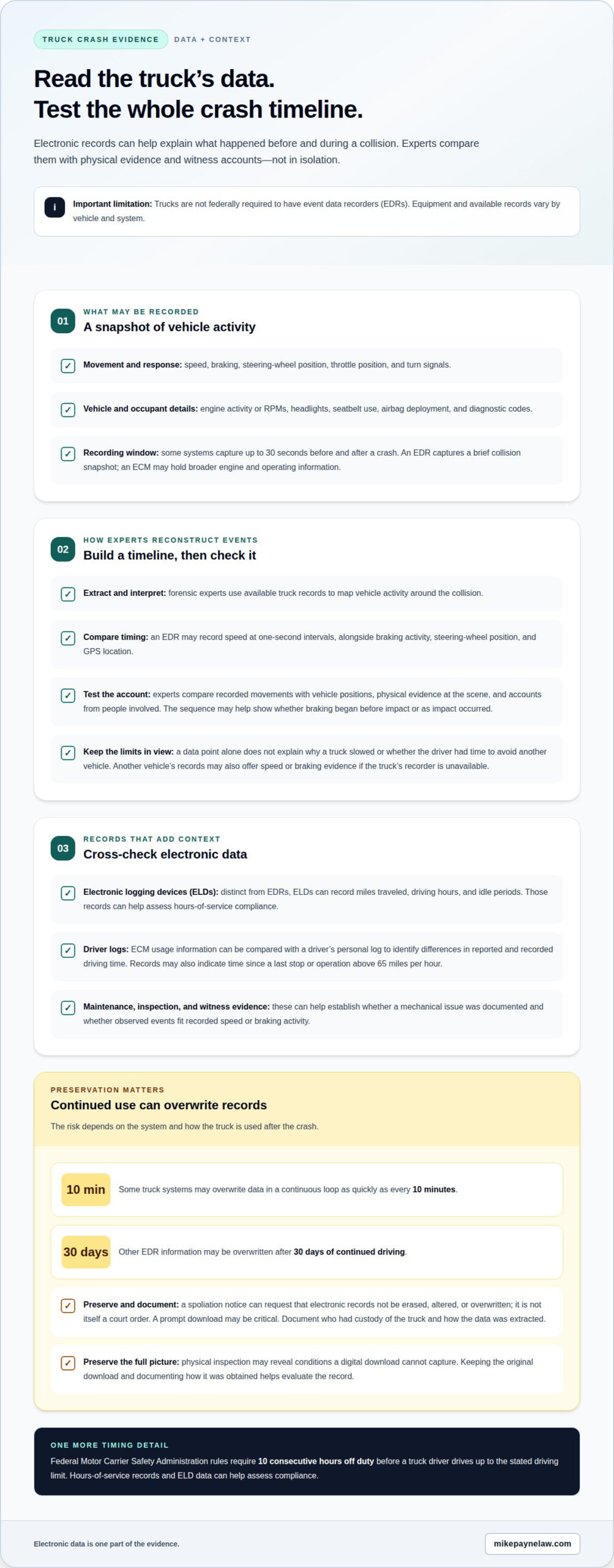
A truck’s “black box” usually refers to an event data recorder (EDR) or electronic control module (ECM). An EDR can capture vehicle and occupant information for seconds before, during, and after a collision. Depending on the system, records may include speed, braking, steering, engine activity, or seatbelt information. Federal regulations don’t require event data recorders in trucks, so equipment and available data can differ.
Rules about ECM data and preservation can vary by state. Some states treat the data as the trucking company’s property, while other legal rules may affect whether records must be preserved for a civil case. Federal Motor Carrier Safety Administration rules require 10 consecutive hours off duty before a truck driver drives up to the stated driving limit.
Act promptly to protect records that could be overwritten as the truck returns to service. A preservation letter, also called a spoliation notice, can ask the trucking company and other parties to safeguard the ECM and related electronic records. It should identify the crash and request that data not be erased, altered, or overwritten. A letter documents the request, but it is not itself a court order.
The parties can also agree in writing to preserve the truck and its data. If they cannot agree, an attorney may seek a protective order. A court order can limit access to or movement of the truck before inspection, helping protect evidence from being changed. The inspection should document who had custody of the truck and how the data was extracted.
Retrieval and analysis costs depend on the truck’s recording system, access to the vehicle, and the technical work needed to interpret its data; the price is provided after a quote request. Preserving the truck also matters because an inspection may reveal relevant physical conditions that a digital download cannot capture.
Can a Driver Lose or Overwrite Black Box Data?
Yes. Continued driving can replace collision records, and some truck systems may overwrite data in a continuous loop as quickly as every 10 minutes. Other event data recorder (EDR) information may be overwritten after 30 days of continued driving. The risk depends on the system and how the truck is used after the crash.
An EDR captures a brief snapshot around a collision, while an electronic control module (ECM) may store broader engine and operating information. Depending on the equipment, records can include speed, braking, steering movement, throttle position, engine RPMs, turn signals, headlights, seatbelt use, airbag deployment, and diagnostic codes. Some systems record up to 30 seconds before and after a crash. A truck’s records may also indicate how long it traveled since its last stop or how long it operated above 65 miles per hour.
Federal rules distinguish electronic logging devices from event data recorders. Federal Motor Carrier Safety Administration rules address hours-of-service records; electronic logging devices can record miles traveled, driving hours, and idle periods. Those records can help assess compliance with safety regulations. Federal regulations do not require event data recorders in trucks, so EDR availability and recorded information depend on the vehicle’s equipment.
Logs and maintenance records add context. For example, ECM usage data can be compared with a driver’s personal log to identify differences between reported and recorded driving time. Inspection and maintenance records may show whether a mechanical issue was documented before the collision. Witness accounts can also be compared with recorded speed or braking activity.
When a truck keeps operating, preserving its data is important. A spoliation notice can ask the trucking company to protect electronic records, but a prompt download may be critical to prevent data from being overwritten. The Law Offices of Michael D. Payne represents people injured in truck accidents and can address evidence preservation and access to records when a trucking company or insurer disputes a personal injury claim.
Accident reconstruction
Black box records can help experts build a timeline of a truck collision. They compare electronic readings with physical evidence and accounts from people involved.
Reconstructing Crashes with Black Box Data
Crash reconstruction uses recorded vehicle information to assess how a collision unfolded. Forensic experts can extract and interpret truck data, then compare it with evidence from the scene. The timeline can help test whether a driver’s account fits the vehicle’s recorded movements. For an injured person, that comparison may clarify disputed events and help connect the collision to the injuries and resulting claims. Black box data in a truck accident lawsuit can make the timeline more precise.
Speed and Braking Evidence
Speed and braking records can help show how a truck responded before impact. An EDR may record vehicle speed at one-second intervals, along with braking activity, steering-wheel position, and GPS location. Experts can compare those readings with physical evidence, such as the vehicles’ positions after impact. The sequence may help determine whether braking began before the collision or as impact occurred.
Those readings need context. A data point does not, by itself, explain why a truck slowed or whether the driver had time to avoid another vehicle. Reconstruction experts assess the timing and consistency of available records. They may also compare the truck’s data with information from another vehicle involved, which could provide speed or braking evidence if the truck’s recorder is unavailable.
When a collision triggers an airbag or another recording event, information may be extracted and saved to a separate digital device. Preserving the original download and documenting how it was obtained helps attorneys evaluate the record and explain its meaning. Evaluating black box data in a truck accident lawsuit also means examining how the electronic record fits with the rest of the evidence.
Black box evidence is strongest when considered alongside independent details. Scene photographs, vehicle damage, camera footage, witness statements, road conditions, and expert opinions can support or challenge the timeline. In truck accident cases, this combined evidence helps attorneys assess driving conduct, possible negligence, and how the crash caused an injury. It can also document the factual basis of a claim without treating a single electronic reading as the whole story.
Black box data in truck accident verdicts and settlements
Black box evidence can affect how parties assess a truck accident claim, but a device reading alone does not determine its outcome. Its value depends on what the system records and how well the information fits the other evidence.
Black Box Evidence in Case Outcomes
In settlement discussions or at trial, electronic records may help clarify a disputed fact, such as whether the truck slowed before impact. A reconstruction expert can explain how a recorded reading relates to the vehicles’ positions, while photographs or witness accounts may support or challenge that interpretation. A clear connection between the data and the collision can make a claim’s factual basis easier to evaluate.
Results still depend on the full record, including the injuries, available vehicle evidence, and each party’s account. For example, a speed reading may matter differently if scene evidence supports a sudden stop or another vehicle’s records suggest a conflicting timeline. Settlement discussions consider the evidence and disputed issues; a verdict depends on the evidence presented for the factfinder’s consideration.
Reliability and Court Admissibility
Reliability concerns whether the record accurately reflects the truck’s system and whether its extraction and interpretation can be explained. An attorney may work with a qualified expert to examine the download, identify what the device captured, and compare it with other evidence. That process helps address challenges about data handling or the meaning of a particular reading.
Whether a court admits a record depends on the legal and evidentiary issues in the case. A judge may consider questions about the device, the method used to recover information, and the expert’s explanation. Even if admitted, the data does not prove every disputed point by itself. Its weight depends on how consistently it fits the physical evidence, witness statements, and other records.
Preserving the original record and documenting its handling can help answer later questions about its integrity. If you need to discuss electronic evidence after a truck collision, contact an attorney about your truck accident claim.
Law Offices of Michael D. Payne: Truck Accident Representation
The Law Offices of Michael D. Payne represents people injured in truck accidents, including cases where electronic records may help explain how a collision happened. The firm can help address disputes over fault, preserve relevant evidence, and evaluate how available records support a personal injury claim.
A truck’s data is only one part of a case. Driver logs, inspection records, witness accounts, and crash-scene evidence may add context or reveal gaps. Legal representation can help bring those pieces together and respond when the trucking company or insurer challenges the evidence or your account of the crash.
If you were injured in a truck collision and need help understanding your claim, contact Law Offices of Michael D. Payne to discuss your situation.
Take the Next Step Toward Protecting Your Claim
The next step is to make sure decisions about the truck and its records don’t happen without your interests represented. Keep copies of crash-related communications and note any updates from the trucking company or insurer. These details can help an attorney understand what has happened since the collision and identify questions that need attention.
Discussing black box data in a truck accident lawsuit with a lawyer can help you understand how electronic evidence fits with your injuries, the available records, and the claim process. You deserve clear guidance while you focus on recovery. A careful review can help you understand your options, even when the other side disputes what happened.
Contact Law Offices of Michael D. Payne to discuss your truck accident claim. Taking that step can help you approach the next decisions with support and renewed confidence.
Frequently Asked Questions
Can black box data be used in criminal cases as well as civil lawsuits?
Yes, electronic vehicle records can be relevant in criminal proceedings as well as civil lawsuits. Their value depends on how they relate to the incident and how investigators or the parties interpret them. For example, a recorded vehicle action could help examine a disputed account, while other evidence provides context. The data alone doesn’t establish criminal responsibility or civil liability.
Can weather conditions be determined from black box data alone?
No. A truck’s recorder captures information from vehicle systems, not the surrounding weather itself. Rain, fog, or wet pavement must be established through separate evidence, such as scene photographs, nearby camera footage, witness observations, or weather records. Comparing those sources with vehicle activity may help explain how conditions affected the crash, but the electronic record alone cannot show what the weather was.
What Information Does a Black Box Give?
A black box can provide a time-linked record of selected vehicle activity around an event. The exact information depends on the truck’s equipment and the data available for extraction. For instance, a reading may help clarify whether the vehicle’s operation changed before impact. It won’t independently explain the driver’s reasons or establish every detail of the collision.
What Is an EDR?
An EDR, or event data recorder, is an electronic system that records selected vehicle and occupant information around a crash. It differs from a camera because it records system data rather than a visual scene. In a truck collision, experts can interpret an EDR download alongside other evidence to assess the vehicle’s actions and how the event unfolded.
What is Black Box Evidence?
Black box evidence includes information recovered from a vehicle’s onboard recording system, along with material explaining how it was extracted and interpreted. For example, a downloaded file may be presented with an expert’s explanation of its entries. That context matters: a digital record is more useful when its source, handling, and connection to the collision are clearly explained.
What data does a truck’s event data recorder (black box) capture?
A truck EDR may capture selected operating and occupant details tied to a crash event. Depending on the system, examples include vehicle movement, driver inputs, and safety-system activity. The recorder’s make, configuration, and saved event determine which fields can be recovered. A truck may also have other electronic systems, so an EDR download isn’t necessarily a complete record of every trip or vehicle function.