

Your official accident report is the only shield you have against a dishonest driver who decides to change their story once the dust settles. Without this document, your personal injury claim is vulnerable to aggressive insurance company tactics designed to devalue your suffering. We know the confusion you’re facing. It’s exhausting to navigate the maze of the LAPD, LASD, or CHP while you’re trying to recover from a traumatic crash. You deserve a clear path forward, not a bureaucratic headache. This guide provides the definitive, step-by-step process on how to get a police report for a car accident in Los Angeles so you can secure the evidence required to win. We’ll break down the exact 2026 fee structures for each agency, explain the mandatory wait times, and show you how to obtain a certified copy that establishes clear liability. We’re here to help you cut through the red tape and move from a state of uncertainty to a position of strength.
Key Takeaways
- Secure the objective evidence you need to prevent insurance adjusters from twisting the facts of your crash.
- Navigate the specific jurisdictional requirements for how to get a police report for a car accident in Los Angeles whether the LAPD, LASD, or CHP responded.
- Decode technical California Vehicle Code violations and impact diagrams to establish undeniable liability for your injuries.
- Find out how to file a counter report or correct factual inaccuracies if the initial record is missing or contains errors.
- Learn why having a professional champion manage the administrative burden is the fastest way to move your claim toward a successful settlement.
Why Your Los Angeles Accident Report is the Foundation of Your Claim
A police report is not just a piece of administrative paperwork; it is the primary shield for your legal rights. In the chaotic moments following a crash, facts become blurred and adrenaline masks the true extent of your injuries. When you begin the process of learning how to get a police report for a car accident in Los Angeles, you are actually securing the most powerful piece of evidence for your recovery. This document provides an objective, third-party account of the collision that prevents the other driver from changing their story later. Without it, you are trapped in a “he-said, she-said” battle that insurance companies love to exploit.
Insurance adjusters are paid to save their companies money. They rarely approve significant settlements without an official police record to verify the facts. The report preserves crucial details that vanish within hours, such as the exact weather conditions, the presence of skid marks, and the contact information of neutral witnesses. It also records any citations issued at the scene, which serves as immediate proof that the other driver violated the law. If you want to move forward with a successful personal injury lawsuit, this report is your starting line.
The Role of the Investigating Officer
When an officer arrives at the scene, they act as a neutral investigator. They use their training in traffic collision reconstruction to determine how the impact occurred. The officer will look for California Vehicle Code violations, such as speeding or failing to yield, and note these in the report. While the officer’s opinion on fault is highly influential, it is not always the final word. Our team carefully reviews the “Narrative” section of the report. This is where the officer describes the sequence of events in detail. This narrative often contains the specific evidence we need to prove the other driver’s negligence and hold them accountable for your losses.
Preserving Evidence Before It Vanishes
Time is your enemy after an accident. You must request your report immediately to ensure no details are lost to memory or time. A comprehensive report links your specific injuries directly to the force and angle of the crash. This connection is vital when building a motor vehicle accident claim. It proves that your medical bills and pain are a direct result of the defendant’s actions. By obtaining this record early, you empower your attorney to challenge insurance denials with cold, hard facts. Don’t let the bureaucracy of the LAPD or LASD slow you down. Securing this foundation is the first step in our aggressive pursuit of the justice you deserve.
Step-by-Step: Requesting Your Report from LAPD or LASD
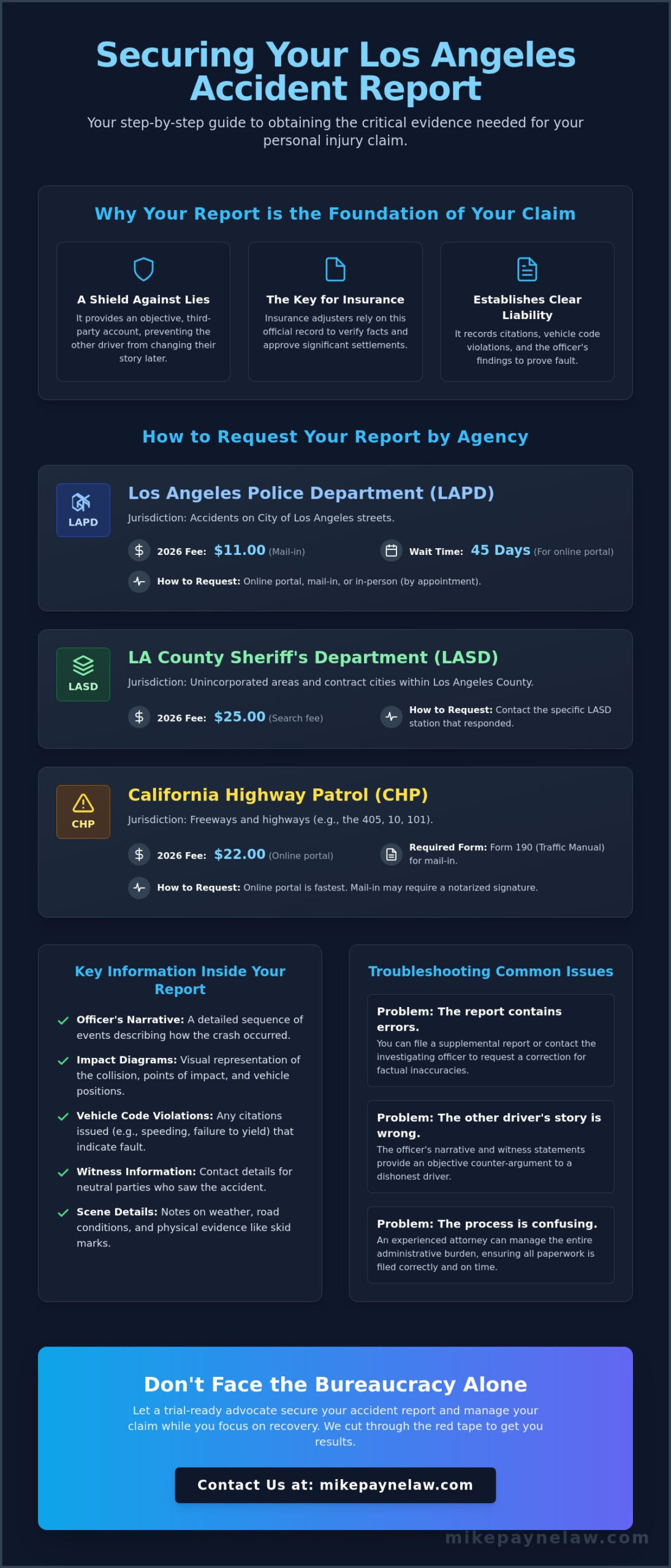
Los Angeles is a complex patchwork of jurisdictions. Knowing which badge arrived at your scene is the first step in learning how to get a police report for a car accident in Los Angeles. If the crash occurred on city streets, the Los Angeles Police Department (LAPD) likely handled it. If you were on a freeway like the 405 or the 10, the California Highway Patrol (CHP) took the lead. Accidents in unincorporated areas or contract cities usually fall under the Los Angeles County Sheriff’s Department (LASD). Identifying the correct agency prevents you from wasting weeks waiting on a record that doesn’t exist in their system.
Before you start the request, gather your case number, the exact date of the accident, and the specific location. You must also verify the current fees, which vary significantly by department. Based on 2026 data, mail-in requests for the LAPD cost $11.00, while the LASD charges a $25.00 search fee. The CHP offers an online portal for $22.00. Most agencies allow you to choose between online portals, mail-in forms, or in-person pickup by appointment. If the paperwork feels like another injury, you can contact our office to let a professional advocate handle the administrative burden while you focus on healing.
LAPD Request Procedures (City of Los Angeles)
The LAPD Records and Identification Division manages all city traffic reports. For the fastest results, use their third-party online portal. Be aware that there is a mandatory 45-day waiting period before reports appear online. If you prefer the mail, send your request to 100 West 1st Street, Los Angeles, CA 90012. You must include a check or money order and proof that you are an “Interested Party.” This typically includes your driver’s license or insurance documents proving you were involved in the collision.
LASD and CHP Request Procedures
The CHP uses a specific “Traffic Manual” request form (Form 190) for all records. If you submit this by mail, you may need a notarized signature to verify your identity. For the LASD, you must locate the specific station that handled your call, such as those serving the West Covina or surrounding county areas. The LASD currently requires appointments for in-person pickups; call (562) 345-4441 to schedule. Understanding how to get a police report for a car accident in Los Angeles through these county and state agencies requires patience and precision. One missing signature can reset your wait time by weeks.
What Information Is Hidden in a Los Angeles Police Report?
Once you hold the physical document in your hand, the real work begins. A Los Angeles traffic collision report is a dense, technical document that requires a trained eye to translate. It doesn’t just list who was involved. It provides a forensic blueprint of the negligence that upended your life. Understanding how to get a police report for a car accident in Los Angeles is only half the battle; you must also know how to weaponize the data inside to force a settlement from a reluctant insurer.
The report contains a “Remarks” section that is often a gold mine for your claim. This is where the officer records spontaneous statements made by the drivers at the scene. If the other driver apologized or admitted they were “in a rush,” those words are documented forever. Additionally, the report lists insurance policy numbers and coverage details. This information ensures that the other driver’s carrier cannot hide the true extent of the available funds for your recovery. We use these details to build an aggressive strategy that targets the maximum compensation possible.
Decoding CVC Violations
Officers use specific codes from the California Vehicle Code (CVC) to summarize illegal behavior. You might see CVC 22350, which refers to the “Basic Speed Law,” or CVC 21453 for red light violations. When an officer cites these codes, they are providing the groundwork for a legal concept called “Negligence Per Se.” This means that because the driver broke a safety law, they are presumed to be negligent. These violation codes act as a formal declaration of fault that makes it nearly impossible for the defense to deny their client’s recklessness. These codes serve as primary evidence that the defendant’s violation of the law caused your injuries.
The Narrative and Diagrams
The officer’s sketch is a visual reconstruction of the moment of impact. It shows the “Point of Impact” (POI) and the “Final Rest” positions of the vehicles. These diagrams are critical when we hire experts to prove that the other driver’s version of events is physically impossible. The narrative section will also mention indicators of impairment or signs that the driver was on their phone. If you suspect the other driver was texting, our distracted driving accident attorney uses this narrative as a starting point to subpoena phone records. We don’t just read the report; we use it to corner the opposition and demand justice for our clients.
Troubleshooting: What if the Report is Missing or Wrong?
Even after you master how to get a police report for a car accident in Los Angeles, you may discover the final document is riddled with errors or simply doesn’t exist. This is a critical moment. A mistake on your report can be the difference between a full settlement and a total denial. If the agency claims your report is “not ready” after the standard 45-day LAPD waiting period, it usually indicates a backlog or a missing piece of evidence. We step in to push these agencies for the answers you deserve. We don’t accept bureaucracy as an excuse for delaying your justice.
If the police did not attend the scene, you must take immediate action. You can file a “Counter Report” at the nearest station. This ensures there is a formal record of your version of events. For accidents involving injuries or property damage exceeding $1,000, California law requires you to submit an SR-1 form to the DMV within 10 days. A late report is always better than no report. It provides the paper trail your insurance company requires to open a claim. If you’re struggling with a missing or incorrect record, contact our team today for a professional review of your case.
Correcting Factual vs. Opinion Errors
Factual errors are objective mistakes. These include an incorrect accident date, a misspelled name, or the wrong vehicle make. You can usually fix these by contacting the reporting officer and providing documentation. Opinion errors are much harder to change. If the officer blamed you for the crash, they are unlikely to rewrite their conclusion. However, we can help you submit a supplemental statement to be attached to the official record. Never attempt to argue with an officer alone. You need a trial-ready advocate to frame your statement in a way that protects your legal interests.
Filing a Report After the Fact
Many minor accidents escalate into major medical issues days later. Understanding how to get a police report for a car accident in Los Angeles is a vital skill, but the process doesn’t end when the form is submitted. If you didn’t call 911 at the scene, you must visit a local station in person to file a “Late-Reported” incident. Bring photos, witness names, and your medical records. This creates an official timeline that links your injuries to the crash. In Los Angeles, the LASD and LAPD stations are often overwhelmed, so showing up in person with your evidence is the most effective way to ensure your report is filed correctly. We use these late-filed reports to aggressively challenge insurance companies that claim your injuries are unrelated to the accident.
Let a Trial-Ready Advocate Secure Your Los Angeles Accident Report
You shouldn’t have to battle city hall while you are fighting to recover from a serious injury. The administrative weight of dealing with the LAPD or the Sheriff’s Department is a burden you don’t need. While many people spend weeks researching how to get a police report for a car accident in Los Angeles, our clients focus on their physical therapy and their families. We take over the red tape immediately. We know exactly which windows to visit and which portals to ping to get your records fast. More importantly, we know how to use that report to shut down insurance adjusters who try to blame you for a crash you didn’t cause.
Michael D. Payne brings a unique advantage to your case. As a former insurance defense lawyer, he knows the exact tactics the other side will use to pick apart your accident report. He identifies the weaknesses in their arguments before they even present them. We don’t just read the report; we analyze it for every possible leverage point. This meticulous evidence gathering is how we maximize compensation for our clients. We turn a simple piece of paper into a formidable weapon for justice.
The Michael D. Payne Difference
We believe that your financial situation should never be a barrier to justice. Our firm advances all costs for evidence gathering. This includes the fees for police reports, expert witness consultations, and scene reconstructions. We provide aggressive West Covina car accident representation with a boots-on-the-ground approach. We don’t just sit in an office. We visit accident scenes, interview witnesses, and ensure the official report matches the reality of what happened on the road. We are local professionals who understand the specific needs of the Los Angeles community.
Start Your Recovery with a Free Consultation
Many people don’t realize that a trial-ready attorney can often pull these records as part of the initial case evaluation. You don’t have to wait for the mail to arrive before you seek legal help. Bring your case number to your initial call, and we can begin the process of verifying the facts immediately. We operate on a contingency fee model. This means you pay nothing out of pocket, and you pay no legal fees at all unless we win your case. It is a foundational promise of our firm. Don’t let a confusing government process delay your claim. Contact the Law Offices of Michael D. Payne today for a free case evaluation and let a professional champion secure the evidence you need to win.
Take Control of Your Legal Recovery Today
You now have the definitive roadmap for how to get a police report for a car accident in Los Angeles. You’ve seen how to navigate the jurisdictional maze between the LAPD and LASD. You understand that technical CVC codes and officer narratives are the keys to proving liability and protecting your future. Don’t let a clerical error or a delayed filing derail your path to justice. Michael D. Payne brings over 25 years of personal injury experience to your side. As a former insurance defense attorney, he understands exactly how the other side will try to pick apart your file. We work on a contingency fee basis; you pay nothing unless we secure a recovery for you. We’re ready to be your shield against aggressive insurance tactics. Get a Free Consultation with Michael D. Payne. You’ve been through enough stress already. Let a local professional take the lead and fight for the maximum compensation you deserve.
Frequently Asked Questions
How long does it take to get a police report in Los Angeles?
The timeline depends on the agency that responded to your crash. The LAPD typically requires a minimum 45-day waiting period before a report is available through their online portal. The California Highway Patrol generally processes records faster, often within 7 to 10 business days. Mail-in requests for the Los Angeles County Sheriff’s Department can take between 4 to 6 weeks. Knowing how to get a police report for a car accident in Los Angeles quickly is essential for meeting insurance deadlines.
Can I get a Los Angeles police report for free?
No, law enforcement agencies in Los Angeles County charge administrative fees for certified copies of accident reports. The cost ranges from $11.00 for an LAPD mail-in request to $25.00 for a search through the LASD. While these fees are a standard part of the process, our firm advances all evidence-gathering costs for our clients. We ensure that a small fee never stands in the way of building a powerful personal injury claim for the justice you deserve.
What if the police report says the accident was my fault?
An officer’s finding of fault is an influential opinion, but it is not the final word in a civil lawsuit. Officers often make mistakes based on incomplete witness statements or a lack of physical evidence at the scene. We aggressively challenge incorrect fault findings by hiring independent reconstruction experts. We use the narrative and diagrams within the report to prove the other driver’s negligence, even when the initial assessment was wrong. We don’t accept substandard resolutions based on a single officer’s error.
Do I need a police report to file an insurance claim in California?
You can technically open a claim without one, but insurance adjusters are notoriously difficult to work with when an official record is missing. Without a report, the other driver can easily change their story to avoid liability. Obtaining a report is the most effective way to lock in the facts of the crash. It provides the objective foundation required to secure a fair settlement for your medical bills and property damage. We use these reports to force adjusters to act fairly.
Can I get a police report if the accident happened on a private parking lot?
Police departments often refuse to respond to accidents on private property unless there are significant injuries or criminal activity. If an officer did not attend your parking lot collision, you must visit a local station to file a “Counter Report” in person. This creates a formal record of the incident that insurance companies will recognize. Learning how to get a police report for a car accident in Los Angeles involves knowing these station-specific procedures for incidents on private property.
What is the difference between an LAPD report and a DMV SR-1 form?
An LAPD report is an investigative document created by an officer at the scene to determine how the crash happened. The DMV SR-1 form is a mandatory notification you must file within 10 days if the accident resulted in injury or property damage over $1,000. Both documents are critical for your case. While the police report provides evidence of fault, the SR-1 ensures you remain in compliance with California’s financial responsibility laws. We help our clients manage both filings correctly.
Can I request a police report if I was not the driver?
Yes, California Vehicle Code Section 20012 allows any “interested party” to request a copy of the traffic collision report. This includes passengers who were injured in the crash, the parents of involved minors, and legal representatives. You must provide proof of your involvement, such as your name appearing in the officer’s notes or insurance documentation. We handle these requests for our clients to ensure they have the evidence needed to recover without the administrative headache of dealing with bureaucracy.
How much does the LAPD charge for a traffic collision report in 2026?
The LAPD currently charges $11.00 for a traffic collision report requested by mail. If you choose to obtain the report online through their third-party vendor, additional convenience fees may apply. Photographs associated with the crash are typically $5.00 per CD. It is vital to use the correct fee amount to avoid processing delays that could stall your claim. Our team manages these payments on behalf of our clients to keep their pursuit of justice moving forward without any unnecessary interruption.