

What if the attorney who sounds most confident isn’t the one best prepared to protect your family’s interests? After a loved one’s death, grief and urgent decisions can make it hard to judge who deserves your trust. If you’re searching for an abogado de muerte injusta, look beyond promises. Focus on whether the lawyer understands your type of case, communicates clearly, and can explain the next steps.
You deserve straightforward answers about who may bring a claim, what losses may be considered, how fees and case costs work, and what could affect the timeline. California’s general deadline for filing a wrongful death lawsuit is two years from the date of death, but some claims have shorter deadlines. Prompt, case-specific guidance can help you understand which rules may apply.
This guide covers questions to ask, records that may help with an initial case review, and how wrongful death claims differ from survival actions. You’ll also learn how to evaluate an attorney’s experience, communication, and fee agreement. The Law Offices of Michael D. Payne handles wrongful death matters in Southern California. Michael D. Payne’s former insurance defense experience may inform how a claim is assessed. No attorney can promise a particular outcome, but clear answers can help your family make a more informed decision.
Key Takeaways
- Choose counsel based on relevant experience, fit for your family’s situation, clear communication, and a willingness to explain the case strategy.
- Ask who will handle your case, how often you’ll receive updates, and what steps may come next.
- Understanding who may bring a California wrongful death claim and what losses may be considered can help you ask more focused questions.
- Before hiring an abogado de muerte injusta, review the written fee agreement and clarify how the negotiated percentage and advanced litigation costs are handled.
- Compare Southern California counsel, including firms serving West Covina and nearby communities, by the clarity and care of their answers, not slogans alone.
What a Wrongful Death Attorney Does for a California Family
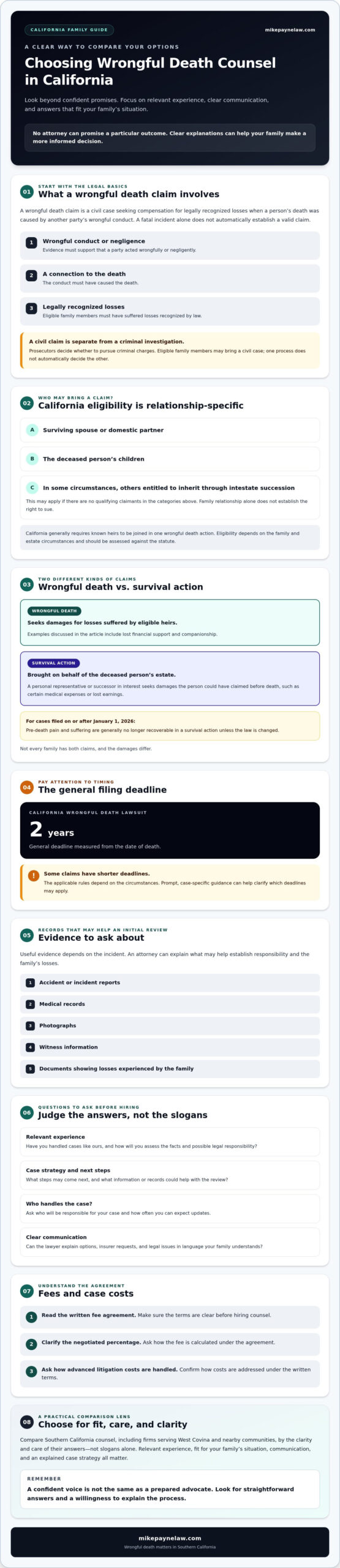
A wrongful death claim is a civil case seeking compensation for legally recognized losses when a person’s death was caused by another party’s wrongful conduct. A fatal incident may be devastating, but it doesn’t automatically create a valid wrongful death claim. The facts and California law must support one. For a general overview, see What is a wrongful death claim?
A civil claim is separate from a criminal investigation. Prosecutors decide whether to pursue criminal charges, while eligible family members may bring a civil case to seek damages. One process doesn’t automatically decide the other. A family can ask about a civil claim even if no criminal case is filed, but whether the claim can proceed depends on the evidence, legal responsibility, and the family’s circumstances.
Who may bring a wrongful death claim in California?
California Code of Civil Procedure section 377.60 identifies who may bring a wrongful death claim. Eligible claimants generally include a surviving spouse or domestic partner and the deceased person’s children. If there are no qualifying claimants in those categories, the law may allow others entitled to inherit through intestate succession to bring a claim. Other circumstances can affect eligibility, so a family relationship alone doesn’t establish the right to sue. An attorney can review the family and estate circumstances against the statute.
What can a wrongful death attorney handle?
Counsel can investigate how the death occurred, identify potentially responsible parties, gather records, and communicate with insurers. Depending on the incident, useful evidence may include accident or incident reports, medical records, photographs, witness information, and documents showing the losses the family has experienced. An attorney can assess which damages may be legally available and what evidence could support them, without promising a recovery.
This work can help families understand the status of a civil case and which decisions need attention. For example, an insurer may ask questions or request information while the family is still gathering records. Legal counsel can manage those communications and explain a request before the family responds. If you’re looking for an abogado de muerte injusta, ask how the lawyer will investigate the facts, keep you informed, and explain your options in language you understand.
The Law Offices of Michael D. Payne handles wrongful death matters in Southern California. Learn more about the firm’s wrongful death representation and the support it may provide as your family evaluates its options.
California Wrongful Death Claims: Liability, Damages, and Deadlines
A California wrongful death claim generally requires evidence that a party acted wrongfully or negligently, that the conduct caused the death, and that eligible family members suffered legally recognized losses. Each element needs support. A collision report, for example, may help explain how a crash happened. Witness accounts and financial records may help establish responsibility and the family’s losses. An abogado de muerte injusta can assess how available evidence fits the legal requirements, but no claim has a guaranteed value or outcome.
How do California wrongful death and survival claims differ?
A wrongful death claim seeks damages for losses suffered by eligible heirs, such as lost financial support or companionship. California Code of Civil Procedure section 377.60 describes who may bring one. Review the statute’s California wrongful death rules for its eligibility framework. California generally requires known heirs to be joined in one wrongful death action.
A survival action is different. It is brought on behalf of the deceased person’s estate by a personal representative or successor in interest, and it seeks damages the person could have claimed before death, such as certain medical expenses or lost earnings. Not every family has both claims, and the damages differ. For cases filed on or after January 1, 2026, pre-death pain and suffering are generally no longer recoverable in a survival action unless the law is changed.
What losses may a family discuss with an attorney?
Depending on the facts and applicable law, a wrongful death claim may involve financial support the deceased would have provided, the value of household services, and loss of companionship, comfort, care, or guidance. Economic damages are assessed through evidence such as earnings history, benefits, household contributions, and medical or funeral records. For families managing immediate final arrangements, guidance from resources like Sunnyside Cremation and Funeral can also help clarify the practical steps and documentation needed for burial or memorial costs. Non-economic losses are personal and fact-specific. In medical malpractice cases, different rules and caps may apply to non-economic damages.
Deadlines depend on the defendant, claim type, and circumstances. California’s general wrongful death lawsuit deadline is two years from the date of death. Medical malpractice and claims involving government entities may have shorter or different requirements, and a government claim generally must be presented within six months. Exceptions may affect the calculation, so don’t rely on the general deadline without prompt legal review.
Understanding which claim may apply, what evidence supports each loss, and which deadline governs can help your family make informed decisions. Review its wrongful death representation to learn more about the firm’s work.
How to Compare Wrongful Death Attorneys Before You Hire
Credentials matter, but they don’t tell you who will handle your family’s case or how clearly the attorney will explain difficult decisions. Compare practical details, then ask each lawyer how they would assess the facts, evidence, and potential obstacles in your situation.
| What to compare | Questions to ask |
|---|---|
| Experience | How much of your practice involves wrongful death claims, and have you handled cases involving this type of incident? |
| Case fit | What facts or legal issues could make this case stronger or more difficult? |
| Communication | Who will be our primary contact, and how will we receive updates? |
| Fee clarity | Can you explain the written fee agreement, including how the negotiated fee and case costs are addressed? |
| Litigation approach | How will you investigate liability, preserve evidence, and respond if the insurer disputes responsibility? |
Questions to ask at an initial case review
Bring what you have, but don’t delay a conversation because records are incomplete. Ask which documents could help assess the claim, such as incident reports, medical records, photographs, insurance letters, or witness information. Find out what remains uncertain, what additional evidence may be needed, and which legal issues could affect the case. Clear answers should help you understand next steps, not pressure you to expect a particular result.
Assess experience and local case fit
Ask about experience with wrongful death claims and the type of incident involved. A fatal crash, for instance, may raise different evidence questions from a death connected to unsafe property conditions. If the incident occurred in West Covina or Pomona, ask how the attorney would investigate and pursue a Southern California case, including which evidence may be important.
Michael D. Payne has more than 25 years of experience and a former insurance defense background. That perspective may inform how the firm evaluates an insurer’s position, but it doesn’t guarantee a particular strategy or outcome. For a fatal commercial truck incident, you can also review the firm’s fatal trucking accident representation.
Choosing an abogado de muerte injusta means weighing how well the attorney listens, explains risks, and takes responsibility for communication, not just years in practice. Learn about the firm’s approach to these cases through its wrongful death case representation.
Fees, Evidence, and What to Expect After Contacting Counsel
Contacting an attorney doesn’t mean you need to have every record or answer ready. The first steps should clarify what happened, what information may be missing, and what the representation terms would be. For families considering an abogado de muerte injusta, understanding the process and fee agreement can make the decision more manageable.
What to expect after reaching out:
- Initial conversation: Explain the basic circumstances, including when and where the death occurred and what you know about the incident.
- Fact review: Counsel can review available documents, identify questions, and discuss what facts may need further investigation.
- Written terms: Before hiring, review the fee agreement and ask how the negotiated percentage, litigation costs, and any repayment obligations are addressed.
- Investigation: If you retain counsel, the attorney may gather records, contact witnesses, and examine evidence relevant to liability and losses.
- Claim strategy: Counsel can explain potential options, obstacles, and next steps based on the facts gathered. The strategy may change as new information emerges.
What information can help an initial case review?
Gather what’s reasonably available, but don’t postpone urgent family, medical, or official needs to assemble a complete file. Helpful items may include incident or police reports, photographs, witness names and contact details, and letters or messages from insurers. Medical or employment records may be relevant depending on the circumstances and losses being considered. Records about the family relationship may also matter in some cases.
Keep original documents and communications. Don’t alter or discard potentially important evidence, and avoid posting about the incident or claim publicly. If you’re unsure whether something matters, ask counsel before taking action.
How should families understand contingency fees and case costs?
Payne represents clients on a contingency-fee basis under a negotiated agreement and advances litigation costs as part of its representation arrangement. The written agreement should explain how the fee is calculated and how costs are handled, including what happens if there’s no recovery. Ask directly whether any costs or repayment obligations could remain in that situation. Don’t assume a contingency arrangement eliminates every possible financial obligation.
Read the terms carefully and ask for an explanation of anything unclear before signing. To discuss wrongful death representation and ask questions about the process, contact Payne.
Choosing Local Wrongful Death Counsel in Southern California
Choosing a local attorney is about more than proximity. Your family needs counsel who will listen carefully, explain decisions in plain language, and give case-specific answers about experience, strategy, and written fee terms. You should feel comfortable asking questions before deciding whether the relationship is right for your family.
What should families expect from a local attorney relationship?
Good communication should be clear and consistent. Ask who will be your primary contact, how updates will be shared, and what to do if new information comes to light. If several relatives are involved, identify who should receive updates and how the attorney will coordinate communication while respecting the family’s circumstances.
If you prefer to discuss the case in Spanish, ask whether Spanish-language communication or interpretation is available and how it would be arranged. Don’t assume language services are offered unless the firm confirms them. The same goes for meeting arrangements and availability. Confirm what the attorney can provide before making a decision.
How can you assess relevant experience and local fit?
Ask whether the attorney has handled wrongful death claims involving the type of incident your family experienced, and how they would investigate the facts and evaluate potential obstacles. A case arising in West Covina or a nearby Southern California community may involve local records, witnesses, or insurers. Ask how the firm would approach those case-specific details rather than relying on a general description of its practice.
Payne is a Southern California personal injury firm founded in 1998. Michael D. Payne has over 25 years of experience, including a former insurance defense background that may inform how he evaluates insurer positions. Experience can help shape an assessment, but it can’t guarantee a settlement, verdict, or other result. Look for an attorney who can explain both the strengths and uncertainties in your family’s situation.
When should a family seek a case review?
Consider seeking legal guidance promptly. Filing periods may apply, and the deadline can depend on the claim, defendant, and circumstances. Ask the attorney to identify which rules may govern your case instead of assuming one general deadline applies. An initial discussion can help clarify potential next steps, but it doesn’t guarantee the firm will accept the case or that a particular outcome will follow.
The right abogado de muerte injusta should treat your questions seriously and explain what they know, what remains uncertain, and how the written terms work. If you’re considering representation in West Covina, Pomona, Ontario, Covina, Chino, Fontana, San Bernardino, Baldwin Park, or Azusa, you can learn about the firm’s wrongful death representation and discuss possible next steps.
Choose Counsel With Clarity and Confidence
Choosing a wrongful death attorney means looking past slogans. Focus on relevant experience, direct answers about your family’s circumstances, a clear communication plan, and written fee terms you understand. Ask how the attorney will assess liability, evidence, potential damages, and obstacles before deciding who should represent your family.
Payne was founded in 1998. Michael D. Payne has over 25 years of experience, including a former insurance defense background that may inform how he evaluates claims and insurer positions. The firm works on a contingency-fee basis under a negotiated written agreement and advances litigation costs according to that arrangement. Clarify how fees, costs, and any repayment obligations apply to your case.
If you’re considering an abogado de muerte injusta, you don’t have to make every decision at once. A thoughtful conversation can help you understand possible next steps, without promising a particular result or requiring you to choose representation before you’re ready. Learn how Michael D. Payne can help your family understand its options. Clear information can help you move forward one decision at a time.
Frequently Asked Questions
What does a wrongful death attorney do in California?
A wrongful death attorney investigates whether another party’s conduct legally caused the death and whether eligible family members may seek damages. Counsel can gather records, assess evidence and potential losses, communicate with insurers, and explain the legal process and possible obstacles. Payne handles wrongful death matters in Southern California, including West Covina, Pomona, Ontario, Covina, Chino, Fontana, San Bernardino, Baldwin Park, and Azusa.
Who can file a wrongful death lawsuit in California?
California law generally allows a surviving spouse or domestic partner and the deceased person’s children to bring a wrongful death claim. If there are no qualifying claimants in those categories, people entitled to inherit through intestate succession may be eligible. Other circumstances can affect standing, so a family relationship alone doesn’t establish eligibility. California generally requires known heirs to be joined in one wrongful death action. An attorney can review the family and estate circumstances.
How long do I have to file a wrongful death lawsuit in California?
The general deadline is two years from the date of death, but different rules may apply. A wrongful death case involving medical malpractice generally has a deadline tied to the earlier of one year from discovery or three years from the injury. For a claim against a government entity, a claim generally must be presented within six months of the death. Exceptions and claim type matter, so confirm the deadline for your circumstances promptly.
What damages may be available in a California wrongful death claim?
Potential damages may include the financial support the deceased would have provided, the value of household services, and loss of companionship, care, comfort, or guidance. The available categories and evidence depend on the facts and applicable law. Economic losses may be assessed using records such as earnings history and household contributions. Medical malpractice cases may have special limits on non-economic damages. An attorney can explain what may apply without estimating or promising a recovery.
How much does a wrongful death attorney cost?
Payne handles wrongful death matters on a contingency-fee basis under a negotiated written agreement and advances litigation costs under its representation arrangement. The agreement should explain how the fee is calculated, how costs are treated, and whether any repayment obligations could apply if there’s no recovery. Ask for clear answers before signing. If you’re looking for an abogado de muerte injusta, review the written terms rather than assuming every cost is waived.
What should I bring to a wrongful death attorney consultation?
Bring whatever is available, but don’t delay urgent needs while collecting documents. Helpful information may include incident or police reports, photographs, witness names and contact details, and letters or messages from insurers. Medical or employment records may be relevant depending on the incident and losses. Keep original records and communications, and don’t alter or discard potential evidence. If you’re unsure whether an item matters, ask the attorney before sharing or discussing it publicly.
Can a family file a wrongful death claim if the person who caused the death was not criminally charged?
Possibly. A civil wrongful death claim is separate from a criminal case, and criminal charges aren’t required to bring a civil claim. Prosecutors decide whether to pursue criminal charges; eligible family members pursue a civil claim based on evidence and applicable law. The standards and purposes differ, so the absence of charges doesn’t automatically resolve whether a civil case may proceed. An attorney can assess the facts and explain the family’s options.