

What if the key to understanding a truck crash lies in records the trucking company controls? If you’re wondering how federal trucking regulations and my accident case connect, start with the evidence. A missed rest requirement or incomplete inspection record may raise important questions, but a rule violation alone doesn’t automatically prove fault.
It’s understandable to feel uncertain about which rules apply, what records matter, and whether the evidence could support your California injury claim. Federal requirements can help investigators assess a driver’s hours, vehicle condition, and safety practices. The important step is connecting a specific requirement to the crash and the harm you suffered.
This article explains which federal trucking rules may be relevant, how hours-of-service, inspection, and other records can factor into a fault investigation, and what steps may help preserve evidence. You’ll also learn how regulatory evidence fits into a California claim, why it must be assessed alongside the crash facts, and how truck accident counsel can evaluate potential issues. The Law Offices of Michael D. Payne brings more than 25 years of attorney experience, including a former insurance defense perspective, to examining the records and challenges that can shape a case.
Key Takeaways
- Federal trucking rules may apply differently depending on the vehicle, driver, and trip, so the facts of the crash matter.
- Understanding how federal trucking regulations and my accident case connect starts with identifying a specific rule and evidence that may show whether it was followed.
- A possible violation doesn’t automatically establish fault. Investigators must consider how it relates to the collision and resulting injuries.
- Documenting the crash and preserving relevant evidence promptly can help protect records that may be controlled by the driver or trucking company.
- An experienced truck accident lawyer can assess which rules apply, examine the evidence, and evaluate potential insurer arguments without promising a particular outcome.
Federal trucking regulations and your accident case: why the rules may matter
After a truck crash, it can be hard to know which rules apply, who has relevant records, or whether a possible violation affects your claim. Start with the evidence, not an assumption. Federal trucking regulations are safety requirements that may govern certain motor carriers and drivers. Whether they apply depends on the vehicle’s use and operation.
That distinction matters. A commercial-looking truck isn’t automatically subject to every federal requirement, and different trips can raise different regulatory questions. Federal rules can guide an investigation, but they don’t decide who caused the crash or whether an injured person is entitled to compensation.
When can federal rules apply to a commercial truck?
The Federal Motor Carrier Safety Administration (FMCSA) is the federal agency responsible for regulating motor carrier safety. Its requirements may apply based on factors such as the vehicle, the commercial operation, and the trip. Exemptions and state-specific requirements can also affect which rules govern a particular situation.
For example, the type of carrier and how a vehicle is being used may matter when assessing whether a federal safety requirement applies. The label “truck” alone doesn’t answer that question. Investigators need to identify the operation and circumstances, then assess the specific rule instead of assuming every requirement covers every vehicle or trip.
How regulations fit into a California accident claim
Whether a rule was followed is one question in a California truck accident claim. Whether a person or company acted negligently, and whether that conduct caused the crash and resulting harm, are separate questions. A suspected violation may point investigators toward useful evidence, but it must be considered alongside the collision facts and other proof.
Regulatory evidence can help show whether a safety requirement was followed. It isn’t, on its own, a final decision about legal responsibility.
That’s the practical answer to “how do federal trucking regulations and my accident case connect?” A rule matters when it applies to the operation and the evidence links a possible failure to the crash. Medical records and other injury documentation also matter when evaluating a claim. For people hurt in Southern California, the regional setting doesn’t create a separate liability test. The analysis still turns on the facts, applicable law, and proof of harm.
Which FMCSA rules may matter after a truck crash?
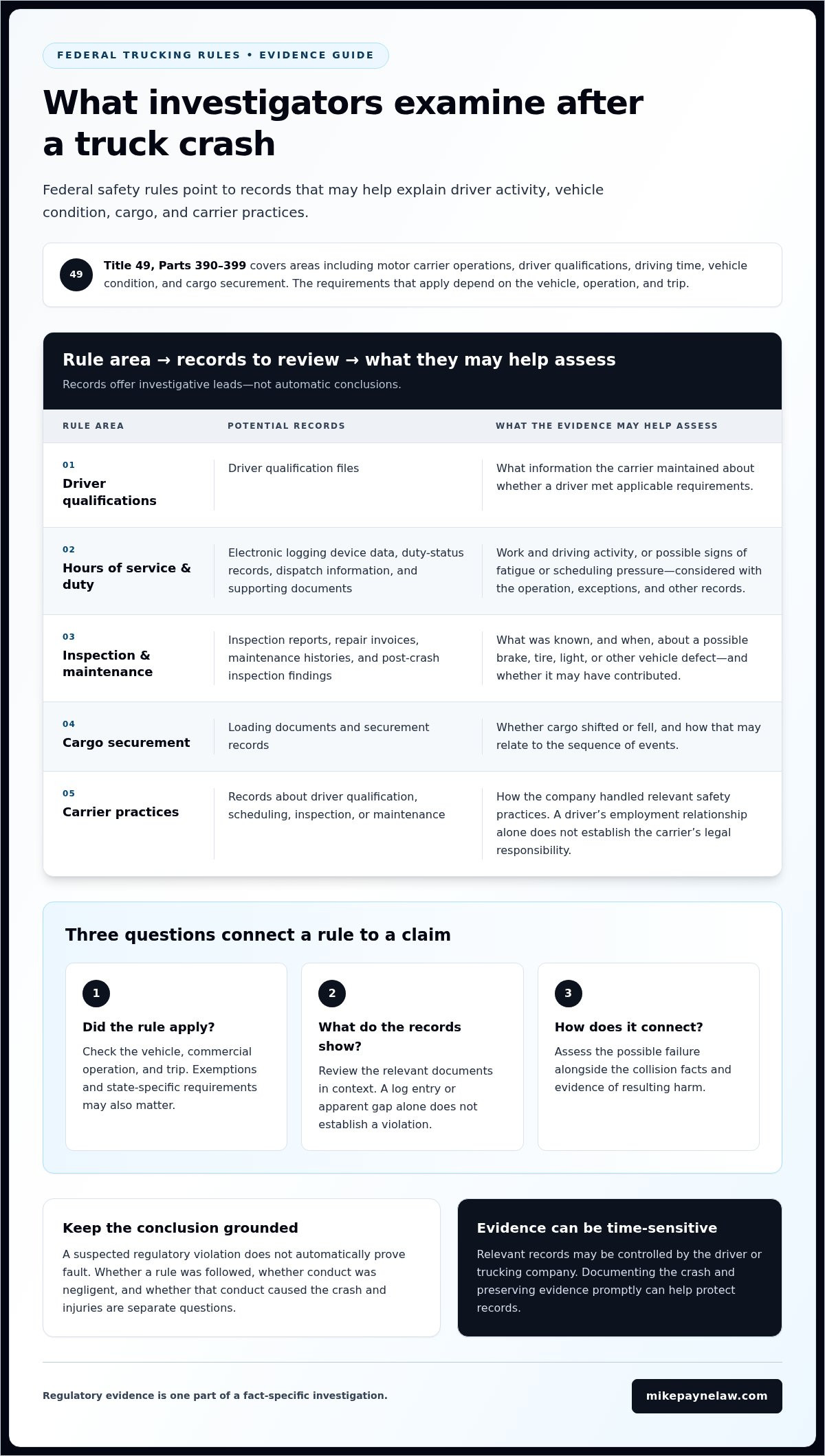
Federal motor carrier safety rules cover more than a driver’s conduct behind the wheel. Title 49 of the Code of Federal Regulations, Parts 390-399, includes requirements for motor carrier operations, driver qualifications, driving time, vehicle condition, and cargo securement. The precise requirements depend on the vehicle, operation, and trip, so investigators first need to determine which rules apply.
Each category points to different evidence. Driver qualification files may show what information a carrier maintained about a driver. Logs and related duty records may help reconstruct work and driving activity. Inspection reports, maintenance documents, and cargo records may help assess a claimed mechanical problem or shifting load. These records provide leads, not automatic conclusions.
Driver qualification, hours of service, and duty records
Driver qualification rules address whether a driver meets applicable requirements to operate a commercial vehicle. Hours-of-service rules limit driving and work time for covered drivers and operations. The FMCSA’s Hours of Service (HOS) regulations overview explains these requirements. Depending on the operation, investigators may examine driver qualification files, electronic logging device data, duty-status records, dispatch information, and supporting documents for signs of fatigue or scheduling pressure.
Those records need context. A log entry or apparent gap doesn’t, by itself, establish that a rule applied or was violated. The vehicle’s use, the driver’s operation, relevant exceptions, and other records all matter.
Inspection, maintenance, cargo, and carrier responsibilities
If a brake, tire, light, or other vehicle defect may have contributed to a collision, inspection reports, repair invoices, maintenance histories, and post-crash inspection findings may help establish what was known and when. If cargo shifted or fell, loading documents and securement records may be relevant. The evidence should be tied to the alleged hazard and the sequence of events, not treated as a checklist of presumed failures.
Carrier practices may also warrant review, including how the company handled driver qualification, scheduling, inspection, or maintenance. A driver’s employment relationship with a carrier alone doesn’t establish that the carrier is legally responsible. The company’s conduct and its connection to the crash must be assessed under applicable law.
In brief: a rule category identifies what to examine, records may show whether a requirement was followed, and the rule’s applicability and connection to the crash still must be established. That’s a useful starting point for understanding federal trucking regulations and my accident case. To learn how motor vehicle accident representation can help evaluate evidence, visit the firm’s motor vehicle accident page.
Does a federal trucking violation automatically prove fault?
No. A federal rule violation doesn’t automatically establish fault or guarantee compensation. It may be important evidence, but the case still requires a fact-specific review of whether the requirement applied, what happened, and whether any failure contributed to the crash and legally recognized harm. The FMCSA’s Federal Motor Carrier Safety Regulations cover different areas of commercial vehicle safety, and the applicable rules depend on the operation.
A safety-rule violation is evidence to assess, not a final decision about negligence, causation, or recovery. In California, negligence-per-se principles may affect how a qualifying legal violation is evaluated, but they don’t make every regulatory violation automatic proof of negligence. The rule, its applicability, the circumstances, and current legal standards all matter.
What a violation may show, and what it does not prove
A record suggesting that a driver exceeded an applicable duty limit, for example, may raise questions about fatigue. It doesn’t establish that fatigue caused the collision. Investigators must compare the record with other evidence, such as the crash sequence, witness accounts, vehicle data, and the driver’s actions. They must also assess the injuries and supporting medical documentation.
The same careful analysis applies to an alleged maintenance failure or cargo problem. A defect or lapse matters to a claim only if the evidence connects it to the incident and resulting harm. Disputed facts, alternative explanations, and the legal significance of the conduct must also be examined.
| Rule requirement | Evidence of a possible violation | Questions still to resolve |
|---|---|---|
| Applicable hours-of-service requirement | Driver logs, electronic records, or dispatch documents | Did the requirement apply, and did fatigue contribute to the crash? |
| Applicable inspection or maintenance duty | Inspection reports, repair history, or vehicle condition evidence | Was there a relevant defect, and did it cause or contribute to the collision? |
| Applicable cargo-securement requirement | Loading documents, photographs, or post-crash cargo evidence | Did cargo shift or fall, and did that event cause the injury? |
Who may bear responsibility in a trucking crash?
Depending on the evidence, a review may include the driver, motor carrier, maintenance contractor, cargo loader, or vehicle manufacturer. Each party’s potential responsibility depends on its conduct, its connection to the crash, and applicable law. A carrier isn’t automatically responsible simply because the driver worked for it. The facts and legal relationship must be assessed.
Sorting through these issues takes more than spotting a rule violation. The Law Offices of Michael D. Payne brings over 25 years of attorney experience, including Michael D. Payne’s former insurance defense background, to evaluating evidence and potential claim challenges. Learn about motor vehicle accident representation as you consider how federal trucking regulations and my accident case may relate to the facts.
What evidence can connect trucking rules to your accident?
Evidence can help show whether a trucking safety requirement applied, whether it was followed, and whether a possible failure contributed to the collision. After a crash involving commercial traffic on a Southern California road, focus first on your health and safety. Don’t return to the scene or approach a truck to collect information. Records held by a driver or company may require formal legal steps to preserve and obtain.
Records investigators may examine
Depending on the crash and the rules at issue, an investigation may consider:
- Crash evidence: available police or collision reports, scene and vehicle photographs, witness names and contact details, and your own account of what you remember.
- Injury documentation: medical records and bills that help document injuries and treatment connected to the collision.
- Driver and carrier records: electronic logging device data, duty records, dispatch documents, and driver qualification or carrier safety records, when relevant and available.
- Vehicle and cargo records: inspection reports, maintenance and repair history, post-crash vehicle findings, loading documents, and cargo-securement information if a defect or shifting load may have played a role.
Not every record exists, applies, or remains available in every case. Access and retention can vary. An investigator or attorney may need to use appropriate legal processes to request and preserve relevant materials. The goal is to connect specific records to the alleged rule issue and the events of the crash, not to collect documents without a clear purpose.
Steps to take while evidence is fresh
Take practical steps from a safe place. Keep copies of reports, insurer or company correspondence, medical records, and photographs already in your possession. Write down what you recall while it’s fresh, and save witness details if you have them. If identifying details such as the truck’s plate, company name, or a USDOT number are already available to you, note them. Don’t put yourself at risk to obtain them.
Avoid posting detailed accounts or guesses about fault publicly. Early statements can leave out facts you haven’t had a chance to verify. Preserve what you have and let the investigation establish what happened.
Understanding federal trucking regulations and my accident case often means securing relevant evidence before it becomes harder to locate. Payne represents truck accident clients in Southern California. Learn how the firm handles these claims through its motor vehicle accident representation.
How a California truck accident lawyer can assess federal regulations
Regulatory evidence needs a careful, case-specific review. A lawyer can identify which federal or state requirements may apply to the truck’s operation, obtain relevant records through appropriate legal processes, and assess whether the evidence connects a possible violation to the collision. The review also considers documented injuries and losses. A rule issue matters only in context, and it doesn’t guarantee a particular claim outcome.
Questions counsel may investigate in your case
A thorough assessment asks more than whether a record looks concerning. Counsel may examine:
- Which federal or California requirements plausibly applied to the vehicle, driver, and operation?
- What evidence supports or challenges a suspected violation, and does it connect to how the crash happened?
- Which drivers, carriers, maintenance contractors, cargo handlers, or other parties may hold relevant records or warrant further review?
- What medical and other documentation supports the injuries and losses connected to the collision?
The evidence must also be tested against likely insurer arguments. An insurer may dispute whether a rule applied, whether a record proves noncompliance, or whether an alleged failure caused the crash or injury. Michael D. Payne’s more than 25 years of attorney experience and former insurance defense background provide perspective when evaluating those challenges. That perspective supports a rigorous review, not a promise of results.
A practical next step for injured people in Southern California
Keep copies of records already in your possession, including crash documents, photographs, medical records, and correspondence. Avoid trying to obtain company-controlled evidence yourself. Prompt, case-specific legal guidance can help identify relevant records and consider how to preserve them. A claim review doesn’t mean every case must go to trial; it helps clarify the evidence and available options.
Payne represents truck accident clients in Southern California. Read more about motor vehicle accident representation and how an evidence-focused review may help answer questions about federal trucking regulations and my accident case. Contingency fee representation is governed by the specific written agreement.
If you were injured in a truck crash, contact the firm to discuss your circumstances.
Take the Next Step Toward Clarity
Federal trucking rules can guide an accident investigation, but a possible violation doesn’t automatically establish fault or guarantee recovery. The key is determining which requirements apply, securing relevant records, and assessing whether the evidence connects a rule issue to the collision and your documented injuries. That’s how to begin answering the question, “How do federal trucking regulations and my accident case fit together?”
Attorney Michael D. Payne brings over 25 years of experience and a former insurance defense perspective to reviewing evidence and evaluating potential claim challenges. The firm handles cases on a contingency fee basis, with the specific terms set out in the written representation agreement.
You don’t have to sort through confusing records and legal questions alone. Discuss your truck accident case with Payne and take a practical step toward understanding your options.
Frequently Asked Questions
Do federal trucking regulations apply to every truck accident?
No. Federal trucking requirements don’t apply to every vehicle or trip. Applicability can depend on how the vehicle is used, the type of commercial operation, and whether an exception or state-specific requirement affects the situation. A truck’s size or appearance alone doesn’t settle the question. Investigators need to identify the vehicle and operation, then determine which specific rules, if any, govern the circumstances of the crash.
Does an FMCSA violation automatically prove negligence?
No. A suspected or documented violation may be relevant evidence, but it doesn’t automatically establish negligence, prove that the violation caused the collision, or guarantee compensation. The analysis considers whether the rule applied, what the evidence shows, whether the conduct contributed to the crash, and whether the injured person’s harm is documented. California negligence-per-se principles may be relevant in some circumstances, but their application depends on the facts and current law.
Which federal trucking regulations could affect my accident case?
Depending on the vehicle and operation, relevant rules may address driver qualifications, hours of service, vehicle inspection and maintenance, cargo securement, or carrier safety practices. The applicable rule category can guide investigators toward records such as driver logs, inspection reports, repair histories, or loading documents. Not every requirement applies to every truck or trip. The key is connecting a specific applicable rule and its evidence to the events of the crash.
What evidence can show whether trucking rules were followed?
Potential evidence includes crash reports, photographs, witness information, medical records, electronic logging data, dispatch documents, vehicle inspection reports, maintenance records, and cargo documentation. Which records matter depends on the suspected safety issue, and some may be held by the driver or trucking company. Their existence, relevance, access, and retention can vary. Keep records already in your possession and avoid approaching a truck or returning to a crash scene to gather evidence.
How long are truck company records kept after a crash?
There isn’t one retention period that applies to every type of trucking record or every operation. Requirements can vary by record category, and company retention practices may differ. Don’t assume that important materials, such as electronic data, dispatch records, or inspection documents, will remain available indefinitely. Preserve what you already have and seek prompt legal guidance about identifying relevant records and using appropriate legal processes to request their preservation.
Can the trucking company be responsible for a driver’s actions?
Possibly, but the driver’s employment by a carrier doesn’t by itself settle the company’s responsibility. The review may consider the driver’s conduct, the carrier’s own practices, the relationship between the driver and company, and applicable law. Depending on the evidence, other parties, such as a maintenance contractor or cargo loader, may also warrant investigation. Responsibility must be assessed based on each party’s conduct and its connection to the crash and resulting harm.
What should I do if I suspect a truck driver violated a safety rule?
Prioritize medical care and safety. Keep copies of crash reports, photographs, medical records, and correspondence already in your possession. Write down what you remember and note truck or carrier identifying details only if you can do so safely and lawfully. Don’t speculate publicly about fault or try to obtain company records yourself. A case-specific review can help assess whether a rule applied and what evidence may support or challenge a suspected violation.
Can a California truck accident lawyer help investigate federal rule violations?
Yes. A lawyer can assess which federal or state requirements may apply, identify relevant evidence, and evaluate whether a possible violation connects to the crash and documented injuries. Payne represents truck accident clients in Southern California, including West Covina, Pomona, Ontario, Covina, Chino, Fontana, San Bernardino, Baldwin Park, and Azusa. Attorney Michael D. Payne has over 25 years of experience and previously worked as an insurance defense lawyer.