

Did you know that a single photograph taken minutes after your accident could be the difference between a denied claim and a six-figure settlement? When you’re lying on a cold floor in Ontario, California, the last thing on your mind is building a legal case. The physical pain and sudden mobility issues you’re facing are overwhelming, and the anxiety of rising medical bills only makes it worse. Securing the specific evidence needed for a slip and fall case in ontario is the only way to ensure a negligent property owner is held accountable for your injuries.
It’s common to feel overwhelmed, especially when online searches often confuse California laws with Canadian requirements. In California, you generally have two years to file a personal injury claim, but the clock starts ticking the moment you hit the ground. This guide details exactly what you must gather to prove liability and secure the maximum compensation you deserve. Using insights from a former insurance defense perspective, we’ll provide a clear evidence checklist and help you understand California premises liability laws. We’re here to be your shield and ensure you don’t settle for anything less than a full recovery.
Key Takeaways
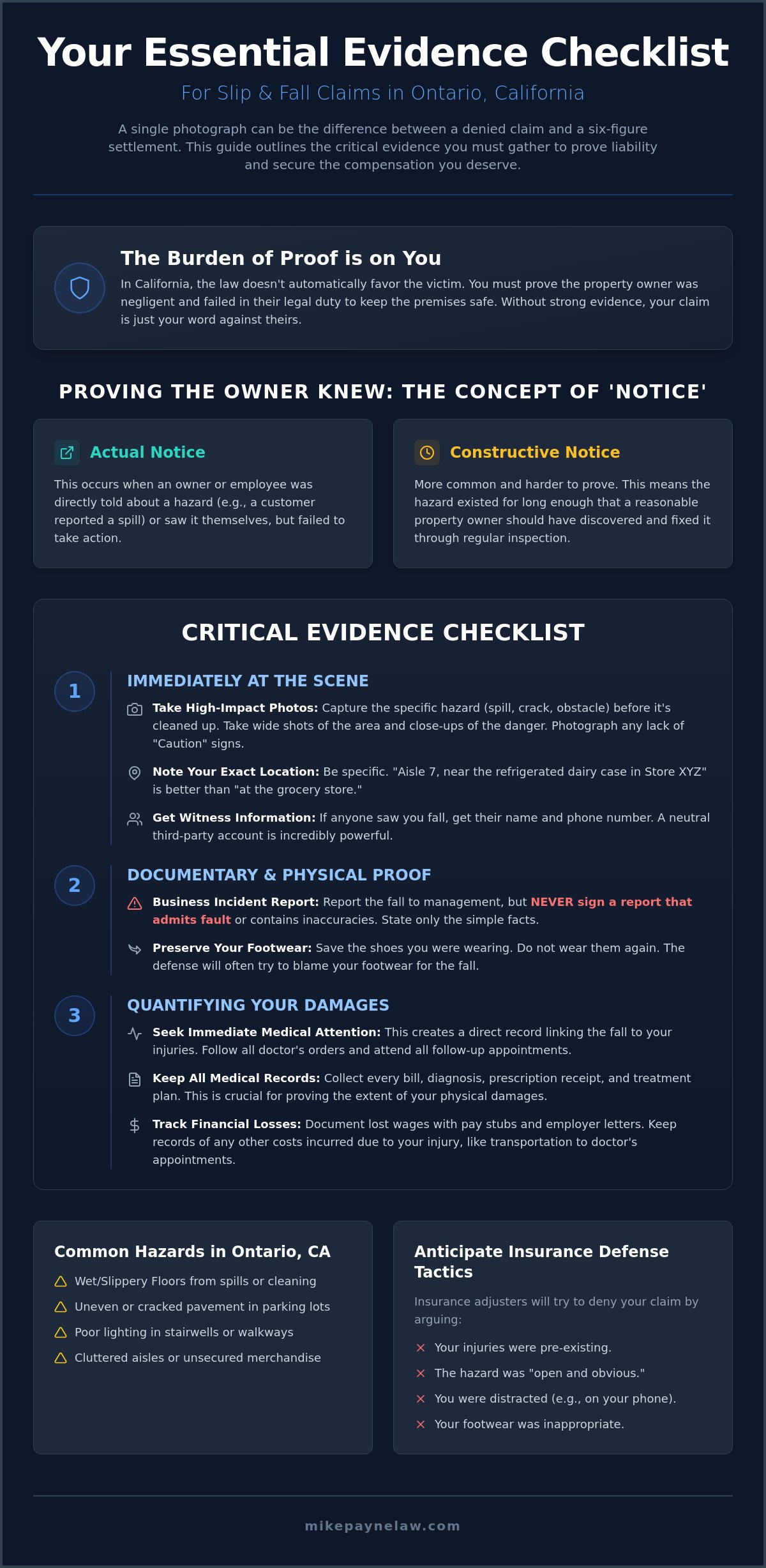
- Understand the legal burden of “constructive notice” and why proving a property owner knew about a hazard is essential for your claim.
- Learn how to capture the specific evidence needed for a slip and fall case in ontario, including high-impact photos of the hazard before it’s cleaned up.
- Discover why you should never sign a business incident report that admits fault, protecting your right to seek maximum compensation.
- Identify the critical medical and financial documentation required to prove the full extent of your physical injuries and lost earning capacity.
- See how a former insurance defense attorney uses insider knowledge to dismantle defense tactics and build a trial-ready case for you.
Proving Liability: Why Evidence is the Foundation of Your Ontario, CA Claim
In a slip and fall case, the law doesn’t automatically side with the victim. You bear the entire burden of proof. This means you must demonstrate that the property owner failed in their legal duty to keep the premises safe. Without the specific evidence needed for a slip and fall case in ontario, your claim is just your word against a corporation’s defense team. Insurance adjusters in the Inland Empire are trained to find gaps in your story. They’ll claim you were distracted or that the hazard wasn’t there long enough for them to fix it. We don’t let them get away with those tactics.
Many people searching for legal help get confused by results for Ontario, Canada, which has drastically different notice periods and statutes. In Ontario, California, we follow California premises liability laws. You generally have two years to file a claim, but you must prove the owner was negligent. Negligence in a California slip and fall context is the failure of a property owner to use reasonable care to keep the premises in a safe condition. If they ignored a spill or left a broken walkway unrepaired, they are responsible for your medical bills and lost wages.
The Concept of ‘Notice’ in California Premises Liability
To win, we must prove the owner had “notice” of the danger. Actual notice occurs when an employee was directly told about a hazard or saw it happen but failed to act. Constructive notice is more common and often harder to prove. It means the hazard existed for such a duration that a reasonable inspection would have uncovered it. We dig deep into maintenance logs and “sweep sheets” to show that a business failed its duty to inspect the area. If a spill sat on a floor for forty minutes without being cleaned, that’s a clear failure of their safety protocols.
Common Slip and Fall Hazards in the Inland Empire
Ontario is a massive hub for commerce and tourism. We see frequent injuries in retail giants like Ontario Mills, where wet floors from cleaning or spilled drinks create invisible traps for shoppers. The parking lots and walkways near the Ontario Convention Center also present risks, particularly through poor lighting or uneven pavement that becomes a tripping hazard after dark. Understanding the causes of slip and fall accidents in these specific local environments helps us build a stronger case. We know the layouts, we know the common safety failures, and we know how to hold these entities accountable for their shortcuts.
Insurance companies look for any reason to deny your claim. They’ll argue your injuries were pre-existing or that the hazard was “open and obvious.” Our job is to close those gaps. By securing evidence needed for a slip and fall case in ontario immediately after the incident, we position you for maximum compensation. We don’t just ask for a settlement; we prepare every case as if it’s going to trial. This aggressive approach is the only way to ensure the insurance company takes your pain and your future seriously.
Critical Scene Evidence: Photos, Hazards, and Immediate Proof
The moments following a fall are chaotic. Your adrenaline is surging, and your body is likely screaming in pain. However, this is the most critical window to secure the evidence needed for a slip and fall case in ontario. Property managers are quick to clean up spills or put out “Caution” signs only after an injury occurs. If the hazard disappears before it’s documented, your path to recovery becomes much steeper. Visual proof remains the single most compelling asset in a California courtroom because it strips away the ability for a defense team to rewrite history.
You must capture the specific cause of your fall. Was it a leaking refrigeration unit in a grocery store? Was it a fresh spill left unattended? Perhaps it was a complete lack of warning signs in a high-traffic area. These failures often represent direct violations of established OSHA safety standards, which require businesses to maintain walking surfaces free of recognized hazards. Beyond the hazard itself, don’t overlook your own attire. Save the shoes you were wearing. Do not wear them again until your case is resolved. Insurance companies love to blame a victim’s footwear for a fall, so preserving the tread and condition of your shoes is a vital defensive move.
How to Take Effective Evidence Photos
Don’t just snap one or two blurry pictures. Start with wide-angle shots that capture the entire scene, including any nearby landmarks or store aisles. This proves exactly where you were and shows if safety cones were missing from the vicinity. Next, move in for close-ups. Use your phone’s camera to document the texture, size, and depth of the hazard. If there are skid marks in a spill, photograph them; they prove you actually slipped through the substance. Finally, capture the environmental factors like dim lighting or shadows that may have obscured the danger.
The Role of Eyewitness Statements
Eyewitnesses are the backbone of a strong claim. A neutral third party who saw you fall carries far more weight in court than a friend or family member who might be perceived as biased. If you see someone stop to help, ask for their name and phone number immediately. If they are in a rush, ask if you can record a thirty-second voice memo on your phone describing what they saw. Most people are willing to help a neighbor in need if you approach them calmly. If you’re too injured to do this yourself, ask a bystander to take the photos and collect numbers for you. If you need immediate guidance on how to handle a complex scene, reaching out to a premises liability representative can provide the clarity you need during this vulnerable time.
Documentary Proof: Incident Reports and Surveillance in Ontario Businesses
Physical evidence at the scene is vital, but the paper trail created by a business is often where a case is won or lost. When you fall at a major retailer like Target, Costco, or within the massive corridors of Ontario Mills, the management will immediately begin their own documentation process. This paperwork is a double-edged sword. While it serves as official evidence needed for a slip and fall case in ontario, it is also a tool used by corporate defense teams to limit their liability. You need to know how to handle these documents before the ink even dries.
Internal maintenance logs and employee cleaning schedules are often the “smoking gun” in a premises liability claim. These logs are supposed to show that an employee inspected the area at regular intervals. If we find that the floor hadn’t been checked for hours before your fall, it proves the owner failed their duty of care. We look for inconsistencies where a manager might have backdated a log or skipped a scheduled sweep. This level of neglect is exactly what we use to secure maximum compensation for your suffering.
Securing Video Footage from Local Ontario Retailers
Digital evidence is incredibly fragile. Most large retailers in the Inland Empire overwrite their surveillance footage every 7 to 30 days. If you wait too long to act, the most objective proof of your accident could be deleted forever. To prevent this, we immediately issue a “Spoliation of Evidence” letter. This is a formal legal notice that requires the business to preserve all relevant video footage. We don’t just look for the fall itself; we look for the minutes leading up to it. This helps us identify if an employee walked past the hazard and ignored it or if the spill was created by a leaking roof that management knew about.
Navigating the Store Incident Report
The “Golden Rule” of incident reports is simple: never sign a statement that admits fault. A store manager might try to pressure you into signing a document that says you were “clumsy” or “distracted.” Don’t do it. Instead, focus on getting a copy of the report they fill out. Look closely at their notes. Sometimes a manager will accidentally admit they knew about a leak or that a previous customer had complained about the same spot. These admissions are powerful evidence needed for a slip and fall case in ontario. To build a complete picture of liability, you should also learn more about causes of slip and fall accidents and how they correlate with store logs. We use every piece of documentation to ensure your story is heard and your rights are protected.
Medical Records and Financial Proof: Quantifying Your Damages
While photos of a hazard prove liability, your medical records prove your loss. You can’t secure a fair settlement based on pain alone; you need hard data. In California, medical documentation serves as the primary evidence needed for a slip and fall case in ontario to quantify the physical and financial toll of the accident. We examine every hospital bill, every diagnostic image, and every physical therapy note to build a wall of proof that insurance companies cannot ignore. If you don’t document the damage, the law assumes it didn’t happen.
Quantifying your damages also requires a meticulous paper trail of your financial losses. We use pay stubs and tax returns to prove lost earning capacity, especially if your injuries prevent you from returning to your specific job in the Inland Empire. Beyond big-ticket items, you must track every out-of-pocket expense. This includes:
- Pharmacy receipts for pain management medications.
- Invoices for medical equipment like crutches, braces, or knee scooters.
- Gas and mileage logs for trips to specialists or rehabilitation centers.
- Receipts for any domestic help required due to your limited mobility.
Proving the Link: Immediate Medical Attention
Insurance adjusters are trained to look for a “gap in treatment.” If you wait more than 48 hours to see a doctor after falling at a place like Ontario Town Square, they’ll argue you weren’t actually hurt or that a different event caused your pain. Don’t give them that opening. ER records or Urgent Care notes from local Ontario facilities establish “causation,” which is the direct link between the property owner’s negligence and your injury. This documentation is also our best weapon against the “pre-existing condition” defense. We use current MRIs and specialist reports to show the acute, life-altering change in your health compared to your prior history.
Documenting Non-Economic Damages (Pain and Suffering)
Medical bills don’t show the full human cost of a fall. This is where an “Injury Journal” becomes vital. It isn’t a diary; it’s a daily log of your pain levels and the life events you’ve been forced to miss. Record the days you couldn’t play with your children or the nights your sleep was interrupted by throbbing pain. We also gather statements from family members to describe how your quality of life has diminished. These personal accounts help us Calculate your potential injury claim value by turning abstract suffering into concrete evidence. This is a critical part of the evidence needed for a slip and fall case in ontario that most competitors overlook.
If you are tired of being ignored by insurance adjusters who treat your recovery like a line item, reach out to Michael D. Payne to start building your trial-ready case today.
Securing Your Recovery with an Ontario, CA Slip and Fall Attorney
Gathering the evidence needed for a slip and fall case in ontario is only half the battle. Once you have the photos, maintenance logs, and medical records, you must face an insurance company that is professionally incentivized to pay you nothing. This is where Michael D. Payne steps in as your primary shield. With over 25 years of experience, including a background in insurance defense, he knows the exact scripts adjusters use to devalue your pain. He anticipates their tactics before they even file a motion, effectively turning their own playbook against them.
We don’t just process claims; we build cases for the courtroom. This trial-ready approach is why we are able to secure higher settlements for our clients. When an insurance company knows a lawyer is willing to go the distance rather than accepting a substandard resolution, their tone changes. In California, the statute of limitations for personal injury is currently two years. While that might sound like a long time, evidence disappears and memories fade quickly. You must act decisively to protect your future before this legal window closes forever.
Why a Local Inland Empire Lawyer Matters
You don’t need a faceless TV firm from Los Angeles that treats you like a case number. You need a relatable fighter who knows the specific terrain of the Inland Empire. Michael D. Payne understands the local Ontario courts and the specific defense firms that represent the retail hubs we’ve discussed. You get direct access to your attorney throughout your case, ensuring your voice is heard. This neighborly tone combined with professional grit ensures you feel empowered during a vulnerable time. We are boots-on-the-ground advocates who aren’t afraid to challenge powerful entities on your behalf.
Your Next Steps to Justice
The path from chaos to compensation follows a definitive professional action plan. If you’ve been injured, follow these steps immediately to protect the evidence needed for a slip and fall case in ontario:
- Step 1: Seek medical attention immediately. As established, ER or Urgent Care notes are the bedrock of your causation evidence.
- Step 2: Preserve all physical and digital evidence. Keep the shoes you wore, your photos, and any correspondence from the property owner.
- Step 3: Contact the Law Offices of Michael D. Payne for a free consultation. Let us handle the high-stakes confrontation while you focus on your physical recovery.
We operate on a contingency fee basis. This means you don’t pay a single cent in legal fees unless we win your case. It’s our foundational trust-builder and a promise that we are personally invested in your well-being. Don’t let a negligent property owner or a cold insurance company dictate your future. Secure a professional champion who will fight for the maximum compensation you deserve.
Take Charge of Your Recovery Today
Proving a property owner’s negligence requires more than just showing you fell. You must establish constructive notice through maintenance logs and secure visual proof before the hazard is cleaned away. Immediate medical attention isn’t just for your health; it’s the objective link that prevents insurance adjusters from devaluing your claim. By documenting your daily pain and financial losses, you create a narrative that a courtroom cannot ignore.
Securing the evidence needed for a slip and fall case in ontario is a high-stakes task that shouldn’t be handled alone. Michael D. Payne brings over 25 years of experience and a former insurance defense perspective to your corner. He knows the exact tactics used to deny claims and builds every case to be trial-ready from day one. You face zero upfront costs because we work on a contingency fee basis. You don’t pay a single cent unless we win your case.
Fight for the compensation you deserve; contact Michael D. Payne today!
You’ve already taken the first step by educating yourself on your rights. Now, let a local professional carry the legal burden and fight the insurance companies for you so you can focus entirely on your healing and your family.
Frequently Asked Questions
How much evidence is enough for a slip and fall case in Ontario, CA?
Enough evidence means proving it’s more likely than not that the owner’s negligence caused your fall. You don’t need a mountain of paperwork, but you do need specific evidence needed for a slip and fall case in ontario like photos of the hazard and a medical report. We focus on quality over quantity, ensuring every piece of documentation directly links the property owner’s failure to your physical injuries.
Can I still sue if there were no witnesses to my fall?
Yes, you can still pursue a claim without eyewitnesses. We rely on circumstantial evidence, such as store surveillance footage, electronic maintenance logs, and the physical characteristics of the hazard itself. If a spill shows skid marks or dirt, it proves the substance was on the floor long enough for the owner to notice. Your own testimony and immediate medical records also serve as powerful proof of the event.
What if the property owner fixed the hazard immediately after I fell?
Under California law, the fact that an owner fixed a hazard, known as subsequent remedial measures, usually cannot be used as direct evidence of negligence in court. However, it doesn’t ruin your case. We use the evidence needed for a slip and fall case in ontario gathered before the repair, such as your photos or witness statements, to prove the danger existed. A quick repair often confirms the owner recognized the danger, even if the repair itself is shielded.
Do I need a lawyer if the insurance company offered me a quick settlement?
A quick offer is almost always a lowball attempt to make your claim disappear before you know the full extent of your injuries. Insurance adjusters want you to sign away your rights before you realize you might need surgery or long term physical therapy. We review these offers to ensure they cover your future medical bills and lost wages. Don’t let a corporation’s bottom line dictate the value of your health.
How long do I have to file a slip and fall lawsuit in California?
In California, the statute of limitations for a personal injury claim is generally two years from the date of the accident. If you miss this deadline, you lose your right to seek compensation forever. While two years seems like a long time, crucial evidence like video footage can be deleted within weeks. It’s vital to start the legal process immediately to preserve the integrity of your claim.
What happens if I was partially at fault for my own fall?
California follows a pure comparative negligence rule. This means you can still recover compensation even if you were 99% at fault, though your total award will be reduced by your percentage of responsibility. If a jury finds you were 20% responsible for not seeing a spill, you would still receive 80% of the total damages. We fight to minimize your fault and maximize the property owner’s liability.
How do I get surveillance footage from a store like Ontario Mills?
Retailers rarely hand over video footage voluntarily. We secure this evidence by sending a formal spoliation letter that legally requires them to preserve the tapes. If the store refuses to cooperate, we use the power of the court to subpoena the footage during the discovery phase of your lawsuit. Acting quickly is essential because many digital systems automatically overwrite data every 30 days or less.
What are the most common mistakes that ruin an Ontario slip and fall claim?
The biggest mistakes are admitting fault at the scene, failing to see a doctor immediately, and posting about the accident on social media. Saying “I should’ve been looking where I was going” can be used against you as an admission of negligence. Additionally, insurance adjusters monitor social media to find photos of you being active, which they use to claim your injuries aren’t serious. Silence and professional medical documentation are your best defenses.