

What if the most important witness to your West Covina car accident isn’t a person at all, but a silent circuit board tucked under your driver’s seat? You might wonder, do cars have black boxes, and the answer is a definitive yes for 99.6% of new vehicles hitting the road in 2026. It’s frustrating to stand on the side of the road while an insurance adjuster tries to twist your words and shift the blame onto you. You deserve a fair fight. You shouldn’t have to worry about “big brother” spying on your every move or being held responsible for a crash that wasn’t your fault.
At Mike Payne Law, we use this data to turn the tide in your favor. This guide reveals how your vehicle’s Event Data Recorder (EDR) captures the critical seconds before impact to prove your innocence and secure the maximum compensation you need for your recovery. We will break down your specific privacy rights under California Vehicle Code Section 9951 and show you exactly how this evidence becomes your strongest ally when we go to battle for your justice.
Key Takeaways
- Many drivers ask, “do cars have black boxes,” and the answer lies in the Event Data Recorder (EDR) that captures critical speed and braking data seconds before impact.
- Learn how Mike Payne uses this digital evidence to expose lying drivers and prove liability in complex Southern California accidents.
- Understand your ownership rights under California law to prevent unauthorized access to your vehicle’s sensitive crash data by insurance companies.
- Discover why you must act immediately to preserve EDR data before it is overwritten or lost forever at a salvage yard or repair shop.
- See how this “trial-ready” evidence can turn a standard police report into a winning injury claim for residents in West Covina and the Inland Empire.
What Is a Car Black Box? Understanding Event Data Recorders (EDR)
If you are involved in a collision on the 10 Freeway, the evidence you need to win your case might be hidden right under your feet. Many drivers ask, do cars have black boxes? The answer is a definitive yes. While people use the term black box to describe these devices, they are officially known as an Event Data Recorder (EDR).
The term black box is technically a misnomer. Unlike the orange flight recorders found in airplanes, automotive EDRs are usually small, silver or grey metal components integrated into the vehicle’s airbag control module. They don’t record your private conversations or your radio station choice. Instead, they capture high-speed technical data that reveals exactly what your vehicle was doing seconds before an impact.
The history of this technology has shifted from luxury to necessity. In the early 2000s, EDRs were primarily found in high-end models to help manufacturers study airbag deployments. By 2014, federal regulations required manufacturers to standardize data if they chose to install an EDR. Today, the landscape has changed completely. By 2026, federal mandates require all new light vehicles to be equipped with these devices. This shift ensures that every driver has access to a digital witness that cannot be intimidated by insurance company lawyers.
The Purpose of the EDR in Modern Vehicles
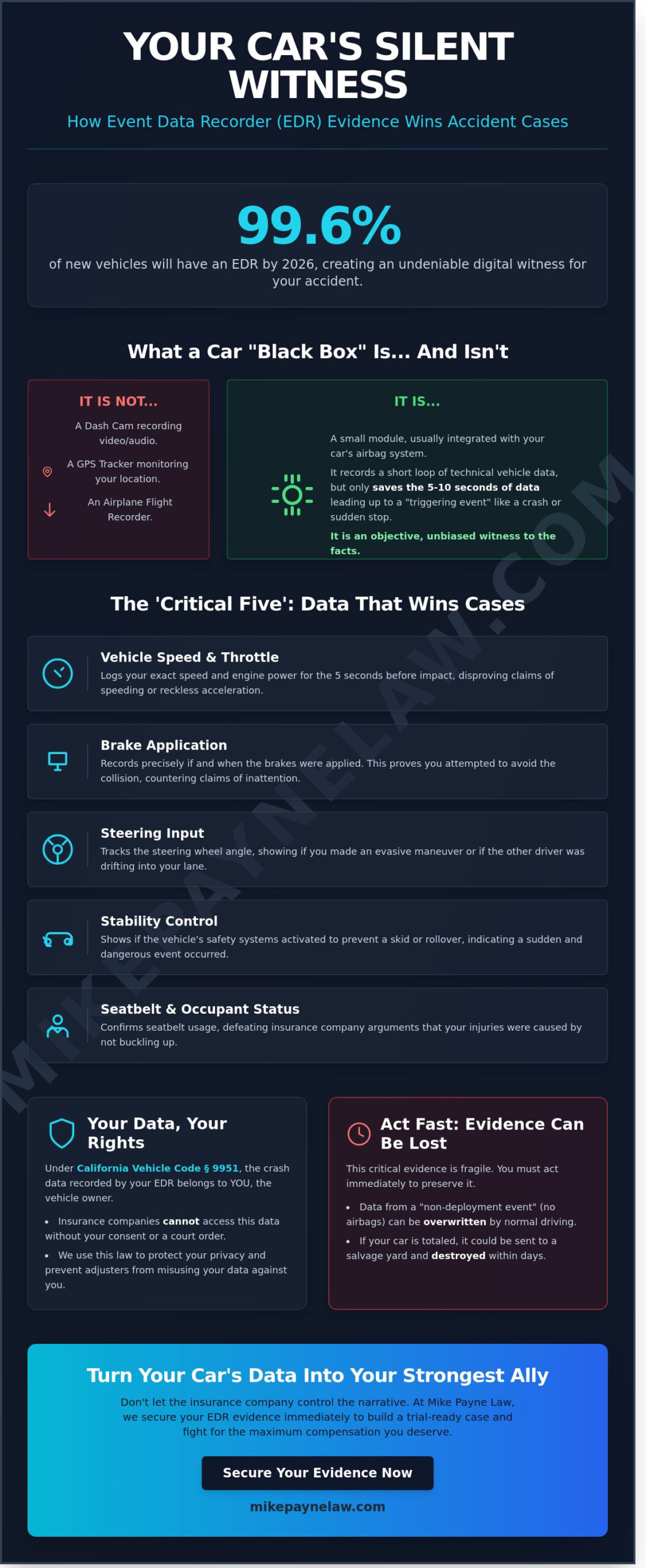
The EDR serves one primary function: recording technical data during a triggering event. A trigger is typically a crash or a near-crash, such as an airbag deployment or a sudden, violent change in velocity. The device records a continuous loop of data but only saves it when a collision occurs. This information helps the National Highway Traffic Safety Administration (NHTSA) analyze why accidents happen and how to improve vehicle safety standards. Since 2014, nearly 96% of all new vehicles have included these devices to protect both the manufacturer and the consumer.
EDR vs. Dash Cams and GPS Trackers
It is vital to distinguish EDRs from other recording devices. EDRs do not record audio or video inside the cabin. They are not “spy” devices used by insurance companies to track your daily commute or your location. While a GPS tracker monitors your movements and a dash cam records the view through your windshield, the EDR records the “heartbeat” of the car.
In California courtrooms, EDR data is considered the gold standard for evidence in motor vehicle accidents
What Data Does Your Car Actually Record Before a Crash?
When you ask, “do cars have black boxes,” you’re really looking for an objective witness. In the chaos of a collision, your memory might fail. The other driver might lie to protect their insurance rates. The Event Data Recorder (EDR) doesn’t have an agenda. It just has the facts. This device is typically housed within the Airbag Control Module (ACM). It acts as the vehicle’s brain, constantly monitoring sensors to decide if an impact is severe enough to deploy life-saving measures.
The ACM distinguishes between two types of incidents. A “deployment event” occurs when the crash is violent enough to trigger the airbags. This data is usually locked and cannot be overwritten. A “non-deployment event” is a significant jolt or near-miss that triggers the recording but doesn’t pop the bags. In Pomona or Ontario traffic courts, this data is far more reliable than eyewitness testimony. Adrenaline and stress can distort human perception, but the EDR records reality at a granular level. According to NHTSA EDR regulations, these devices must capture specific metrics that prove exactly what happened in the seconds before impact.
The ‘Critical Five’ Data Points
- Vehicle Speed and Throttle: The EDR logs your exact speed and engine percentage for the five seconds leading up to the hit.
- Brake Application: It records if and when the driver hit the brakes. This proves whether a driver actually tried to stop or was distracted.
- Steering Input: The device tracks steering wheel angle. This shows if a driver swerved or was drifting out of their lane.
- Stability Control: It notes if the vehicle’s computer tried to intervene to prevent a skid or rollover.
- Occupant Detection: The system records seatbelt usage and the weight of passengers. This is critical for defending against claims that injuries were caused by a failure to wear a belt.
Advanced 2026 EDR Capabilities
By 2026, the technology has evolved beyond basic speed logs. Modern EDRs now capture data from Advanced Driver Assistance Systems (ADAS). If your car’s automatic emergency braking or lane-keep assist engaged, the black box records it. This is vital for motor vehicle accidents involving semi-autonomous features.
Precision timestamping is another major leap forward. In multi-vehicle pileups on the I-10, determining the sequence of impacts is often impossible for witnesses. New EDR sensors provide millisecond-accurate timing for every strike. This allows us to reconstruct the pileup and identify which driver truly initiated the chain reaction. If you’re facing a complex liability battle, you need a fighter who knows how to pull this data. You can reach out to our team to discuss how we use this evidence to protect your rights.
Who Owns Your Car’s Black Box Data in California?
You bought the vehicle, you pay the insurance, and you maintain the engine. It only makes sense that you own the data generated by the car. In the state of California, the law is on your side. California Vehicle Code § 9951 explicitly states that any data recorded by an Event Data Recorder (EDR) belongs to the registered owner of the vehicle. This ownership right is a critical pillar of your privacy. When people ask do cars have black boxes, they are often worried about big brother watching. In West Covina, your digital footprint on the road is protected property.
The 2015 Federal Driver Privacy Act reinforced these state level protections. It ensures that the information stored on your EDR cannot be accessed by just anyone who has a plug and a laptop. This data is sensitive. It tracks your speed, braking patterns, and seatbelt usage in the seconds before a crash. Because this information is yours, you have the right to refuse access to it in most civil situations. We treat your data with the same level of protection we apply to your physical property.
California’s Strict Privacy Protections
California law requires every manufacturer to disclose the presence of an EDR in the owner’s manual. You shouldn’t have to guess if your movements are being tracked. If you are involved in a personal injury claim, your consent is generally required before any party downloads that information. However, there are three specific exceptions where your privacy might be bypassed:
- A court order or search warrant issued by a judge.
- Data used for medical research or vehicle safety studies, provided your identity remains anonymous.
- Service technicians accessing data to diagnose or repair the vehicle.
If the West Covina Police or San Bernardino County Sheriff want your EDR data after a wreck, they typically need a warrant. They must prove to a judge that the data is essential evidence for a criminal investigation. Without that warrant or your express permission, any data they pull could be thrown out of court. We don’t let authorities trample on your rights.
Can the Data Be Used Against You?
We work with expert witnesses who specialize in accident reconstruction. These experts interpret the raw binary code and put it into the context of the actual crash. Our team ensures that the data tells the whole truth, not just the parts that help the insurance company save money. If you have been injured, you need a personal injury attorney california trusts to stand up to these corporate giants. We fight to make sure your own car’s data isn’t weaponized against your recovery. You deserve a legal champion who is personally invested in your financial well being.
How EDR Evidence Wins Car Accident Cases in the Inland Empire
When a collision occurs in Ontario or Chino, the at-fault driver often tries to rewrite history. They might claim they were traveling at the speed limit or that you suddenly swerved into their lane. This is where the question do cars have black boxes becomes the most important factor in your recovery. Mike Payne uses EDR data to dismantle these lies. We don’t rely on the other driver’s honesty; we rely on hard physics and digital records. Data provides the truth that witnesses often forget or distort under pressure.
On SoCal freeways like the I-10, I-210, and I-15, speed and recklessness are the primary causes of catastrophic injuries. EDR reports provide a second-by-second breakdown of velocity, throttle position, and engine RPMs in the moments leading up to an impact. If a driver was traveling at 88 mph in a 65 mph zone, the data makes that recklessness undeniable. This evidence turns a frustrating “he-said-she-said” dispute into a winning settlement by removing all doubt about who caused the crash. Working with an experienced car accident lawyer West Covina residents trust means having someone who knows exactly how to use this digital evidence to shut down insurance company tactics before they cost you money.
Proving Liability in High-Stakes Collisions
In a 2024 Fontana rear-end crash, the defendant claimed they applied their brakes well in advance. Our accident reconstruction experts pulled the EDR data and found the driver didn’t touch the brake pedal until 0.4 seconds before the collision. This technical proof is a cornerstone of our strategy. It’s especially vital for a truck accident lawyer dealing with commercial rigs that carry even more sophisticated data recorders. Knowing how to preserve this evidence is one of the most critical what to do after car accident steps to protect your claim. Pairing this digital evidence with a thorough car accident report gives our team the complete picture needed to build an airtight case.
Aggressive Advocacy Against Insurance Adjusters
Insurance adjusters are professionals at low-balling victims. They often try to shift a percentage of fault onto you to reduce the settlement amount. Mike Payne stops this tactic cold. When the do cars have black boxes inquiry reveals you were driving safely, we use that data to force the insurance company into a fair payout. Our firm maintains a trial-ready stance on every case. We don’t just send letters; we prepare for battle. An experienced auto accident attorney knows that when the data is on your side, the insurance company loses its leverage. We use that advantage to demand the maximum compensation you deserve.
Don’t let a lying driver ruin your chance at justice. Contact Mike Payne Law today to start building a data-driven case for your recovery.
Why You Must Act Fast: Securing Black Box Evidence with Mike Payne
The clock starts ticking the second your airbags deploy. While many drivers wonder, do cars have black boxes, few realize that this vital evidence is temporary. In 2026, most Event Data Recorders (EDRs) only store data from a limited number of ignition cycles. If a tow yard worker or a mechanic starts the engine just 25 to 30 times, the critical data from your crash could be overwritten and lost forever. In San Bernardino and West Covina, standard police reports focus on visible skid marks and witness statements. They rarely include a full EDR download. This leaves a massive gap in your case that the Law Offices of Michael D. Payne fills immediately. Understanding how to obtain and interpret your car accident report in West Covina and Southern California is an essential first step that works hand-in-hand with EDR evidence to strengthen your claim.
We take the financial burden off your shoulders from day one. Our “No Fee Unless We Win” guarantee means West Covina and Pomona residents don’t pay a cent unless we recover compensation. We handle the high costs of hiring technical experts to pull and analyze EDR data. When people ask, do cars have black boxes, they are usually looking for the truth about what happened in their accident. We make sure that truth is preserved and used to fight for your recovery. If you want to understand how a dedicated car accident lawyer in West Covina builds a maximum-recovery strategy around this evidence, we are ready to walk you through every step.
Immediate Steps for Evidence Preservation
Securing the vehicle is the first battle in a personal injury claim. Our team moves quickly to protect your interests through the following steps:
- Issuing a Spoliation Letter: We send a formal legal notice to insurance companies and salvage yards. This letter mandates that the vehicle and its electronic data must be preserved under penalty of law.
- Controlling the Vehicle Location: You should never let an insurance company move your car to a salvage yard before a lawyer inspects it. Once a car enters a yard, it is often stacked or stripped for parts, which can destroy the EDR.
- Expert Data Retrieval: We dispatch specialists to download the data before the “ticking clock” of ignition cycles wipes the memory clean.
You need a legal shield to stop insurance companies from “accidentally” losing your best evidence. For an immediate case evaluation, contact us today.
The Payne Advantage: Fierce Advocacy for SoCal Victims
Mike Payne isn’t just another lawyer; he’s a relatable fighter who understands the local community. He spent over 25 years learning how insurance companies think. Because he worked on the inside of insurance defense, he knows the exact tactics they use to hide or downplay black box data. He uses that insider knowledge to dismantle their excuses and protect your right to fair compensation.
We avoid the cold, detached persona of large corporate firms. Our approach is “boots-on-the-ground” advocacy. We understand that you are under significant physical and emotional stress, so we handle the heavy lifting. We are trial-ready and won’t accept low-ball settlements that ignore the facts hidden in your car’s computer. If you’ve been hurt, don’t wait for the evidence to vanish into a scrap heap. Visit our Motor Vehicle Accidents page to see how we fight for the justice you deserve.
Secure the Truth Behind Your Crash Today
The seconds leading up to a collision shouldn’t be a mystery. As we move through 2026, California Vehicle Code Section 9951 ensures you own your vehicle’s data, but it’s rarely easy to access without help. While many drivers wonder do cars have black boxes, the real question is how you use that data to win your claim. This digital evidence vanishes quickly if a vehicle is scrapped or repaired; you must act fast. You need a legal champion who knows how the other side thinks. Mike Payne spent years as an insurance defense lawyer. He knows exactly how these companies try to bury the facts to avoid paying what they owe.
With 25+ years of experience, our team moves quickly to download EDR data before it’s gone forever. We handle every case on a contingency fee basis. That means there’s no fee unless we win. Don’t let a powerful insurance company dictate the narrative when the data speaks for itself. We’re here to protect your rights and your recovery. Fight for the compensation you deserve, contact Mike Payne today!
You’ve been through enough already. Let us take the lead and fight for the justice you’re owed.
Frequently Asked Questions
Can I find the black box in my car and remove it myself?
No, you shouldn’t try to remove the Event Data Recorder (EDR) because it’s usually integrated into the Airbag Control Module located deep under your center console. Attempting to dismantle it can disable your airbags and lead to a “spoliation of evidence” charge in court. If you’re involved in a lawsuit, a judge may penalize you for destroying data that proves liability. We protect your rights by ensuring this evidence remains intact for expert analysis.
Does every car in West Covina have an event data recorder?
While not every single vehicle has one, 99 percent of new cars sold since September 1, 2014, are equipped with an EDR according to NHTSA standards. If you’re driving a vehicle manufactured in the last 10 years, it almost certainly records crash data. When asking do cars have black boxes, West Covina drivers should assume their vehicle is tracking speed and braking. We use this data to hold negligent drivers accountable.
How long does a car’s black box store data before it’s deleted?
Most EDRs only record 5 to 10 seconds of data leading up to an impact. This information is constantly overwritten unless a “non-deployment” or “deployment” event occurs, such as an airbag firing or a sudden jerk. Once a crash is detected, the device locks that data permanently. You must act fast to preserve this evidence before the vehicle is sold or scrapped. Mike Payne fights to secure this data before it disappears forever.
Will my insurance company increase my rates based on black box data?
Your insurance company can use EDR data to determine fault, which directly impacts your premiums. Under California Insurance Code Section 1861.02, rates must be based primarily on your driving safety record. If the black box proves you were speeding or driving recklessly, your insurer will likely hike your rates or deny your claim. We step in to ensure the data isn’t misinterpreted by aggressive insurance adjusters looking for an excuse to pay less.
What happens if the black box is damaged in a high-speed accident?
EDRs are built to survive extreme forces, often housed in heavy-duty aluminum or steel casings that withstand up to 5,000 pounds of pressure. Even in catastrophic high-speed collisions on the I-10, the internal memory chip usually remains readable by specialists. If the unit is physically crushed, forensic engineers can often still extract the raw data in a lab. We hire the right experts to recover every byte of evidence for your case.
How much does it cost to have a lawyer download my car’s crash data?
At Mike Payne Law, we handle the costs of data recovery as part of your litigation, and you pay nothing unless we win. While independent forensic downloads often cost between $500 and $2,000 for the equipment and expert time, we front these expenses to build your case. This ensures you have the same high-tech resources as the big insurance companies. We’re personally invested in your recovery and financial well-being.
Can EDR data prove I was wearing my seatbelt during a Pomona accident?
Yes, the EDR records the “belt status” for the driver and often the front-seat passenger at the moment of impact. If an insurance company falsely claims you weren’t buckled up to reduce your compensation, this data provides the hard proof we need to shut them down. It tracks whether the buckle was engaged and if the pretensioners deployed. We use these facts to fight for the full justice you deserve.
Do electric vehicles like Teslas have different black box systems?
Electric vehicles like Teslas go far beyond standard EDRs by recording data from cameras, Autopilot sensors, and steering inputs. While most cars store 5 seconds of data, a Tesla can record much more through its proprietary Gateway system. This makes it harder for other drivers to lie about what happened. We understand the technical nuances of these systems and know how to force manufacturers to hand over the truth.