

What if the company that hired you isn’t the only party whose role needs review after a construction accident? Several businesses or individuals may have been involved with a job-site hazard. Searching for a construction accident lawyer los angeles can help you find information, but confirm directly that any firm you contact handles cases from your location.
If you’re unsure whether workers’ compensation is your only option, or you’re dealing with medical bills, missed work, and insurance calls, those concerns are understandable. An injured employee may have a workers’ compensation claim and, in some circumstances, a separate personal injury claim involving a potentially responsible third party. Which options may apply depends on the facts and the parties involved.
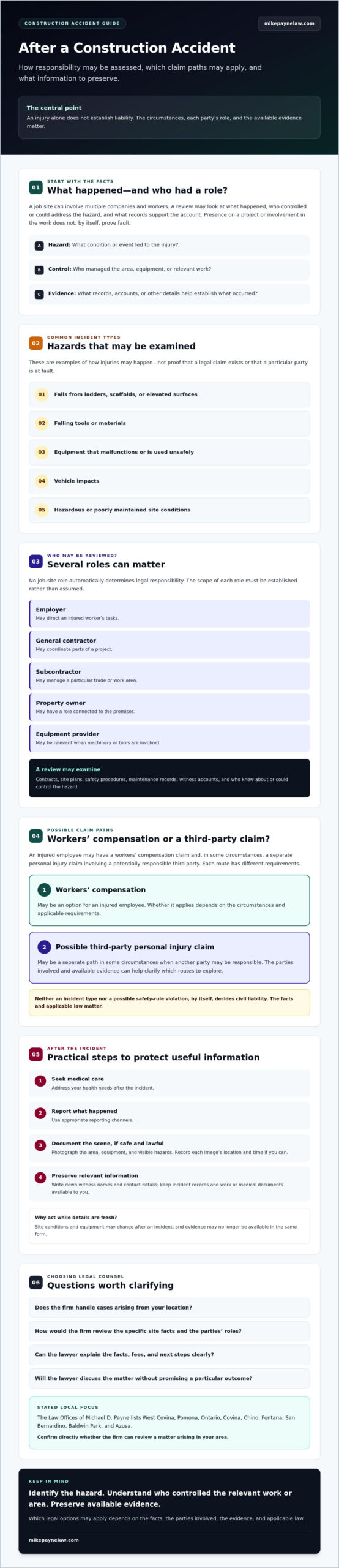
This article explains how responsibility may be assessed, what claim paths could apply, and what records to preserve while details are fresh. You’ll also find practical next steps and questions to ask a lawyer reviewing your circumstances. The Law Offices of Michael D. Payne has a stated local focus that includes West Covina, Pomona, Ontario, Covina, Chino, Fontana, San Bernardino, Baldwin Park, and Azusa. Confirm directly whether the firm can review a matter arising in your area.
Key Takeaways
- A construction accident alone doesn’t establish liability. The circumstances and each party’s role matter.
- Workers’ compensation and a possible third-party claim have different requirements. The parties involved and the available evidence can help clarify which routes to explore.
- After an incident, seek medical care, report what happened through appropriate channels, and preserve relevant records and witness information lawfully.
- If you search for a construction accident lawyer los angeles, confirm the firm handles cases from your location before relying on that geographic description.
- Look for a lawyer who explains the facts, fees, and next steps clearly without promising a particular outcome.
Construction Accidents in Los Angeles: Common Hazards and Why Liability Can Be Complex
A construction accident claim may seek compensation for harm caused by someone else’s negligence or a dangerous condition, but an injury alone doesn’t establish legal responsibility. The facts matter: what happened, who controlled the hazard, and what evidence supports the account. A job site may involve several companies and workers, so identifying the relevant roles can take more than an initial account of the incident.
Which construction-site hazards commonly lead to injury?
Falls from ladders, scaffolds, or elevated surfaces can cause serious harm. Injuries may also involve falling tools or materials, equipment that malfunctions or is used unsafely, vehicle impacts, or hazardous and poorly maintained site conditions. These examples describe ways an injury may happen. They don’t prove that a legal claim exists or that a particular person or company is at fault.
Site conditions and equipment may change after an incident. If it’s safe and lawful, take photographs of the area, equipment, and visible hazards. Record the location and time of each image if you can. Write down witness names and contact details, and keep any incident records and work or medical documents available to you. A construction worksite accident claim may require looking at how the hazard arose, who could address it, and what evidence is still available.
Workplace safety rules can be part of that broader review. The Occupational Safety and Health Administration (OSHA) is the federal agency associated with workplace safety oversight; California also has its own workplace safety agency. A safety concern may warrant investigation, but an incident type or possible rule violation doesn’t by itself decide civil liability.
Why can more than one party be involved?
A project may bring together a property owner, general contractor, subcontractors, equipment suppliers, workers, and visitors. Their roles differ. One company may direct a work area, another may supply or maintain equipment, and an injured person may be an employee, independent contractor, or visitor. Those details can affect which legal routes may be available and which facts need review. For property owners and managers seeking professional trade partners who prioritize structured job-site practices, you can discover Mike and Mike Roofing as an example of a dedicated specialty contractor.
Possible responsibility is not proven liability. An investigation may examine contracts, site plans, safety procedures, maintenance records, witness accounts, and who knew about or could control the hazard. Location also matters when choosing legal counsel. The Law Offices of Michael D. Payne has a stated local focus that includes West Covina, Pomona, Ontario, Covina, Chino, Fontana, San Bernardino, Baldwin Park, and Azusa. Confirm directly whether the firm can review a matter arising elsewhere.
Identifying who controlled the hazard can help show which parties may need closer investigation. Evidence and applicable law determine whether liability can be established.
If you’re searching for “construction accident lawyer los angeles,” ask a firm about its geographic coverage and how it would review the specific site facts.
Who May Be Liable After a Los Angeles Construction Accident?
No job-site role automatically determines legal responsibility. Liability depends on the evidence, applicable law, and what each person or company did, controlled, or may have failed to do. A general contractor, property owner, subcontractor, or equipment provider could be part of an investigation. Being present or involved in a project doesn’t by itself prove fault.
How do site roles affect a liability investigation?
An employer may direct an injured worker’s tasks. A general contractor may coordinate parts of a project, while a subcontractor may manage a particular trade or work area. A property owner may have a role connected to the premises, and an equipment provider may be relevant if machinery or tools are involved. The scope of each role must be established rather than assumed.
For example, a worker is injured near a temporary opening in a floor. An investigation might examine which company created or maintained the opening, who controlled access to that area, and what relevant contracts and site records show. The example doesn’t identify a liable party. It shows why job titles alone can’t answer the question.
What evidence can help clarify responsibility?
Preserve information you can access safely and lawfully. Keep photographs, witness names and contact details, your own account of when and where the incident happened, medical records, and communications related to the injury. If you know which companies or crews were working nearby, note that too. Don’t enter restricted areas or take documents you aren’t authorized to access.
Other records, such as incident reports, work assignments, equipment maintenance documents, or safety procedures, may be held by an employer or another company. A lawyer can assess which records may matter and how they can be requested appropriately. Keep your own materials in their original form. Avoid editing images or messages.
Cal/OSHA oversees workplace safety enforcement in California. Its rules may provide relevant context for an investigation, including California’s Construction Safety Orders. California Labor Code provisions may also be relevant, depending on the circumstances. A safety concern or alleged rule violation isn’t by itself a final finding of civil liability. The facts and applicable law still need careful review.
Preserving evidence promptly can help clarify what happened, but no single record guarantees that liability will be established. If you’re considering a construction accident lawyer los angeles to review disputed responsibility, you can read more about construction worksite accident representation and confirm whether the firm can review your circumstances.
Workers’ Compensation or a Third-Party Claim: What May Apply in California?
An injury at work doesn’t automatically rule out every other possible legal claim. Workers’ compensation and a personal injury claim against a potentially responsible third party are separate routes, with different requirements and potentially different parties. Whether either applies depends on the worker’s circumstances, the evidence, and California law.
| Possible route | Who may be involved | General focus |
|---|---|---|
| Workers’ compensation | Often the employer and its workers’ compensation insurer | Work-related benefits, which may include medical care and wage-replacement benefits, subject to eligibility and applicable rules |
| Third-party claim | A potentially responsible person or company other than the employer | Whether that party’s conduct contributed to the injury and what remedies may be available under personal injury law |
What does workers’ compensation generally address?
Workers’ compensation is a system for addressing many injuries connected to a person’s job. A claim may involve reporting the injury, medical information, and communications with the employer or insurer. This overview doesn’t cover every possible benefit or remedy, and eligibility can depend on the facts. Don’t assume that receiving, applying for, or disputing benefits answers every question about other potential claims.
When might a third-party claim need to be considered?
A separate review may be appropriate when someone other than the employer may have contributed to the injury. For example, a site visitor might be hurt by equipment operated or maintained by an outside company. A visitor’s circumstances differ from an employee’s, and the example doesn’t establish that anyone was legally at fault. An injured worker’s situation also requires its own review of the parties, evidence, and applicable rules.
Deadlines and available remedies can differ by claim type, and exceptions may apply. Workers’ compensation generally has a one-year filing period, while personal injury lawsuits generally have a two-year limitation period in California. These are general rules, not a deadline calculation for an individual case. Get advice promptly so the facts and any applicable timelines can be assessed. For background on workplace safety, Los Angeles readers can also consult the UCLA Labor Occupational Safety and Health Program.
A construction accident lawyer los angeles can review how the incident happened and whether a claim involving a non-employer deserves separate consideration. Payne provides personal injury representation, including workplace injury representation. Contact the firm to ask whether it can review your specific situation.
After a Construction Accident in Los Angeles: Steps to Protect Your Position
After an injury, focus first on your health. Then take practical steps to keep important details from being lost. The right actions depend on your circumstances, but this sequence can help you organize what happened without putting your recovery at risk.
- Get medical care. Seek prompt evaluation for your injuries and follow your provider’s guidance. Explain how and where the incident happened, and keep copies of visit summaries and other medical records you receive.
- Report the incident through appropriate channels. Notify your employer or site contact as required by the circumstances. Keep a record of when and how you reported it, and save any confirmation or incident report you’re given.
- Write down what you remember. Record the date, approximate time, site location, conditions, equipment involved, and names or contact details of potential witnesses. Details can become harder to recall later.
- Preserve relevant materials lawfully. Keep available photographs, witness information, medical documents, and communications. Save original files and records without altering them. Don’t enter restricted areas or take documents you’re not authorized to access.
- Review requests carefully. An insurer may ask questions or request a recorded statement. The effect of a statement depends on the circumstances. Keep communications factual and consider getting case-specific legal advice before providing a detailed account, signing documents, or accepting a settlement.
What should an injured worker document first?
Start with the basic timeline and conditions: where you were, what task was underway, what equipment was involved, and what you noticed before and after the incident. Keep copies of reports and medical records available to you. If a vehicle was involved at the worksite, you can review information about motor vehicle accident representation.
What should you ask before speaking with an insurer?
Ask who the caller represents, what information they’re requesting, and whether the request is in writing. Don’t guess if you’re unsure of an answer. Before signing a release or settlement, seek individual legal advice about what it covers and how it may affect possible claims. Deadlines vary by claim and circumstance, so don’t rely on a universal date. Have current California time limits checked for your situation.
A construction accident lawyer los angeles can review the incident details, potential claim routes, and documents before you decide how to respond. For construction-specific information, see construction worksite accident guidance. To ask the firm to review your circumstances, contact Payne.
Choosing a Construction Accident Lawyer in Los Angeles: What to Ask Before You Hire
Choosing a lawyer is about more than credentials. A construction injury may involve several companies, disputed site control, and more than one possible claim route. Look for clear answers about how the lawyer will assess your facts, investigate the incident, and keep you informed. No responsible lawyer can promise a particular result before reviewing the evidence.
What should you ask a construction accident lawyer?
Use your first conversation to understand the lawyer’s approach, not just hear general assurances. Ask practical questions such as:
- What construction-site cases have you handled? Ask how the lawyer would investigate who controlled the work area, hazard, equipment, or safety process.
- How will relevant evidence be preserved? Discuss photographs, witness information, incident reports, and records that may be held by employers or other companies.
- Which claim routes and parties may need review? Ask how the lawyer will distinguish workers’ compensation issues from a potential claim involving a non-employer.
- Who will handle my case and communicate with me? Clarify who your main contact will be and how significant developments will be explained.
- How are fees and case costs addressed? Ask how the contingency fee, advanced litigation costs, and any repayment terms are described in the written agreement.
Read the agreement carefully before signing. Payne describes its representation as contingency-based and says it advances litigation costs. Confirm the exact fee and cost terms in writing, including how costs are treated, rather than relying on a general verbal summary.
How can Michael D. Payne’s approach help with a case review?
Michael D. Payne has over 25 years of experience and a former insurance-defense background. That perspective may inform a careful review of insurer positions, but it doesn’t guarantee a particular advantage or outcome. The firm represents people in personal injury matters, including workplace injuries. Ask whether it currently accepts construction accident cases arising in Los Angeles and whether your location is within its coverage.
A useful case review should connect the details of your injury to the evidence, potential parties, and possible legal routes. Bring any records you can lawfully access, and ask what information the lawyer needs next. If you’re looking for a construction accident lawyer los angeles, contact the firm to ask whether your circumstances fall within its current case coverage.
Take the Next Step With a Clearer View of Your Options
After a construction injury, responsibility isn’t always obvious. Facts about who controlled the hazard can help identify which parties warrant review. Workers’ compensation and a possible third-party claim are different routes, and evidence such as photographs, reports, and witness details may help clarify what happened. Deadlines depend on the claim and circumstances, so get advice specific to your situation.
Michael D. Payne has over 25 years of experience and a former insurance-defense background. He represents people in personal injury matters, including workplace injuries. The firm describes its representation as contingency-based and advances litigation costs, but the written agreement controls the specific fee and cost terms. Ask about them before deciding whether to proceed.
If you’re looking for a construction accident lawyer los angeles, an individualized case review can help you understand potential next steps without assuming a result. Contact Michael D. Payne to discuss your construction accident and ask whether the firm can review your circumstances.
Frequently Asked Questions
Can I sue someone other than my employer after a construction accident in California?
Possibly. A claim against someone other than your employer depends on the facts and that party’s role in the incident. Workers’ compensation and a third-party claim are separate legal routes, and receiving benefits doesn’t establish that another party is liable. A California attorney can review who controlled the hazard, the available evidence, and applicable rules before advising whether another claim may be available.
Can I file a workers’ compensation claim and a third-party claim for the same construction accident?
In some situations, both claim routes may warrant review, but neither is automatic. The parties involved, how the injury occurred, and any benefits already received may affect the analysis. A third-party claim has distinct requirements from workers’ compensation. Don’t assume you can or can’t pursue both based on a general description. Ask a California attorney to assess your specific facts and explain possible effects.
Who can be held responsible for a construction accident in Los Angeles?
Depending on the circumstances, parties investigated may include an employer, general contractor, subcontractor, property owner, or a company connected to equipment. A party’s presence at the site doesn’t prove legal responsibility. The investigation considers the hazard, each party’s role and control, and available records or witness accounts. A local search for “construction accident lawyer los angeles” can be a starting point, but ask counsel to assess the actual evidence.
What should I do after a construction accident at work?
Get appropriate medical attention, report the incident through the proper workplace channels, and write down what happened while your memory is fresh. Preserve relevant photos, witness information, medical records, and communications lawfully. Don’t guess about fault or sign documents you don’t understand. Reporting duties and legal deadlines may differ based on the claim and circumstances, so seek prompt, case-specific advice about what applies.
How long do I have to file a construction accident claim in California?
There isn’t one deadline that applies to every construction injury claim. The time limit can depend on the claim type, the parties involved, and other circumstances; some situations may require earlier action. Don’t rely on a general online estimate or assume the same deadline covers workers’ compensation and a lawsuit. Ask a California attorney to identify the current deadlines that apply to your particular facts.
Can I still have a claim if I was partly responsible for a construction accident?
Possibly. Partial responsibility doesn’t automatically determine whether a claim exists or how it may be evaluated. The facts, applicable legal rules, and type of claim all matter. Describe what happened honestly and preserve relevant evidence rather than deciding your case is hopeless based on an initial assumption. A lawyer can review the circumstances and explain potential options without promising a particular outcome.
How do construction accident lawyers charge in California?
Some personal injury firms use contingency-fee agreements, where the attorney’s fee depends on a recovery under the written terms. Litigation costs and repayment terms may be addressed separately, so review the agreement and ask questions before signing. Payne describes its representation as contingency-based and says it advances litigation costs; confirm the exact terms directly. Its stated local focus includes West Covina, Pomona, Ontario, Covina, Chino, Fontana, San Bernardino, Baldwin Park, and Azusa. Ask whether the firm can review your specific matter.