

A truck crash on a familiar San Bernardino freeway can become far more than a two-driver insurance dispute. Complex truck accident litigation in San Bernardino often follows crashes along I-10 or I-215, or on the steep, winding Cajon Pass connection to I-15. California generally gives injured people two years from the accident date to file a truck accident lawsuit.
That distinction matters: a commercial truck crash can involve the driver, trucking company, cargo handlers, maintenance contractors, and records not usually involved in a car claim. You may know where the collision happened and how it affected you, yet still have questions about who may be responsible and which deadline applies.
This guide explains where truck crashes happen locally, how California filing deadlines work, and what sets truck accident litigation apart from a car accident case. You’ll learn why preserving evidence and identifying potentially responsible parties matter, and when truck accident representation may help protect your claim.
Key Takeaways
- Learn how California’s comparative negligence rules can affect compensation when responsibility for a crash is shared.
- See why identifying everyone who may have contributed to a commercial truck crash can shape a claim.
- Know that claims involving a government vehicle have a distinct filing deadline: California Legislature says a tort claim must be filed within 6 months.
- Understand how federal driving-hour and rest requirements can make truck accident cases different from car accident claims.
What is the statute of limitations for a truck accident lawsuit in California?
California generally gives an injured person two years from the crash date to file a truck accident lawsuit under Code of Civil Procedure section 335.1. Missing that deadline can bar a claim, so an attorney should assess the date and claim type promptly.
California Civil Code section 1714(a) supports comparative negligence: compensation can reflect each party’s share of responsibility. If a truck driver was speeding and another driver also contributed, evidence about both actions can affect the claim. Liability may extend beyond the driver to a trucking company or logistics business when its conduct contributed to the collision.
Federal rules may govern commercial drivers and carriers, including hours-of-service limits, drug and alcohol testing, and electronic logging devices. California’s AB 5 can also matter when a company’s classification of a truck driver as an independent contractor is disputed. The applicable rules depend on the vehicle, work, and facts of the crash.
Truck lawsuits arising in San Bernardino County are handled in the Superior Court of California, County of San Bernardino. The appropriate courthouse depends on venue, including where the collision occurred and which court location serves that area.
Damages are assessed using documented losses, such as medical expenses, lost income, future care needs, pain, and reduced quality of life. Settlement discussions may consider those losses, evidence of negligence, shared fault, and available insurance. A trucking company’s lawyers or insurers may dispute responsibility or the extent of your injuries; a truck accident lawyer can evaluate an offer against the documented impact of the crash.
There is no single timeline for complex cases in San Bernardino County. Disputed fault, multiple companies, serious injuries, expert analysis, and settlement negotiations can all affect how long litigation takes.
Common defenses include denying negligence, shifting blame to another driver, or disputing whether a company controlled the driver. Fatigue, unsafe cargo placement, poor maintenance, and faulty parts may point to different causes and responsible parties. Preserving logs, maintenance records, and crash evidence can help address those disputes.
Where Do Truck Accidents Happen in San Bernardino?
Commercial trucks travel through San Bernardino County on I-10, I-215, and I-15. Cajon Pass connects to I-15 through steep, winding terrain, creating demanding conditions for large vehicles. I-10 carries commercial traffic, while I-215 combines freight and commuter traffic. A collision on either route can involve several vehicles, not just a truck and one car. The National Safety Council reports that large commercial trucks are more than twice as likely as other vehicles to be involved in catastrophic and fatal accidents. These corridors are important to consider in complex truck accident litigation in San Bernardino.
A jackknife crash can block lanes and trigger secondary collisions. The truck driver’s actions may be relevant, but liability could also involve the motor carrier, trailer loader, freight broker, or maintenance contractor. If a defective component contributed, its manufacturer may also be a potentially responsible party. Investigators must connect each party’s conduct to the crash rather than assume that every company in the shipping chain shares fault. Sorting out those connections is central to complex truck accident litigation in San Bernardino.
California’s 2024 figures show the scale of the issue: the Federal Motor Carrier Safety Administration reported 12,256 traffic accidents involving large trucks, 5,136 injuries, and at least 359 deaths. Those statewide numbers don’t identify a specific San Bernardino danger spot. They do show why careful investigation matters when a local crash involves a commercial vehicle and serious harm.
After a collision, seek medical attention, report the crash to authorities, and preserve available evidence. If it’s safe, document vehicle positions, visible damage, skid marks, roadway conditions, and witness information. Avoid discussing fault with insurance representatives before understanding the facts. In a jackknife or multi-vehicle crash, these details can help distinguish the initial impact from later collisions and clarify which parties may be responsible. For a crash involving a fatal injury, truck accident representation can help address the complex claims that follow.
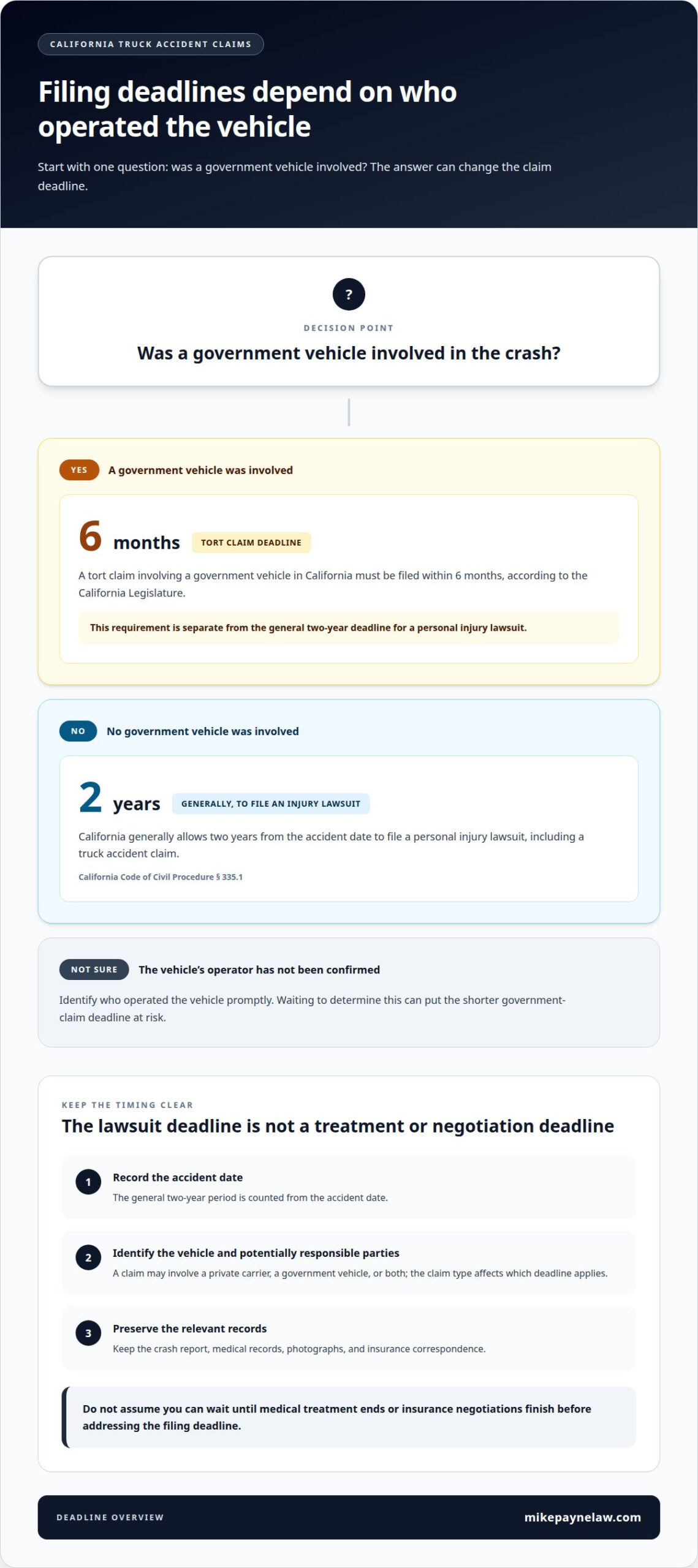
California truck accident filing deadlines
California generally allows two years from the accident date to file a personal injury lawsuit under Code of Civil Procedure section 335.1. That deadline applies to truck accident cases involving an injury, including claims alleging a truck driver or trucking company caused the crash. The California statute of limitations sets the time to bring a lawsuit, not the time to finish medical treatment or negotiate with an insurer. Record the collision date and raise the filing deadline during an early legal consultation.
A government vehicle can trigger a shorter deadline. According to the California Legislature, a tort claim involving a government vehicle in California must be filed within 6 months. That requirement is separate from the general two-year deadline for a personal injury lawsuit. If a government vehicle was involved, promptly identify that fact and get legal advice about the claim process. Waiting to determine who operated the vehicle can put the shorter deadline at risk.
Start by building a clear timeline. Preserve the crash report, medical records, photographs, and insurance correspondence, then note the accident date and every potentially responsible party. A truck accident attorney can assess whether the claim involves a private carrier, a government vehicle, or both. Those details matter because the proper defendant and filing process affect how you can seek compensation. Don’t treat an insurance claim as a substitute for filing a lawsuit.
In complex accident cases, several companies may dispute who caused the collision. The investigation can take time, but the applicable deadline still matters. A truck accident lawyer can review the crash circumstances, identify the type of claim, and plan next steps before filing time runs out. Keep a written record of key dates and communications. Acting promptly helps preserve the opportunity to pursue a claim while fault, vehicle records, and witness accounts can still be investigated.
Differences between truck and car accident litigation
A San Bernardino County truck case can involve federal safety rules, a driver, a carrier, and other businesses. A car accident claim usually focuses more narrowly on drivers’ conduct and insurance. That broader investigation changes what evidence matters and which parties may be involved.
The Federal Motor Carrier Safety Administration identifies commercial vehicles with a gross vehicle weight rating of 10,001 pounds or more as subject to federal regulations. The Federal Motor Carrier Safety Administration limits commercial truck drivers to 11 hours of driving within a 14-hour on-duty window and requires a 10-hour rest period. Those records can help assess whether a driver’s schedule complied with applicable rules.
Vehicle maintenance is another key difference. Federal regulations require trucking companies to maintain their vehicles properly, so maintenance records and inspection evidence may help show whether a defect or neglected repair contributed to a crash. In a car collision, investigators may focus on vehicle damage, road conditions, and driver behavior. In a commercial truck case, they may also examine carrier practices and the driver’s work records.
Truck size can intensify the consequences of a collision. Commercial trucks transporting goods can weigh up to 80,000 pounds, about 20 times the weight of an average passenger car. That force can cause severe injuries and involve several vehicles. Personal injury claims may therefore require detailed medical evidence, proof of lost income, and analysis of each party’s role. Insurance companies may contest fault, injury severity, or which business bears responsibility.
A truck accident lawyer can connect the crash evidence to the applicable rules and identify relevant records before disputes narrow the claim. If a commercial vehicle crash injured you in California, talk with an accident lawyer about your truck accident case.
Law Offices of Michael D. Payne: Truck Accident Representation
Law Offices of Michael D. Payne represents people injured in truck crashes, including cases involving disputed fault, multiple companies, or serious injuries. Turn to the firm for help identifying potentially responsible parties, preserving relevant evidence, and presenting the impact of your injuries during insurance negotiations. Attorney Michael D. Payne’s background as a former insurance defense lawyer informs his approach to challenging claim denials and evaluating settlement positions.
Truck accident cases call for focused investigation. A claim may involve driver records, carrier policies, vehicle maintenance, and medical documentation. Representation can help bring those pieces together while you focus on treatment and recovery. The firm also represents people in car accidents, slip and fall incidents, and motorcycle accidents.
For a discussion of your truck accident claim, contact Law Offices of Michael D. Payne.
Take the Next Step Toward a Clear Path Forward
After a serious truck crash, your next steps can shape how clearly your claim is presented. Gather the questions that still need answers: which parties may share responsibility, what records could clarify the crash, and how your injuries affect daily life. A focused review can help organize those concerns into a practical plan.
Complex truck accident litigation in San Bernardino calls for more than reacting to an insurer’s position. It requires a careful review of the evidence, the people and companies involved, and the losses you’re facing. You don’t have to sort through every detail alone. Law Offices of Michael D. Payne can discuss your situation and explain a path forward based on its facts.
Contact Law Offices of Michael D. Payne to discuss your truck accident claim. Take the next step with a clearer understanding of your options and the support to move forward.
Frequently Asked Questions
What are the Causes of Commercial Truck Accidents in Southern California?
Common causes include driver fatigue, unsafe cargo placement, poor maintenance, and faulty parts. Long driving hours can reduce alertness, while poorly positioned freight may affect a truck’s balance. Mechanical problems can also contribute to a collision. In a San Bernardino-area crash, investigators can compare driver logs, cargo-loading details, and maintenance history to determine which conditions may have played a role.
How Much Does it Cost to Hire a Truck Accident Lawyer in California?
Law Offices of Michael D. Payne handles truck accident cases under its No Fee Guarantee: “we do not charge a fee unless we win.” Before deciding how to proceed, ask how the arrangement applies to your claim and what litigation costs involve. A clear discussion helps you understand the fee terms without assuming every case follows the same path.
What if the truck driver was classified as an independent contractor In San Bernardino?
A driver’s independent-contractor label doesn’t by itself answer which company may be responsible. California’s AB 5 may be relevant to worker classification, while the crash investigation also examines the carrier’s role and the facts connecting each business to the driver’s work. Preserve contracts, dispatch communications, and route or delivery records, then have an attorney assess how those materials may affect liability in a San Bernardino claim.
What is a ‘jackknife’ accident and who is liable in San Bernardino?
A jackknife crash occurs when a truck’s trailer swings out of line with its cab, potentially blocking lanes or striking nearby vehicles. Responsibility depends on evidence about what caused the loss of control. The truck driver, motor carrier, cargo loader, or maintenance contractor may be relevant parties. A component manufacturer may also matter if a defect contributed. Photos and witness accounts can help distinguish each party’s role.
What is the statute of limitations for truck accident claims in California?
Most California injury lawsuits over a truck crash must be filed within two years of the accident date. A claim involving a government vehicle has a shorter deadline: according to the California Legislature, a tort claim must be filed within 6 months. Note the crash date and identify whether a public vehicle was involved, because that detail changes the deadline requiring attention.
What evidence should be preserved after a commercial truck crash in San Bernardino?
Preserve photographs of vehicle damage, lane positions, debris, skid marks, traffic controls, and road conditions. Record witness names and contact details, and keep medical records and insurance messages together. Truck electronic data, electronic logging device records, and driver logs can be overwritten or destroyed within 30 days after a crash. Prompt preservation matters, particularly when repairs are underway or the truck has left the scene.