

A crash report doesn’t settle who’s legally responsible. Under California car crash law, evidence, each driver’s share of fault, and filing deadlines can matter more than assumptions about what happened.
If you’re unsure how insurance and a legal claim fit together, that uncertainty is understandable. This article explains California’s general rules, the records that can help clarify a crash, and when legal guidance may be useful.
You’ll learn how comparative fault can affect a claim, why preserving evidence matters, and how deadlines can vary by case. The Law Offices of Michael D. Payne represents car accident victims in West Covina and throughout Southern California. The firm has 30 years of Experience, offers free accident case consultations, and is available 24/7. Se Habla Español. Hablamos Español.
Key Takeaways
- California car crash law considers evidence and each party’s conduct when assessing responsibility, so don’t assume fault is obvious.
- An insurance claim and a civil claim serve different purposes. Knowing the difference can help you make informed decisions.
- Preserve records, document relevant facts, and keep track of medical care while you learn which deadlines may apply.
- Legal guidance can help organize evidence, identify potential issues, and manage communications with insurance companies.
- A car crash lawyer can gather evidence and work with investigators and expert witnesses to help clarify the facts of a case.
What does car crash law cover in California?
After a collision, it can be difficult to separate what happened on the road from the legal and insurance issues that follow. Car crash law covers questions such as who may be responsible, how insurance claims are evaluated, and how injured people can seek compensation for injuries or vehicle damage. These rules guide how a claim is assessed, but they don’t automatically decide who should pay.
A crash claim seeks compensation through insurance or a civil lawsuit; a criminal traffic matter concerns whether the state will pursue penalties for an alleged violation. The same collision can raise both kinds of issues, but they serve different purposes. A civil claim focuses on responsibility for harm and resulting losses. Criminal proceedings are separate, and a civil claim isn’t resolved simply because a traffic citation was issued or dismissed.
The law that applies can depend on where the crash occurred. This section explains California’s general framework, not a final legal opinion about a particular case. The location, people involved, insurance policies, and circumstances can all affect the analysis. If a collision happened across state lines or involved people from different states, the legal issues may require closer review.
Which California rules may affect a crash case?
Negligence and liability are central to many injury claims. The analysis asks whether someone failed to use reasonable care and whether that conduct contributed to the harm. A driver’s actions may be relevant, but so are the surrounding facts and available evidence. Avoid relying on assumptions made at the scene to decide who is responsible.
California Civil Code section 1714 generally addresses responsibility for injuries caused by a person’s want of ordinary care or skill. State statutes and court decisions may also shape civil claims. How those rules apply depends on the facts and legal issues in a particular case. A police report may provide useful information, for example, but it doesn’t necessarily settle civil liability or determine the value of a claim.
Why out-of-state car crash advice may not apply
Online guidance may be written for a different state. An Illinois public guide or a Michigan-focused explanation of insurance and injury rules may help readers understand those states, but its requirements shouldn’t be treated as California law. Insurance procedures, coverage rules, and standards that affect injury claims can vary from state to state.
This distinction matters when you’re reading about insurance coverage or requirements for bringing an injury claim. Don’t assume an Illinois or Michigan rule governs a collision in California. Start with the state where the crash occurred, then consider whether other facts affect the analysis. The Law Offices of Michael D. Payne provides California motor vehicle accident representation for crash victims in West Covina and Southern California.
How does California determine fault after a car crash?
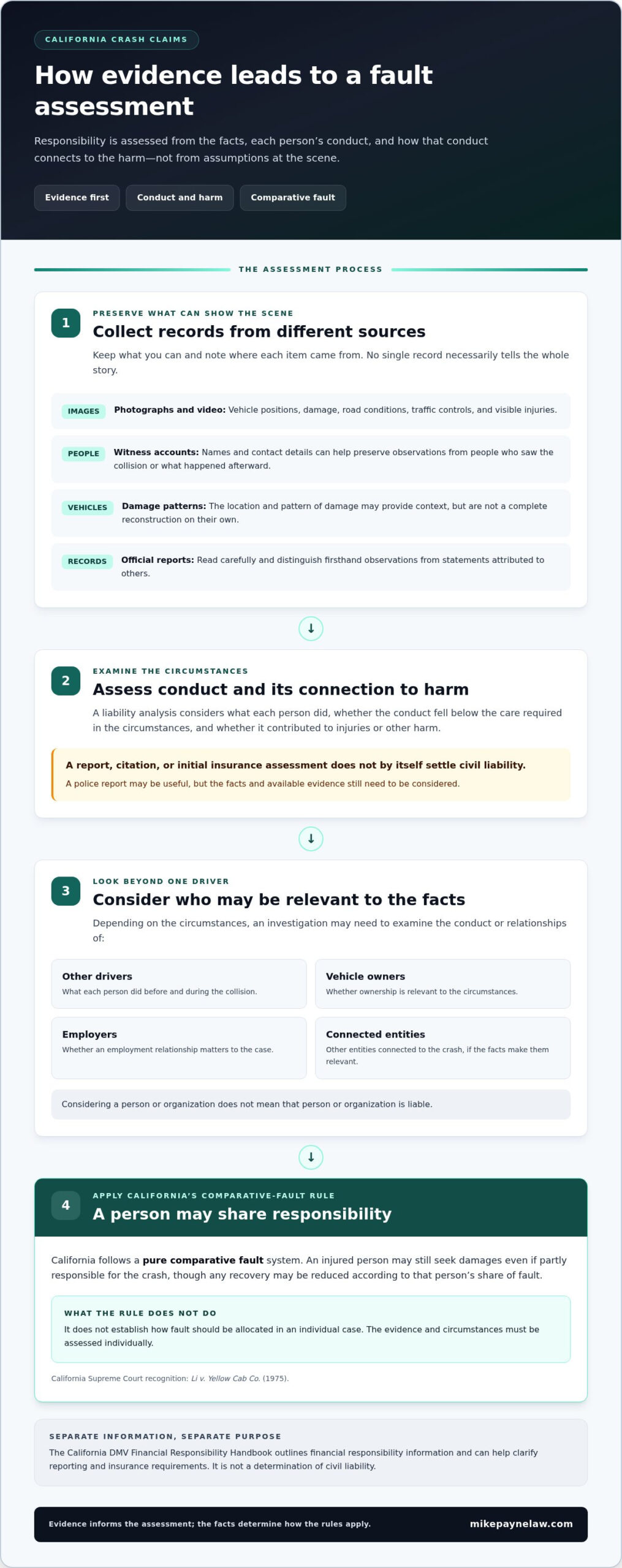
Fault depends on evidence, not assumptions about who caused the collision. A liability analysis examines what each person did, whether that conduct fell below the care required in the circumstances, and whether it contributed to someone’s injuries or other harm. A driver’s account matters, but it’s only one part of the picture. The same is true of an initial insurance assessment or a citation.
California follows a pure comparative fault system, recognized by the California Supreme Court in Li v. Yellow Cab Co. (1975). An injured person may still seek damages even if partly responsible for the crash, though any recovery may be reduced according to that person’s share of fault. That principle doesn’t establish how fault should be allocated in an individual case. The evidence and circumstances must be assessed individually.
Responsibility may also extend beyond one driver. Depending on the facts, an investigation may need to consider other drivers, vehicle owners, employers, or entities connected to the crash. That doesn’t mean any particular person or organization is liable. It means the relevant conduct and relationships should be examined before drawing conclusions. California car crash law turns on how the facts connect to the harm.
What evidence can help establish responsibility?
Evidence can come from several sources. Preserve what you can and note where each item came from. No single record necessarily tells the whole story.
- Photographs and video: Images of vehicle positions, damage, road conditions, traffic controls, and visible injuries may help show what the scene looked like.
- Witness accounts: Names and contact details can help preserve observations from people who saw the collision or what happened immediately afterward.
- Vehicle damage: The location and pattern of damage may provide context, but shouldn’t be treated as a complete reconstruction on its own.
- Official records: A police report or other record can document reported details. Read it carefully and distinguish firsthand observations from statements attributed to others.
Official records can also explain obligations that are separate from deciding fault. The California DMV Financial Responsibility Handbook outlines state financial responsibility information. It can help clarify reporting and insurance requirements, but it isn’t a determination of civil liability.
Can more than one party share responsibility?
Yes. Imagine two drivers approaching an intersection, with questions about both a traffic signal and each driver’s actions. Investigators may need to examine all of those facts before responsibility can be assessed. This example doesn’t predict the result of a real claim. Comparative fault is applied to the circumstances and evidence of a specific case, not to a simple label assigned at the scene.
If questions about responsibility are complicating your next steps, Payne gathers evidence and works with investigators and expert witnesses. Learn about the firm’s motor vehicle accident representation and how legal guidance can help assess the facts.
How do insurance and civil claims fit into California car crash law?
Insurance and civil claims can address the same collision, but they aren’t the same process. An insurance claim asks an insurer to evaluate a request for coverage or compensation under an applicable policy. A civil claim seeks a legal remedy from a person or entity alleged to be responsible for harm. An insurance decision doesn’t automatically resolve a civil claim, and a civil claim doesn’t automatically determine what a particular policy covers.
The people, documents, and questions involved can differ between the two processes. The table offers a general guide, not a prediction of how an individual claim will be handled.
| Process | General purpose | Who may be involved |
|---|---|---|
| Insurance claim | Seek benefits or compensation under an applicable policy | The claimant, an insurer, and potentially other policyholders |
| Civil claim | Seek a legal remedy based on alleged responsibility for harm | The injured person, the person or entity accused of responsibility, and their legal representatives |
Coverage depends on policy language and the facts. The type of policy, the people covered, and the circumstances of the collision can all matter. Don’t assume that an insurer’s involvement means every loss is covered or that a claim has been fully resolved. Save claim-related letters and forms, and keep your account of events accurate and consistent.
What role can an insurance adjuster play?
An adjuster generally reviews a claim and related information to assess the insurer’s position. The review may include records, statements, photographs, or other materials. An adjuster’s assessment is part of the insurance process, not a court ruling on civil liability. Answer questions truthfully, avoid guessing when you don’t know an answer, and read documents carefully before signing or agreeing to anything.
You don’t need to treat every conversation as a dispute. Still, keep copies of correspondence and make notes about important discussions. If you’re uncertain how a request relates to your claim, understanding the relevant policy and case facts can help you decide what to do next.
When might an insurance dispute become a legal issue?
A dispute may arise over who caused the crash, whether an injury is connected to it, which losses are supported, or how policy language applies. Disagreement alone doesn’t mean a lawsuit is inevitable. Some issues may be addressed with further documentation or communication. Others may call for a closer legal assessment of the evidence, applicable law, and insurance documents.
An insurer’s involvement doesn’t mean you have to handle every issue without legal guidance. Payne represents car accident victims, gathers evidence, works with investigators and expert witnesses, and communicates with insurance companies to protect clients’ interests. The firm has 30 years of Experience, offers free accident case consultations, and is available 24/7. Se Habla Español. Hablamos Español. Learn more about motor vehicle accident representation and how the firm can help assess your options.
What evidence and deadlines should California crash victims understand?
Well-organized records can help clarify what happened, how an injury developed, and which losses are connected to a collision. Preserve materials as the case unfolds. A practical sequence is to save records, document relevant facts, track medical care, and get legal guidance about issues that may affect your options.
- Preserve records: Keep medical documents, repair estimates and invoices, insurance letters, photographs, witness details, and official records together. Save originals when possible.
- Document relevant facts: Note dates, conversations, and changes in your symptoms or ability to manage daily activities. Keep observations factual and distinguish what you remember from what someone else told you.
- Track treatment: Maintain appointment summaries, care instructions, and related records. Consistent documentation can help establish a timeline and identify questions that need follow-up.
- Obtain legal guidance: A case review can help identify potentially relevant evidence and clarify which deadlines may apply. Don’t wait for an insurance discussion to end before asking about filing time limits.
Which records may matter as a case develops?
Medical records can document reported symptoms, evaluations, and treatment over time. Repair documents and photographs may help show vehicle damage, while insurance correspondence preserves what was requested or communicated. Witness information and official records may add context. Keep dates and copies clear. Gaps or inconsistent timelines can make disputed facts harder to sort out. No single document necessarily proves responsibility or the full extent of an injury.
Why should California filing deadlines be checked promptly?
Different claims can have different time limits, and special rules may apply depending on the parties and circumstances. In general, California law sets a two-year period to file a personal injury lawsuit and a three-year period for property damage lawsuits. Claims involving a government entity generally require an administrative claim within six months. Exceptions may affect how a deadline applies, so verify the rule for the specific claim.
Missing an applicable filing deadline can limit or eliminate your ability to pursue a legal claim. An insurance claim or ongoing settlement discussion doesn’t necessarily pause a lawsuit deadline. These timelines concern legal filings, not necessarily every notice or step required by an insurance policy. California’s limitation rules, including Code of Civil Procedure sections 335.1 and 338, should be reviewed in light of the facts and any exceptions. If the collision involved a public entity, act promptly to determine which claim requirements apply.
The right deadline can depend on who was involved, the type of loss, and other case details, so don’t rely on a general online timeline alone. Payne can review records, gather evidence, and discuss questions about your situation. The firm has 30 years of Experience and offers free accident case consultations. Se Habla Español. Hablamos Español. Discuss your crash claim and any deadlines that may apply.
When can a California car crash lawyer help you understand your options?
A crash can leave you juggling treatment, repair questions, insurer requests, and uncertainty about who may be responsible. Legal guidance can help bring those issues into focus. A lawyer may organize available evidence, identify questions about liability and damages, and explain possible next steps based on the facts and applicable law. That guidance can help you make informed decisions, but it can’t promise a particular result.
Payne represents car accident victims in West Covina and Southern California. The firm gathers evidence and works with investigators and expert witnesses to examine questions that may arise in a case. It can also communicate with insurance companies and advocate for clients’ interests without promising compensation or a specific outcome. The firm has 30 years of Experience and is available 24/7.
What can a consultation help clarify?
A free accident case consultation is an opportunity to discuss your account of the collision and ask questions about records, potential responsibility, insurance communications, and next steps. You can explain what you know and identify what remains uncertain. A conversation can help outline issues for closer review, but it isn’t a promise that a claim will succeed or result in payment. The firm provides West Covina car accident legal representation and works to protect clients’ interests as insurance matters move forward.
It may help to have relevant correspondence, medical and repair records, and a timeline of key events available for discussion. You don’t need to reach a legal conclusion before asking questions. The goal is to understand the situation more clearly and identify what information could matter next. Se Habla Español. Hablamos Español.
How does the firm’s fee language work?
The firm’s fee arrangement is described as a “No Fee Guarantee”: “we do not charge a fee unless we win.” No Recovery. No Fee. Simple As That. This describes the firm’s fee arrangement, not a promise of a win, settlement, or recovery. Each case depends on its facts, evidence, and applicable law.
Choosing whether to seek legal help is personal. A consultation gives you space to explain what happened, understand questions that deserve attention, and consider your options without assuming that hiring a lawyer guarantees compensation. If you’re dealing with a car crash claim in Southern California, Payne can discuss your situation and explain how the firm may assist. Request a free accident case consultation.
Take the next step with a clearer plan
The decisions after a collision don’t have to be made all at once. Start by identifying what remains uncertain: a document you don’t understand, a question about responsibility, or an insurance request you’re unsure how to answer. A focused conversation can help you see which questions deserve attention and what information may be useful to gather next.
California car crash law can be difficult to apply to one person’s circumstances. General guidance gives you a foundation, but the details of your situation matter. You can discuss those details without assuming in advance what the outcome should be. The goal is clarity, so you can make your next decision with greater confidence.
If you’re ready to talk through your circumstances, request a free accident case consultation with Payne at (626) 974-8713. The firm represents accident victims in West Covina, Pomona, Ontario, Covina, Chino, Fontana, San Bernardino, Baldwin Park, and Azusa. A steady, informed next step can help you move forward with purpose.
Frequently Asked Questions
Is California a no-fault state for car accidents?
No. California generally follows an at-fault system, so a claim may seek compensation from the person or party whose conduct caused harm. The car crash law that applies can also involve your own insurance, depending on the policy and circumstances. An insurer’s involvement doesn’t by itself establish who was legally responsible. Review the relevant policy and collision facts before assuming which coverage or claim route applies.
Can I still pursue a car crash claim if I was partly at fault?
Yes. California’s pure comparative fault rule allows an injured person to pursue damages even if their own conduct contributed to a crash. Any recovery may be reduced based on the share of fault assigned to them. For example, both a driver’s actions and another party’s conduct could be examined. That illustration doesn’t predict how fault would be allocated in your situation, which depends on the evidence and applicable law.
What happens if the other driver has no insurance?
You may still have options, but the available path depends on the facts and your own policy. Check whether your policy includes uninsured motorist coverage and review any relevant collision coverage. These provisions have specific terms and may not apply in every situation. Keep the other driver’s information, claim correspondence, and crash records together so an attorney or insurer can assess available coverage without assuming payment is assured.
How long do I have to file a car accident lawsuit in California?
Generally, California allows two years to file a personal injury lawsuit and three years to file a property damage lawsuit. A claim involving a government entity may require an administrative claim within six months. Exceptions and case-specific rules can change how a deadline applies. Insurance negotiations don’t necessarily extend the time to file. Get advice promptly, especially if a public agency or vehicle may be involved.
Do I need a police report to make a car crash claim?
A police report can be useful, but not having one doesn’t automatically prevent you from making a claim. Other material, such as photographs, witness details, medical records, and insurer documents, may help establish what happened. Separate reporting rules may still apply: California requires a DMV report within 10 days for crashes involving injury or death, or property damage over $1,000. If someone is injured or killed, report it to police or CHP within 24 hours.
Can I speak with an insurance adjuster before getting legal advice?
Yes, but keep your communication truthful, clear, and limited to what you know. If you don’t remember a detail, say so rather than guessing. Ask what a document is for and take time to understand it before signing. Keep copies of letters and forms, and make notes about important conversations. If questions about responsibility, injuries, or policy language become complicated, legal advice can help you assess your next steps.
What should I bring to a free accident case consultation?
Bring what you have, but don’t delay a conversation because a record is missing. Useful materials may include the police report, photographs, insurance letters, medical visit summaries, repair estimates, and a short timeline of key events. Write down questions you want answered, such as which facts still need clarification or whether a deadline may apply. Your account of the crash and what has happened since can help frame the discussion.
Does the Law Offices of Michael D. Payne offer consultations in Spanish?
Yes. Payne serves Spanish-speaking clients. Se Habla Español. Hablamos Español. You can discuss your questions and accident circumstances in Spanish during a free accident case consultation. The firm represents accident victims in West Covina and Southern California, including Pomona, Ontario, Covina, Chino, Fontana, San Bernardino, Baldwin Park, and Azusa. A consultation is a chance to discuss your situation, not a promise of a particular outcome.