

You can understand your options before deciding how to pursue a car accident claim. California generally gives you two years from a crash to file a personal injury lawsuit, according to the California State Legislature. A professional review with the Law Offices of Michael D. Payne can help clarify what losses to document, how fault may affect recovery, and what steps matter next.
It’s understandable to worry about the cost of legal help while medical bills and missed work add pressure. Start with a realistic assessment of the claim rather than guessing what it may be worth. This article explains the compensation an injured person may pursue, deadlines that can apply, and how California’s fault rules affect recovery. You’ll also learn what information helps make a claim review useful, so you can approach your next decision with more clarity and less guesswork.
Key Takeaways
- Learn which losses may factor into a claim and how medical records and recovery progress can support a settlement demand.
- Understand how California’s comparative-fault rules affect compensation and what options may apply after an uninsured or underinsured driver causes a crash.
- See what information can help make a claim review more useful, from accident details to treatment records and insurer communications.
- Follow the main steps in a claim review and identify the filing deadlines that may affect your next move.
What Compensation Can You Recover After a Los Angeles Car Accident?
A Los Angeles car accident claim may seek compensation for injury-related losses and vehicle damage. Medical records, treatment and recovery, evidence of fault, and available insurance all affect what compensation you can pursue.
A useful car accident claim review in Los Angeles organizes those facts before settlement discussions begin. California law generally gives a person two years from a crash to file a personal injury lawsuit.
Settlement Demands and Medical Recovery
A settlement demand package presents the claim to the insurance company with supporting evidence. It may include medical bills and treatment records, documentation of lost wages, crash details, and vehicle repair estimates. Link each claimed loss to a record, such as a pay statement for missed work or a repair invoice for vehicle damage.
Your recovery matters because ongoing treatment can affect the full picture of injury-related losses. Keep appointment records and bills together, and note how symptoms affect daily activities. Making a demand before the treatment picture is clear may leave important costs or effects unaddressed.
Settlement Practices and Questions
California’s Fair Claims Settlement Practices Regulations set timelines for insurer communications and decisions. An insurer must respond to claimant communications within 15 days of receiving them, and accept or deny a claim within 40 days after receiving proof of claim. After settlement, payment is due within 30 days.
Ask what evidence supports the offer, which losses it covers, and whether accepting it resolves the claim. A settlement should account for documented medical care, lost income, and vehicle damage, not just the initial repair estimate.
For a Los Angeles car accident claim review, gather the crash report, photos, witness details, insurance information, medical records and bills, wage-loss records, and repair estimates. Together, these documents help connect the collision to the losses you’re claiming.
There’s no single settlement timetable for every California crash. Treatment progress, disputed fault, missing records, and the insurer’s review can all affect negotiations. Ask what information is still needed and what happens after the insurer receives the evidence.
When assessing a car accident lawyer, review client feedback and check the lawyer’s status with the State Bar of California. Look for relevant personal injury experience and clear explanations of how the lawyer would approach your case.
Before signing a fee agreement, ask how the fee is calculated and how case expenses are handled. Los Angeles settlements depend on documented losses, injury evidence, fault, and available coverage. A car accident lawyer can explain how these factors apply to your claim.
How is fault determined after a Los Angeles car accident?
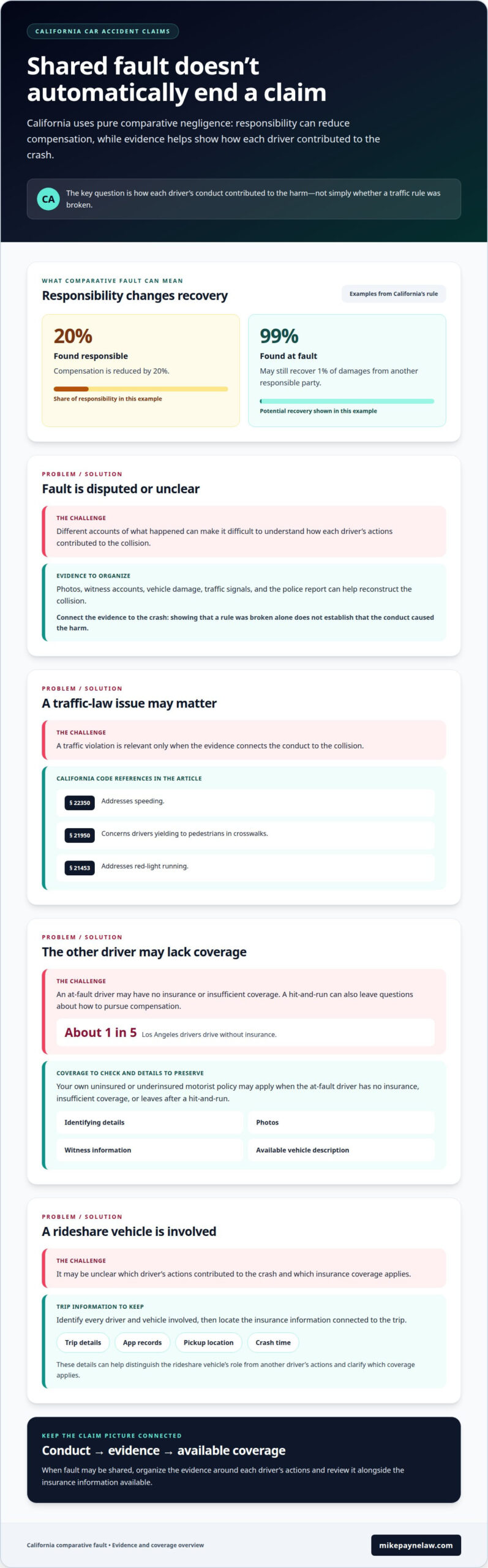
California uses pure comparative negligence to assign responsibility after a collision. An injured person found 20% responsible has compensation reduced by 20%. Even someone 99% at fault may recover 1% of damages from another responsible party. The key question is how each driver’s conduct contributed to the harm.
Investigators and insurers weigh evidence about what happened before impact. Photos, witness accounts, vehicle damage, traffic signals, and the police report can help reconstruct the collision. For example, California Vehicle Code § 22350 addresses speeding, § 21950 concerns drivers yielding to pedestrians in crosswalks, and § 21453 addresses red-light running. Evidence should connect the conduct to the crash, not merely show that a rule was broken.
Uninsured or underinsured drivers add a coverage question. A claim may involve your own uninsured or underinsured motorist policy when the at-fault driver has no insurance or insufficient coverage. A hit-and-run may also lead to a claim under that policy. About one in five Los Angeles drivers drive without insurance, so preserve identifying details, photos, witness information, and any available vehicle description.
Rideshare collisions require identifying every driver and vehicle involved, then locating the insurance information connected to the trip. Save trip details, app records, the pickup location, and the crash time. This information can help distinguish the rideshare vehicle’s role from another driver’s actions and clarify which coverage applies. When fault may be shared, evidence should address each driver’s actions separately.
A car accident claim review in Los Angeles can organize fault evidence alongside available coverage. For help understanding motor vehicle accident representation, start with the collision details, insurance records, and the evidence you’ve preserved.
Free car accident claim review
A free car accident claim review in Los Angeles lets you discuss the collision with an attorney before deciding what to do. The review can clarify how driving conduct, traffic conditions, and available evidence relate to negligence. It can also identify questions that matter when deciding whether to pursue compensation or a lawsuit.
Prepare a short timeline before the conversation. Note where the crash happened, what each vehicle did, when injuries appeared, and which reports or insurer letters you received. For example, if you entered an intersection on a green light, describe the signal, your direction of travel, and the other vehicle’s movement. Specific details make the discussion more useful.
An attorney can use those facts to identify gaps in the claim. A traffic collision report may describe the scene, while photos can show vehicle positions or roadway conditions. Medical records help connect treatment to the crash. If the other driver disputes responsibility, identifying the disagreement early helps focus the next investigation steps.
A review can also clarify the difference between evaluating a claim and filing a lawsuit. Ask what evidence supports the negligence analysis, which losses need more documentation, and what deadlines apply. If treatment is ongoing, explain what care you’ve received and what appointments remain. These details help show the current picture of your recovery.
The consultation is free. If you consider representation afterward, ask how the firm’s fee arrangement works, what expenses may arise, and which decisions remain yours. You should leave understanding the claim’s strengths, unresolved issues, and practical next steps, such as preserving a traffic-camera lead or obtaining a missing medical record. That clarity helps you decide whether to proceed.
How does a car accident claim review work in Los Angeles?
A claim review turns your account of the crash and supporting records into a practical assessment. The process typically moves from gathering facts to identifying coverage questions, evaluating losses, and choosing next steps. Bring the collision date and location, the vehicles involved, and a brief account of what happened.
First, organize the evidence. Collect the traffic collision report, scene photographs, witness contact details, insurer letters, and medical records. Add a timeline of treatment dates and communications with each insurance company. If a document is missing, note its name and who may have it, such as the responding police department or a treating clinic.
Next, examine responsibility and coverage. The review compares each driver’s account with available evidence, including vehicle damage, traffic signals, and witness statements. It also identifies policies that may apply, such as the at-fault driver’s liability coverage or your uninsured motorist coverage. For a rideshare crash, trip details can help identify relevant insurance information.
Then, map losses and unresolved questions. Medical bills, treatment records, wage information, and repair estimates help show how the crash affected you. The review can identify gaps, such as a repair estimate without photographs or missed work without employer records. It can also flag whether ongoing treatment may affect the evidence supporting a settlement demand.
California law does not set a statutory deadline for notifying an insurer about a car accident claim; the policy’s notice provision sets the deadline. The California DMV says a crash must be reported within 10 days if someone is injured or vehicle damage exceeds $750. Keep proof of any report and insurer notice with your claim records.
Use the review to leave with clear next steps: which records to obtain, which coverage questions to resolve, and what deadlines to track. To discuss your collision and claim, request a car accident claim review.
Law Offices of Michael D. Payne: Car Accident Representation
Law Offices of Michael D. Payne provides Car Accident Representation when injuries, disputed fault, or insurer questions make a claim difficult to manage alone. Attorney Michael D. Payne draws on his former insurance defense background to assess the evidence and pursue fair compensation.
Bring the crash report, medical records, insurance correspondence, and a timeline of treatment or missed work. These details help clarify what happened, which losses need documentation, and what issues may require further investigation. The firm also represents people injured in motorcycle and bicycle accidents.
Contact Law Offices of Michael D. Payne to discuss your accident claim.
Take the Next Step With a Clear Plan
The days after a crash can bring paperwork, calls, and decisions. Give yourself room to consider each one carefully. Keep an organized record of incoming messages, documents you send, and questions that still need answers. A short written timeline can also help you explain what has changed since the collision without relying on memory alone.
A car accident claim review in Los Angeles can turn uncertainty into a practical plan. Bring the questions that matter most to you, whether they concern responsibility, insurer communications, or managing the claim while you recover. You deserve to understand the process before choosing your next step.
For guidance on your situation, contact Law Offices of Michael D. Payne. You can take the next step at your own pace, with a clearer picture of what comes next.
Frequently Asked Questions
Can I Afford A Car Accident Lawyer?
Law Offices of Michael D. Payne states its No Fee Guarantee this way: “we do not charge a fee unless we win.” Ask for the fee agreement’s terms and clarify how case expenses are handled before signing. This may help injured people consider representation without paying a legal fee upfront. The firm serves accident victims in West Covina, Pomona, Ontario, Covina, Chino, Fontana, San Bernardino, Baldwin Park, and Azusa.
How much is my Los Angeles car accident case worth?
Your case’s value depends on documented losses and evidence, not a standard amount. Relevant factors include medical expenses, lost income, vehicle damage, the injury’s effect on daily activities, fault evidence, and available insurance coverage. Keep records connecting each loss to the crash. Medical bills and employer records, for example, can help document treatment costs and missed work.
So You’ve Had an Accident, What’s Next?
After addressing urgent safety and medical needs, create a dated file for the claim. Record the claim number, adjuster’s name, communication dates, and documents requested. Save receipts for crash-related purchases and keep copies of everything sent to an insurer. If an adjuster requests a recorded statement or document, note the request and deadline before responding.
Can I File The Case on My Own?
Yes, you can handle a lawsuit yourself, but you’ll be responsible for preparing and filing court papers, organizing evidence, and meeting procedural requirements. A disputed crash, for example, may require you to present records and explain how they support your account. Before deciding, consider whether you can manage those tasks while dealing with treatment and other demands of recovery.
Can I recover if I was partly at fault for a crash in Los Angeles?
Yes. California’s pure comparative negligence rule allows an injured person to recover compensation even when they share responsibility, but the recovery is reduced by their assigned share of fault. A dispute may focus on what each driver saw, when they reacted, and whether the evidence supports their accounts. Preserve photos, messages, and other records that may clarify what happened.
What is the deadline to file a car accident lawsuit in California?
California law generally gives a person two years from a car crash to file a personal injury lawsuit. A different deadline generally applies to claims involving a government entity: a written claim must be presented within six months. Identify early whether a public agency may be involved, because that shorter deadline can affect your next steps.