

A dog doesn’t need a history of aggression for its owner to be held responsible in California. If you’re asking who is liable for a dog bite in california, the owner is often the starting point, even when the dog has never bitten anyone before.
That doesn’t make every claim straightforward. California’s strict-liability rule generally applies when a bite happens in a public place or while the injured person is lawfully on private property. Where the bite happened, what the injured person was doing, and who controlled the dog or property can all affect the answer.
This guide explains when a dog owner may be liable, when another party could also be responsible, and how issues such as trespassing or provocation may affect a claim. It also outlines the details and records that can help clarify what happened. The Law Offices of Michael D. Payne represents people injured in accidents and brings more than 25 years of personal-injury experience, including a former insurance-defense perspective, to evaluating disputed liability and insurance arguments. The firm serves clients in West Covina, Pomona, Ontario, Covina, Chino, Fontana, San Bernardino, Baldwin Park, and Azusa.
Key Takeaways
- To understand who is liable for a dog bite in california, start with the dog’s owner. Civil Code section 3342 generally imposes strict liability for qualifying bites, without requiring proof of a prior bite or the owner’s knowledge of danger.
- Ownership may not be the whole story. Depending on their role and what they knew, a handler or property controller could face a separate, fact-specific negligence claim.
- Whether the injured person was lawfully present, along with any alleged provocation or other conduct, may affect liability or recovery. These facts aren’t automatic defenses.
- After getting medical care, preserve photos, witness details, incident reports, and records that may help establish the dog’s identity, ownership, location, and control.
- Keep your account factual and avoid guessing about disputed details. A careful review can help identify potentially responsible parties and assess insurance arguments.
Who Is Liable for a Dog Bite in California? Start With the Owner
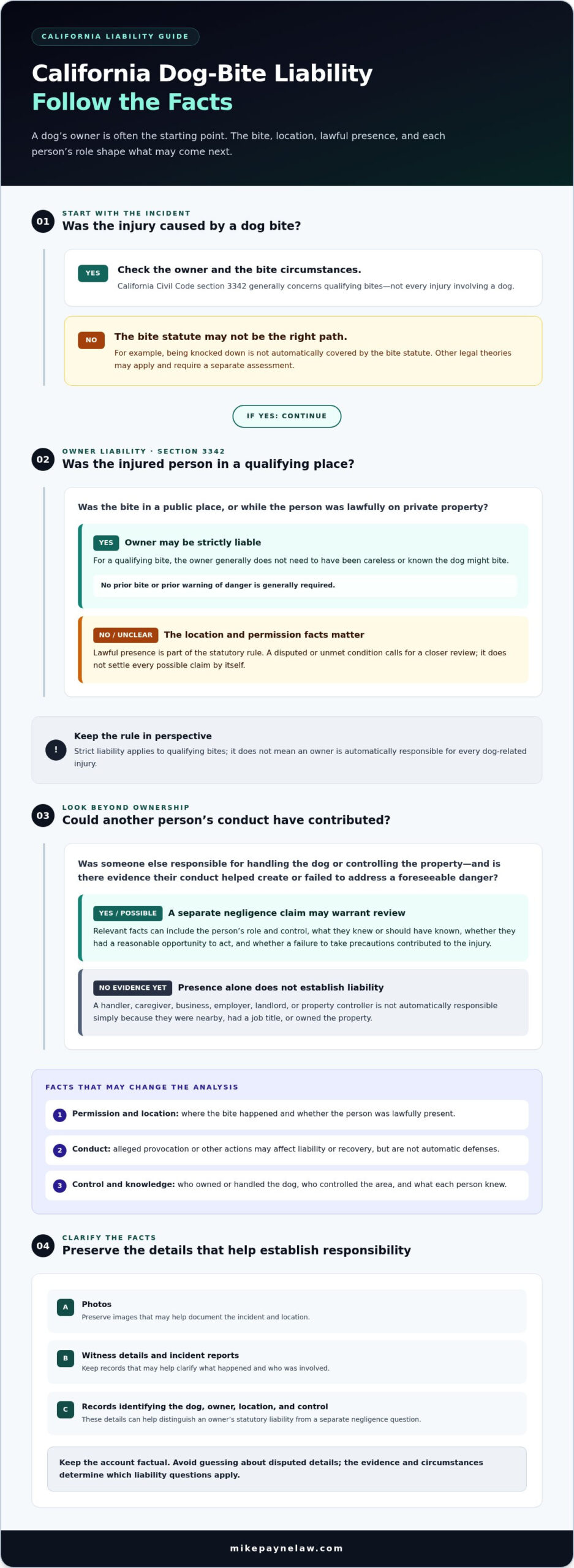
In California, a dog’s owner is generally strictly liable when the dog bites someone in a public place or while that person is lawfully on private property. Under California Civil Code section 3342, the injured person generally doesn’t have to prove the owner was careless or knew the dog might bite. That makes ownership the first place to look when asking who is liable for a dog bite in california.
Strict liability means an owner may be responsible for a qualifying bite even without prior warning that the dog was dangerous. But it doesn’t mean the owner is automatically responsible for every injury involving a dog. The law’s specific conditions still matter, including whether the injury was caused by a bite and whether the injured person was somewhere they were legally allowed to be.
What California Civil Code section 3342 means for a bite victim
Section 3342 focuses on the dog’s owner and the circumstances of the bite. If a dog bites a visitor who has permission to be at a home, for example, the owner generally can’t avoid statutory liability simply by saying the dog had never bitten anyone. The same basic rule applies to qualifying bites in public places.
This differs from a negligence claim, which asks whether someone failed to use reasonable care and whether that failure caused harm. An injury involving a dog that wasn’t caused by a bite, such as being knocked down, doesn’t automatically fall under the bite statute. Other legal theories may apply, but they require a separate assessment of the facts. The statute’s elements and any applicable exceptions must be evaluated under current California law.
Does the owner have to know the dog was dangerous?
Generally, no. For a qualifying bite under section 3342, an injured person usually doesn’t need to show the owner knew the dog had a dangerous tendency or that it had bitten someone before. The owner’s lack of warning or prior incidents doesn’t, by itself, defeat a claim under this rule.
That’s why the “one-bite rule” is a misleading assumption in California. Some people expect an owner to get one free pass before being held responsible. California’s statutory rule generally doesn’t require a prior bite or prior knowledge. Still, a claim isn’t guaranteed. The bite, the injured person’s lawful presence, the dog’s ownership, and other statutory requirements must be established. Details such as permission to enter, the bite location, and who owned the dog deserve careful attention when the facts are disputed.
Start with the owner, but don’t stop at assumptions. A careful review can distinguish a statutory bite claim from a negligence claim and identify which facts support or complicate responsibility.
When Can Someone Besides the Dog Owner Be Liable?
The dog’s owner is often the first person to examine, but the owner may not be the only one whose conduct matters. A separate negligence claim may involve someone who handled the dog or controlled the place where the bite occurred. The key questions are what that person knew, what they could reasonably do, and whether their actions or inaction contributed to the injury.
Section 3342 addresses an owner’s liability for a qualifying bite. Negligence claims against other people depend on proof of their role, duty, and conduct. That distinction matters when asking who is liable for a dog bite in california, especially if ownership is disputed or someone else had day-to-day control of the dog.
When a handler, caregiver, or business may face a negligence claim
A person who temporarily watches or handles a dog isn’t automatically liable just because the bite happened while the dog was in their care. The facts must support a basis for responsibility, such as that the person controlled the dog, knew of a specific risk, and failed to take reasonable precautions.
For example, evidence that a handler knew a dog had repeatedly lunged at visitors but left it unsecured near customers could be relevant. So could evidence that someone responsible for supervising the dog ignored a clear warning or failed to restrain it in the circumstances. The question isn’t simply who was nearby. It’s whether that person’s choices helped create or failed to address a foreseeable danger.
A business or employer could also be relevant if an employee’s actions in the course of work contributed to the incident, or if the business itself was responsible for managing the risk. That requires a fact-specific review. A person’s job title or presence at the scene alone doesn’t establish liability.
When property ownership or control may matter
A bite on someone’s property doesn’t automatically make the landlord, business owner, or property controller responsible. A claim against them generally turns on evidence about their control over the relevant area, whether they knew or should have known of a danger, whether they had a reasonable opportunity to address it, and whether their failure to act contributed to the injury.
Suppose a business knew a tenant or employee regularly brought an aggressive dog into a shared entrance, had authority to address that recurring hazard, and did nothing. Those facts may warrant investigation. By contrast, owning a property without knowing about or controlling the dog’s presence may not be enough by itself. Lease terms, prior complaints, warnings, incident reports, and control over access to the area can help clarify the issue.
These questions overlap with broader premises liability issues involving property control, but the applicable legal theory depends on the evidence. Reviewing the accounts, records, and control of the area can help identify who had the ability to prevent the danger.
Which Facts Can Limit or Change Dog-Bite Liability in California?
A bite claim can turn on more than who owned the dog. Location, permission, what happened just before the bite, and each person’s conduct may affect whether a legal rule applies or how responsibility is assigned. Those details matter when deciding who is liable for a dog bite in california. An insurer’s accusation, such as “you provoked the dog,” isn’t the final word. The circumstances and evidence must support it.
How location and permission affect the statutory rule
California Civil Code section 3342 generally applies to bites in public places and bites on private property where the injured person was lawfully present. Permission may be express, such as an invitation, or implied by the circumstances. A person may also have another legal basis to be on the property. A bite on private property, therefore, isn’t automatically outside the statute.
If an owner argues that the person was trespassing, relevant facts may include why they entered, whether they had permission, and whether that permission covered the place where the bite occurred. Statutory exceptions may also matter. Neither the location alone nor an accusation of trespass settles the issue. The precise circumstances require legal review.
How provocation and comparative fault may affect a claim
Provocation is fact-specific. Teasing or tormenting a dog may support an argument that the injured person contributed to the incident, but ordinary actions around a dog shouldn’t automatically be labeled provocation. Context matters: what the person did, what they could reasonably understand about the dog’s behavior, and how the dog responded.
California follows comparative-fault principles. If an injured person is found partly at fault, that finding may reduce the recovery rather than automatically eliminate it. The effect depends on the claim and the evidence. For instance, reaching toward a dog after being warned to keep distance may be evaluated differently from a sudden, unavoidable encounter. A decision-maker weighs the specific conduct, not just the label an insurer puts on it.
Assess these issues together, not in isolation. Preserve the details while they’re fresh, and don’t assume a disputed allegation automatically defeats a claim.
What Evidence Helps Establish Who Is Responsible for a Dog Bite?
Evidence can help connect the bite to a specific dog, identify its owner or handler, and clarify where the incident happened. It may also show what each person knew and did before the injury. You don’t need to build a case at the scene. Get urgent medical care first, and collect information only when it’s safe and lawful to do so.
Use this checklist when you’re able. If you can’t complete every step, that doesn’t mean you’ve lost the chance to document what happened.
- Get medical attention and follow care instructions. Your health comes first. Keep discharge papers, treatment instructions, prescriptions, and follow-up records. Tell medical professionals accurately how the injury occurred so the nature and timing of the bite are documented.
- Write down the basic facts. As soon as practical, record the date, approximate time, exact location, and a factual account of what happened. Note where you were, why you were there, what happened immediately before the bite, and how the dog was being handled. Separate what you personally observed from what someone else told you.
- Take photographs if it’s safe. Capture visible injuries, torn clothing, the surrounding area, and relevant signs or barriers. Photos taken over time may show how an injury changes during healing. Don’t enter private areas, approach the dog, or put yourself at risk to get a picture.
- Identify the dog and the people involved. Record the dog’s description and, if known, its name and owner’s contact details. Note who was walking, supervising, or otherwise controlling it. Get witnesses’ names and contact information, and ask how they saw the incident. Don’t confront anyone or trespass to obtain information.
- Preserve reports and communications. Save any animal-control or other incident-report details, messages with the owner or witnesses, and insurance correspondence. Keep copies of receipts and medical documents together in a secure folder. Make a note of when and how each record came to you.
These records can help establish the dog’s identity, ownership, location, and control, and preserve details while memories are fresh. But no single photograph, medical record, or report independently proves every element of liability. Treatment records, for example, can document an injury without resolving who owned or controlled the dog. Consider the evidence together with the legal requirements and the accounts of everyone involved.
A focused review can help sort through conflicting accounts and insurance arguments, and identify which details may matter to a claim.
What Should You Do Next After a California Dog Bite?
Start with your health. Seek medical attention promptly, follow care instructions, and get follow-up care if recommended. A legal claim can wait until urgent needs are addressed. After that, take a few steady steps to preserve important details and clarify what happened.
- Keep records together. Save medical documents, treatment instructions, receipts, photographs, witness details, and incident-report information. Make a dated note of conversations with the dog’s owner, a property representative, or an insurer.
- Stick to facts. If someone asks for a statement, describe only what you remember. Don’t guess about the dog’s history, who owned it, or what caused the bite. Avoid accepting blame or minimizing your injuries before the facts are clear.
- Identify potentially responsible parties. Consider who owned or controlled the dog, who was handling it, and whether a business or property controller had a role. Responsibility and available insurance depend on the people involved and the circumstances, so don’t assume the first account you hear settles the issue.
Organized records can help evaluate how the bite happened, the injuries and their effects, and which people or insurance policies may be relevant. They’re a starting point, not proof of every legal element. A careful review can sort through disputed accounts, assess the claim’s strengths, and identify unanswered questions. The Law Offices of Michael D. Payne provides personal-injury representation and reviews the facts and potential responsibility in injury matters.
Why timing and a careful review matter
Deadlines depend on the claim, the defendant, and the injured person’s circumstances. In California, a personal injury lawsuit generally must be filed within two years of the injury. A claim involving a government entity may require an administrative claim within six months, and special rules can apply to minors. These are general rules, not a deadline calculation for every case. Confirm the current statutes and any exceptions promptly, especially if a public agency, a child, or another special circumstance is involved.
Timing matters because missing an applicable deadline can affect the ability to pursue a claim. Don’t rely on an informal promise, an insurance conversation, or uncertainty about who is responsible to pause the clock. A legal review can help identify the deadline and steps that may apply to the specific facts.
For people in West Covina, Pomona, Ontario, Covina, Chino, Fontana, San Bernardino, Baldwin Park, and Azusa, local legal guidance can help make sense of records and competing explanations. Payne represents injured people in Southern California and can review the facts of an injury claim.
Take the Next Step With Clarity
Uncertainty after a dog bite can make it hard to know what to do next. You don’t have to resolve every disputed detail alone. A focused review can help clarify who is liable for a dog bite in california, what evidence may still matter, and whether a potential claim needs prompt attention.
Michael D. Payne brings more than 25 years of personal-injury experience and a former insurance-defense perspective to evaluating injury claims. The firm offers contingency-fee representation, with the specific terms explained in the engagement agreement.
Talk with Michael D. Payne about your injury claim to discuss your situation and next steps.
Frequently Asked Questions
Does homeowners or renters insurance usually cover a dog-bite claim?
Homeowners or renters insurance may cover a dog-bite claim, but coverage depends on the specific policy. Policies can contain exclusions, conditions, and coverage limits, so don’t assume a dog owner is insured or that a policy will pay simply because a bite occurred. The insurer will assess the claim under the policy terms. Keep any letters or messages from an insurer, and remember that a coverage decision is separate from a decision about legal responsibility.
Can a parent bring a California dog-bite claim for an injured child?
Yes. A parent or other legal representative can generally pursue a claim on behalf of a child, following the applicable court procedures. Document the child’s injuries and needs, including medical care, changes to daily activities, and any continuing effects. California’s time limits can differ for minors, and exceptions may apply, including claims involving public entities. Don’t assume a child’s age removes every deadline; get advice based on the circumstances.
What compensation might be available after a dog bite in California?
Depending on the evidence and applicable law, a claim may seek compensation for medical treatment, anticipated future care, lost income, and the physical pain or emotional effects of the injury. Scarring or lasting limitations may also be relevant. Available categories and amounts depend on the person’s circumstances and proof, not just the fact that a bite occurred. Keep bills, work records, and treatment documentation to help show how the injury affected you.
Can I make a claim if I was bitten while working?
Possibly. If the bite happened while you were performing work duties, workers’ compensation may be relevant, and a claim against the dog’s owner or another responsible party may also be considered. The options can depend on who controlled the dog, where the incident happened, and the circumstances of your work. Report the injury through your workplace process, follow medical instructions, and preserve details about the dog and any witnesses.
Can someone be responsible if a dog knocks me down but does not bite me?
Possibly. A fall or other injury caused by a dog without a bite generally requires a different legal analysis from a bite claim under California’s dog-bite statute. Evidence may need to show that the owner knew or should have known the dog was likely to cause that kind of harm, and that the conduct caused the injury. For example, a dog’s forceful charge might be relevant, but the circumstances and available evidence matter.
What if the dog bite happened at a business or apartment complex?
The dog’s owner may still be a key party, while a business or property controller’s responsibility depends on its role and the evidence. Who is liable for a dog bite in california may depend on whether management knew of a risk, controlled the area, and could reasonably address it. Save relevant messages, notices, and incident details. For bites in West Covina, Pomona, Ontario, Covina, Chino, Fontana, San Bernardino, Baldwin Park, or Azusa, a fact-specific review can help clarify potential claims.