

A child doesn’t have to wait until a particular age to use a booster under California car seat laws in 2026: a child who is 8 years old or has reached 4 feet 9 inches may use one, but must still wear a safety belt. The right time to switch also depends on whether the child has outgrown the forward-facing seat’s harness.
It’s understandable to want a clear rule, especially when choosing between a harness, booster and seat belt. California’s rules also address rear-facing seats and where children may ride, and they’re scheduled to change on January 1, 2027.
This article explains when a booster is appropriate, what seat belt fit looks like, and what the rules say about front-seat and rear-facing travel. It also covers how restraint issues may become relevant when a child is injured in a crash, so you can understand both the safety rules and the questions that may follow.
Key Takeaways
- Use a child’s fit in the seat belt, not age alone, to judge when a booster is no longer needed.
- Learn how harness limits and belt positioning can guide the move from a forward-facing seat to a booster.
- Understand the rear-seat rule for young children and the limited situations that may allow an exception.
- See why restraint use may become relevant when a child is injured in a collision and an injury claim follows.
When can a child graduate to a booster seat?
California’s current rules allow a child who is 8 years old or has reached 4 feet 9 inches to use a booster, but the seat belt must still secure them.
Booster Requirements and Belt Fit
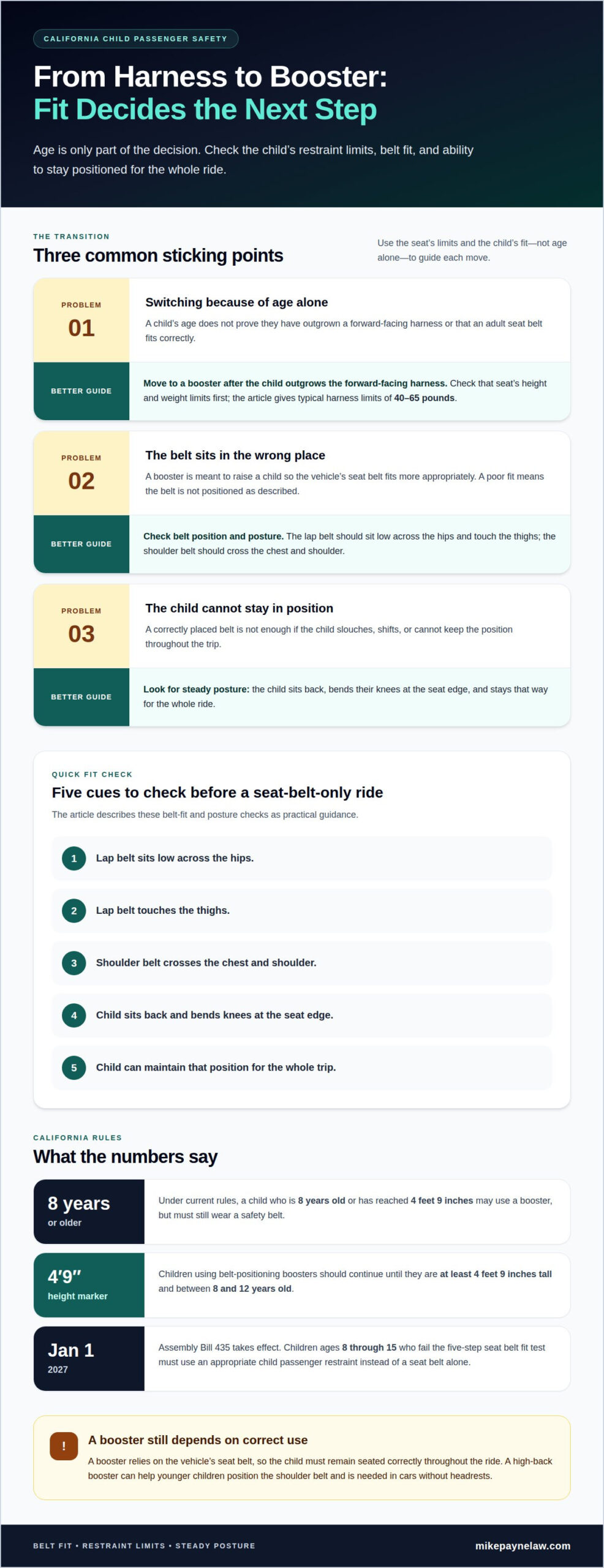
A booster raises a child so the vehicle’s seat belt fits more appropriately. The lap belt should sit low across the hips and touch the thighs, while the shoulder belt crosses the chest and shoulder. The child should sit back, bend their knees at the seat edge, and stay in that position for the whole trip. For a free seat inspection or assistance, look for local child passenger safety programs and community seat-check events in California. Ask the organizer whether an appointment is required.
Booster-Seat Law Changes
California’s booster-seat law change is part of Assembly Bill 435, which takes effect January 1, 2027, according to the California State Legislature. Beginning on that date, children ages 8 through 15 who fail the five-step seat belt fit test must use an appropriate child passenger restraint instead of a seat belt alone. That means age by itself won’t settle whether a child can stop using a booster. Seat belt fit will matter, too.
Age-Based Seat Requirements
Age helps identify the applicable rule, but height, fit, and restraint limits also shape the decision. Under current California rules, a child who is 8 years old or has reached 4 feet 9 inches may use a booster, while still wearing a safety belt. Children using belt-positioning boosters should continue until they are at least 4 feet 9 inches tall and between 8 and 12 years old. The five-step fit test offers another practical guide before parents move to a seat belt alone.
Moving From a Harness to a Booster
A child should move to a booster after outgrowing a forward-facing car seat with a harness. Check the seat’s height and weight limits: forward-facing harness limits are typically between 40 and 65 pounds. A booster relies on the vehicle’s seat belt, so the child must stay seated correctly for the whole ride. A high-back booster can help younger children position the shoulder belt and is needed in cars without headrests. Don’t treat a child’s age alone as proof that the harness has been outgrown.
Front-seat rules and exceptions for children under 8
California’s rules consider a child’s age and the restraint being used. The default is clear: young passengers must ride secured in the back seat.
According to the California State Legislature, children under 8 years of age must be secured in a car seat or booster seat in the back seat. The California State Legislature also requires children under 2 years of age to ride rear-facing unless they weigh at least 40 pounds or are at least 40 inches tall. A limited exception for a child under 8 includes a vehicle with no rear seats. Children under 13 are safest in the back seat.
California’s current law allows a child under 8 who is at least 4 feet 9 inches tall to use a properly fitted safety belt instead of a child passenger restraint. Starting January 1, 2027, Assembly Bill 435 changes the test for children ages 8 through 15: those who fail the five-step seat belt fit test must use an appropriate child passenger restraint. The California State Legislature identifies AB 435 as the law revising child passenger safety rules.
How do California car seat laws compare with current child passenger safety recommendations? The legal minimum is not always the safety recommendation. The California Highway Patrol recommends keeping children rear-facing as long as their seat allows. A child’s age, height, weight, and seat belt fit all matter.
Are taxis, rideshares, or medical needs exceptions? Taxis and rideshare vehicles aren’t exempt from California’s car seat rules. A medical concern is not an automatic exemption; limited legal exceptions apply only when their specific conditions are met. Similarly, whether relying on local hired transport or booking family excursions through a reputable Mombasa safari tour operator, confirming passenger safety guidelines and vehicle seating arrangements in advance helps protect young travelers wherever you go.
How should car seats be installed and secured? California requires children to be secured according to the car seat manufacturer’s height and weight limits. Follow the seat’s instructions and make sure the restraint is properly secured for the child’s size.
Drivers can face a $100 base fine for a first car seat violation and a $250 base fine for each subsequent violation under California Vehicle Code 27360. A properly fitted belt, correct restraint, and back-seat placement help parents follow the rules and protect each child passenger.
What are the age and weight limits for rear-facing car seats?
California’s rear-facing rule sets an age threshold and specific size exceptions. The car seat manufacturer’s limits also determine when a child outgrows the seat.
Rear-Facing Seat Limits
California requires children under 2 years old to ride rear-facing unless they meet a weight or height exception. The seat’s own maximum height and weight limits matter, too. A child can outgrow a particular rear-facing seat before reaching the legal age threshold. Parents should distinguish the law’s minimum requirement from the seat’s individual limits, which govern whether that specific restraint still fits the child.
Height and Weight Exceptions
The exception applies when a child under 2 weighs at least 40 pounds or measures at least 40 inches tall. Either threshold can satisfy the exception; both aren’t required. These figures don’t mean every rear-facing seat accommodates a child that size. The manufacturer’s stated limits still control the seat’s use, so a child’s height and weight must remain within the limits for that model.
Transitioning to Forward-Facing Seats
After a child outgrows a rear-facing seat, the next restraint is a forward-facing car seat with a five-point harness. The key step is reaching the rear-facing seat’s maximum height or weight limit, not simply turning 2. After age 2, the American Academy of Pediatrics recommends keeping children rear-facing as long as possible, until they reach the manufacturer’s maximum rear-facing height or weight limit.
Never place a rear-facing child restraint in front of an active airbag, at any age. This restriction applies even if a child meets a height or weight exception. Keep the rear-facing seat away from an active front airbag. A seat or booster decision should never override this rule. Check the restraint’s limits before changing the child’s facing direction.
What are California’s car seat laws in 2026 by a child’s age, height, and weight?
In 2026, California’s restraint rules depend on a child’s age, size, and seat fit. Use the age bands below as a starting point, then account for the restraint’s limits.
- Under 2: According to the California State Legislature, a child must ride rear-facing unless they weigh at least 40 pounds or measure at least 40 inches tall.
- Under 8: According to the California State Legislature, a child must ride secured in a car seat or booster in the back seat. A child under 8 who is at least 4 feet 9 inches tall may use a properly fitted safety belt instead.
- Age 8 and older: A child may use a booster at age 8, but should continue using it until the seat belt fits properly. Children ages 8 to 12 aren’t subject to a separate California rule requiring them to ride in the back seat.
Age isn’t the only consideration. A child in a forward-facing seat should stay within its harness height and weight limits. Once they outgrow that seat, a booster positions the vehicle’s belt. Before using a seat belt alone, check that the lap belt sits low on the thighs and the shoulder belt crosses the chest and shoulder. The child must maintain that position throughout the ride.
California’s rules are scheduled to change on January 1, 2027. Under Assembly Bill 435, children ages 8 through 15 who fail the five-step seat belt fit test must use an appropriate child passenger restraint instead of a belt alone. That makes actual belt fit more important than age alone for families planning ahead.
For a child injured in a collision, restraint use may become part of the injury claim. The circumstances of the crash and the child’s injuries matter; a restraint issue does not by itself explain what caused the harm. If a crash raises questions about responsibility or an injury claim, get legal guidance.
Law Offices of Michael D. Payne
Law Offices of Michael D. Payne represents people in car accident cases when a child is injured in a collision and questions arise about restraint use. The firm can assess how the crash happened, the child’s injuries, and whether restraint issues affect the injury claim. A car seat concern deserves attention, but it should not replace a clear assessment of the collision and its consequences.
If your family is dealing with a child’s injury after a crash, contact Law Offices of Michael D. Payne to discuss the circumstances.
Move forward with clear support
Knowing how California car seat laws for 2026 apply is one part of protecting a child. If a crash has happened, the next concern is the child’s health, followed by clear answers about how the collision occurred and what may affect an injury claim. A restraint question should be considered in the context of the full event, not treated as the only explanation for an injury.
A timeline of the collision, the child’s symptoms, medical care, and related conversations can help organize important details. Law Offices of Michael D. Payne provides car accident representation for people dealing with a collision’s consequences. The firm can assess how the incident and resulting injuries relate to a claim, considering the facts and the family’s needs.
When you’re ready, contact Law Offices of Michael D. Payne to discuss your situation. You can take the next step at your own pace and move forward with clearer support.
Frequently Asked Questions
How much is a car seat ticket in California?
A first car seat violation carries a $100 base fine per child, and each subsequent violation carries a $250 base fine per child. These are base fines, not necessarily the full amount due after assessments and fees. If more than one child isn’t properly secured, the violation and associated fine can apply per child. The ticket’s circumstances determine which base fine applies.
Why Extend Car Seat Use?
A properly fitting restraint helps position the vehicle’s safety belt correctly. The lap belt should rest across the hips, not the stomach, and the shoulder belt should cross the shoulder, not the neck. For example, a child who meets an age threshold may still need a booster if the seat belt doesn’t fit properly. Both fit and the child’s ability to sit correctly matter.
Can a car seat violation lead to child endangerment charges?
It can, depending on the circumstances. California Penal Code 273a may apply when an unrestrained child is involved in situations such as DUI, reckless driving, street racing, or a crash that injures the child. A restraint violation by itself doesn’t establish that this law applies. The conduct involved and the child’s circumstances matter to whether the statute is relevant.
What happens if a car seat is installed incorrectly in a crash?
An incorrectly installed seat may become a relevant issue when investigators or claim participants examine a child’s injuries after a crash. The installation, restraint use, collision circumstances, and medical evidence can help explain how the injury occurred. An installation problem alone doesn’t establish what caused an injury or determine an injury claim. Preserve the seat and related information after a collision, if possible.
What’s Changing?
Assembly Bill 435 changes California’s child passenger restraint rules starting January 1, 2027, according to the California State Legislature. Children ages 8 through 15 who don’t pass the five-step seat belt fit test must use an appropriate child passenger restraint instead of a seat belt alone. The practical change is that age alone won’t determine when those children may ride without a restraint.
When can my child’s car seat turn forward facing?
Move a child to a forward-facing seat after they outgrow the rear-facing seat’s permitted height or weight limits. The manufacturer sets those limits for each seat, so the transition point varies by model. If a child reaches the maximum height before the maximum weight, they have still outgrown that rear-facing seat. A forward-facing harnessed seat is the next restraint stage.