

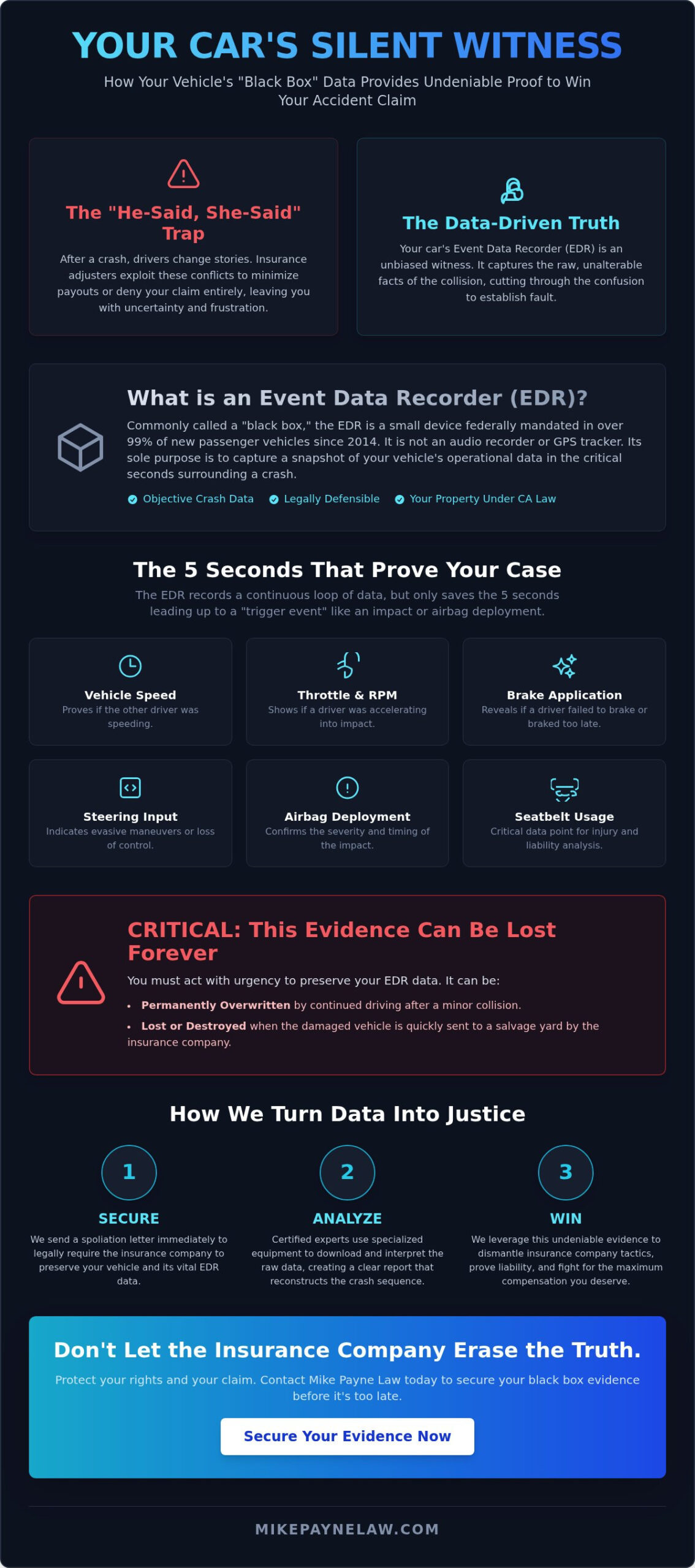
The most important witness to your West Covina crash isn’t standing on the sidewalk. It’s bolted under your driver’s seat. While an insurance adjuster might call you a liar to protect their bottom line, your black box auto data tells a story that can’t be manipulated. Since 2014, federal law has required these Event Data Recorders (EDRs) in nearly every new vehicle, capturing the raw truth of your speed, braking, and steering in the five seconds before impact.
You already know you weren’t at fault, but it’s exhausting to deal with the fear that a reckless driver will get away with it just because there were no other witnesses. You deserve a legal champion who knows how to dig for the facts and fight for the compensation you’re owed. This guide will show you exactly how this hidden vehicle data can be the key to winning your Southern California car accident claim and holding the at-fault party accountable. We’ll explain the difference between insurance tracking and crash data, how to preserve this evidence before it’s deleted, and how Mike Payne uses these digital fingerprints to secure justice.
Key Takeaways
- Learn how your car’s black box auto data acts as a “silent witness” to reveal exactly what happened seconds before a West Covina collision.
- Discover how EDR evidence can end “he-said, she-said” disputes by proving the other driver’s speed and braking patterns on the I-10 or I-210.
- Understand your legal rights under California Code to ensure that your vehicle’s data remains your property and isn’t used against you.
- Find out why you must act with urgency to secure this digital evidence before it is permanently overwritten or lost in a salvage yard.
- See how Mike Payne leverages his “Texas-tough” trial preparation to turn hidden data into a winning strategy against insurance company tactics.
What is a “Black Box” in Your Car? (Event Data Recorders Explained)
You have likely heard of a “black box” on a commercial airliner. Your personal vehicle has one too. Since September 1, 2014, federal regulations have required that 99 percent of new passenger vehicles come equipped with an Event Data Recorder (EDR). This device is not actually black. It is usually a small silver or orange component tucked away under the driver’s seat or behind the center dashboard console. It doesn’t record your private conversations or your GPS history for the entire week. Instead, it acts as a silent, objective witness to the physics of a crash. This black box auto technology captures the raw data of a collision, providing the truth when an insurance company tries to dodge liability.
At Mike Payne Law, we know that insurance adjusters aren’t on your side. They want to minimize your pain and pay out as little as possible. The EDR is a vital tool in our fight for your recovery. It doesn’t have a bias. It doesn’t have a fading memory. It simply records the facts. If you’ve been involved in a motor vehicle accident in West Covina, this data can be the difference between a denied claim and a successful settlement.
The Difference Between EDR and Insurance Telematics
Insurance companies like State Farm or Geico often push “telematics” devices or mobile apps to track your daily driving. These are not the same as your car’s built-in EDR. Telematics are voluntary tools used to monitor habits for premium discounts. The EDR is a crash-analysis tool hard-wired into your vehicle’s safety systems. It only wakes up and saves data during a “trigger event,” such as an airbag deployment or a sudden change in velocity. In a West Covina courtroom, black box auto data carries significantly more weight than a phone app. It provides a level of precision that cannot be faked or altered by a driver. It is a professional-grade record of the vehicle’s internal state at the moment of crisis.
What Exactly Does the Auto Black Box Record?
The EDR records a snapshot of your car’s behavior in the 5 seconds leading up to an impact and for a fraction of a second after. It documents the technical details that human eyes often miss in the chaos of a wreck. The device tracks several critical data points:
- Vehicle speed and engine RPM.
- Throttle position, showing if the driver was accelerating.
- Brake application status and whether the ABS engaged.
- Steering input and the specific angles of the wheel.
- Seatbelt usage for both the driver and passengers.
This data proves exactly what happened when the metal hit the pavement. It shows if the other driver was speeding through a West Covina intersection or if they failed to hit the brakes before the impact. We use these facts to pin down liability and force insurance companies to face the reality of their client’s negligence. When we go to battle for you, this data is one of our most powerful weapons.
How Black Box Data Proves Liability in Inland Empire Crashes
Inland Empire roads like the I-10 and I-210 are high-speed corridors where accidents happen in a split second. When a crash occurs in Pomona or Ontario, drivers often change their stories to avoid higher insurance premiums. This creates a “he-said, she-said” dynamic that can stall your claim for months. A black box auto recorder, technically known as an Event Data Recorder (EDR), acts as an unbiased witness. It captures the objective truth when memories fail or stories change during a deposition.
If a driver was speeding through West Covina, the data proves it without question. It records the exact speed, engine RPM, and throttle position in the five seconds leading up to impact. In a rear-end collision, it reveals if the other party failed to brake before the crash. This level of technical detail is vital for truck accident representation because commercial rigs carry sophisticated logs that track hours of service alongside crash data. Since NHTSA explains EDRs as essential tools for improving vehicle safety and crash analysis, this data holds immense weight in Southern California courtrooms.
Busting Insurance Adjuster Myths
Adjusters often claim low impact speeds to deny injury claims. They argue that if the car didn’t sustain 40% or more structural damage, the occupants couldn’t have been hurt. Mike Payne uses black box auto data to calculate the “Delta-V,” which is the sudden change in velocity during the collision. Even a 5 mph change in velocity can cause severe whiplash or traumatic brain injuries. We use these hard numbers to shut down low-ball offers and demand the full compensation you deserve.
Scientific Accident Reconstruction in SoCal
Forensic experts download the raw hexadecimal code from the vehicle’s computer. This isn’t a simple PDF printout; it requires specialized hardware and software to interpret. Our firm works with a network of Inland Empire reconstruction experts who map this digital data against physical evidence, such as 30-foot skid marks or specific vehicle crush patterns. We build a scientific timeline of the crash that’s difficult for defense lawyers to dispute. If you’ve been injured, you need a lawyer who understands the science of your case. We don’t just guess what happened; we prove it with data.
California Privacy Laws and Your Rights to EDR Data
Many drivers worry their car is spying on them. After a collision in West Covina, the data inside your black box auto recorder becomes a high-stakes piece of evidence. You need to know that in California, this information isn’t public property. It belongs to you. The law treats your car’s data with the same level of privacy as your home or your smartphone. We make sure it stays that way.
California Vehicle Code § 9951 Explained
California Vehicle Code § 9951 dictates exactly how this information is handled. It requires manufacturers to disclose the presence of an EDR in the owner’s manual. This law ensures that residents in Chino and Fontana aren’t victims of privacy overreach by big tech or automotive giants. Your data cannot be retrieved by a third party without your express consent or a specific court order.
Manufacturers must follow strict guidelines regarding what they record. While Federal regulations for EDRs set the technical standards for data capture, California law provides the legal shield that keeps that information private. This protection is vital. It prevents insurance companies from fishing through your history to find reasons to deny your claim. We use these statutes to block unauthorized access and keep the opposition out of your personal business.
When Can the Police or Insurance Company Take the Data?
Police can’t just download your black box auto data because they have a hunch. They generally need a search warrant. These warrants are typically issued in serious felony accidents or cases involving wrongful death. If the police show up with a warrant, the data becomes part of the official investigation. However, even then, we scrutinize the warrant’s validity to protect your rights.
Insurance adjusters are often more aggressive than the police. Many policies contain “implied consent” clauses buried in the fine print. You might have unknowingly agreed to share data when you signed your policy. Don’t let them bully you into a quick download at the tow yard. You should always speak with an attorney for car accidents before signing any data release forms.
Insurance companies aren’t looking for the truth; they’re looking for a “gotcha” moment. They want to see if you were going 5 mph over the limit or if you braked a half-second late. We step in as your primary shield. Our team ensures that if the data is used, it’s used to tell the whole story, not a cherry-picked version that saves the insurance company money. We’re trial-ready and prepared to fight any attempt to twist your data against you.
How to Secure Black Box Evidence After a Collision in Pomona or Ontario
Evidence in a high-stakes car accident is fragile. Your vehicle’s black box auto recorder is a ticking clock. If that car moves, gets jump-started, or undergoes even minor repairs, your proof of innocence might vanish forever. Insurance companies move fast to total cars and clear them out of their inventory. You have to move faster to protect your rights.
The data stored inside your Event Data Recorder (EDR) is often the only unbiased witness to the crash. In 2026, these systems are more complex than ever. They track everything from steering angles to the exact millisecond of airbag deployment. If the car is moved to a salvage yard in Ontario or a scrap heap in Pomona, that data becomes incredibly difficult to recover. You need a legal team that understands the urgency of forensic preservation.
The Danger of the Overwrite
Most EDR systems are designed to be efficient, not exhaustive. They typically only store a limited number of “events,” often as few as 3 to 5, before the oldest data is deleted to make room for the new. If you drive the vehicle after a collision, or even if a mechanic clears a “Check Engine” light, you risk permanent data loss. This is why you should never attempt to “test drive” a vehicle after a significant impact. At Mike Payne Law, we stop this process by sending a formal spoliation letter. This legal document forces insurance companies and tow yards to halt any destruction or alteration of the vehicle. It ensures the black box auto data remains intact for our experts to analyze.
Retrieving Data from a Totaled Vehicle
Accessing a wrecked car in a San Bernardino or Baldwin Park impound lot requires more than just a screwdriver. It requires a Bosch CDR (Crash Data Retrieval) tool. This specialized hardware costs thousands of dollars and requires specific certification to operate correctly. Don’t try a DIY download. Plugging an uncertified device into your car’s OBD-II port can corrupt the file or overwrite the very evidence you need to win your case. We coordinate with forensic engineers who “image” the data directly from the module. This creates a digital snapshot that is admissible in a West Covina court. We handle the logistics of getting into the yard so you can focus on your physical recovery.
Checklist for Preserving Your Vehicle
- Do not start the engine: Even idling can trigger data cycles that might overwrite crash records.
- Take dash photos: Capture any warning lights or “service required” messages immediately after the impact.
- Control the destination: Tell the tow truck driver to take the car to a secure storage facility, not a high-volume repair shop.
- Notify the adjuster: Send a written notice to the insurance company stating that the EDR data must be preserved.
- Consult the pros: Follow this checklist for what to do after a car accident to ensure no steps are missed.
Time is your enemy when it comes to electronic evidence. Every day the car sits in an unsecured lot is a day the insurance company could move it to a crusher. We act immediately to lock down the vehicle and download the truth. If you’ve been hurt in a crash, you need a fighter who knows how to use technology to hold the at-fault driver accountable.
Get Mike Payne on your side today to protect your evidence.
Why Mike Payne Uses Black Box Evidence to Fight Insurance Companies
Mike Payne brings a unique edge to West Covina car accident cases. He isn’t just a lawyer; he’s a former insurance defense insider. He spent years learning the specific strategies adjusters use to minimize payouts. Now, he uses that knowledge to protect you. He knows how they try to hide or ignore black box auto data that could prove their driver was speeding or failed to brake. This inside knowledge turns the tables in your favor during negotiations.
Our firm operates with a “Texas-tough” philosophy. Many firms are quick to accept the first low-ball offer an insurance company throws their way. We don’t do that. We prepare every single case for trial from day one. This aggressive approach forces insurance companies to take your claim seriously. They know that if they don’t offer a fair settlement, Mike Payne is ready to fight them in front of a jury. We don’t just settle; we prepare for battle to ensure you get every dollar you deserve.
A Former Insurance Insider on Your Side
Mike Payne’s experience allows him to stay three steps ahead of the defense. He knows the exact moment an adjuster might try to claim that EDR data is unavailable or corrupted. Our firm takes a proactive stance on litigation throughout the Inland Empire. We move fast to preserve evidence. This is especially vital in fatal trucking accidents. In these high-stakes cases, the black box auto recorder is often the only unbiased witness left. We ensure that data is secured before a trucking company can move the vehicle or overwrite the recording.
Personalized Representation for the Inland Empire
We are deeply committed to the residents of Azusa, Fontana, and Ontario. We don’t just handle cases from behind a desk. We believe in a boots-on-the-ground approach. Our team investigates accident scenes personally to ensure no detail is missed. Whether it’s checking skid marks or identifying hidden cameras, we do the hard work. This dedication has helped us recover millions for our clients since we opened our doors.
We also believe that quality legal help should be accessible to everyone. That’s why we offer a strict contingency fee promise. You won’t owe us a single cent in legal fees unless we win your case. This removes the financial risk for you while we fight for the maximum compensation possible for your medical bills and lost wages.
If you’ve been injured, you need a relatable fighter who won’t back down. Visit our West Covina office today for a free consultation. We’ll review your accident and explain how we can use your car’s data to get you justice. Don’t let the insurance company bury the truth. Let Mike Payne uncover the data.
Take Control of Your Recovery with Trial-Ready Evidence
Your car’s black box auto data is often the difference between a denied claim and a fair settlement. In West Covina and across the Inland Empire, this EDR technology captures the exact seconds before impact, recording your speed and braking patterns with scientific precision. California privacy laws protect this data, but insurance companies won’t hand it over without a fight. You need a trial-ready advocate who knows how to preserve this evidence before it’s overwritten or lost forever.
Mike Payne brings over 25 years of experience to your side. He’s a former insurance defense attorney who knows the exact tactics adjusters use to bury the truth. Today, he uses that insider knowledge to fight for your recovery in Pomona, Ontario, and throughout Southern California. We take the legal burden off your shoulders so you can focus on healing. There’s no fee unless we win your case. You don’t have to face the insurance giants alone.
Fought for by a Trial-Ready Advocate: Contact Mike Payne Law Today
We’re ready to stand as your shield and secure the justice you deserve.
Frequently Asked Questions
Does every car have a black box?
Nearly 99 percent of new vehicles sold in the United States since 2022 come equipped with an Event Data Recorder. While the NHTSA didn’t mandate them for every single vehicle until 2014, most manufacturers like Ford and GM have included them since the early 2000s. If you’re driving a car built in the last 10 years, it almost certainly contains a black box auto device that tracks your speed and braking.
Can I see the black box data from my car after an accident?
You own the data, but you can’t just plug in a USB drive to read it. Accessing this information requires a Crash Data Retrieval tool and specialized software that costs thousands of dollars. Federal law under the Driver Privacy Act of 2015 protects your ownership of the data. Mike Payne Law steps in to ensure this evidence isn’t wiped or ignored by insurance companies looking to dodge their responsibilities.
Will the black box show if I was texting or distracted?
No, a standard recorder doesn’t monitor your phone screen or cabin activity. It focuses on mechanical data like vehicle speed, throttle position, and brake engagement in the 5 seconds before impact. To prove distracted driving, we look at cell phone records or cabin cameras. We use the data to prove the other driver didn’t brake, which often confirms they weren’t paying attention to the road.
How much does it cost to get a black box report for a car accident claim?
A professional download and analysis typically costs between $500 and $2,500 depending on the vehicle’s location and damage. This requires hiring a certified accident reconstruction expert to pull the data and interpret the results. At Mike Payne Law, we front these litigation costs for our clients. You don’t pay us a dime for these expert fees unless we win your case and recover the compensation you deserve.
Can black box data be used against me in a California court?
Yes, California courts allow this data as evidence to determine liability and speed. Under California Vehicle Code Section 9951, this data is discoverable in civil litigation. If the data shows you were speeding or failed to brake, the defense will use it to lower your settlement. That’s why you need a trial-ready attorney who knows how to challenge technical evidence and fight for a fair outcome for your family.
How long does a car black box store data before it is deleted?
Most recorders only save data permanently if an airbag deploys or a significant event occurs. In non-deployment crashes, the data might be overwritten after 250 ignition cycles. This means the evidence could vanish in a few weeks of normal driving. We act fast to send spoliation letters to insurance companies. This legal move forces them to preserve the vehicle and its data before it’s gone forever.
What happens to the black box if my car is totaled?
If your car is totaled, the insurance company usually hauls it to a salvage yard. The black box stays inside the vehicle’s Airbag Control Module. You must act immediately to prevent the insurer from crushing the car or selling it at auction. We fight to secure the vehicle so our experts can download the data before the evidence is lost in a scrap heap. We don’t let the evidence disappear.
Is a black box the same as a dashcam?
No, a black box auto system is a hidden internal computer while a dashcam is an aftermarket camera that records video. The internal system records technical telemetry like engine RPM and steering angles. It doesn’t capture video or audio. Dashcams provide the visual story, but the internal data provides the hard physics. Using both creates an undeniable case that forces insurance companies to stop playing games and pay up.