

A second opinion can be worthwhile when you don’t understand your case’s direction or feel your concerns aren’t being addressed. Most personal injury lawsuits are subject to a two-year statute of limitations under California Code of Civil Procedure section 335.1, according to the California Legislature. If you’re weighing a second opinion on your personal injury case, act promptly and keep important deadlines in view.
It’s reasonable to want a clearer explanation before making decisions about a claim that affects your recovery and finances. If you’re seeking a second opinion on your personal injury case, the Law Offices of Michael D. Payne can review the evidence, explain potential issues, and help you understand your options. California clients can change lawyers, but arranging new representation before ending an existing agreement can help prevent disruption. The sections ahead explain when another perspective may help, what a lawyer may review, and how to approach a change in representation with care.
Key Takeaways
- Consider another legal perspective if communication gaps or unexplained delays leave you unsure about your claim’s progress.
- A focused case review can clarify how evidence, fault, and documented harm may shape your options.
- Before changing representation, understand how the fee agreement addresses the attorney’s fee and case expenses.
- A second opinion may help identify questions about medical treatment, potentially responsible parties, or the next steps in your claim.
Should I Receive A Second Opinion Concerning My Personal Injury Claim?
A second opinion can clarify your options when case strategy, communication, or a settlement offer raises concerns. Review the lawyer’s experience, any deadlines, and how fault may affect your claim before deciding what comes next.
Evaluating Attorney Credentials and Verdicts
Look for an attorney who handles California personal injury litigation and can explain how similar case issues apply to yours. A verdict shows one case’s result, not a guaranteed value for another claim. For example, a reported $73 million verdict involved a Ford E350 15-passenger van rollover. Ask what evidence and legal arguments shaped that outcome, then compare them with your injuries, medical records, and liability facts.
Comparing Settlement Offers and Claim Value
To compare an offer with your Los Angeles injury claim’s potential value, weigh documented medical expenses, other losses, injury effects, evidence of fault, and any unresolved treatment needs. The offer’s headline amount alone doesn’t show how it accounts for those factors. California follows pure comparative negligence: an injured person may recover damages if they are not 100 percent at fault, with recovery reduced according to their share of fault. Ask the reviewing lawyer to explain how the evidence supports each part of the assessment.
Reviewing Deadlines and Delay Risks
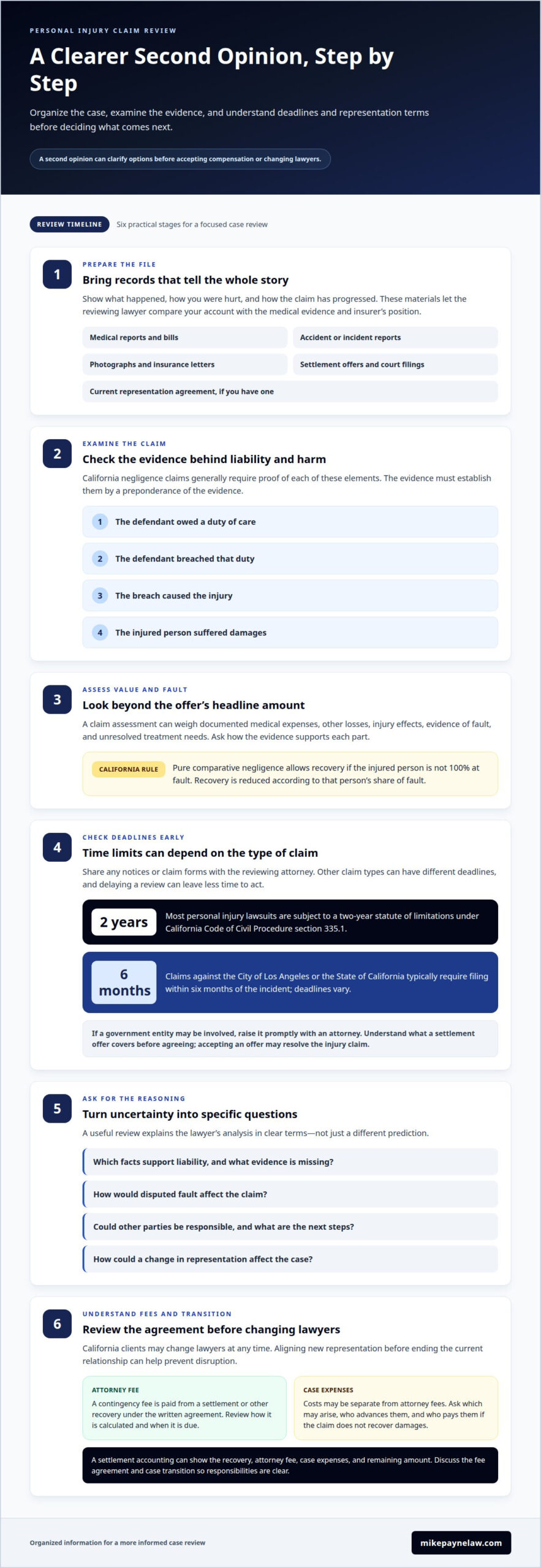
Most personal injury lawsuits in Los Angeles are subject to a two-year statute of limitations under California Code of Civil Procedure section 335.1, according to the California Legislature. Other claim types can have different deadlines. Delaying a second opinion can leave less time to address a filing deadline or respond to a settlement decision. Accepting an offer may resolve the injury claim, so understand what it covers before agreeing. If a government entity may be involved, promptly discuss the claim-specific deadline with an attorney.
Considering Lawyer Changes and Referrals
California clients may change lawyers at any time, but it’s generally preferable to align new representation before ending the current relationship. Discuss the fee agreement and case transition so responsibilities are clear. For referrals, ask a trusted California attorney or medical professional for a personal injury lawyer recommendation. The State Bar of California is the state’s official attorney licensing agency; use licensing information to assess an attorney’s professional standing, not to predict a case outcome.
Getting a second opinion on a personal injury claim
A second opinion gives you another legal evaluation before you accept compensation or change representation. A reviewing attorney can assess the evidence, identify unanswered questions, and explain options for your specific injury claim.
Preparing Documents for Case Review
Bring documents that show what happened, how you were hurt, and how the claim has progressed. Useful records include medical reports and bills, accident or incident reports, photographs, insurance letters, settlement offers, and court filings. Include your current representation agreement, if you have one. These materials help the reviewing lawyer compare your account of the incident with the medical evidence and the insurer’s position.
Questions for the Reviewing Attorney
Ask which facts support liability, what evidence is missing, and how the firm would address disputed fault. Discuss potentially responsible parties, next steps, and how a change in representation could affect the case. These questions help you understand the lawyer’s reasoning, rather than simply hear a different prediction. The reviewing attorney should explain recommendations in clear terms.
California negligence claims generally require proof that the defendant owed and breached a duty of care, caused the injury, and that the victim suffered damages. The claim’s evidence must establish those elements by a preponderance of the evidence. A review may cover car, motorcycle, bicycle, truck, pedestrian, workplace, or premises-related injuries. For collision claims, a review of motor vehicle accident representation can help clarify which evidence matters.
Claims against the City of Los Angeles or the State of California typically require filing within six months of the incident, though deadlines vary. Tell the reviewing attorney if a government entity may be involved, and share any notices or claim forms received. A prompt evaluation can identify deadlines and practical next steps before the claim moves forward.
Contingency fees and no upfront payment
A contingency fee ties an attorney’s fee to recovering compensation for an accident claim. Instead of paying that fee as legal work proceeds, the client pays it from a settlement or other recovery, under the terms of the written agreement. The agreement should explain how the fee is calculated and when it becomes due.
“No upfront payment” doesn’t automatically mean every case expense is covered or waived. Attorney fees and case costs may be treated differently. Costs can include expenses for obtaining medical records or other evidence. The agreement should explain which costs may arise, who advances them, and who pays them if the claim doesn’t recover damages.
Before signing, review the fee agreement with the evaluating attorney. Ask how the fee is calculated, which expenses are separate, and how costs affect your net recovery. If a settlement is proposed, request an accounting that shows the recovery, attorney fee, case expenses, and remaining amount. That breakdown can make a difficult decision more concrete.
A second opinion can also help you understand an existing agreement before changing representation. The reviewing lawyer can explain how a new firm would handle the transition and how prior work or expenses may be addressed. Don’t assume a new agreement cancels obligations under an earlier one. Ask for the terms in writing and make sure you understand them before authorizing a change.
For example, an accident victim may have medical bills, ongoing treatment, and a settlement offer that doesn’t clearly account for all claimed damages. A fee discussion should distinguish the attorney’s fee from medical charges, case expenses, and any other obligations reflected in the final accounting. Each item affects the net recovery differently.
Compare agreements by clarity, not by a headline percentage alone. A lawyer should explain the fee structure, expenses, and settlement accounting in plain language. That record helps you make an informed choice about representation without confusing “no upfront attorney fee” with “no possible costs.”
Reasons to seek a second opinion on a personal injury case
A second opinion can help when your lawyer’s explanation doesn’t answer a concern about your claim. If you’re wondering whether a second opinion on your personal injury case in Los Angeles could clarify your options, another attorney can review the facts and explain the current strategy. The goal is clearer decision-making, not a promised outcome or an automatic change in representation.
Insurance disputes can make a fresh review useful. Ask the reviewing lawyer to identify which evidence supports the insurer’s position and what could challenge it. For example, a disagreement about how an accident happened may call for closer analysis of records, witness accounts, or photographs. Understanding the basis for the dispute helps you decide what to ask next.
Medical care can also affect the timing of legal decisions. If a settlement is being discussed before your treatment is complete, ask how unresolved medical needs could affect the assessment of your injuries. Your personal injury lawyer shouldn’t pressure you to stop treatment before your doctor releases you. A second opinion on your personal injury case in Los Angeles can clarify how medical status and claim strategy relate, without replacing medical advice.
Another review may uncover questions about shared responsibility. A collision, for instance, may involve facts beyond one driver’s actions. A fall may raise questions about who controlled the property. Identifying potentially responsible parties can shape the evidence an attorney examines and the path for pursuing compensation.
Unexplained delays are another reason to seek clarity. Ask what action is pending, what information is needed, and how the proposed strategy addresses the next steps. Without understanding those factors, it can be difficult to assess whether the current approach meets your needs. A consultation can turn broad concerns into specific questions about your case.
If unanswered questions about treatment, responsibility, or progress are holding you back, request a second opinion on your injury claim and discuss the evidence and next steps.
Law Offices of Michael D. Payne: Workplace Injury Representation
The Law Offices of Michael D. Payne represents people pursuing workplace injury claims and can assess whether the evidence supports the current direction of a case. Consider a review when questions about responsibility, medical records, lost income, or an insurer’s position remain unanswered. A focused discussion can clarify the issues and possible next steps for your claim.
The firm also represents people injured in car accidents, slip and fall incidents, and motorcycle accidents. The appropriate legal approach depends on the incident, available evidence, and documented harm. Clear answers matter, especially when you’re weighing a settlement or considering a change in counsel.
Contact Law Offices of Michael D. Payne to discuss your injury claim.
Move Forward With a Clearer Plan
If you’re seeking a second opinion on your personal injury case in Los Angeles, use the conversation to define what you need before choosing your next move. Identify the unanswered issue that matters most, the information that could clarify it, and what would make the explanation useful. A focused discussion can help separate immediate decisions from questions requiring further review.
Once you have greater clarity, you can choose your next step with purpose instead of reacting to uncertainty. Keep your priorities centered on your recovery and a legal strategy you understand. Your questions deserve thoughtful answers, and you should understand the reasoning behind recommendations that affect your claim.
To discuss your situation and consider a next step, contact Law Offices of Michael D. Payne. Move forward at your pace, with a clearer sense of what you need and the confidence to protect your interests.
Frequently Asked Questions
Can I Benefit from a Second Opinion on My Case?
Yes, another lawyer’s perspective can help identify an issue your current strategy hasn’t addressed. For example, if an insurer disputes how the accident happened, a fresh review can clarify which evidence supports your account and what information may still be needed. You can use that analysis to decide what to discuss with your current attorney, even if you keep the same representation.
Can I Switch Lawyers?
Yes, California clients can change lawyers, but plan the transition carefully. Before ending your current representation, discuss the case with a prospective attorney and clarify whether they can take it on. Review both fee agreements and ask how the former lawyer’s work and case expenses will be handled. A planned handoff can help avoid confusion over deadlines, documents, and responsibility for pending tasks.
Does a second opinion cost anything?
The cost depends on whether you’re having an initial consultation or authorizing additional legal work. Ask what the meeting covers and whether further review has separate terms before proceeding. The Law Offices of Michael D. Payne offers free accident case consultations and states, “we do not charge a fee unless we win.” Clarify how case expenses are treated under your agreement.
Does getting a second opinion mean I am firing my lawyer?
No. You can consult another attorney to understand your options without ending your current relationship. Keep the discussion focused on your concerns, such as a proposed settlement, case progress, or a question about evidence. If you later decide to change lawyers, first discuss representation and the transition plan with the new attorney. A consultation alone doesn’t require you to make that change.
How do I get a second opinion from a personal injury lawyer in Los Angeles?
Arrange a discussion with a lawyer who handles the type of injury involved, then explain the incident, your main concern, and any decision you’re facing. Share relevant records and communications so the attorney can understand the case history. Ask what the evidence supports, what questions remain, and what immediate decisions need attention. A California lawyer consulted for legal advice must protect your confidential information even if no attorney-client relationship follows.
Do Los Angeles personal injury attorneys offer free case evaluations or second opinions?
Some offer free consultations, but that doesn’t mean every attorney or every type of case review is free. The Law Offices of Michael D. Payne offers “Free Accident Case Consultations.” Its local focus includes West Covina, Pomona, Ontario, Covina, Chino, Fontana, San Bernardino, Baldwin Park, and Azusa. The firm is “available 24/7” and uses the phrase “Se Habla Español.” A consultation lets you discuss your claim and potential representation.