

The filing deadline can shape your path to compensation. Recovering damages for a dog attack in Chino Hills generally means filing within two years of the bite, according to the California Legislature. If the claim is against a California public agency, the Government Claims Act requires filing within six months of the incident, according to San Diego Law Library.
After an attack, it’s understandable to focus on medical care and recovery. But deadlines, evidence, and questions about what happened can affect a claim, so it helps to understand the rules early.
This article explains California’s filing deadlines, the evidence that can support a claim, and the damages that may be available. It also covers California’s strict-liability rule for dog owners and circumstances that may affect how it applies. You’ll have a clearer picture of possible next steps and when legal representation may help protect your interests.
Key Takeaways
- Learn which circumstances may affect a dog owner’s strict liability, including the injured person’s conduct and presence on the property.
- Understand why the claim deadline can depend on who is responsible for the attack.
- See how medical records and witness accounts can help document the injuries and support a claim.
- Find out how a lawyer can investigate the incident and assess the evidence you provide.
Are There Exceptions to Strict Liability Laws for Dog Owners?
California Civil Code § 3342 makes a dog owner strictly liable when its statutory conditions are met. The rule applies to a dog bite in a public place or while the injured person is lawfully on private property. This can make recovering damages for a dog attack in Chino Hills possible without proving the owner knew the animal might bite. The facts still matter: where the bite happened, whether the injured person had permission to be there, and what occurred immediately before the attack.
California’s strict-liability rule for dog owners has potential exceptions. Trespassing, committing a crime, or provoking the dog may affect whether the owner is liable. For example, evidence that someone entered private property without permission may raise a trespassing issue. Evidence of the person’s actions before a bite may raise provocation. Neither label alone resolves a claim. The circumstances, conduct, and available evidence all matter when assessing liability.
Local rules can also clarify what happened. San Bernardino County § 32.0108 requires a dog taken off private property to be restrained by a leash held by a person competent to control it. San Bernardino County § 32.0101 defines a leash as a specified restraint no longer than 6 feet. A loose dog in Chino Hills may make those details relevant, though a leash-rule issue is distinct from the strict-liability analysis under California law.
Dog attacks in Southern California can involve more than one victim or animal. In a Chino incident on June 16, two loose dogs attacked multiple people and killed another dog. That example underscores why reports, witness accounts, and the location of an attack can matter. Police and animal-control records may help clarify the sequence of events and identify the dog owner.
Homeowners insurance may contribute to compensation, and umbrella coverage may provide additional funds, depending on the policies involved. Renters insurance coverage depends on the policy and whose conduct it covers. Insurance does not eliminate the need to establish the facts and assess any applicable exception.
How long do I have to file a dog bite claim in Chino Hills?
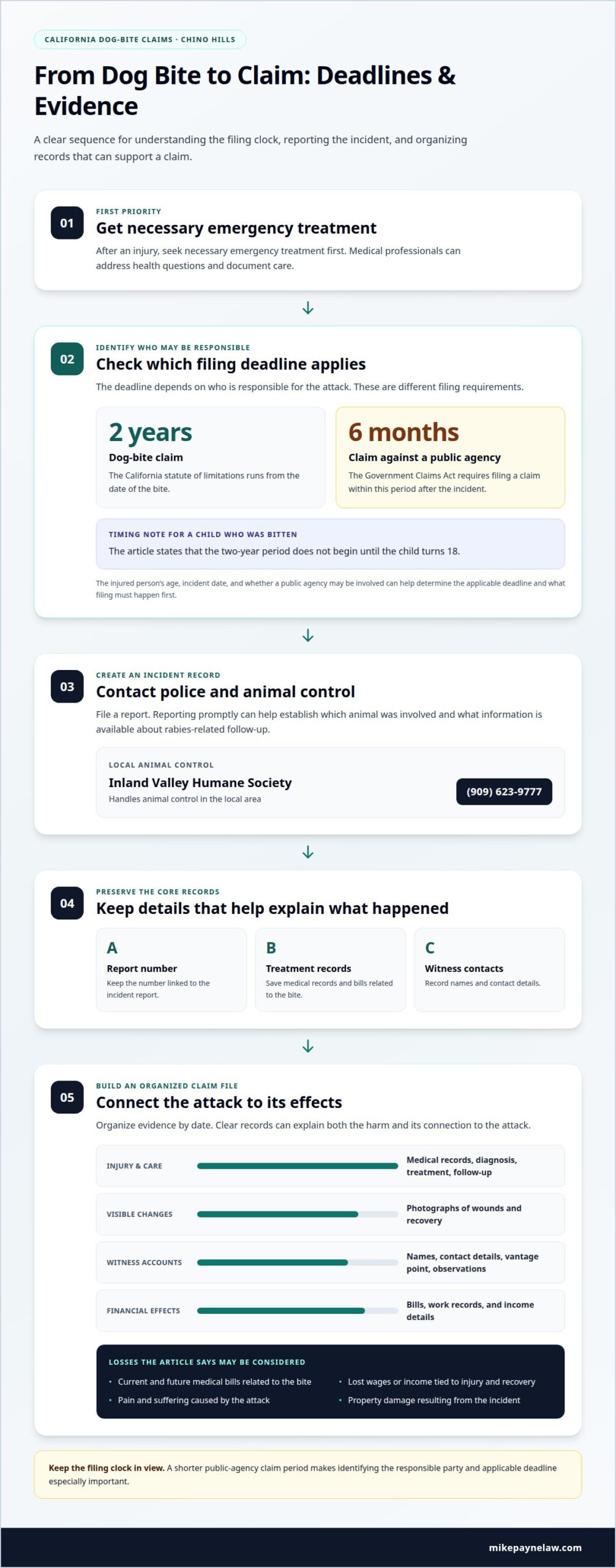
For a California dog-bite claim, the statute of limitations is 2 years from the date of the bite, according to the California Legislature. California Courts also states that the general deadline for a personal injury lawsuit is 2 years from the date of injury. If the claim is against a California public agency, the Government Claims Act requires filing a claim within 6 months of the incident, according to San Diego Law Library. These are different deadlines, so identifying the responsible party matters.
A child who was bitten has a different timing rule: the two-year period doesn’t begin until the child turns 18. The Law Offices of Michael D. Payne can assess the injured person’s age, incident date, and whether a public agency may be involved. Those facts help determine which deadline applies and what filing must happen first. Waiting to understand the claim can put compensation at risk.
After an injury, seek necessary emergency treatment first. Then contact police and animal control, and file a report. In the local area, the Inland Valley Humane Society handles animal control; its listed phone number is (909) 623-9777. The Law Offices of Michael D. Payne can help organize the incident details, identify witnesses, and follow up on records relevant to the claim. Reporting promptly can also help establish which animal was involved and what information is available about rabies-related follow-up. Medical professionals and animal control can address health and animal-reporting questions.
For a dog-bite claim, preserve the report number, treatment records, and witnesses’ contact details. Payne can use these materials to assess liability, document the injury, and track the applicable filing deadline. If the attack involved a public agency, the shorter claim-presentment period makes early legal guidance especially important. If you’re unsure which deadline applies, discuss the filing deadline and next steps before time passes.
How a lawyer documents injuries and gathers witness information for a dog-bite claim
A lawyer can build a personal injury file connecting the dog attack to its physical and financial effects. Medical records can show the diagnosis, treatment, and follow-up care. Photographs can document wounds and visible changes during recovery. The lawyer can organize these materials by date and compare them with bills, work records, and details about how the injury affects daily activities. Clear documentation helps explain the harm, not just that a bite occurred.
Witness information can help establish where the attack happened and what led up to it. An attorney may record each witness’s name, contact information, vantage point, and direct observations. A neighbor who saw a dog leave a yard may offer a different perspective from someone who witnessed the bite. The lawyer can keep those accounts distinct, compare details with available records, and avoid treating assumptions as firsthand evidence. In Chino Hills, the incident location can also guide requests for relevant county or animal-control records.
To evaluate compensation, a lawyer organizes evidence of losses that may include:
- Current and future medical bills related to the bite.
- Lost wages or income tied to the injury and recovery.
- Pain and suffering caused by the attack.
- Property damage resulting from the incident.
Each category needs supporting details. Medical bills, for example, can document treatment expenses, while employment records can help show missed income. A lawyer can compare these records with the injury timeline and witness accounts before presenting the claim. The evidence can explain both the harm and its connection to the attack during resolution discussions with an insurer or dog owner.
A law firm may also assess whether the location raises a premises-liability issue in addition to the dog owner’s responsibility. The lawyer can identify gaps, follow up for relevant documents, and present a coherent account of the injury and losses. For a serious bite, organized records give decision-makers a clearer basis for assessing the claim than conflicting recollections alone.
How a lawyer investigates a dog attack and uses the evidence you provide
A focused investigation can turn your account into a clear timeline. The lawyer reviews where and when the attack happened and what you remember before and after the bite. Photos, messages, incident reports, and medical records can help establish what happened and the harm suffered. Comparing each item with the others can reveal gaps or conflicting details to address before presenting the claim.
The location in San Bernardino County, including Chino Hills, can guide the search for relevant records and witnesses. A lawyer may identify people who saw the dog, the attack, or events just beforehand. The lawyer can ask what each person observed directly, where they stood, and whether they can identify the dog or owner. A neighbor’s account of a dog escaping a yard, for example, may clarify how it reached the injured person.
Evidence you provide can help direct the investigation. A lawyer can organize materials such as:
- Photographs or video showing the scene, the dog, or injuries.
- Police or animal-control report details and incident records.
- Names and contact information for witnesses.
- Medical records and documentation of missed work or other losses.
The lawyer can compare those materials with witness accounts and available records. If a report describes a different location or sequence, that discrepancy needs attention. If a witness saw the dog before the bite, the account may help explain how the encounter unfolded. Evidence should support the claim’s facts without going beyond what anyone actually observed.
During a consultation, the lawyer can assess what the evidence shows about the dog owner’s responsibility and the injuries suffered. The investigation may also help identify applicable insurance coverage and support a demand for compensation. If you have records, photos, or witness details, discuss your dog-attack evidence with an attorney and learn how it may shape the claim. A careful review helps victims present a consistent account, whether the incident occurred in Chino Hills or nearby Pomona.
Law Offices of Michael D. Payne
Law Offices of Michael D. Payne can help assess the incident, organize evidence, and explain how responsibility and documented losses may affect a personal injury claim. Consider seeking legal guidance if the dog’s owner disputes what happened, witness accounts conflict, injuries require ongoing care, or a filing deadline is approaching. A focused review can clarify which records matter and what questions remain before you decide how to proceed.
For a dog attack that involves unsafe conditions on someone else’s property, the firm’s premises liability experience may be relevant to evaluating the circumstances. The next step is to discuss the location, incident reports, medical documentation, and any witness information with an attorney. Contact Law Offices of Michael D. Payne to discuss your situation.
Take the Next Step Toward a Clear Plan
After a frightening attack, deciding what to do next can feel difficult. You don’t have to sort through conflicting accounts, records, and insurance questions alone. A focused legal review can put the available evidence in context and identify a practical path forward. It can be a first step toward recovering damages for a dog attack in Chino Hills while you focus on healing and daily life.
Law Offices of Michael D. Payne represents people injured in personal injury matters, including car accidents, slip and falls, and motorcycle accidents. If you’re unsure how the facts of your dog-attack incident fit together, speak with an attorney about your situation and the questions you’re facing. A free consultation can help you understand your options and decide what comes next.
Contact Law Offices of Michael D. Payne to discuss your circumstances. You deserve a chance to move forward with a plan grounded in your case and your needs.
Frequently Asked Questions
Are Dog Owners Legally Responsible For Damages?
Often, yes. Under California Civil Code § 3342, a dog owner is strictly liable for bite injuries when the statutory conditions apply, according to the California Legislature. The bite must occur in a public place or while the injured person is lawfully on private property. Trespassing, committing a crime, or provoking the dog may affect liability. The circumstances determine how those issues apply.
What are Common Injuries Caused By a Dog Attack?
Dog attacks can cause bite wounds and other physical harm that requires medical assessment. Injuries vary depending on the encounter and the affected area. A clinician’s records can describe the specific diagnosis, treatment, and recovery needs rather than relying on a general label. If symptoms change after the initial visit, later medical documentation can help show how the injury developed and what care followed.
What can a lawyer do if the dog’s owner claims their dog has never bitten anyone before?
A lawyer can explain that a prior bite generally isn’t required for California’s strict-liability rule to apply when its conditions are met. The lawyer can assess the location and circumstances, then seek relevant reports or witness accounts that may clarify what happened. An owner’s claim about the dog’s history does not, by itself, resolve whether the injured person may pursue damages.
What damages can victims recover after a dog attack in California?
Recoverable damages may include medical bills, lost wages or income, pain and suffering, and property damage caused by the attack. A claim may account for treatment expenses and income lost during recovery, as well as the physical and emotional effects of the injury. Evidence should connect each claimed loss to the incident, such as medical records for treatment or repair records for damaged property.
How are medical bills, lost wages, and future care costs calculated in a dog bite claim?
Medical expenses are evaluated using bills and records related to the attack, while lost wages are assessed through employment and income documentation. Future care costs depend on treatment needs supported by medical information, not an estimate detached from the injury. A lawyer can organize these records by category of loss to show how the bite affected finances and continuing care.
Can a dog attack victim recover for scarring, pain, and emotional distress in California?
Yes, pain and suffering may be part of the damages sought after a dog attack. Scarring, ongoing discomfort, and emotional effects can help describe the injury’s impact, alongside medical documentation and the victim’s account. Records may show treatment or changes over time, while clear descriptions of daily limitations add context. These effects are considered alongside the other evidence supporting the claim.