

A distracted-driving claim doesn’t require a ticket to move forward. California law restricts handheld phone use while driving, and according to the California State Legislature, Vehicle Code section 23123 generally bars using a wireless telephone unless it’s configured for hands-free use and used that way. In a civil injury claim, proving a driver was distracted in California means showing it was more likely than not that distraction contributed to the crash.
It’s understandable to think the evidence must be obvious, such as a driver caught texting at the scene. But distraction can also be established through phone records, witness accounts, video, crash data, and physical evidence. A police report that doesn’t mention phone use doesn’t automatically settle the issue.
This article explains how California’s rules relate to injury claims, what circumstantial evidence may show, and how the civil burden of proof works. It also covers when accident reconstruction and expert testimony can help explain how a collision happened and whether distraction contributed.
Key Takeaways
- A distracted-driving injury claim can rely on evidence even when the driver wasn’t cited at the scene.
- Phone activity, witness accounts, and crash evidence can help show whether distraction more likely than not contributed to the collision.
- Preserve relevant video promptly, since some surveillance footage may be overwritten within days.
- Accident reconstruction can use physical evidence to explain how the crash unfolded and assess whether distraction fits the evidence.
Is Distracted Driving Illegal in California?
Yes. California restricts handheld phone use while driving, and a violation may help explain how a collision happened. But a traffic citation isn’t required to support a civil claim.
Restrictions on Phone Use While Driving
California Vehicle Code section 23123 generally bars drivers from using a wireless telephone unless it is configured for hands-free use and used that way, according to the California State Legislature. Section 23123.5 addresses operating a handheld device while driving. A mounted phone may be used for GPS or calls when interaction requires no more than a single swipe or tap. The device must be mounted without blocking the driver’s view. These rules matter because phone activity can help establish distraction, even if no officer saw the driver using a device.
Evidence can include phone records, witness testimony, and police reports. Records may show calls, texts, or data use near the collision, though they typically don’t reveal message content. A private person can’t obtain another person’s carrier records simply by asking the provider; a court order or subpoena may secure them during discovery. Witnesses, including pedestrians and other drivers, can describe what they saw. A police report may record the officer’s observations, but silence about phone use doesn’t end the investigation. Repeat violations also carry consequences: California adds a license point for a cell phone violation after the first offense when another occurs within 36 months.
The Appellate Ruling on Handheld Phone Use
In June 2025, a California appellate court determined that operating a wireless telephone includes viewing an app. That ruling matters when a driver claims they weren’t texting or speaking on a call. Looking at an app can still be relevant evidence of phone operation. Investigators can compare the driver’s account with available phone records, witness observations, and the timing of the collision to assess what happened.
California’s general deadline for a personal injury lawsuit is two years from the accident date under Code of Civil Procedure §335.1, according to the California State Legislature. The California State Legislature states that this section applies to a person under the age of 18 years. A claimant’s share of responsibility may affect the compensation they can recover. For example, if the claimant is found partly responsible, that percentage reduces the amount they may recover.
Circumstantial evidence and the civil burden of proof
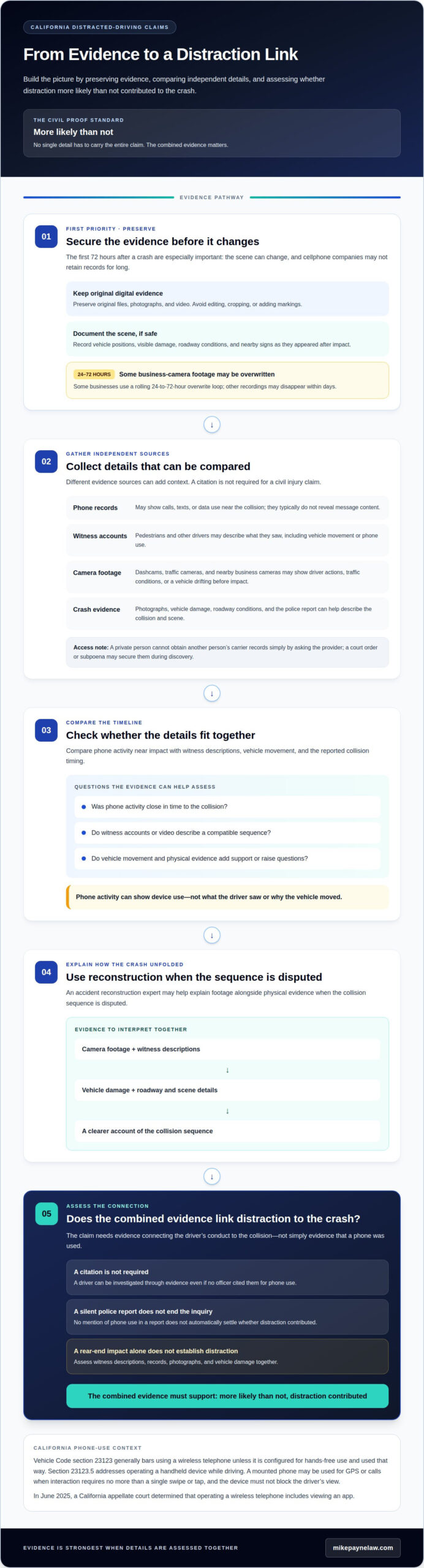
California injury claims can rely on several connected facts, even without a direct admission or eyewitness to phone use. The central question is whether distraction more likely than not contributed to the collision. Proving a driver was distracted in California often means showing how separate details support the same account.
The Civil Burden of Proof
In a civil personal injury claim, the injured person must show that distraction more likely than not contributed to the crash. Circumstantial evidence helps establish this through facts that fit together. For example, a sudden lane departure, phone activity near impact, and a witness’s description may each add context. No single detail must carry the entire case; the combined evidence matters.
Evidence of Phone Use at the Crash
Carrier records may show calls, texts, or data use near the collision, but typically don’t reveal message content. Their timing can be compared with a witness account, vehicle movement, and the reported impact. This helps assess whether phone activity coincided with driving and could relate to the crash. Records alone may show device use, not what the driver saw or why the vehicle moved.
Electronic Records and Evidence Preservation
Preserve original digital files, photographs, and video without editing them. The first 72 hours after a crash are especially important because cellphone companies may not retain records for long, and the scene can change. If safe, document vehicle positions, visible damage, roadway conditions, and nearby signs. These details can help compare later statements with the scene as it appeared after impact.
Evidence Linking Distraction to Liability
Proving a driver was distracted in California requires evidence connecting the driver’s conduct to the collision, not simply evidence of phone activity. A rear-end impact alone doesn’t establish distraction, and a traffic citation isn’t required for a civil claim. Witness descriptions, records, photographs, and vehicle damage can be assessed together to evaluate responsibility. An attorney can help organize those facts and identify gaps that need attention.
For help assessing how evidence supports a vehicle collision claim, discuss your case with an attorney.
Do I need an accident reconstruction expert?
Witness statements, dashcam footage, and traffic cameras can help prove distracted driving in California. An accident reconstruction expert may help explain footage alongside physical evidence when the collision sequence is disputed.
Sources of Camera Footage
Camera footage can show a driver’s actions, traffic conditions, and the moments before impact. A dashcam may capture a phone in a driver’s hand; a traffic camera may show a vehicle drifting before a collision. Nearby business security cameras can also record the roadway, while another driver’s dashcam may capture the event from a different angle. Each view can add context.
Preserving Camera Footage
Preserving footage means securing original recordings before they disappear or change. Some businesses overwrite surveillance footage on a rolling 24-to-72-hour loop, and other recordings may be overwritten within days. A lawyer can send a preservation request to a business or relevant party. Keep the original device or file when possible, and don’t crop, edit, or add markings to a copy presented as original evidence.
Witness Statements and Video Evidence
Witness statements describe what people saw, while video can help test the timing and details of those accounts. A pedestrian might report seeing a driver look down before impact; footage could show the vehicle’s movement at that moment. Together, these sources may help clarify whether a device distracted the driver and whether that conduct caused the collision. Medical records document injuries, but don’t establish what the driver was doing.
An expert isn’t automatically necessary. If clear footage shows the vehicle’s path and timing, other evidence may explain the event. When camera angles conflict or the sequence remains unclear, an accident reconstruction expert can analyze physical evidence and explain how the crash occurred. That analysis can help a lawyer connect what the footage shows with how the collision unfolded.
Accident reconstruction and expert testimony
An accident reconstructionist uses physical evidence from a crash scene to assess how the collision happened. In a car accident involving suspected phone distraction, this analysis can connect vehicle movement, impact damage, and other evidence to the sequence of events. The expert’s role is to explain what the evidence supports, not to decide the legal claim.
For example, vehicle event data may record speed, braking, steering, and seat belt use shortly before a crash. A reconstructionist can examine those details alongside vehicle damage and scene evidence to assess the vehicles’ movements. If the data shows no braking before impact, that may help explain the sequence, but doesn’t establish by itself what the driver was looking at or doing.
That distinction matters. Phone records may indicate activity near a collision, while physical evidence can help establish how the crash unfolded. An officer’s observations, witness accounts, and video may add context. An expert can explain how those sources fit together, identify inconsistencies, and clarify whether a driver’s actions align with the physical evidence. Eating or reaching for an item may also be considered a possible distraction when supported by evidence.
Expert testimony is most useful when the collision mechanics are disputed or the evidence needs technical explanation. It can help a judge or jury understand how braking, steering, impact points, or vehicle paths relate to competing accounts. The expert’s analysis should distinguish measured facts from conclusions. This clarity helps prevent an unexplained data point from being treated as proof of distraction.
A reconstructionist doesn’t replace evidence of the driver’s conduct. The strongest analysis connects physical findings to reliable records and testimony, then explains the limits of each. If a crash’s sequence is unclear, discuss the evidence with an attorney who can assess whether expert analysis may help establish what happened.
Law Offices of Michael D. Payne
Law Offices of Michael D. Payne helps injured people assess whether available evidence supports a distracted-driving claim. When phone records, witness accounts, camera footage, or reconstruction findings conflict, legal representation can help organize the evidence and explain how it relates to the collision and resulting injuries.
Turn to an attorney when you’re unsure what evidence matters, a driver disputes responsibility, or the insurer challenges your account. The firm provides car accident representation, including guidance on the facts and legal issues involved in pursuing an injury claim. Careful case review can help you understand the next steps without assuming any single record proves distraction.
Contact Law Offices of Michael D. Payne to discuss your situation.
Take the Next Step Toward Clarity
Moving forward means making informed choices about your recovery and your claim. Proving a driver was distracted in California can involve difficult evidence questions, especially when the other driver disputes what happened. You don’t have to sort through those questions alone. A lawyer can assess how the available evidence relates to your injuries and the collision, then explain your options for pursuing accountability.
Law Offices of Michael D. Payne offers car accident representation, as well as slip and fall and motorcycle accident representation. The right legal support can help you understand what your claim requires and decide how to proceed, without assuming the outcome in advance. If you’re ready to discuss your situation, contact Law Offices of Michael D. Payne. Taking that step can bring a clearer path forward while you focus on your well-being.
Frequently Asked Questions
What Evidence Is Required to Prove Distracted Driving?
There’s no single type of evidence that must appear in every claim. The useful question is whether different evidence supports a consistent account. For example, a witness may describe a driver looking down, while vehicle damage and available footage help establish the timing of the collision. Evidence about the injuries and their impact supports separate parts of the claim, including the losses for which compensation is sought.
Can I get the other driver’s phone records myself?
Generally, you can’t get another driver’s carrier records simply by asking the phone company. In a civil case, the records may be obtained through formal discovery using a court order or subpoena. They can show activity such as calls, texts, or data use around the crash, but typically won’t show message content. That distinction matters when evaluating what the records can establish.
Why Does Proving Distracted Driving Matter?
Showing distraction can help explain why a collision occurred and support an argument that another driver’s conduct caused harm. It can also help respond to a dispute over responsibility. The evidence must connect the conduct to the crash and claimed injuries; showing phone use alone doesn’t establish every part of an injury claim. For instance, a call record may be relevant, but doesn’t by itself establish the full extent of losses.
Are There Exceptions for GPS Use?
California permits hands-free use of a mounted phone for GPS or calls when interaction requires no more than a single swipe or tap. The mount must not block the driver’s view. This doesn’t mean every GPS-related action is permitted: a 2025 California appellate ruling determined that operating a wireless telephone includes viewing an app. What the driver did and how the device was used matter.
Can I still recover if the other driver was never cited?
Yes. A citation isn’t a prerequisite to pursuing a civil injury claim. A police officer may not have witnessed the driver’s conduct, and a report may not capture every relevant detail. The claim can be evaluated using evidence beyond the ticket record. The central issue remains whether the evidence supports responsibility for the collision and injuries, not whether police issued a citation.
Does a citation for texting while driving guarantee I win my case?
No. A citation may support your account, but it doesn’t automatically establish that phone use caused the collision or prove the extent of your injuries. A civil claim still depends on whether the evidence shows the required connection between the conduct, the crash, and the harm. The citation is one relevant piece, not a decision on every issue affecting liability or compensation.