

In crashes involving large trucks, 97 percent of fatalities are suffered by people in passenger cars rather than people in the truck. A truck accident claim may arise when a collision involving a commercial truck causes injury or loss, and an inland empire truck accident attorney can help assess who may be responsible. A loaded tractor-trailer can weigh as much as 25 times more than a passenger car, making the impact of a crash especially serious.
After a truck collision, it may be unclear whether the driver, trucking company, or another party bears responsibility. You may also be dealing with medical care, missed work, and insurer pressure while recovering. Clear, practical guidance can help you understand your options and protect your ability to pursue a claim.
This article explains what qualifies as a truck accident, who may be liable, and how evidence such as driver logs, maintenance records, and vehicle data can help establish what happened. It also covers potential compensation and legal representation for people in West Covina, Pomona, Ontario, Covina, Chino, Fontana, San Bernardino, Baldwin Park, and Azusa.
Key Takeaways
- A truck accident claim can seek compensation for medical expenses, lost income, pain and suffering, and long-term care costs.
- Responsibility may extend beyond the truck driver to a trucking company, cargo loaders, or maintenance providers.
- California’s personal injury lawsuit deadline is two years under Code of Civil Procedure Section 335.1, according to the California Legislature.
- Driver logs, maintenance records, and vehicle data can help show how a crash happened and who may be responsible.
- Legal representation can help organize evidence and pursue a truck injury claim through settlement negotiations or trial.
What Is A Truck Accident?
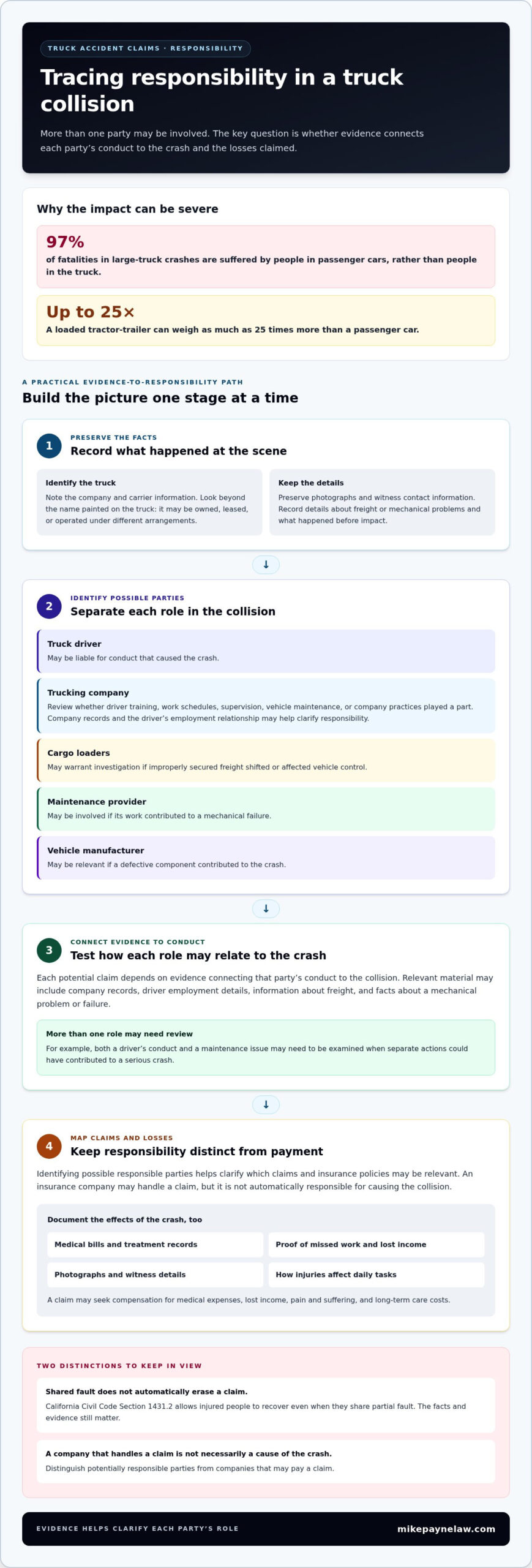
A truck accident is a collision involving a commercial truck, such as a tractor-trailer, delivery truck, or work vehicle. It can involve a passenger car, motorcycle, pedestrian, or another truck. The vehicle type matters because a loaded tractor-trailer can weigh as much as 25 times more than a passenger car. That difference can make a collision especially destructive, even when the initial impact seems limited.
The consequences can be severe for people outside the truck. In large-truck crashes, 97 percent of fatalities are suffered by people in passenger cars rather than truck occupants. Inland Empire collisions may happen on I-10, I-15, or I-215, where commercial trucks travel alongside local traffic. Following too closely is one identified cause of commercial truck accidents. If a rideshare vehicle was also involved, its driver and trip circumstances may raise separate questions addressed in Uber accident claims.
Compensation after a truck accident may address documented losses connected to an injury. A claim may seek payment for medical expenses, lost income, pain and suffering, and long-term care costs. For example, someone unable to return to work can document missed wages, while treatment records can show the care needed after the crash. Future needs matter too: a lasting injury may require continued treatment or help with daily activities.
To pursue compensation, an injured person generally needs evidence connecting the crash to another party’s responsibility and the losses claimed. A truck accident lawyer can organize records and assess how the collision happened. Useful materials may include medical bills, proof of missed work, photographs, and witness details. Keep copies together, note how injuries affect daily tasks, and follow treatment instructions so their impact is clearly documented.
Responsibility can be contested, and an insurer may question the extent or cause of an injury. California Civil Code Section 1431.2 allows injured people to recover even when they share partial fault. That means an injured person’s own contribution does not automatically erase a claim. The facts still matter, including the conduct of everyone involved and the evidence supporting each claimed loss. For someone hurt near San Bernardino, documenting treatment and income changes can help show the practical effects of the crash.
Potentially liable parties
A truck collision may involve several parties, and responsibility depends on each party’s role in causing the crash. Identifying them helps clarify which claims and insurance policies may be relevant.
Potentially Liable Trucking Companies
A trucking company may be responsible if its decisions or conduct contributed to a collision. Evidence about driver training, work schedules, supervision, or vehicle maintenance may show whether company practices played a part. Company records and the driver’s employment relationship can help clarify responsibility.
Look beyond the name painted on the truck to identify the company operating it. A truck may be owned, leased, or operated under different arrangements. During a consultation, a lawyer can review the available facts and identify the business entities involved.
Other Potentially Liable Parties
A truck driver may be liable for conduct that caused the crash. Cargo loaders may also be investigated if improperly secured freight shifted or affected vehicle control. A maintenance provider may be involved if its work contributed to a mechanical failure. Each claim depends on evidence connecting that party’s conduct to the collision.
A vehicle manufacturer may also be relevant if a defective component contributed to the crash. Insurers may handle claims, but an insurance company is not automatically responsible for causing a collision. Distinguishing potentially responsible parties from companies that may pay a claim is an important step.
Start by documenting facts that distinguish each party’s role. Record the truck’s company and carrier information, along with details about freight or mechanical problems. Preserve photographs and witness contact information, and note what happened before impact. These details can help a lawyer assess whether to investigate the driver, trucking company, cargo handlers, maintenance providers, or manufacturer.
Financial responsibility may involve more than one party when separate actions contributed to a serious crash. For example, both a driver’s conduct and a maintenance issue may need review. A law firm can organize evidence around each party’s connection to the collision, injuries, and resulting losses. This analysis helps victims understand which claims may be pursued.
After a crash, avoid treating an insurer’s initial position as a complete account of liability. Keep communications and claim documents, and get legal guidance before agreeing to a resolution that affects your injury claim. For families dealing with a fatal collision, information about fatal trucking accident claims can help explain the distinct issues involved.
Services in the Inland Empire and Southern California
Truck accident claims in California involve filing deadlines, fault rules, and evidence tied to the crash. Understanding these points helps you assess an accident case and choose legal support in the region.
California Truck Accident Claim Deadlines
In California, the statute of limitations for personal injury lawsuits is two years under Code of Civil Procedure Section 335.1, according to the California Legislature. This deadline makes prompt action important, especially when witness accounts or records could become harder to obtain.
Note the collision date and organize medical records, insurer letters, and repair documents. A claim and a lawsuit are separate steps, so discussing the accident with an insurer does not by itself preserve a filing deadline. A California truck accident lawyer can assess which deadline applies and help plan next steps.
Choosing an Inland Empire Truck Accident Attorney
Look for an attorney who handles truck accident claims and can explain investigations into driver conduct, company practices, and other potential causes. Ask how the lawyer will share case developments, assess evidence, and approach negotiations or trial. Clear answers help you understand what representation involves.
When comparing attorneys, ask about their truck accident work and how they explain past outcomes. Read reviews for specific details about communication and case support, rather than relying only on star ratings. Compare each attorney’s answers and whether they address your questions directly.
California uses pure comparative negligence for truck accident liability claims involving parties that contributed to a collision. California Civil Code Section 1431.2 allows injured people to recover even when they share partial fault. A driver’s share of responsibility can therefore affect a claim without automatically ending it.
For example, a truck driver and another motorist may both have contributed to a crash near Fontana. Evidence about each person’s actions helps determine how responsibility should be assessed. A legal review should connect those facts to the injuries and losses, rather than treating fault as an all-or-nothing question.
Local context can make an investigation more specific. A crash near San Bernardino or Chino may involve commercial traffic, local roads, and witnesses with different accounts. Share the collision location, date, vehicles involved, and insurer communications during an initial consultation. These details give an attorney a practical starting point for evaluating the claim.
Choose legal support that explains California’s rules and the steps ahead in plain language. An inland empire truck accident attorney should be able to discuss deadlines, comparative fault, evidence needs, and how a claim may proceed. That conversation can help you make an informed decision and protect important case details.
Personal injury case investigation and evidence gathering
A truck accident investigation connects the collision, potentially responsible parties, and resulting losses. In the Inland Empire, records can help show how a commercial truck was operated, maintained, and involved in the crash.
Investigating the Personal Injury Case
An investigation examines the crash circumstances alongside injury and recovery records. Attorneys may review driver logbooks, maintenance records, employment history, and training evidence. These materials can help show whether driver hours, rest periods, maintenance practices, or training issues played a role. Each record should be assessed against the collision sequence and injuries described in medical documents.
Compliance with federal hours-of-service rules may also be relevant to a truck accident case. Investigators can compare available driver logs with other evidence about the trip and crash. Inconsistencies between the records and the events may raise questions for further review. This analysis can help explain whether conduct or company practices contributed.
Gathering Evidence and Proving Liability
Evidence connects a party’s actions to the collision. Black box data may document the collision sequence, while photographs can show vehicle positions, damage, and road conditions. Driver logs and maintenance records may add context about the truck’s operation and condition. Together, these sources can help assess whether the driver, trucking company, or another party contributed.
Keep useful details together: the crash report, witness names, insurer letters, photographs, and treatment records. Note the date and source of each item. For example, a photo showing truck damage is more useful when paired with the location and date it was taken. Organized records make it easier to track evidence supporting liability and injury-related losses.
Preserving Evidence
Preserve original photographs, messages, and documents instead of relying only on edited copies. Save medical records and bills as they arrive, and keep notes about symptoms and treatment. Driver logs, maintenance files, employment history, and black box data may matter to a commercial truck claim, so identify these records early for investigation.
Record where evidence came from and when you received it. Keep the truck carrier’s details and correspondence from its insurer. Avoid altering vehicle photographs or deleting relevant messages. A clear record of collected materials helps an attorney assess the evidence and explain how it supports your claim.
Steps After an Inland Empire Truck Accident
After a truck accident, seek medical attention, report the collision to law enforcement, and preserve available information. When safe, note the location, vehicles involved, witnesses, and visible damage. Keep report details and medical paperwork together. These steps help document the incident and resulting injury.
Before discussing a claim with a trucking company’s insurer, consult an attorney. Insurer questions may concern fault, treatment, or settlement, so provide accurate details and keep copies of communications. An attorney can organize an investigation around driver logs, maintenance records, and other relevant evidence while you focus on recovery.
Truck accident legal representation in Riverside and the Inland Empire
A truck collision on I-10, I-15, or I-215 can involve disputed facts, serious injuries, and several insurance interests. Legal representation helps organize the claim, assess responsibility, and present evidence supporting recovery. The goal is a clear case built around the injured person’s medical needs and documented losses, not pressure to accept an incomplete account of the crash.
An experienced accident lawyer can manage insurer communications while investigating the collision. That work may include reviewing driver logs, maintenance records, black box data, and medical documents. For example, records may help explain whether vehicle maintenance or driver conduct contributed to a crash near Fontana. A focused investigation also identifies evidence that supports each claimed loss.
Truck accident claims may proceed through settlement negotiations or trial. Settlement discussions weigh evidence about liability, injury, treatment, lost income, and future care. If the parties dispute fault or injuries are severe, litigation may be necessary. The listed average timeline for Inland Empire truck accident claims is 12-24 months, depending on severity, so progress depends on the evidence and disputes involved.
Representation also involves preparing the claim before responding to an insurer’s position. Organize medical records, bills, work documents, photographs, and correspondence by date. If an adjuster questions a gap in treatment, records explaining the care timeline can clarify the issue. A lawyer can assess these materials alongside crash evidence and address arguments about fault or injury severity.
Choose counsel who explains the legal process clearly and answers questions about investigation, negotiation, and trial preparation. Ask how the attorney will keep you informed and which evidence matters most to your claim. For a collision near Ontario or San Bernardino, that may mean connecting vehicle records with witness accounts and medical findings. Clear communication helps you make informed decisions.
Strong advocacy means challenging unsupported arguments, presenting the evidence, and pursuing resolution through negotiation or trial. Injured people deserve a process that takes recovery and documented losses seriously. If you need guidance after a truck crash, discuss your motor vehicle accident claim and the next steps for presenting it.
Law Offices of Michael D. Payne: Car Accident Representation
Law Offices of Michael D. Payne provides Car Accident Representation for people injured in vehicle collisions, including crashes involving a passenger car and a truck. If injuries, medical care, or disputed responsibility make a claim difficult to manage, legal guidance can clarify next steps and the evidence that may support recovery.
Bring relevant records to a discussion, such as medical documents, insurer letters, photographs, and information about the vehicles involved. These details can help explain the collision and its impact. The firm also provides Slip and Fall Representation, Motorcycle Accident Representation, and Bicycle Accident Representation for people facing those separate injury situations.
If you’d like to discuss your accident claim, contact Law Offices of Michael D. Payne.
Take the Next Step Toward Protecting Your Claim
Decisions after a serious collision can shape how a claim moves forward. Keep relevant documents together, note questions as they arise, and seek legal guidance before agreeing to a resolution. An inland empire truck accident attorney can help you understand your options and decide how to proceed based on the evidence and your recovery needs.
Law Offices of Michael D. Payne handles injury matters through Car Accident Representation, Slip and Fall Representation, and Motorcycle Accident Representation. If a truck crash has left you managing injuries, paperwork, and uncertainty, discussing your situation can clarify a practical next step. The firm offers free accident case consultations and serves people across West Covina, Pomona, Ontario, Covina, Chino, Fontana, San Bernardino, Baldwin Park, and Azusa.
Contact Law Offices of Michael D. Payne to discuss your injury claim. Take the next step when you’re ready, and move forward with a clearer plan.
Frequently Asked Questions
How Can You Get Compensation?
You can pursue compensation by documenting your injuries and showing how another party contributed to the crash. Keep treatment records, accident-related receipts, and insurer communications. If symptoms limit your work, ask your employer for records of missed shifts or changed duties. These documents can support a claim with the responsible party’s insurer. If negotiations do not resolve the dispute, a lawsuit may be the next step.
Who Is the Responsible Party for Your Accident?
Responsibility depends on whose conduct contributed to the collision. A driver may have caused a crash through unsafe driving, while a trucking company’s maintenance or training decisions may also matter. If a mechanical failure is suspected, vehicle repair history may be relevant. If cargo shifted, loading practices may need review. Witness accounts, vehicle records, and the crash circumstances help identify potentially responsible parties.
Which law firms handle truck accident cases in San Bernardino and nearby Inland Empire communities?
Law Offices of Michael D. Payne provides truck accident representation for injured people in Southern California. Its local service area includes San Bernardino, Fontana, Ontario, Chino, Pomona, West Covina, Covina, Baldwin Park, and Azusa. To discuss a claim, gather the crash report, insurer correspondence, and a brief treatment timeline. These details can start a focused conversation about the collision and the legal work involved.
What compensation can I recover after a truck accident in California?
A California truck accident claim may seek recovery for injury-related medical expenses, lost income, pain and suffering, and long-term care costs. Different records support each category. Treatment statements can document medical expenses, while employer records may help establish lost income. For continuing care needs, keep treatment plans and recommendations describing the assistance or services involved. Evidence should connect each claimed loss to the collision and injury.
What evidence should I preserve after a commercial truck accident?
Preserve materials that may help reconstruct the crash and document its effects. Keep original photos and videos, the police or incident report, insurer messages, medical paperwork, and recovery-related receipts. Save digital files in their original format when possible, and note who provided each document. If a witness shares contact details or an account, record when you received it and keep it with your case records.
How do California and federal trucking regulations affect truck accident claims?
California and federal trucking rules can shape which records investigators examine, including driver logs, rest periods, maintenance, and training. Those records may help explain whether a safety issue contributed to the crash. California Civil Code Section 1714 codifies the duty of care relevant to negligence claims, according to the California Legislature. Federal hours-of-service compliance may also be investigated when trip records or driver logs raise concerns.
Who may be liable for a truck accident: driver, trucking company, or others?
Potentially liable parties include the truck driver, trucking company, cargo loaders, and maintenance providers. A vehicle manufacturer may also warrant investigation if a defect appears connected to the collision. For example, if a component failure is reported, repair records and the vehicle’s condition can help clarify whether maintenance or a defect played a role. Evidence must connect each party’s conduct or product to the crash.