

One death can lead to two distinct California claims, each addressing a different person’s losses. The difference in a wrongful death vs survival action case affects who may bring the claim and what damages may be pursued.
It’s understandable to assume both claims cover a family’s grief and the harm caused by a loved one’s death. California law draws a sharper line: a wrongful death claim addresses losses suffered by eligible surviving family members, while a survival action seeks recovery for harm the deceased person suffered before death. These rules are state-specific, so information about another state may not apply.
This guide explains who may bring each claim in California, what losses each may cover, and why the rules for pre-death pain and suffering in a survival action deserve careful attention. You’ll also find practical steps to help protect your family’s legal options, including preserving records, identifying who is authorized to act, and understanding that different claims may have different deadlines. Clear information can’t undo a loss, but it can help you understand what choices may remain.
Key Takeaways
- The key to understanding wrongful death vs survival action is whose losses the claim addresses: eligible survivors’ losses or harm the deceased person suffered before death.
- California law sets different rules for who may bring each claim. Identify potential wrongful death claimants separately from the person authorized to act for the estate.
- Wrongful death damages generally focus on eligible survivors’ losses, while a survival action may address certain losses belonging to the deceased person’s estate.
- Both claims may be pursued when the facts and law support them, but each has distinct requirements and deadlines.
- Preserve relevant records, clarify potential claimant roles, and seek legal guidance promptly to help protect your family’s options.
Wrongful Death vs. Survival Action: What Each California Claim Represents
After a loved one’s death, sorting through legal terms can feel like another burden. The central difference is straightforward: a California wrongful death claim seeks recovery for eligible survivors’ losses, while a survival action continues a claim the deceased person could have pursued for harm suffered before death. The wrongful death vs survival action distinction is about whose legal interests each claim represents.
California law controls who may bring these claims and what each can address. Wrongful death statutes appear in California Code of Civil Procedure section 377.60 and following; survival actions are governed by sections 377.20 and 377.30 and following. A general overview of a wrongful death claim can provide background, but another state’s rules don’t determine a California case.
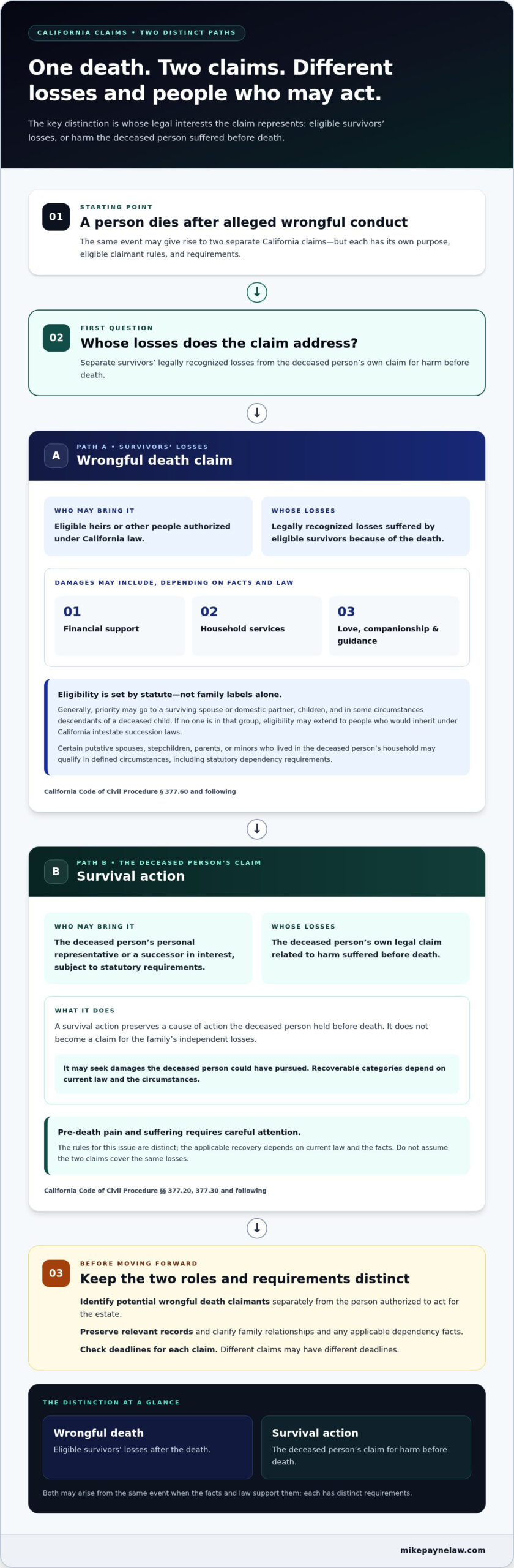
Quick comparison under California law
Claimant: Eligible heirs or other people authorized under California law bring a wrongful death claim. The deceased person’s personal representative or a successor in interest brings a survival action, subject to statutory requirements.
Purpose: Wrongful death addresses losses eligible survivors suffer because of the death. A survival action carries forward the deceased person’s own legal claim related to the injury.
Whose losses: The wrongful death claim concerns survivors’ legally recognized losses. The survival action concerns losses or other remedies tied to the deceased person’s claim before death.
What does a California wrongful death claim address?
A wrongful death claim addresses legally recognized harm to eligible survivors when another party’s wrongful conduct causes a person’s death. Depending on the facts and the law, survivors may seek damages for losses such as financial support, household services, and the relationship’s love, companionship, and guidance. The claim isn’t simply a way to recover for every relative’s grief. California law determines who has standing, and family members don’t automatically share identical rights to bring a claim or recover damages.
This is separate from the deceased person’s own pre-death claim. For example, if someone is injured in a collision and later dies from those injuries, eligible family members may have a wrongful death claim for their own losses. The person’s claim for injuries before death is a separate legal matter.
What does a California survival action continue?
A survival action preserves a cause of action the deceased person held before death; it doesn’t become a claim for the family’s independent losses. California Code of Civil Procedure section 377.30 allows the decedent’s personal representative or successor in interest to pursue it, subject to applicable procedural requirements. The claim may seek damages the deceased person could have pursued, though recoverable categories depend on current law and the circumstances.
In short, wrongful death addresses eligible family members’ losses; a survival action continues the deceased person’s claim. Both claims may arise from the same event but serve different purposes. The Law Offices of Michael D. Payne handles California wrongful death matters and can review claimant roles, evidence needs, and applicable rules in light of the specific facts.
Who Can Bring a Wrongful Death Claim or Survival Action in California?
After a death, relatives may assume that being part of the family automatically gives them the right to file or participate in every claim. California law draws specific lines. Code of Civil Procedure sections 377.60 and 377.30 set different rules for wrongful death plaintiffs and the people authorized to continue the deceased person’s claim. The wrongful death vs survival action distinction therefore affects not only what a case addresses, but who may act.
Who may bring a California wrongful death action?
California Code of Civil Procedure section 377.60 generally gives priority to the deceased person’s surviving spouse or domestic partner, children, and, in some circumstances, descendants of a deceased child. If there is no one in that group, the right may extend to people who would inherit from the deceased under California’s intestate succession laws. The statute also recognizes certain other potential claimants in defined circumstances.
Those alternatives may include a putative spouse, stepchildren, parents, or a minor who lived in the deceased person’s household, if statutory dependency requirements are met. The exact relationship, dependency, and family circumstances matter. A relative’s grief or close relationship alone doesn’t establish eligibility, and one person’s eligibility doesn’t automatically determine who else may participate.
For example, a parent may have a potential claim if the statutory conditions apply, even if the deceased had no spouse or children. In a blended family, a stepchild’s relationship and financial dependency may need careful review. Eligibility can’t be determined by family labels alone. California’s statutory criteria control.
Who may bring a California survival action?
A survival action is pursued by the deceased person’s personal representative or a successor in interest under California Code of Civil Procedure section 377.30. A personal representative is someone authorized to act for the estate, commonly through a probate appointment. A successor in interest is a person who succeeds to the deceased person’s interest in the claim and must satisfy the applicable statutory procedures.
That role differs from being eligible to bring a wrongful death claim. A child or spouse may qualify as a wrongful death claimant but isn’t automatically authorized to pursue the survival action solely because of that relationship. The person authorized to pursue the survival claim acts for the deceased person’s legal interest, not as a representative of every relative’s individual losses.
Probate circumstances and procedural requirements can affect who is able to move a survival claim forward. California law includes requirements for establishing successor-in-interest status, and the appropriate steps depend on the case. The absence of a probate appointment alone doesn’t answer who may qualify. Families should identify potential wrongful death claimants separately from the estate representative or successor in interest, then have those roles assessed together.
Because family structures and estate circumstances can complicate eligibility, a case-specific review can help clarify who may have a role under California law. The Law Offices of Michael D. Payne handles California wrongful death matters and can discuss the family’s circumstances and the evidence needed to evaluate potential claims.
What Damages Can Each California Claim Address?
The damages question in a wrongful death vs survival action case turns on who experienced the loss. A wrongful death claim addresses legally recognized losses suffered by eligible survivors. A survival action seeks damages tied to the deceased person’s own claim before death. The same incident may support both, but the claims don’t make the same losses recoverable twice.
Which losses may be considered in wrongful death?
California Code of Civil Procedure section 377.61 allows eligible heirs to seek damages for their own losses. Depending on the evidence, these may include lost financial support the deceased would have provided, the value of household services, and loss of the deceased person’s love, companionship, comfort, care, assistance, protection, affection, society, and moral support.
These categories require proof tied to the survivors and their relationship with the deceased. Financial records, employment information, and evidence of household contributions may help establish economic loss. Testimony about the relationship may help explain the loss of companionship and support. The law doesn’t award damages simply for a relative’s grief or sorrow, however. Emotional suffering is real, but it isn’t itself a wrongful death damages category under California law. The circumstances and evidence determine which legally recognized losses may be claimed.
Which losses may be considered in a survival action?
A survival action concerns damages the deceased person could have sought for the injury before death. Under California Code of Civil Procedure section 377.34, potentially recoverable economic losses may include medical expenses and lost earnings incurred before death. These belong to the deceased person’s claim, not to relatives as compensation for their own financial or emotional losses. Bills, wage information, and treatment records may help establish them.
Pain, suffering, and disfigurement require special attention to the lawsuit’s filing date. As of January 1, 2026, those noneconomic damages are generally not recoverable in a survival action. A temporary California law allowing them expired on December 31, 2025, so lawsuits filed on or after January 1, 2026 are subject to the restored rule. The law may treat earlier-filed cases differently; a case-specific review is important before drawing conclusions.
Punitive damages may also be available through a survival action when the deceased person would have been entitled to them under California law. They are generally not recoverable in a wrongful death claim itself. That distinction can matter when evaluating allegations of especially serious misconduct, but punitive damages aren’t automatic. The facts and applicable legal standards must support them.
Keep the categories separate when gathering evidence. A surviving family member’s lost support belongs in the wrongful death analysis; the deceased person’s medical expenses before death belong in the survival analysis. California law and the facts determine what can be pursued and by whom.
Can a California Family Pursue Both Claims, and What Should Happen Next?
Yes. Depending on the facts and California law, a family may pursue a wrongful death claim and a survival action arising from the same event. They address separate interests: eligible survivors’ losses and the claim the deceased person held for injuries before death. Bringing them together doesn’t merge their legal basis, damages, or claimant requirements. Evaluate each claim separately.
When might both claims be relevant?
Imagine a person is injured in a crash, receives medical care, and later dies from those injuries. Eligible survivors may have losses connected to the death, while the deceased person’s claim may include qualifying expenses or other damages from the period between injury and death. The example doesn’t establish that any particular relative qualifies or that a specific loss is recoverable. Those questions depend on evidence, statutory rules, and the circumstances.
A civil claim is separate from a criminal case. A family’s civil claims don’t depend on prosecutors filing charges or obtaining a conviction. The claims have their own parties, legal standards, and procedures. A criminal investigation may provide relevant information, but it doesn’t replace the need to protect civil claims and their deadlines.
What records and deadlines deserve early attention?
Preserve records that may help explain what happened, the injuries, and the family’s losses. Keep copies of incident reports, photographs, messages, medical and billing records, employment and income documents, and information showing household contributions or the relationship with the deceased. Keep original files unaltered, and note where records came from and when they were obtained.
California deadlines depend on the claim and the circumstances, so don’t assume one filing date applies to every case. Generally, a wrongful death lawsuit must be filed within two years of the death. Claims involving a government entity may require an administrative claim within six months. Medical malpractice and other circumstances can involve different rules. A survival action’s deadline may depend on the limitation period for the underlying injury claim and the time elapsed after death. Prompt legal review can help identify which rules apply.
Take these steps early:
- Preserve records. Gather available incident, medical, employment, and relationship evidence, and keep it organized.
- Identify possible claimants. Write down family relationships, potential dependents, and who may be authorized to act for the estate.
- Seek legal guidance promptly. Request a case-specific review of the claims, evidence, and potentially applicable deadlines.
Payne can review how California law may apply, help gather evidence, and work with investigators and expert witnesses. Discuss your family’s circumstances through a wrongful death case consultation.
Discuss a California Wrongful Death or Survival Action With Local Counsel
After a loss, legal terms and family responsibilities can be hard to sort through. A case-specific review can help clarify who may bring each claim, what evidence may matter, and which California rules apply. That includes examining how the incident happened, what losses followed, and who may be authorized to act for the deceased person’s claim.
Payne represents families in California wrongful death matters and has 30 years of Experience serving West Covina and the Los Angeles area. The firm’s California wrongful death representation includes reviewing the circumstances and identifying evidence that may help assess potential legal paths. No particular result can be promised, but a careful investigation can help bring relevant facts into focus.
What happens during a free accident case consultation?
During a free accident case consultation, families can describe what happened, share questions, and discuss how California law may apply to their circumstances. You don’t need to have every document or legal term figured out before asking for guidance. The firm can help identify useful information and issues that may need closer review.
Evidence can be critical. Depending on the incident, the firm can gather records and work with investigators and expert witnesses to examine the available facts. This may include reviewing how an injury occurred, what happened before death, and which records could clarify the losses. The firm offers a No Fee Guarantee: we do not charge a fee unless we win. The firm is available 24/7. Se Habla Español. Hablamos Español.
How can local accident circumstances shape the investigation?
Different incidents call for different evidence. In a vehicle-related death, relevant materials may include collision reports, photographs, witness accounts, and records concerning the vehicles involved. The firm represents people in motor vehicle accident cases across Southern California. If a commercial truck was involved, the investigation may also need to examine trucking-related records and other evidence specific to that collision. The firm also handles truck accident cases.
For families in West Covina, Pomona, Ontario, Covina, Chino, Fontana, San Bernardino, Baldwin Park, and Azusa, the circumstances of the incident guide the investigation. A consultation is an opportunity to discuss the facts, claimant roles, and evidence needs without assuming every case follows the same path.
If your family is weighing the difference between a wrongful death vs survival action, request a free accident case consultation. The discussion can help you understand potential options and the California rules that may affect your family’s legal choices.
Take the Next Step With Clarity and Support
Choosing what to do next doesn’t require your family to have every answer today. Start with a focused conversation about the circumstances, the people involved, and the questions that still need attention. You can ask for guidance while you’re gathering your thoughts. A clear plan can help replace uncertainty with manageable next steps.
The distinction between wrongful death vs survival action can shape how a California case moves forward, but your family’s specific facts matter more than general explanations. Payne offers free accident case consultations to discuss how California law may apply. The firm has 30 years of Experience, is available 24/7, and offers a No Fee Guarantee. Se Habla Español. Hablamos Español.
When you’re ready, request a free accident case consultation to discuss your family’s circumstances and possible next steps. Call (626) 974-8713 to speak with the firm. You deserve clear information and the space to make informed decisions.
Frequently Asked Questions
Can a family file both a wrongful death claim and a survival action in California?
Yes, both may be relevant when the facts support separate claims, but filing both isn’t automatic. A wrongful death claim and survival action have distinct claimant rules and damage theories. A family may need to distinguish losses claimed by eligible survivors from expenses or other losses tied to the deceased person’s claim before death. Case-specific legal review can help determine whether both claims fit and how California procedures apply.
Does a wrongful death lawsuit require a criminal conviction in California?
No. A civil wrongful death lawsuit and a criminal prosecution are separate proceedings with different purposes and standards of proof. A civil claim generally doesn’t require a criminal conviction, and prosecutors may make decisions independently of a family’s civil options. Evidence from an investigation may be relevant, but its role varies. A California attorney can assess the incident and available evidence without assuming how either proceeding will unfold.
Is a California wrongful death claim part of probate?
Not necessarily. A wrongful death claim belongs to eligible survivors, while probate concerns administration of the deceased person’s estate. The same death may raise both issues, but they are not the same proceeding. Estate administration can matter if someone must act on a survival action for the deceased person. Whether probate is open, who has authority, and what procedural steps are required depend on the circumstances.
Can a wrongful death case proceed while a criminal case is pending?
It may proceed on a separate civil track, but timing and evidence issues can vary. A pending prosecution doesn’t automatically decide the civil claim or mean the civil case must pause. At the same time, investigation schedules, access to evidence, and other case-specific concerns may affect coordination. Families should discuss the facts with a California attorney, especially before making decisions about records, statements, or the timing of civil filings.
Can more than one family member bring a wrongful death lawsuit in California?
California law identifies who may qualify, and related heirs’ interests are generally addressed within a single wrongful death action rather than through separate overlapping cases. That doesn’t mean every relative can file independently or recover damages. Identifying potential heirs early can help prevent procedural disputes and ensure the family’s circumstances are considered. The eligible people and required steps should be assessed under current law for that family.
What evidence can help support a California wrongful death claim?
Useful evidence depends on what conduct caused the death and which losses are being evaluated. An incident report or witness account may help establish events, while medical records can document injuries and treatment. Employment, tax, or household records may help show financial contributions; photographs, messages, and family records may provide context about relationships. Preserve original materials where possible. No single document guarantees a result, so evidence should be reviewed together.
Can stepchildren or other dependents qualify in a California wrongful death action?
Potentially, but eligibility depends on California’s statutory categories and the specific relationship or dependency facts. Evidence such as records showing financial support, shared living arrangements, or the nature of a family relationship may be relevant. A label alone may not resolve eligibility. Families with stepchildren or other dependent relationships in West Covina, Pomona, Ontario, Covina, Chino, Fontana, San Bernardino, Baldwin Park, or Azusa should seek individualized legal guidance.