

What if the medical lien figures in your settlement file aren’t the final amount you owe? If you’re wondering how to handle medical liens on a settlement, start by identifying who is seeking repayment and checking whether the claim is accurate before any money is distributed.
It’s understandable to worry that liens could take a larger share of your recovery than expected. Hospitals, health insurers, Medicare, Medi-Cal, and providers who treated you on a lien basis may have different reimbursement rights. A balance on a statement doesn’t automatically show what can be recovered or whether the amount can be challenged or negotiated.
This guide explains how to identify potential lien holders, request and review supporting records, and address disputed or negotiable claims before distribution. You’ll also learn why medical liens and attorney fees are separate deductions that can both affect your net proceeds. With more than 25 years of experience, including a background in insurance defense, Michael D. Payne understands the importance of examining every claim carefully. A clear plan can help you protect your interests and understand what may remain from your California injury settlement.
Key Takeaways
- Learn how to handle medical liens on a settlement by identifying each claimant and checking the claim before settlement funds are distributed.
- Understand why hospitals, health plans, Medicare, Medi-Cal, and treatment providers may follow different rules for seeking reimbursement.
- Compare claimed charges with itemized bills, payment records, treatment dates, and the care connected to your injury.
- Follow a clear process to request written balances, verify claims, raise disputes, and document any resolution.
- See how legal counsel can help address lien claims and why attorney fees and case costs are separate from medical reimbursement.
How Medical Liens Can Change Your California Settlement
A settlement can resolve your injury claim without putting the full amount in your hands right away. A medical lien is a claim seeking payment from settlement proceeds for care connected to the accident. The claim may come from a treating provider, a health plan seeking reimbursement, or a public-benefit program. The source matters because each may rely on different legal rights and procedures. For a general explanation of the concept, see What is a Lien?
These terms are related, but they aren’t interchangeable. An unpaid medical bill is a provider’s request for payment. A lien is a claim against specified property or funds, while a health plan or public program may assert a reimbursement claim under its own rules. A bill alone doesn’t prove that an enforceable lien exists or establish that the full amount must be paid from your settlement. The claim’s basis, documentation, and connection to your accident-related treatment all matter.
What does a medical lien mean after an accident?
After an accident, someone else may pay for care or allow treatment with payment expected later. If you recover compensation from the party responsible for your injuries, a provider, insurer, Medicare, or Medi-Cal may seek repayment from those proceeds. That doesn’t make every bill a lien or automatically validate every reimbursement demand. Assess the claim based on its source and supporting records.
This issue can arise in a car crash as well as other injury cases. The medical claim is only one part of the broader case: liability, damages, insurance coverage, and evidence of your losses also shape the recovery. For more on the injury claim itself, see the firm’s California motor vehicle accident representation.
Why the settlement amount is not the final amount you receive
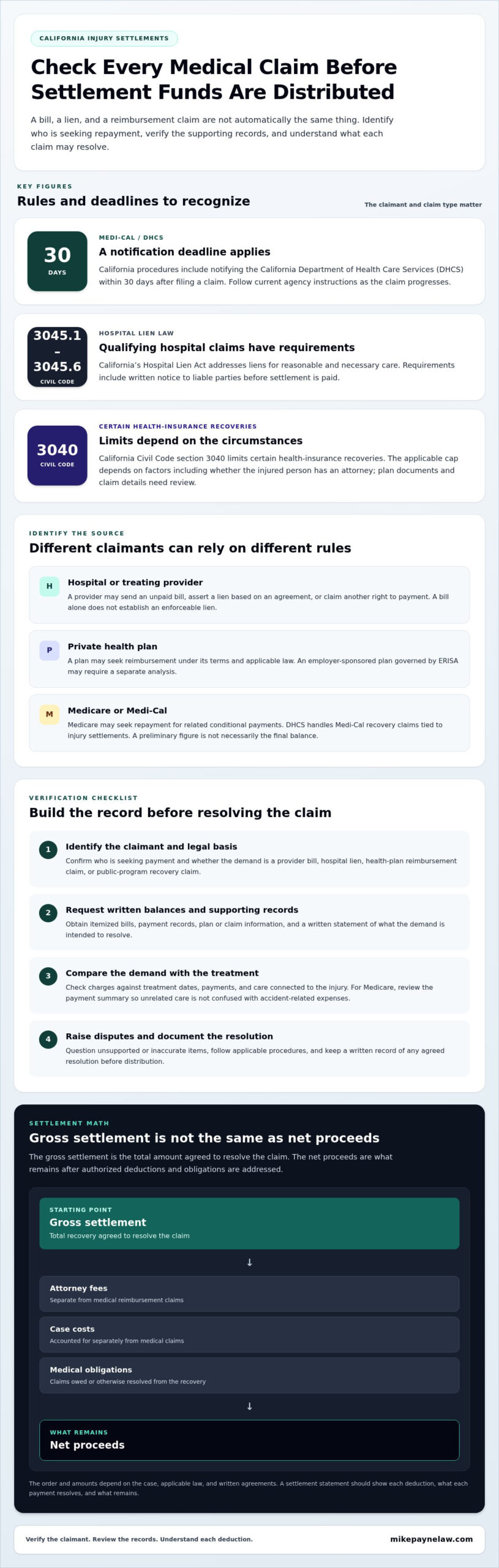
The gross settlement is the total amount agreed to resolve the claim. Before funds reach you, the distribution may account for attorney fees, case costs, and medical obligations that are owed or otherwise resolved from the recovery. The amount left is your net proceeds. The order and amounts depend on the case, applicable law, and written agreements. Attorney fees and advanced case costs are separate from medical reimbursement claims, so they should be accounted for separately.
Quotable takeaway: “The gross settlement is the total recovery; your net proceeds are what remains after authorized fees, costs, and medical obligations are addressed.”
That difference is why it helps to plan before accepting a distribution. A settlement statement should show what is being deducted, what each payment resolves, and what remains. If a claimed balance is disputed, treating it as automatically payable can put pressure on your recovery. Understanding how to handle medical liens on a settlement starts with separating the total settlement from each claim against it, then examining what is supported and owed.
Which California Medical Lien or Reimbursement Claims May Apply?
The name on a demand letter matters. A hospital seeking payment under a California statute isn’t necessarily in the same position as a health insurer relying on plan terms or a public program recovering benefits it paid. Each claim has its own legal basis, notice requirements, proof, and resolution process. Identify who is asserting the claim before deciding which records and rules to examine.
Provider and hospital claims versus health-plan reimbursement
A provider may send an unpaid bill, assert a lien based on an agreement, or claim a right to payment under another legal basis. Those aren’t automatically equivalent, and a bill alone doesn’t establish an enforceable lien. California’s Hospital Lien Act, Civil Code sections 3045.1 through 3045.6, allows qualifying hospitals to assert liens for reasonable and necessary care, subject to requirements that include written notice to liable parties before settlement is paid.
Private health plans may instead seek reimbursement under plan terms and California law. California Civil Code section 3040 limits certain health-insurance recoveries, with the applicable cap depending on factors such as whether the injured person has an attorney. That doesn’t mean every plan claim qualifies for the same calculation. The plan documents, payments, and claim circumstances need review.
Medicare, Medi-Cal, and other public-benefit recovery claims
Medicare may seek repayment for conditional payments it made for treatment related to an injury when another party is responsible for payment. The Centers for Medicare & Medicaid Services (CMS) administers Medicare recovery. Check the payment summary against the injury and treatment records so unrelated care isn’t confused with accident-related expenses.
Medi-Cal recovery is handled through the California Department of Health Care Services (DHCS), which has a process for asserting claims tied to injury settlements. California procedures include notifying DHCS within 30 days after filing a claim. The amount and resolution depend on applicable rules and the case details, so don’t treat a preliminary figure as the final balance. Follow current agency instructions and deadlines as the claim progresses.
Employer-sponsored plans can add another layer. If a plan is governed by the federal Employee Retirement Income Security Act (ERISA), its terms may affect reimbursement analysis. Don’t assume the rules for a private California health plan resolve an ERISA claim or that every plan is treated alike.
- Provider or hospital: Examine the claimed basis, notice, agreement, and treatment charges.
- Private health plan: Review plan language and payment records, along with applicable California limits.
- Medicare or Medi-Cal: Confirm program-specific procedures, covered services, and current recovery figures.
“The source of a reimbursement claim determines which rules, records, and resolution process you must review.” Sorting those sources is a key first step in how to handle medical liens on a settlement. The Law Offices of Michael D. Payne represents injured people in Southern California, including people pursuing motor vehicle accident claims in West Covina, Pomona, Ontario, Covina, Chino, Fontana, San Bernardino, Baldwin Park, and Azusa.
How to Check Whether a Medical Lien Is Accurate and Enforceable
Review every claim in two stages. First, determine whether the claimant has a legal, contractual, or other valid basis to seek payment from the settlement. Then check whether the amount and treatment included in the demand are supported. A letter requesting payment is not, by itself, proof that the full balance is owed or that the claimant can recover it from your proceeds.
Enforceability depends on the claim’s source, the documents behind it, applicable law, and the facts of your case. A provider agreement, hospital lien notice, health-plan reimbursement provision, or public-program payment record may call for a different review. Don’t assume one document establishes every part of the claim. Check both the right to recover and the calculation.
Documents to request before agreeing to a payoff
Request a current, itemized accounting and the documents supporting the claimant’s right to reimbursement. For a provider or hospital, request the itemized ledger and current balance. For a health plan, request the relevant plan language and payment history. For Medicare, request the conditional-payment information; for Medi-Cal, obtain the applicable recovery summary from the California Department of Health Care Services. Keep copies of requests, replies, and updated balances.
Compare the accounting with the treatment records and claim timeline. For example, if an itemized statement includes care from before the accident or treatment for a separate condition, flag those entries for clarification. Focus the review on dates, providers, services, and injury-related care without circulating medical details that aren’t needed to resolve the claim.
Common issues that deserve closer review
Small discrepancies can matter. Look for charges listed twice, services that don’t match the treatment records, payments or credits missing from the ledger, and balances calculated before the latest payments were applied. Compare the date of the demand with the latest statement, too. A previously accurate figure may no longer reflect the current amount.
- Check the scope: Do the listed services appear connected to the accident injuries?
- Check the math: Do the charges, payments, adjustments, and stated balance reconcile?
- Check the basis: Has the claimant provided the agreement, notice, plan term, or other documentation supporting its asserted recovery right?
- Check for updates: Is the statement current, and are later payments or corrections reflected?
If the records don’t answer a question, request a written explanation and keep the disputed items separate from amounts you can verify. Don’t treat an unexplained balance as automatically invalid, either. Flag unresolved facts for legal review before agreeing to a payoff. A careful document review turns a broad demand into specific questions and helps you make informed decisions about how to handle medical liens on a settlement.
How to Handle Medical Liens Before Settlement Funds Are Distributed
Once a settlement is being finalized, keep control of the process. Don’t distribute funds tied to a disputed claim until the obligation and applicable procedures have been reviewed. A deliberate sequence helps prevent missed claimants, outdated payoff figures, and uncertainty about what a payment resolves.
A practical sequence from settlement notice to written resolution
- Identify every claimant. Review treatment records, insurance correspondence, benefit notices, provider agreements, and settlement communications. List each provider, hospital, health plan, and public program that may claim reimbursement.
- Request written payoff information. Ask each claimant for an itemized balance, supporting records, the basis for its recovery claim, and the date through which the quoted amount is valid. For government programs or health plans, request current information through the applicable process.
- Verify each claim. Compare the requested amount with payment records and the treatment or benefit information you have gathered. If figures are unclear or appear to include unrelated services, ask for an explanation in writing.
- Dispute or seek a reduction where appropriate. Send a focused, documented request through the process that applies to that claimant. Include records that support the issue, and track any response deadline stated in an agency notice, plan document, or court order. Negotiation may be possible, but the rules and outcome depend on the claim type, governing law, and case circumstances.
- Get the resolution in writing. Before final distribution, obtain written confirmation of the agreed amount and, where applicable, a release or satisfaction showing what the payment resolves. Make sure the final figures are current and consistent with the settlement accounting.
Don’t assume a phone conversation or informal promise closes a claim. A written record can clarify whether the agreed payment resolves the asserted balance and whether any additional amount may still be claimed. If the payoff figure expires before funds are sent, request an updated figure rather than relying on an outdated quote.
Keep a clear settlement and lien paper trail
Keep one organized file for the settlement and every reimbursement claim. Save notices, itemized statements, payment histories, dispute letters, agency or plan correspondence, settlement accounting, payment confirmations, and final releases. Record when each document arrived and what action followed. Track deadlines stated in agency notices, plan documents, or court orders, and verify the applicable date rather than assuming one deadline fits every claim.
Before closing the claim, retain the notices, balances, supporting records, dispute correspondence, written agreements, payment proof, and final releases. That checklist gives you a clear record of what was claimed, resolved, and paid. The Law Offices of Michael D. Payne represents injured people in Southern California. If a motor vehicle injury settlement includes reimbursement claims, learn about the firm’s California motor vehicle accident representation.
When a California Injury Lawyer Can Help Resolve Medical Liens
A lien or reimbursement demand can affect how much of a settlement remains after the claim is resolved. A lawyer can help identify who is asserting each claim, review the supporting records, communicate with providers, insurers, or public programs, and document how each obligation is handled. This work connects lien review to the settlement terms and final accounting, so you can see what remains open before funds are distributed.
That review matters when documents conflict, a balance appears outdated, or the claimant’s right to recover isn’t clear from the paperwork. Michael D. Payne has more than 25 years of experience and previously worked in insurance defense. That background informs his understanding of how injury claims are evaluated, but no particular lien reduction or settlement result can be promised. Each claim turns on its own documents, rules, and facts.
What legal review can clarify before you accept a final distribution
Counsel can assess whether each claim is supported by the required records and has a basis under applicable law or an agreement. A lawyer can also coordinate lien questions with releases, settlement terms, and the case’s financial accounting. The goal is a documented picture of what will be paid, what remains disputed, and what proof will close each resolved claim.
Before approving a final distribution, ask for a clear accounting that separates medical reimbursement claims from attorney fees and case costs. Confirm whether each claimant has issued a current payoff figure and what written confirmation will show that the claim is resolved. If a demand remains disputed, clarify how it will be addressed before funds are disbursed.
Questions to resolve before closing out the settlement
Make sure you understand the status of every claim and the documents supporting the proposed deductions. Review how the written fee agreement treats attorney fees and advanced litigation costs. These are distinct from medical reimbursement obligations. Payne handles injury claims on a contingency-fee basis and advances litigation costs; review the specific terms and accounting under the written agreement and applicable law.
- Which claims are still open? Identify every unresolved provider, insurer, or public-program demand.
- What closes each claim? Confirm whether payment requires a release, satisfaction, or other written proof.
- How is the distribution calculated? Review how fees, advanced costs, medical obligations, and remaining client funds are shown.
Getting these answers in writing can prevent uncertainty after the settlement closes. A lawyer can help you understand how to handle medical liens on a settlement without treating every demand as automatically valid or assuming every claim can be reduced. For help with lien claims in an injury case, contact Payne.
Make Your Next Settlement Decision With Clarity
Before you authorize the final distribution, take time to understand what remains unresolved and what each payment will close. A clear written accounting can help you move forward with fewer unanswered questions and a better understanding of the recovery you’ll receive.
Knowing how to handle medical liens on a settlement isn’t just about responding to demands. It’s about making an informed decision before the claim is closed, with the terms, deductions, and remaining obligations clearly explained. You shouldn’t have to guess what a balance means or whether a payment ends a claim.
Michael D. Payne can review how lien questions fit into your injury settlement and help you understand the decisions ahead. Talk with Michael D. Payne about your injury settlement.
Frequently Asked Questions
Settlement questions can arise after accidents throughout the San Gabriel Valley and Inland Empire, including West Covina, Pomona, Ontario, Covina, Chino, Fontana, San Bernardino, Baldwin Park, and Azusa.
Can a medical provider take money directly from my settlement?
A provider may be paid from settlement funds if it has a valid right to payment and the settlement is handled in a way that accounts for that claim. The answer depends on the documents, applicable law, and the provider’s specific claim, not just the existence of a bill. Before authorizing payment, confirm who will issue it, what balance it resolves, and whether the provider will document satisfaction of the claim.
Does Medicare have to be repaid from a personal injury settlement?
Medicare may seek repayment for conditional payments it made for care related to an injury when another party is responsible for the costs. The amount can depend on which services Medicare paid for and how the claim resolves. Review the payment information for unrelated treatment or corrections, and follow current Centers for Medicare & Medicaid Services (CMS) procedures before funds are distributed. Keep records of disputes and final payment confirmation.
How does Medi-Cal recover accident-related medical payments?
Medi-Cal may seek reimbursement for eligible payments connected to an injury claim, with recovery handled through the California Department of Health Care Services (DHCS). Evaluate the claim under current DHCS procedures and the limits that apply to the specific case. Request an updated accounting, check that the listed services relate to the accident, and follow current agency instructions and deadlines rather than relying on an old estimate.
Can medical liens be negotiated after a settlement?
Sometimes, but no reduction is automatic. Options depend on the claimant, the legal or contractual basis for recovery, applicable rules, and documented circumstances such as the settlement and payments made. A provider’s demand may require a different approach from a public-program or health-plan claim. Make any request in writing, support it with relevant records, and get the final agreed amount and the effect of payment confirmed in writing.
What happens if a medical lien is larger than my settlement?
A claim that exceeds the settlement needs prompt review before you agree to any distribution. The amount claimed doesn’t, by itself, determine how the proceeds must be allocated; the claim’s source, supporting documents, applicable law, and other obligations may matter. Don’t assume the claimant will accept a particular amount or that you must pay the full demand. Have the figures and resolution options assessed before funds are released.
Should I spend my settlement before medical liens are resolved?
It’s safer not to spend or distribute funds that may be needed for unresolved claims. If a payoff is disputed or an agency’s recovery figure is still being reviewed, setting aside the relevant funds can help avoid complications while the amount and process are clarified. Before using the proceeds, review the settlement accounting, any written obligations, and applicable procedures. Get written confirmation when a payment is intended to close a claim.
Are medical liens the same as health insurance subrogation?
No. A medical lien generally describes a claim against settlement proceeds, while subrogation commonly refers to a health plan’s effort to recover amounts it paid for injury-related care. The terms can overlap in practice, but they don’t establish the same legal right. Review the plan language, payment records, and applicable law to determine the basis and scope of a reimbursement demand. Don’t assume a bill or lien notice settles that question.