

A wrongful-death claim can address lasting losses, but it usually won’t solve this month’s bills. After a fatal accident, the sudden loss of income can make rent, funeral expenses, medical bills, and everyday costs difficult to manage. Understanding financial support for families after a fatal accident starts with separating help that may be available sooner from compensation that could take time to pursue.
Your family may be looking for immediate options such as life insurance proceeds, employer benefits, or survivor benefits while also trying to understand whether a California wrongful-death claim may apply. These questions are difficult to face while grieving, and no single source of support is automatic.
This guide explains potential short-term resources, the losses a wrongful-death claim may address, and records worth preserving. It also covers why deadlines matter and how legal guidance can help protect a potential claim. Michael D. Payne brings more than 25 years of experience, including a background in insurance defense, to wrongful-death representation across Southern California. A clear plan can help your family take practical steps without mistaking a possible future recovery for immediate financial relief.
Key Takeaways
- Separate urgent household needs from compensation a legal claim may pursue. A wrongful-death case doesn’t guarantee immediate financial relief.
- Explore potential financial support for families after a fatal accident through insurance, employment benefits, and public programs, each with its own eligibility rules.
- Learn which family members may be eligible to bring a California wrongful-death claim and what losses it may address.
- Organize household, employment, insurance, and accident records as you’re able, without putting urgent personal needs on hold.
- An attorney can assess potential liability, evidence, insurance, and claim options, and help manage insurer communications.
What financial pressures can follow a fatal accident?
After a sudden death, grief can come alongside bills, phone calls, and decisions the household never expected to face. A family may lose the person who paid some or all of the household expenses, provided childcare, or helped care for another relative. Income can stop while recurring costs continue, and travel, medical, or funeral expenses may add pressure. Every family’s situation is different, so there’s no single checklist everyone must follow right away.
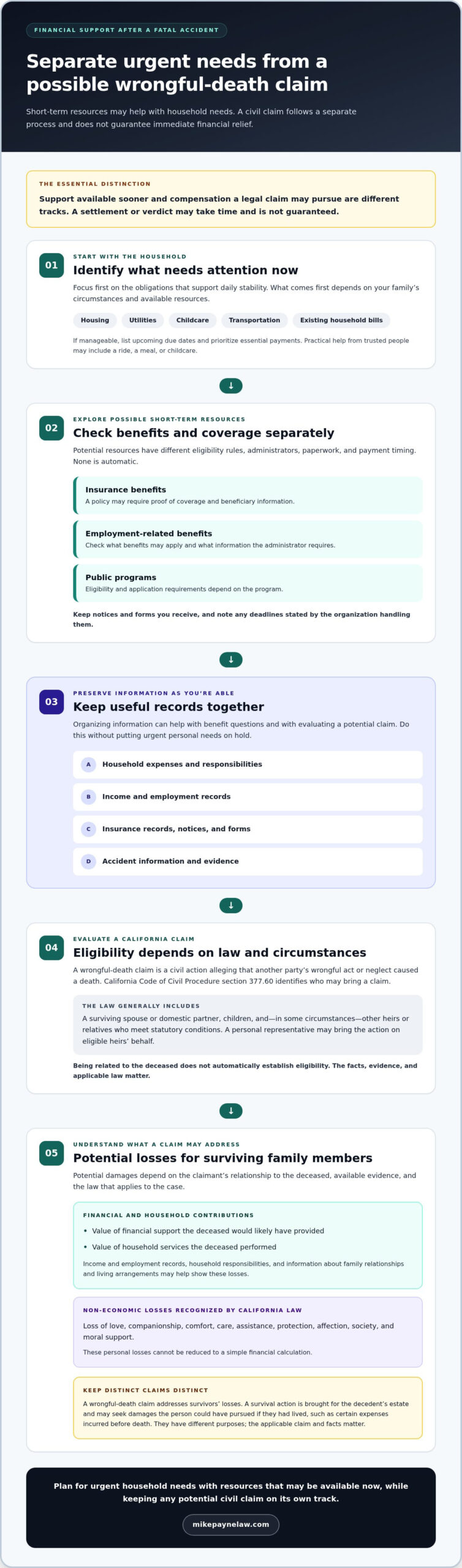
It helps to separate two needs: what the household must manage now and what a civil claim may seek to address later. A wrongful-death claim isn’t an emergency grant, and a settlement or verdict isn’t immediate or guaranteed. For a general overview of wrongful death claims, keep in mind that rules vary by state. California law determines who may bring a claim and what losses may be considered.
Which expenses may become urgent first?
Start by identifying the obligations that protect daily stability, such as housing, utilities, childcare, transportation, and existing household bills. Which expenses need attention first depends on your family’s circumstances and available resources. If it feels manageable, list upcoming due dates and prioritize essential payments. You might also ask trusted relatives or friends for specific practical help, such as a ride, a meal, or childcare. You don’t have to solve every financial question at once.
Why does financial support take different forms?
Potential resources include insurance benefits, employment-related benefits, public programs, and civil claims. Each has different eligibility rules, administrators, paperwork, and payment timing. A policy or benefit may require proof of coverage and beneficiary information. A public program may have its own application requirements, while a civil claim requires legal and factual review. None is automatic. Keep notices and forms you receive, and note any deadlines stated by the organization handling them.
This distinction matters when planning. Short-term help may depend on existing coverage, benefits, or program eligibility. A legal claim addresses alleged responsibility and losses through a separate process. One doesn’t guarantee the other. Families considering a claim can learn more about California wrongful-death representation and how an attorney may assess the circumstances.
Short-term needs call for practical support now; compensation through a legal claim is a separate process that may take time and has no guaranteed outcome. Keeping those tracks distinct can help your family make immediate decisions without relying on money that may not arrive soon, while preserving the option to explore longer-term recovery.
What can a California wrongful-death claim seek to address?
A California wrongful-death claim is a civil action alleging that another party’s wrongful act or neglect caused someone’s death. It seeks compensation for losses suffered by eligible surviving family members, not payment for every expense connected to the death. Any potential claim depends on the facts, evidence, and applicable law.
California Code of Civil Procedure section 377.60 identifies who may bring a claim. The law generally includes a surviving spouse or domestic partner, children, and, in some circumstances, other heirs or relatives who meet statutory conditions. A personal representative may also bring the action on eligible heirs’ behalf. Being related to the deceased doesn’t automatically establish eligibility, so family assumptions alone can’t determine who may participate.
How is wrongful death different from a survival action?
A wrongful-death claim addresses the survivors’ losses. A survival action is brought for the decedent’s estate and may seek damages the person could have pursued if they had lived, such as certain expenses incurred before death. These are distinct claims with different purposes. Don’t assume funeral costs, pre-death medical bills, or punitive damages are recoverable through a wrongful-death claim. The applicable claim and facts matter.
Which losses may be considered?
Depending on the evidence and circumstances, wrongful-death damages may include the value of financial support the deceased would likely have provided and the value of household services they performed. Income and employment records, household responsibilities, and information about the family’s relationship and living arrangements may help show these losses.
California law also recognizes non-economic losses, including loss of love, companionship, comfort, care, assistance, protection, affection, society, and moral support. These personal losses can’t be reduced to a simple financial calculation. A claim must be evaluated under the rules that apply to the specific case, including any limits relevant to the type of incident.
In California, potential damages depend on the claimant’s relationship to the deceased, the available evidence, and the law that applies to the case. Identifying eligible claimants and distinguishing wrongful-death losses from estate-related claims are important steps in evaluating potential recovery. The Law Offices of Michael D. Payne represents wrongful-death clients across Southern California, including families in West Covina, Pomona, Ontario, Covina, Chino, Fontana, San Bernardino, Baldwin Park, and Azusa.
Does a wrongful-death claim provide immediate financial support?
No. A wrongful-death claim isn’t emergency assistance and can’t guarantee immediate payment. It’s a civil case that depends on evidence, eligible claimants, liability, and applicable law. A settlement or court award may take time, and there’s no guaranteed outcome. For urgent expenses, families may need to explore separate benefits or support while a potential claim is evaluated.
When considering financial support for families after a fatal accident, assess each possible source on its own terms. Who administers it, what it may cover, who qualifies, and what documents are required can vary. A policy or program may require a claim form, proof of death, beneficiary information, employment records, or other supporting paperwork. Keep copies of what you submit and any responses you receive.
Which sources may help with near-term needs?
- Life insurance: Review policies and beneficiary information, if available. Coverage and payment depend on the policy and the insurer’s requirements.
- Employment-related benefits: Contact the employer or benefits administrator about any applicable coverage or benefits and the required documents. Don’t assume these benefits are included.
- Social Security survivor benefits: Eligibility depends on federal rules and the survivor’s circumstances. The Social Security Administration’s survivor benefits information explains how to learn about potential benefits and application requirements.
- Crime-victim assistance: California Victim Compensation Board assistance may be available for certain losses related to qualifying crimes. It isn’t general assistance for every accident. Review current eligibility and covered expenses through the California Victim Compensation Board.
How is a claim different from a benefit or policy?
Insurance proceeds and employment or public benefits are governed by policy terms or program rules. A civil wrongful-death claim, by contrast, seeks compensation from a party alleged to be responsible for the death. It requires a legal and factual assessment. A benefit application doesn’t establish liability, and filing a claim doesn’t ensure compensation.
These options can involve different administrators and documentation, and their rules may affect a family’s next steps. An attorney can assess potential claims, review available insurance and evidence, and consider how possible sources of recovery may interact without promising a particular result. Michael D. Payne has more than 25 years of experience and a background in insurance defense, and represents wrongful-death clients across Southern California.
What should families organize while seeking financial support?
You don’t need to assemble every document at once. Preserve records you already have, but don’t put urgent family needs on hold to build a perfect file. A simple physical or digital folder can make paperwork easier to find as you explore financial support for families after a fatal accident.
Which records can help clarify household losses?
Gather what’s readily available. These records can help show the household’s financial picture and the support the deceased provided:
- Household finances: Recent income records, tax documents, benefit statements, recurring bills, and receipts for expenses connected to the death.
- Employment and services: Employment or pay records, plus notes about regular caregiving, transportation, home maintenance, or other services the deceased contributed.
- Communications: A dated log of calls, emails, and letters with insurers, employers, and benefit administrators. Record names, contact details, reference numbers, and requested follow-up.
Keep originals unchanged and make copies for applications or legal review. If a document is missing, note where it may be available rather than letting the search become another burden.
Which accident and benefit records should be preserved?
Set aside any police or incident reports, insurance policies, insurer correspondence, and employer benefit information you can access. Keep copies of applications, receipts, and written decisions, including denials or requests for more information. If you have photos, witness details, or other materials related to the accident, preserve them in their original form and note when and how you received them.
Deadlines vary by claim type. If a government entity or employee may be involved, a formal California government claim generally must be filed within six months of the death. Other deadlines and exceptions may apply, so get case-specific guidance promptly rather than relying on a general timeline.
Organized records can help clarify potential losses and support applications, but they don’t determine eligibility or guarantee compensation. Michael D. Payne can assess wrongful-death issues, help preserve relevant evidence, and address insurer communications. For a fatal truck crash, the firm also discusses fatal trucking accident cases.
If you’re ready to discuss how records and deadlines may affect your family’s options, contact the Law Offices of Michael D. Payne.
How can a wrongful-death attorney help protect a family’s options?
Legal guidance can help turn unanswered questions into a clearer plan. An attorney can review how the fatal accident happened, identify potentially responsible parties, assess who may be eligible to bring a California wrongful-death claim, and examine available insurance and evidence. Counsel can also evaluate whether a separate survival action may apply to losses belonging to the deceased person’s estate. These claims have different purposes, and the facts and applicable law shape what options may exist.
Deadlines matter. A lawyer can identify which time limits may apply, including whether a government entity could be involved, and explain practical steps to preserve records and evidence. Counsel may also handle insurer communications, reducing the claim-related conversations family members have to manage while grieving and addressing immediate household needs.
What can an attorney evaluate?
A careful review may consider accident reports, witness information, available video or photographs, insurance policies, and records related to financial and household losses. An attorney can assess how the evidence supports or limits potential claims, explain who may bring them, and identify information that may need to be preserved or obtained. No review can guarantee eligibility, liability, or a particular recovery.
Michael D. Payne has more than 25 years of experience and previously worked in insurance defense. That background can inform how he evaluates insurer communications and potential coverage issues while representing wrongful-death clients across Southern California.
What should families expect from the first conversation?
You can share what you know, even if details are incomplete. Helpful starting points include the date and location of the accident, the deceased person’s immediate family, any known insurance or employer benefits, and contact from insurers or other involved parties. Existing records can help, but you don’t need to have everything organized before discussing the situation.
The attorney can explain potential next steps based on the information available, including questions about evidence, deadlines, and possible claims. That discussion is an assessment, not a promise of eligibility or an outcome. For accidents involving a vehicle, learn about the firm’s California motor-vehicle accident representation.
The Law Offices of Michael D. Payne handles cases on a contingency-fee basis and advances litigation costs under the firm’s agreement. The agreement governs fees and costs; representation doesn’t guarantee a recovery. If you’re considering legal guidance as you look for financial support for families after a fatal accident, contact the firm to discuss your family’s situation.
Take the Next Step With Clear Guidance
After a fatal accident, separate urgent household needs from benefits or insurance that may be available and compensation a civil claim might pursue later. Eligibility and recovery depend on your family’s circumstances, the evidence, and California law. Keep relevant records when you can, and don’t assume a wrongful-death claim will provide immediate financial relief.
Michael D. Payne represents wrongful-death clients across Southern California, including West Covina, Pomona, Ontario, Covina, Chino, Fontana, San Bernardino, Baldwin Park, and Azusa. He brings more than 25 years of experience and a former insurance-defense perspective to evaluating potential claims, evidence, and insurer communications. The firm handles cases on a contingency-fee basis and advances litigation costs under its agreement; this doesn’t guarantee a recovery.
If your family is weighing financial support for families after a fatal accident, a conversation can help clarify possible options and practical next steps. Speak with Michael D. Payne about your family’s options. You don’t have to sort through every question alone. Taking one informed step at a time can help you move forward.
Frequently Asked Questions
What financial support is available after a fatal car accident in California?
Possible sources include existing life insurance, eligible employment benefits, Social Security survivor benefits, and a civil wrongful-death claim. Each has separate eligibility rules, documentation requirements, and timing. A claim may seek legally recoverable losses, but it isn’t immediate assistance and doesn’t guarantee payment. The family’s relationship to the deceased, the accident circumstances, and the available evidence all matter when assessing potential options.
Who can file a wrongful-death claim in California?
California law identifies eligible heirs and other statutory categories, but being related to the deceased doesn’t automatically establish eligibility. The answer may depend on specific family relationships and circumstances. California Code of Civil Procedure section 377.60 governs who may bring a claim. A lawyer can review the statute and facts to help clarify who may qualify before the family makes decisions about a potential case.
Can a family get money before a wrongful-death case is resolved?
Possibly, but no source is automatic or guaranteed. Families can review existing life insurance, employment benefits, and potentially eligible public benefits, each with its own rules and paperwork. A civil claim may take time and its outcome is uncertain, so avoid relying on an anticipated settlement for urgent bills. Keep relevant documents together and seek guidance promptly about options and deadlines.
What damages can a family recover after a fatal accident in California?
Depending on the evidence and applicable law, a wrongful-death claim may address lost financial support, household services, and losses such as companionship, care, and comfort. The claimant’s relationship to the deceased and the case facts matter. Some expenses may relate to a separate survival action or other rules, rather than wrongful death itself. Have California counsel assess the specific claims before assuming an expense is recoverable.
Does Social Security provide survivor benefits after an accidental death?
Some surviving family members may qualify for Social Security survivor benefits after an accidental death. Eligibility depends on federal requirements, the deceased person’s work record, and the survivor’s circumstances, so benefits aren’t automatic in every case. These benefits are separate from a wrongful-death claim. Families can review current eligibility and application information with the Social Security Administration and keep work, identity, and family records organized.
Can families receive help with funeral expenses after a fatal accident?
Possible help depends on the circumstances and the rules of the benefit, policy, or program. A life insurance policy, employer benefit, or assistance program for victims of qualifying crimes may be worth reviewing, but none should be assumed to cover funeral costs. California wrongful-death and survival claims are distinct, so don’t assume these expenses are recoverable through a particular claim. Review current program requirements and get case-specific legal guidance.
How long does a California wrongful-death claim take?
There’s no single timeline. An investigation, disputes about responsibility, insurance issues, the number of parties, and whether the case settles or goes to court can affect how long it takes. A claim isn’t immediate financial support. Filing deadlines also vary, and claims involving a government entity may require action sooner. Families in West Covina, Pomona, Ontario, Covina, Chino, Fontana, San Bernardino, Baldwin Park, and Azusa can seek case-specific guidance promptly.