

What if the first challenge after a motorcycle crash isn’t proving what happened, but overcoming what someone assumes about riders? Motorcycle bias in accident claims can lead an adjuster to suspect speeding or recklessness before reviewing all the evidence. After a serious collision, that can add to the stress of dealing with injuries and uncertainty about fault.
Your concern is understandable. A stereotype isn’t proof, and a disputed claim should turn on the facts of the crash. In California, shared fault can reduce compensation, so it matters how responsibility is assessed. Clear, well-preserved evidence can help answer specific questions about speed, visibility, road position, and the other driver’s actions.
This article explains how bias may shape an injury claim and how to counter unsupported blame with evidence such as photos, witness accounts, crash reports, and medical records. You’ll also learn what to preserve, how to respond carefully to an insurance adjuster, and what to consider when evaluating legal help. The goal is a documented account of what happened, not a promise of a particular result.
Key Takeaways
- Motorcycle bias in accident claims can shape how a crash is interpreted, but assumptions are not proof of fault.
- Match evidence to the disputed issue, such as visibility, right-of-way, speed, impact, or vehicle position.
- In California, shared fault may affect compensation. Responsibility depends on the specific facts, not stereotypes.
- If someone blames you, prioritize medical care, preserve records and scene evidence, and avoid guessing about details you’re unsure of.
- When fault or evidence is disputed, evaluate legal help by the attorney’s experience, evidence strategy, communication, and clear fee explanations.
Motorcycle Bias in Accident Claims: What Riders May Be Up Against
After a collision, a rider’s actions should be assessed using evidence, not assumptions about motorcycles. Yet motorcycle bias in accident claims can arise when ideas about riders influence how someone interprets a crash, an injury, or a claim. That doesn’t mean every adjuster is biased or that a stereotype decides the outcome. It means an early impression should be tested against what the evidence actually shows.
Fault can be difficult to assess when accounts conflict, injuries are serious, or important details are missing. A careful review helps separate what someone believes happened from what the evidence supports. The neutral Motorcycle safety overview discusses risk factors and protective equipment, but general information cannot establish what caused a particular collision.
What assumptions can shape a motorcycle accident claim?
Possible stereotypes include assumptions that a rider was speeding, taking unnecessary risks, occupying an improper lane position, or not wearing protective gear. Those impressions may prompt questions, but they aren’t proof of negligence or causation. Whether a rider’s conduct contributed to a collision depends on the specific circumstances and evidence.
For example, a driver might initially say a motorcycle appeared “out of nowhere.” That phrase alone doesn’t establish the rider’s speed or explain the impact. A nearby camera recording, witness account, or physical evidence may show that the driver changed lanes into the motorcycle’s path. Treat the initial impression as a claim to investigate, not a conclusion.
Why an insurer’s early account is not the whole story
An early claim assessment may rely on a brief statement, a few photographs, or details in an initial report. Those materials can be useful, but they may not capture sightlines, vehicle positions, or events immediately before impact. As additional evidence becomes available, the account of the crash may need to be reconsidered.
A police report can provide relevant information, including observations and statements recorded at the scene. But it doesn’t automatically resolve civil fault or answer every question about how the collision happened. If an early account blames you, keep your own description factual and avoid guessing about details you can’t recall. Riders seeking case-specific context can learn more about motorcycle accident representation. An individualized review can help distinguish supported conclusions from unresolved questions and identify evidence that may clarify disputed facts.
How Evidence Counters Motorcycle Stereotypes in a Claim
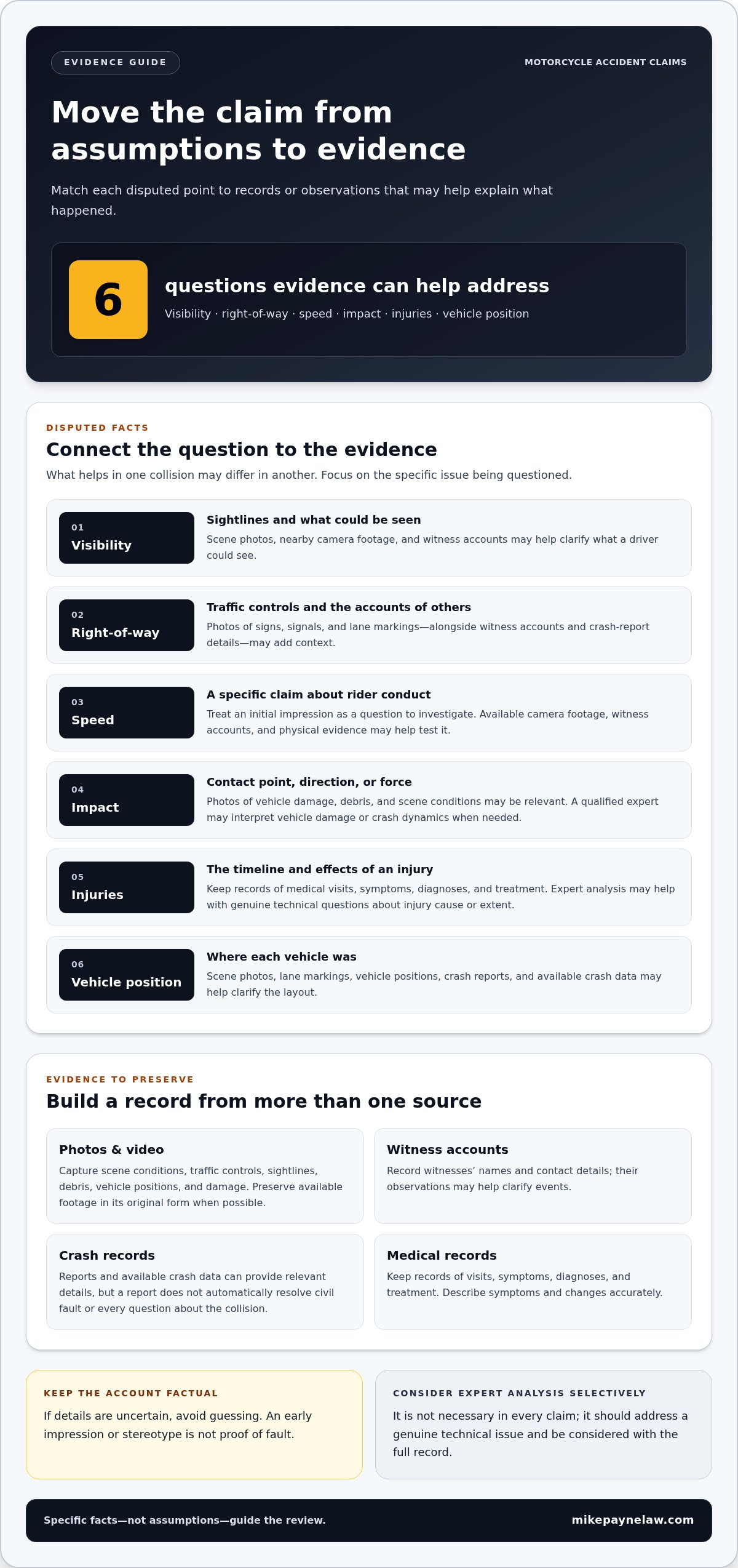
To challenge a claim about rider conduct, start with the specific question in dispute. Evidence is most useful when it helps explain visibility, right-of-way, speed, impact, injuries, or where each vehicle was positioned. Instead of relying only on a general concern that the process feels unfair, identify records and observations that support a clear account of the collision.
Corroborating evidence can test a claim about rider conduct by showing whether the physical facts match the assumption. For general context, the NHTSA motorcycle crash statistics provide information about motorcycle safety. Broader statistics, however, can’t determine what happened in one specific crash.
Which evidence can clarify how the crash happened?
Photographs of the scene may show lane markings, traffic controls, road conditions, sightlines, debris, and vehicle positions. Images of damage can document where contact occurred and may be relevant to questions about the direction or force of impact. If available, nearby camera footage may capture events that no single witness saw.
Record witnesses’ names and contact details, and preserve photos or video in their original form when possible. Crash reports and other available crash data may also provide useful details. The value of each item depends on the collision: a blocked sightline may matter in one case, while vehicle damage or road layout may be more informative in another. Organize evidence by the question it may answer, such as where each vehicle was, what the driver could see, or how the impact occurred.
How medical and expert evidence can address disputed injuries
Seek appropriate medical care and keep records of visits, symptoms, diagnoses, and treatment. Medical documentation can help connect reported injuries to the timeline after the crash and show how those injuries were evaluated and treated. Be accurate about symptoms and changes in your condition. Consistency between your account and the medical record can help clarify the effects of the collision.
Some cases raise technical questions that require specialized analysis. A qualified expert may help interpret matters such as vehicle damage, crash dynamics, or the cause and extent of an injury. Expert analysis isn’t necessary in every claim; it should address a genuine issue and be considered alongside the full record.
In motorcycle bias in accident claims, evidence that lines up across independent sources can help move the discussion from assumptions to verifiable facts. For broader information about evaluating a motor vehicle injury claim, review motor vehicle accident legal representation. An individualized review can help identify which evidence bears most directly on the disputed issues.
Motorcycle Bias, Shared Fault, and California Claim Decisions
In California, being partly responsible for a crash doesn’t automatically prevent an injured person from seeking compensation. The state follows a comparative-fault rule: a person’s recovery may be reduced according to their share of responsibility. The California Supreme Court adopted this approach in Li v. Yellow Cab Co. (1975) 13 Cal.3d 804. How fault is allocated depends on the facts and evidence in the particular case.
Shared fault may affect potential recovery, but no individual outcome can be predicted from a rider’s motorcycle use alone. A fair analysis examines the conduct that contributed to the collision, not a general belief that motorcyclists are reckless. The Comprehensive motorcycle safety program offers a rider-focused perspective on safety, including the importance of broader awareness. In a claim, the key question remains what the evidence shows about this crash.
Can a rider recover compensation if blamed partly for a crash?
Potentially. Under California’s comparative-fault framework, a rider who is found partly responsible may still recover, with any recovery reduced in proportion to the fault assigned. That doesn’t mean every rider qualifies for compensation or that an insurer’s fault assessment is the final word. The result depends on the evidence, the applicable law, and how responsibility is determined.
Examine a disputed fault share against details such as traffic controls, sightlines, vehicle movements, and witness accounts. The aim is to assess what each person did and how it relates to the collision, not to assign blame based on a stereotype.
Assumptions versus evidence: how to read a fault dispute
Use the distinctions below to identify what a claim’s conclusions should be tested against:
| Unsupported assumption | Evidence to examine |
|---|---|
| “Motorcyclists are reckless.” | Specific observations, video, or witness accounts of the rider’s actions before impact. |
| “The rider must have been speeding.” | Available crash data, physical evidence, and reliable accounts that bear on speed. |
| “The motorcycle appeared suddenly, so the rider caused the crash.” | Road layout, sightlines, traffic controls, and the other vehicle’s movements. |
| “The rider’s helmet or experience explains the collision.” | Evidence connecting the disputed factor to the cause of the crash, rather than relying on the factor alone. |
Helmet use, riding experience, or motorcycle ownership by themselves don’t establish who caused a collision. In motorcycle bias in accident claims, the useful question is whether a proposed fault conclusion matches the specific facts, including evidence that may support or challenge it.
What to Do if Blamed After a Motorcycle Crash
Being blamed can feel overwhelming, but a calm, organized response helps protect the facts. Take these steps:
- Prioritize medical care. Get evaluated for injuries and follow medical advice. Keep records of visits, symptoms, diagnoses, and treatment.
- Preserve available evidence. Save scene photos, video, vehicle-damage images, and relevant messages or letters. If nearby cameras may have recorded the crash, promptly note their locations. Footage may be overwritten or unavailable.
- Record contacts and details. Keep the names and contact information of witnesses, insurers, and other people involved, along with the dates and substance of conversations.
- Track expenses. Organize bills, repair documents, receipts, and other records related to the collision.
How to respond to blame without weakening your account
Keep statements accurate, measured, and limited to what you know. If you can’t recall your speed, the exact timing, or another detail, say so rather than guessing. Don’t adopt someone else’s account just to end a difficult conversation. At the same time, don’t conceal facts, alter evidence, or ignore reasonable insurer communications. Save letters and messages, and make a note of calls while details are fresh.
In motorcycle bias in accident claims, speculation can blur the line between what happened and what someone assumes happened. A clear record helps keep your account consistent and grounded in what you remember.
Which records should a Southern California rider preserve?
Keep a simple file with the crash date, time, location, road and weather observations, vehicle positions, and any details you remember about the events before impact. Add witness information, the incident or police report if available, repair estimates and records, medical documents, photographs, and any scene video. Riders in West Covina, Pomona, Ontario, Covina, Chino, Fontana, San Bernardino, Baldwin Park, and Azusa can use the same careful recordkeeping approach.
Act promptly to identify potentially short-lived footage, such as recordings from nearby businesses or traffic cameras. Its availability isn’t guaranteed, so record where it may exist and when you noticed it. California deadlines may apply: a personal injury lawsuit generally must be filed within two years, while claims involving a government entity can have a much shorter administrative claim deadline. The rules and exceptions depend on the circumstances, so verify the deadline that applies to your case.
If blame is disputed, the Law Offices of Michael D. Payne can review the available evidence and explain how it may affect a motorcycle injury claim. Discuss your motorcycle accident claim.
When a Motorcycle Accident Lawyer Can Help Challenge Claim Bias
Legal review can be useful when fault is disputed, injuries are serious, more than one person or vehicle may share responsibility, or important evidence is contested. These cases can involve competing accounts and unanswered questions. Just as property owners facing complex damage claims often consult public adjusting firms like apexadjustinggroup.com to represent their interests against insurer evaluations, injured riders benefit from dedicated claim support. A lawyer can assess the available record and explain how the facts and applicable law may affect your claim, without promising a particular result.
What a lawyer may do to address disputed motorcycle-claim evidence
A careful review can identify what the evidence supports and where information is missing. That may include examining crash reports, photographs, medical records, witness accounts, and insurer communications, then organizing a documented account of the collision and injuries. The appropriate strategy depends on the specific crash, the evidence available, and the law that applies.
When considering legal help, look for a clear explanation of how the attorney would evaluate disputed facts, how you’ll receive updates, and what relevant experience they bring. Michael D. Payne has more than 25 years of experience and previously worked in insurance defense. That background can inform how he approaches claim evaluation, but it doesn’t guarantee an outcome.
How to understand fees and take a next step
The firm handles cases on a contingency-fee basis and advances litigation costs, subject to the client’s agreement. Ask for a clear explanation of the fee and cost terms, and review the written agreement so you understand how they apply to your case. Transparent answers are part of making an informed decision.
If disputed fault or serious injuries have left you uncertain about what comes next, a case-specific conversation can help you understand the issues to consider. The Law Offices of Michael D. Payne represents injured motorcycle riders across Southern California. Contact the Law Offices of Michael D. Payne to discuss your circumstances and the evidence available. No review can promise a particular result, but a focused assessment can clarify the questions your claim raises.
Build Your Claim Around the Facts
Motorcycle bias in accident claims can create doubt, but assumptions don’t establish fault. A clear account supported by relevant records, witness information, and other available evidence helps keep attention on what happened. In California, shared fault may affect potential recovery, so disputed responsibility deserves a careful, fact-specific review.
If blame is being assigned or important evidence is contested, Michael D. Payne can help assess the claim. He brings more than 25 years of experience, including a former insurance-defense background that informs his perspective on claim evaluation. The firm handles cases on a contingency-fee basis and advances litigation costs, subject to the agreement.
Talk with the Law Offices of Michael D. Payne about your motorcycle accident claim. Get a clearer view of the evidence and the questions your case raises. You deserve to have your account considered on its facts.
Frequently Asked Questions
Can motorcycle bias affect an accident claim?
Yes, assumptions about riders may influence how someone initially interprets a crash or injury claim, but they don’t prove fault or determine the outcome. An adjuster may ask about speed, lane position, or protective gear; the key is whether the evidence supports a conclusion about the collision. Photos, witness accounts, vehicle damage, and medical records can help distinguish a stereotype from facts specific to your case.
Are motorcycle riders automatically considered at fault after a crash?
No. Riding a motorcycle doesn’t automatically make someone responsible for a collision. Fault depends on the specific circumstances, including each person’s actions and the available evidence. A police report or an insurer’s early assessment may be relevant, but neither necessarily resolves civil responsibility. If you’re blamed, focus on preserving records and giving accurate information rather than accepting a conclusion based on assumptions about riders.
Can I still recover compensation if I was partly at fault in California?
Possibly. California follows comparative fault, which means an injured person’s compensation may be reduced according to their share of responsibility. Being partly at fault doesn’t automatically bar recovery, but eligibility and the amount depend on the facts, applicable law, and how fault is determined. A case-specific legal review can help assess the evidence. No general rule can predict the result of an individual claim.
What evidence can challenge an insurer’s claim that I caused a motorcycle crash?
Evidence that addresses the disputed issue can help test an insurer’s account. Depending on the crash, that may include scene photographs, nearby video, witness contact details, vehicle damage, medical records, repair documents, and available crash data. For example, road layout and sightlines may clarify visibility, while physical evidence may help assess impact or vehicle position. Preserve original records when possible, and don’t alter or discard relevant materials.
Should I give a recorded statement to an insurance adjuster after a motorcycle accident?
Before giving a recorded statement, understand who is requesting it and why. You may want legal advice, particularly if fault is disputed or you’re unsure how to answer. If you do provide information, be truthful and measured. Don’t guess about speed, timing, or other details you can’t recall, and don’t speculate about fault. Keep copies of communications and respond appropriately to reasonable claim-related requests.
When should I contact a motorcycle accident lawyer about claim bias?
Consider legal review if fault is disputed, injuries are serious, several parties may be involved, or important evidence is being challenged. An attorney can assess available records, identify gaps, and explain how the facts may affect your claim. The Law Offices of Michael D. Payne represents injured riders in West Covina, Pomona, Ontario, Covina, Chino, Fontana, San Bernardino, Baldwin Park, and Azusa. Michael D. Payne has more than 25 years of experience, including a former insurance-defense background.