

The industrial medical clinic your employer sent you to wasn’t chosen to protect your recovery; it was hired to protect an insurance carrier’s bottom line. If you are asking yourself, can I see my own doctor after a work injury in california, you are far from alone in demanding better care. You shouldn’t have to endure rushed five-minute evaluations, dismissed symptoms, or premature return-to-work orders when your body is still in serious pain.
It’s completely natural to distrust a corporate-aligned physician who minimizes your injuries to reduce claim liability. Fortunately, you don’t have to remain trapped in a system that ignores your physical well-being. California law provides lawful methods to regain control over your care and transfer your treatment to a trusted physician who puts your health first. This guide breaks down exactly how predesignation rules function, how to switch treating physicians within Medical Provider Networks (MPNs), and how third-party claims can expand your legal options for justice.
Key Takeaways
- When asking can I see my own doctor after a work injury in california, the baseline answer under state law is generally no, unless you meet specific statutory exceptions.
- Submitting a valid DWC Form 9783 before an accident occurs is the primary legal tool to bypass employer clinics and secure immediate care with your personal physician.
- Workers assigned to a Medical Provider Network (MPN) retain the legal right to switch treating physicians within that approved network if care is inadequate.
- Worksite accidents caused by negligent third parties allow you to file separate civil claims to recover damages like pain and suffering beyond standard workers’ compensation caps.
- Securing seasoned legal counsel with inside knowledge of insurance defense strategies stops adjusters from manipulating your medical care or rushing your recovery.
California Workers’ Comp Doctor Rules: Can You See Your Personal Physician?
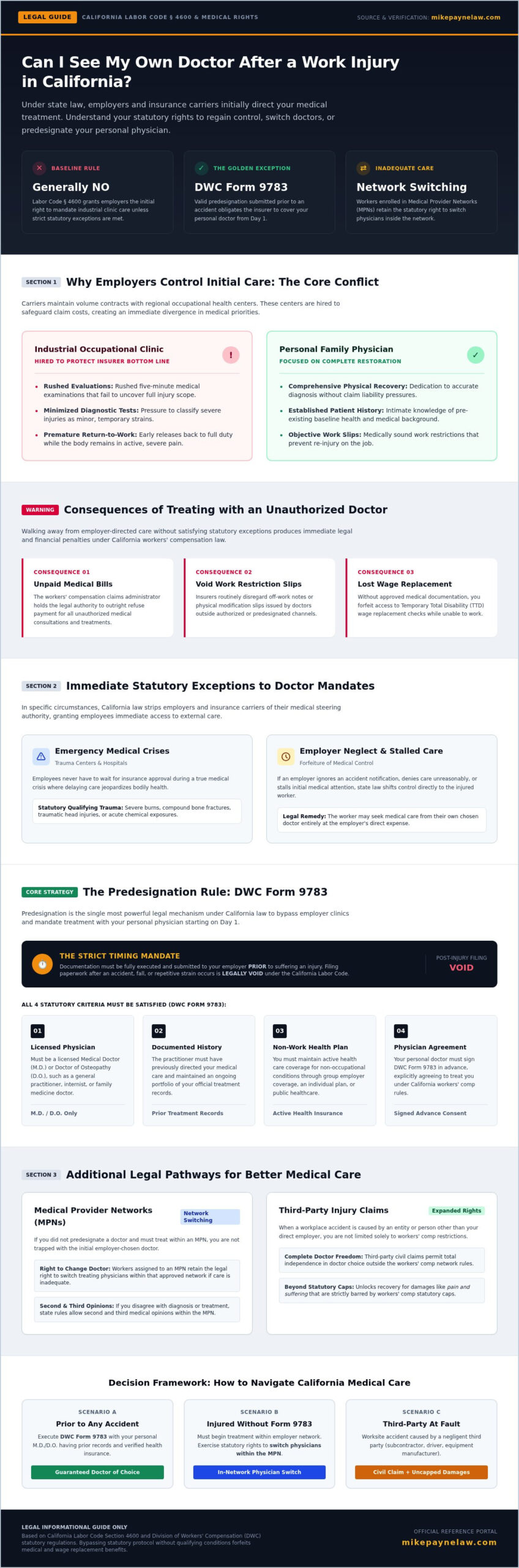
The short answer under California law is generally no. Under California Labor Code Section 4600, employers and their insurance carriers hold the initial legal right to direct medical treatment following a workplace accident. If you are asking, can I see my own doctor after a work injury in california right after getting hurt, the baseline statutory answer restricts you to the medical provider selected by your employer.
Bypassing this protocol without meeting strict statutory exceptions carries severe financial and legal consequences. If you treat with an unauthorized physician, the workers’ compensation claims administrator will refuse to pay those medical bills. Even worse, the insurer will disregard work restriction notes or off-work disability slips from unapproved doctors. That leaves you without temporary total disability wage replacement checks while you recover. Challenging these provider assignments requires decisive legal strategy to stop insurance adjusters from controlling your physical recovery.
Why Employers Direct Initial Workplace Injury Care
In California’s workers’ compensation system, carriers direct treatment to manage operational expenses and claim costs. Insurers maintain volume contracts with regional occupational health clinics. These industrial medical centers understand who pays the bills, creating an inherent conflict of interest. While your personal family physician focuses entirely on complete physical restoration, occupational clinic doctors are pressured to minimize diagnostic tests, classify injuries as minor strains, and rapidly return workers to regular duty.
Immediate Exceptions: Emergency Care and Unreasonable Delays
You never have to wait for insurance approval during a true medical crisis. California law exempts emergency treatment from standard doctor choice restrictions, allowing you to seek emergency care at any hospital or trauma center. Severe trauma qualifies as an emergency if delaying care jeopardizes your health, including severe burns, compound fractures, head injuries, or acute chemical exposures.
Employer neglect also alters the rules. If an employer ignores your accident report, denies care unreasonably, or stalls initial medical treatment, California Labor Code provisions allow the employee to seek medical attention from their own doctor at the employer’s expense. When an insurer fails in its statutory duty to provide prompt treatment, it forfeits immediate medical control.
The Predesignation Rule: How to Qualify Under DWC Form 9783
The single most powerful legal mechanism to bypass industrial clinics is physician predesignation. For workers asking can I see my own doctor after a work injury in california without interference, this process provides the definitive solution. Predesignation legally obligates your employer and their workers’ comp insurance carrier to fund treatment directly with your chosen physician starting on day one.
Timing is everything. California law enforces an unyielding deadline: your predesignation documentation must be executed and submitted to your employer prior to suffering a workplace accident. Filing paperwork after a fall, vehicle collision, or repetitive strain occurs is legally void under the California Labor Code. Your employer must provide information regarding these rights upon hire, but the burden rests entirely on you to complete the statutory requirements.
Mandatory Conditions for Valid Personal Doctor Predesignation
Simply writing down your doctor’s name on a piece of paper won’t protect you. To meet the state’s legal threshold under DWC Form 9783, all four of these statutory criteria must be satisfied:
- Licensed Physician: The practitioner must be a licensed medical doctor (M.D.) or doctor of osteopathy (D.O.), such as a general practitioner, internist, or family medicine specialist.
- Documented Medical History: The doctor must have previously directed your medical care and maintained your ongoing treatment records.
- Non-Occupational Health Insurance: You must maintain health care coverage for non-work-related conditions through an employer group policy, individual plan, or public healthcare program.
- Signed Physician Agreement: Your personal physician must sign the form agreeing in advance to treat you for work-related conditions under workers’ comp fee schedules.
Executing and Filing California DWC Form 9783
Complete Form 9783 carefully, have your physician sign the document, and deliver it directly to your company’s human resources or personnel department. Keep a signed copy stamped with the date received by HR. If you send it digitally, save the email thread and delivery receipts.
Insurance adjusters regularly contest predesignations. They often claim the document was never submitted, lost during internal restructuring, or signed by an unqualified clinic. Establishing an undeniable paper trail prevents insurance carriers from stripping away your chosen doctor. If an insurer ignores your documentation or tries to bully you into their preferred clinic, you can reach out to an advocate to safeguard your medical rights immediately.
Navigating Medical Provider Networks (MPN) and the 30-Day Transfer Rule
Most California employers maintain a Medical Provider Network (MPN), which is an approved group of doctors selected by the insurance company to treat industrial injuries. If you did not execute Form 9783 prior to getting hurt, this network governs your treatment. Workers wondering can I see my own doctor after a work injury in california without predesignation find that their medical care is initially restricted to this roster. However, being inside an MPN does not force you to stay with a company doctor who ignores your complaints.
You have statutory rights to replace your treating doctor. Understanding the rules governing network switches and situations where an employer fails to establish an MPN gives you direct leverage against recalcitrant insurance adjusters.
Changing Doctors Within Your Employer’s MPN
California law permits you to switch to a different physician within the network after your initial evaluation. Demand a complete, current MPN list directly from the claims adjuster or the insurer’s Medical Access Assistant (MAA). Insurers often provide outdated directories filled with retired providers to delay care. You hold the legal right to choose any primary treating physician (PTP) in that network who practices within regional access standards: 15 miles or 30 minutes travel time for primary care, and 30 miles or 60 minutes for specialists.
The 30-Day Rule When No Valid MPN Exists
Not every employer maintains a certified MPN. If your employer lacks an approved network, the California Labor Code 30-day transfer rule applies. Under this regulation, the employer or their insurer holds medical control only for the first 30 days after you report the injury. Once that 30-day window expires:
- You can select your own personal physician or any medical specialist you trust.
- You must provide written notice to your claims adjuster naming your new treating doctor.
- The doctor must agree to practice under California workers’ compensation medical treatment guidelines and billing fee schedules.
Disputing Treatment Decisions: Second Opinions and QME Evaluations
When an MPN physician denies essential MRIs, physical therapy, or surgery, you are entitled to seek a second and third opinion from other network doctors. If disagreements persist after a third opinion, an Independent Medical Review (IMR) can be requested. When the insurer denies liability for specific body parts, disputes are resolved through a state-issued Qualified Medical Evaluator (QME) panel. Insurers manipulate these panels using biased utilization review vendors to cut off benefits. Overcoming these administrative tactics requires rigorous legal action to force the insurer to authorize appropriate specialty care.
Workplace Injuries Involving Third Parties: Total Freedom in Doctor Choice
Workers’ compensation exclusivity stops you from suing your direct employer for negligence. It does not protect reckless third parties who harm you on the job. If an external entity caused your harm, you can pursue a personal injury lawsuit alongside your workers’ compensation claim. For injured workers asking can I see my own doctor after a work injury in california, this dual approach unlocks an entirely different medical path. In a civil injury lawsuit, you are not bound by workers’ comp MPN directories or employer referrals.
Civil claims allow you to treat with independent orthopedic surgeons, neurologists, and physical therapists outside the workers’ comp network. Doctors provide care on a medical lien basis, often accessible through referral platforms like The Injury Specialists. They treat you immediately, agreeing to wait for payment until your civil case resolves from the settlement proceeds. No insurance claims adjuster can deny your MRI through arbitrary utilization reviews.
Identifying Third-Party Workplace Accidents
Third-party liability arises whenever someone outside your immediate employer’s payroll contributes to your injuries. Typical examples across Southern California include:
- Vehicle Collisions on the Job: A delivery driver or sales representative rear-ended by a distracted motorist while driving company vehicles.
- Multi-Employer Job Sites: General contractor negligence, unsafe scaffolding erected by independent subcontractors, or defective heavy machinery at industrial facilities. For these hazards, review our dedicated construction and worksite accident representation.
- Defective Tools and Equipment: Failures involving manufacturing defects on power equipment, forklifts, or safety harnesses.
- Dangerous Commercial Property: Slip and falls occurring while delivering goods or performing off-site vendor services on poorly maintained premises.
Workers’ Comp vs. Third-Party Claims: Doctor Choice and Recovery
The differences between an administrative comp claim and a civil injury lawsuit directly impact your physical recovery and financial security:
- Medical Provider Choice: Workers’ comp confines you to strict networks or predesignations. Third-party civil claims give you complete freedom to select top medical specialists on medical liens.
- Treatment Approvals: Workers’ comp subjects every procedure to aggressive utilization review denials. Civil lien care rests solely on medical necessity determined by you and your doctor.
- Financial Recovery: Comp limits wage benefits to statutory caps (maximum $1,764.11 weekly for 2026 temporary disability) and completely bars compensation for physical pain. Civil lawsuits allow 100% actual lost earnings, lost future earning capacity, and complete compensation for pain, suffering, and emotional distress.
Don’t let an insurer trap you in substandard care when a negligent party caused your injuries. Take control of your recovery today by choosing trusted legal representation for your worksite accident.
How the Law Offices of Michael D. Payne Protects Injured Workers
Dealing with severe physical pain while battling insurance bureaucrats is exhausting. When you ask, can I see my own doctor after a work injury in california, you are fighting for your physical health and your family’s future. Attorney Michael D. Payne brings over 25 years of courtroom and personal injury litigation experience to serve as your shield. Our firm steps directly between you and corporate insurance carriers, dismantling bad-faith delay tactics and demanding proper medical attention.
You don’t have to let an insurer dictate the terms of your recovery. We take immediate action to contest improper doctor assignments, uncover viable third-party liability claims, and push for maximum compensation under California law.
The Advantage of Former Insurance Defense Insight
Insurance companies train their claims adjusters to protect profits above all else. They intentionally steer injured employees toward regional industrial clinics known for minimizing disability ratings and rubber-stamping premature return-to-work orders. Having spent early career years as an insurance defense lawyer, attorney Michael D. Payne knows every strategy adjusters deploy to delay treatment approvals and deny specialist care.
We use that inside knowledge to your advantage. Our office anticipates insurer maneuvers before they unfold, dismantling biased medical reports and holding adjusters accountable to state regulations. We prepare every claim with aggressive courtroom readiness, showing insurers that we won’t settle for substandard outcomes.
Protecting Workers in West Covina, Pomona, and the Inland Empire
Our firm provides fierce, localized representation across Southern California, including West Covina, Pomona, Ontario, San Bernardino, and Riverside. You don’t need to manage unreturned phone calls, confusing network provider lists, or combative adjusters on your own. We handle all insurer communications, medical record acquisitions, and aggressive legal filings so you can concentrate entirely on physical healing.
Financial worries should never stand in the way of justice. The Law Offices of Michael D. Payne handles workplace injury and third-party claims on a contingency fee basis, meaning you pay nothing unless a recovery is achieved. If an insurance carrier is limiting your treatment or pushing you back to work before you heal, contact the firm to discuss your situation and assert your rights.
Take Control of Your Medical Care and Legal Rights Today
Getting hurt on the job is overwhelming, but you don’t have to surrender your health to corporate insurance adjusters. While asking can I see my own doctor after a work injury in california usually begins with rigid employer networks, state law gives you enforceable avenues to challenge subpar care. Whether you executed a valid predesignation, need to switch treating physicians within an MPN, or qualify for full medical autonomy through a third-party claim, your recovery must always come first.
Attorney Michael D. Payne brings over 25 years of fierce courtroom litigation experience to protect injured workers across Southern California. As a former insurance defense attorney, he knows the exact playbook adjusters use to limit medical authorizations and downplay injuries. Under our contingency fee representation, you face zero out-of-pocket costs; you pay nothing unless a recovery is achieved. You don’t have to face powerful insurers alone. Demand a free case evaluation with Attorney Michael D. Payne and take decisive action to protect your health, your livelihood, and your family’s future.
Frequently Asked Questions
Can I see my own doctor immediately after getting hurt on the job in California?
In most cases, no. Under California Labor Code Section 4600, your employer or their insurance carrier holds the legal right to direct your medical care immediately after an accident. If you wonder, can I see my own doctor after a work injury in california, you can only do so from day one if you predesignated that physician in writing before the incident or if you require immediate emergency treatment.
What happens if I go to my personal doctor without employer predesignation?
The workers’ compensation insurance carrier will refuse to pay those medical bills. Additionally, the insurer can reject any work status reports or disability slips issued by an unauthorized doctor. This means your temporary disability wage replacement checks could be delayed or denied entirely. You may also end up personally responsible for unauthorized medical charges unless an attorney successfully challenges the insurer’s network validity or procedural delays.
Can my employer force me to use their clinic if I require emergency medical care?
Absolutely not. California law guarantees your right to seek emergency stabilization at any nearby hospital, trauma center, or emergency room. Your employer cannot mandate that you wait for an occupational clinic appointment if delaying care threatens your life or physical stability. Once your emergency condition stabilizes, however, ongoing post-emergency care and physical rehabilitation typically transition back under the control of the employer’s designated medical network.
How do I change doctors if I am unhappy with the physician assigned by workers’ comp?
You can legally request a switch within your employer’s Medical Provider Network (MPN). First, notify the insurance adjuster or Medical Access Assistant in writing that you want a new primary treating physician. Then, choose a different practitioner from their current MPN directory within your regional geographic area. If your employer lacks an approved MPN, you can transfer care to any doctor accepting workers’ compensation after 30 days.
What is California DWC Form 9783 and when must it be submitted?
DWC Form 9783 is the official California Division of Workers’ Compensation form used to predesignate a personal physician. You must submit this document in writing to your employer’s human resources department before any workplace injury takes place. To qualify, your doctor must have treated you previously, keep ongoing records, agree in advance to workers’ comp rules, and you must hold existing non-occupational health insurance.
Can I choose my own doctor if my injury was caused by someone other than my employer?
Yes, when pursuing a separate third-party personal injury lawsuit against an external negligent party. If you are injured in West Covina, Pomona, or Ontario by an outside contractor or careless motorist, you aren’t restricted by workers’ comp provider directories for your civil claim. You can treat with top independent specialists on a medical lien basis, ensuring quality care without waiting on insurance adjuster approvals.
What should I do if the workers’ comp insurance company denies my doctor’s treatment requests?
When an insurer denies necessary treatment via utilization review, you must act fast. You can appeal through the Independent Medical Review (IMR) process or seek a Qualified Medical Evaluator (QME) panel. Navigating these insurer barriers alone often leads to continued denials. Having an advocate like attorney Michael D. Payne steps into the fight, challenging bad-faith delays and protecting workers across San Bernardino, Riverside, and the San Gabriel Valley.