

Admitting a split-second mistake on a California roadway doesn’t strip away your legal right to justice. If you’re lying awake wondering, can I sue for a car accident if I was partially at fault, the clear answer under state law is yes. Insurance adjusters want you to believe that sharing even a fraction of the blame completely wipes out your claim. That intimidation is calculated to protect their bottom line while your medical expenses mount and lost wages drain your savings.
California law doesn’t leave you defenseless. Under the state’s pure comparative negligence system, you can still recover financial damages even if you bear a significant share of responsibility. Insurance carriers fight relentlessly to inflate your fault because every percentage point they pin on you cuts directly into your financial recovery. Discover how California legally apportions accident liability, how to shut down aggressive adjuster blame-shifting, and what critical steps protect your right to compensation.
Key Takeaways
- If you are wondering, can I sue for a car accident if I was partially at fault, California’s pure comparative negligence standard protects your legal right to pursue compensation even if you bear significant responsibility.
- Your final payout is calculated through a proportional reduction formula, meaning your financial recovery is lowered only by your exact percentage of assigned fault.
- Insurance adjusters aggressively exploit early recorded statements and casual apologies to inflate your share of liability and minimize their financial payout.
- Preserving critical crash evidence early, such as vehicle black box data, surveillance footage, and witness testimony, is vital to refuting false allegations of fault.
- Securing aggressive legal representation with insider knowledge of insurance defense playbooks stops carriers from unfairly shifting blame onto you.
Understanding California Pure Comparative Fault Law After a Crash
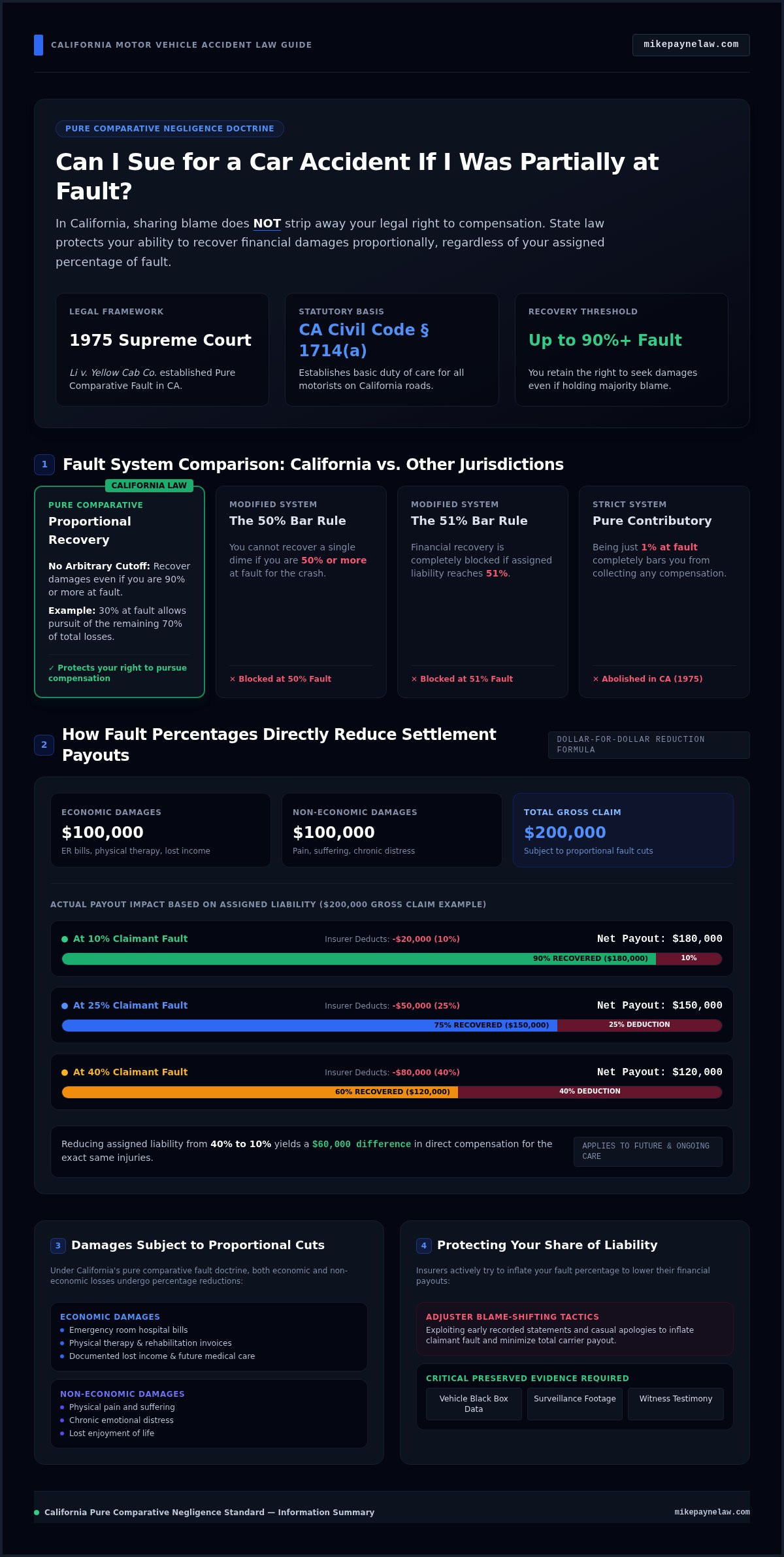
Many injured motorists wonder, can I sue for a car accident if I was partially at fault? The straightforward answer under state law is an emphatic yes. In 1975, the landmark California Supreme Court decision in Li v. Yellow Cab Co. abolished the harsh, all-or-nothing contributory negligence rule. Instead, the court adopted a pure comparative fault system. Under this framework, you retain the legal right to seek damages even if you bear 90% or more of the legal responsibility for a collision. Your recovery is simply reduced by your percentage of fault.
Every motorist on California roads owes others a basic duty of care under California Civil Code § 1714(a). This statute establishes that individuals are responsible for injuries caused by their want of ordinary care or skill. When an accident occurs, insurance adjusters frequently misrepresent these legal principles to unrepresented claimants. They attempt to intimidate victims into abandoning legitimate claims. Knowing your statutory rights under motor vehicle accident representation stops carriers from weaponizing self-doubt against you.
What Is California Pure Comparative Negligence?
Pure comparative fault apportions liability proportionally between all involved parties based strictly on the factual evidence. Unlike jurisdictions where sharing blame destroys your lawsuit, California ensures that fault does not automatically terminate your financial recovery. As established under California’s comparative negligence doctrine, an injured party assigned 30% of the blame can still pursue the remaining 70% of their total losses from the other negligent driver.
Pure Comparative Fault vs. Modified Comparative Fault Systems
Generic legal advice online often confuses Southern California drivers because most states follow modified comparative fault systems. In those states, strict legal bars cut off your recovery entirely:
- The 50% Bar Rule: You cannot recover a single dime if you are 50% or more at fault for the crash.
- The 51% Bar Rule: Financial recovery is completely blocked if your assigned liability reaches 51%.
- Pure Contributory Negligence: In a handful of jurisdictions, being just 1% at fault bars you from collecting any compensation.
California rejects these arbitrary thresholds. Because our courts follow pure comparative fault, out-of-state rules do not apply to your West Covina collision. Even if an insurance adjuster argues that your actions contributed significantly to the impact, asking can I sue for a car accident if I was partially at fault still yields a clear path forward under California law.
How Shared Fault Directly Reduces Your Settlement Payout
When clients ask, can I sue for a car accident if I was partially at fault, their second question is almost always about the payout. California courts apply a direct mathematical deduction to determine your recovery. If your damages total $200,000 and you bear 20% of the responsibility, you collect $160,000. Every single percentage point shifted onto you reduces your check dollar-for-dollar.
Under California’s pure comparative fault system, both economic and non-economic damages undergo this proportional formula. Economic damages include emergency room bills, physical therapy invoices, and documented lost income. Non-economic damages cover physical pain, chronic distress, and lost enjoyment of life. Because both categories face proportional cuts, shaving just 15% off your assigned fault on a serious injury case puts tens of thousands of dollars back in your pocket.
Calculating the Real Value of a Shared-Fault Claim
Look at how the numbers work in practice. Suppose an intersection crash creates $100,000 in medical expenses and lost wages, alongside $100,000 in general damages for pain and suffering, creating a $200,000 gross claim.
- At 40% claimant fault: The insurer deducts $80,000, leaving you with a net payout of $120,000.
- At 25% claimant fault: The deduction falls to $50,000, securing $150,000 for your recovery.
- At 10% claimant fault: You recover $180,000. That is a $60,000 difference for the exact same injuries.
Future medical procedures and ongoing physical therapy follow this identical calculation. Keeping your assigned liability as low as possible preserves the financial resources you need to heal.
Multiple-Vehicle Collisions and Apportioning Third-Party Blame
Chain-reaction pileups on congested corridors like Interstate 10 or Highway 60 often involve three or four motorists. Under California Civil Code § 1431.2, also known as Proposition 51, fault divides among multiple defendants through a hybrid rule. Economic losses remain subject to joint and several liability. This means you can recover your full economic damages, minus your comparative fault percentage, from any solvent at-fault defendant.
Non-economic damages, however, are strictly several. Each defendant pays only their exact assigned percentage of pain and suffering. When adjusters start pointing fingers across multiple insurance policies, getting experienced motor vehicle accident representation ensures every liable carrier pays its fair share.
Deceptive Insurance Adjuster Tactics in Partial Fault Auto Claims
Carriers train adjusters to shift blame immediately. When an injured driver asks, can I sue for a car accident if I was partially at fault, the other driver’s insurer often responds with intimidation. They try to convince you that your own actions eliminate their financial responsibility. In reality, claims representatives use specialized claims assessment software programmed to depress settlement reserves by inflating victim fault percentages.
Quick settlement checks are another common weapon. Adjusters rush to offer unrepresented victims a few thousand dollars within days of a wreck. Accepting that money requires signing a broad liability release before doctors uncover the full extent of spinal disc tears or joint trauma. As noted in the California Department of Insurance accident guide, insurers must adhere to fair settlement standards, yet unrepresented motorists routinely face calculated resistance designed to suppress legitimate payouts.
The Danger of Giving Recorded Statements Without Legal Representation
Adjusters frequently call within forty-eight hours asking for a friendly recorded statement. They ask leading questions designed to make everyday courtesy sound like legal culpability. Saying “I’m sorry” or “I didn’t see the other car until the last second” gets entered into their claim file as an admission of inattention. You are under no legal obligation to provide a recorded statement to the other motorist’s insurance carrier. Always decline these interviews until you have spoken with an attorney.
How Insurance Defense Panels Artificially Inflate Your Fault
Insurance defense panels know that answering can I sue for a car accident if I was partially at fault depends on proving precise crash dynamics. They hire defense-friendly reconstructionists to argue you were driving slightly over the speed limit or reacted too slowly. These claims are manufactured to inflate your fault from zero to 30% or 40%. Decades of former insurance defense experience give our firm an inside look at these carrier playbooks, allowing us to expose biased methodologies and protect your financial recovery.
Critical Evidence Required to Minimize Your Assigned Liability
Concrete proof dismantles an insurer’s attempt to pin disproportionate fault on you. When asking can I sue for a car accident if I was partially at fault, the ultimate value of your recovery hinges entirely on physical and digital documentation. Defense adjusters search for ambiguities they can twist into claimant negligence. Decisive evidence shuts down their arguments before they gain traction.
Physical and Digital Evidence from the Collision Scene
Objective scene documentation establishes the baseline facts of your collision. Skid mark measurements, debris scatter fields, vehicle crush patterns, and sightline obstructions show actual vehicle positions and impact forces. Commercial surveillance cameras from nearby retail storefronts often capture the collision before memories fade. Timely subpoena requests for traffic camera footage often determine liability outcomes. Modern passenger vehicles also store vital telemetry in their Event Data Recorders (EDRs). This black box data records exact vehicle speed, throttle position, steering angles, and brake application milliseconds before the crash, refuting claims that you failed to slow down.
Challenging Inaccurate Police Reports and Witness Statements
Responding officers rarely witness traffic accidents firsthand. In California civil litigation, an officer’s opinion in a collision report is not the final word on liability. When an officer relies heavily on an aggressive driver’s narrative or misinterprets roadway evidence, that conclusion can be contested. We regularly interview neutral witnesses, review private dashcam videos, and submit formal requests to supplement or amend erroneous police findings.
Qualified accident reconstruction engineers analyze these data points to recreate vehicle speeds and braking dynamics. If an insurer claims you caused a wreck, contact our motor vehicle accident team to protect your rights and keep the blame where it belongs.
Why Aggressive Legal Advocacy Secures Maximum Financial Recovery
Answering can I sue for a car accident if I was partially at fault requires more than knowing the statute; it demands an advocate ready to enforce it. Auto insurers count on unrepresented claimants accepting whatever percentage of blame an adjuster assigns. When carriers realize you have an experienced trial litigator in your corner, their settlement posture shifts immediately. Preparing every contested claim for a jury trial strips away the carrier’s favorite advantage: waiting you out until medical bills force an unfair settlement. Over 25 years of trial litigation experience across Southern California provides the leverage needed to defeat these stall tactics.
Levelling the Field Against Billion-Dollar Auto Insurers
Insurance adjusters expect injured drivers to buckle under pressure. Michael D. Payne spent years working as an insurance defense attorney, learning the precise internal playbooks carriers use to devalue claims and shift blame. That defense background serves as a direct shield for you. We anticipate their legal arguments, expose biased defense testimony, and coordinate with trusted medical professionals who thoroughly document collision trauma. Securing comprehensive motor vehicle accident representation ensures you aren’t left facing corporate claims teams on your own.
The Contingency Fee Protection: Zero Upfront Cost to Fight
Mounting hospital invoices and missed paychecks create immense financial strain. Pursuing justice shouldn’t add to that burden. Our firm represents clients on a strict contingency fee basis. You pay nothing out of pocket to retain our legal team. We advance all litigation costs, from filing fees and witness subpoenas to complex engineering reports. Our fee comes exclusively as a percentage of the compensation we recover for you. If we don’t win your case, you owe no legal fees.
Stop letting an insurer dictate what your recovery is worth. If you are asking can I sue for a car accident if I was partially at fault, reach out to the Law Offices of Michael D. Payne to protect your rights today.
Take Control of Your Recovery and Demand Fair Compensation
Sharing fault does not mean surrendering your right to justice. If you are asking can I sue for a car accident if I was partially at fault, California’s pure comparative negligence standard gives you the legal power to hold negligent parties accountable. Every percentage point an adjuster tries to pin on you is money stripped away from your medical care and financial recovery. You don’t have to accept unfair blame or let an insurance carrier dictate what your claim is worth.
Michael D. Payne brings over 25 years of courtroom litigation experience across Southern California to your corner. As a former insurance defense attorney, he understands the exact tactics adjusters use to depress settlement values and shift liability onto injured victims. Through our contingency fee representation, you pay no legal fees unless we successfully recover compensation for your case. Stand up against corporate settlement tactics. Schedule your consultation with the Law Offices of Michael D. Payne today, and take the first decisive step toward protecting your future.
Frequently Asked Questions
Can I sue for a car accident if I was partially at fault in California?
Yes, you can file a lawsuit and collect damages even if you share fault. Under California’s pure comparative negligence system, asking can I sue for a car accident if I was partially at fault always comes down to proportional liability. Your total payout is simply reduced by your percentage of fault. Whether your crash happened in West Covina or on an Inland Empire highway, your partial blame never strips away your right to hold other negligent drivers accountable.
What happens if I was 50 percent at fault for a car accident?
You recover exactly half of your overall damages. Unlike modified comparative fault states that bar recovery at 50% liability, California allows you to collect the remaining 50% from the other negligent motorist. If your medical bills, lost wages, and pain total $100,000, you are legally entitled to receive $50,000. Each driver’s insurer pays their respective share based on evidence collected from the scene across Southern California roadways.
Can I recover compensation if I was mostly at fault for the crash?
Yes, California permits financial recovery even if you carry 90% or more of the blame. If an insurer asks can I sue for a car accident if I was partially at fault when primarily responsible, the legal answer remains yes. In catastrophic injury cases with extensive medical bills, recovering even 10% or 15% of a multimillion-dollar claim provides crucial financial relief for Pomona or Baldwin Park families facing steep lifelong rehabilitation expenses.
How do insurance companies determine fault percentages after an accident?
Insurance carriers analyze physical crash evidence, witness testimony, traffic citations, and vehicle event data recorders to assign percentages. Adjusters also use proprietary claims software specifically designed to shift liability onto claimants and protect their reserves. Because carriers frequently manipulate these percentages to lower their financial payouts, retaining an attorney who understands defense playbooks is essential to ensure liability calculations accurately reflect the physical evidence from the collision.
Will my insurance rates increase if I share fault in a collision?
Your auto insurance premiums can increase if your insurer determines you were principally at fault, which California law defines as bearing more than 50% liability. If your attorney keeps your assigned fault below 50%, insurers generally cannot impose a fault-based surcharge under California Department of Insurance regulations. Defending your liability percentage in local courts protects not only your immediate injury settlement payout but also your long-term insurance rates across Ontario and Covina.
What should I do if the police report wrongly blames me for the crash?
Take prompt action to challenge the narrative with objective counter-evidence. Police collision reports represent an officer’s opinion, not binding courtroom evidence. You can dispute factual errors by providing dashcam footage, independent witness statements, or surveillance video from nearby San Bernardino or Azusa businesses. Your attorney can submit a formal request for a supplemental traffic collision report to correct inaccurate statements or demonstrate that the responding officer misjudged roadway physical evidence.
How long do I have to file an injury lawsuit if I share fault in California?
You have exactly two years from the collision date to file a personal injury lawsuit under California Code of Civil Procedure § 335.1. If your crash involved a government agency or city vehicle in Fontana or Chino, you face a much tighter six-month administrative deadline. Missing these statutory filing deadlines completely extinguishes your right to compensation, regardless of how minor your shared fault was in the collision.