

What if the “friendly” insurance adjuster checking in on your recovery is actually using every word you say to devalue your claim? It is a cold reality that many accident victims face. You are likely dealing with mounting medical bills and the stress of missing work, all while trying to decipher complex legal jargon. You want a fair shake, but you need to know how to ensure you don’t get taken advantage of by insurance companies during this vulnerable time.
I understand the pressure you are under. After 25 years in the legal field, including time spent as a defense attorney for the insurance industry, I have seen the playbook they use to underpay victims. This guide reveals the insider strategies you need to protect your settlement. You will learn about the latest 2026 California legislative changes, including the new 30-day health claim deadlines and increased liability limits. We will expose the digital assessment tools adjusters use to slash payouts and provide a clear roadmap to securing maximum compensation. You can focus on healing while we handle the fight on a contingency fee basis.
Key Takeaways
- Recognize the “friendly” adjuster’s traps, from recorded statement requests to invasive medical releases designed to devalue your injury claim.
- Master the “Anti-Take-Advantage” protocol to ensure you don’t get taken advantage of by insurance companies while you focus on healing.
- Navigate the unique legal landscape of Southern California’s high-traffic corridors like the I-10 and I-15 with localized expert knowledge.
- Leverage the insider perspective of a former insurance defense attorney who understands the secret software carriers use to calculate payouts.
- Protect your financial future with an aggressive legal strategy that operates on a contingency fee basis, meaning you pay nothing unless we win.
The Truth About Insurance Companies and Your Injury Claim
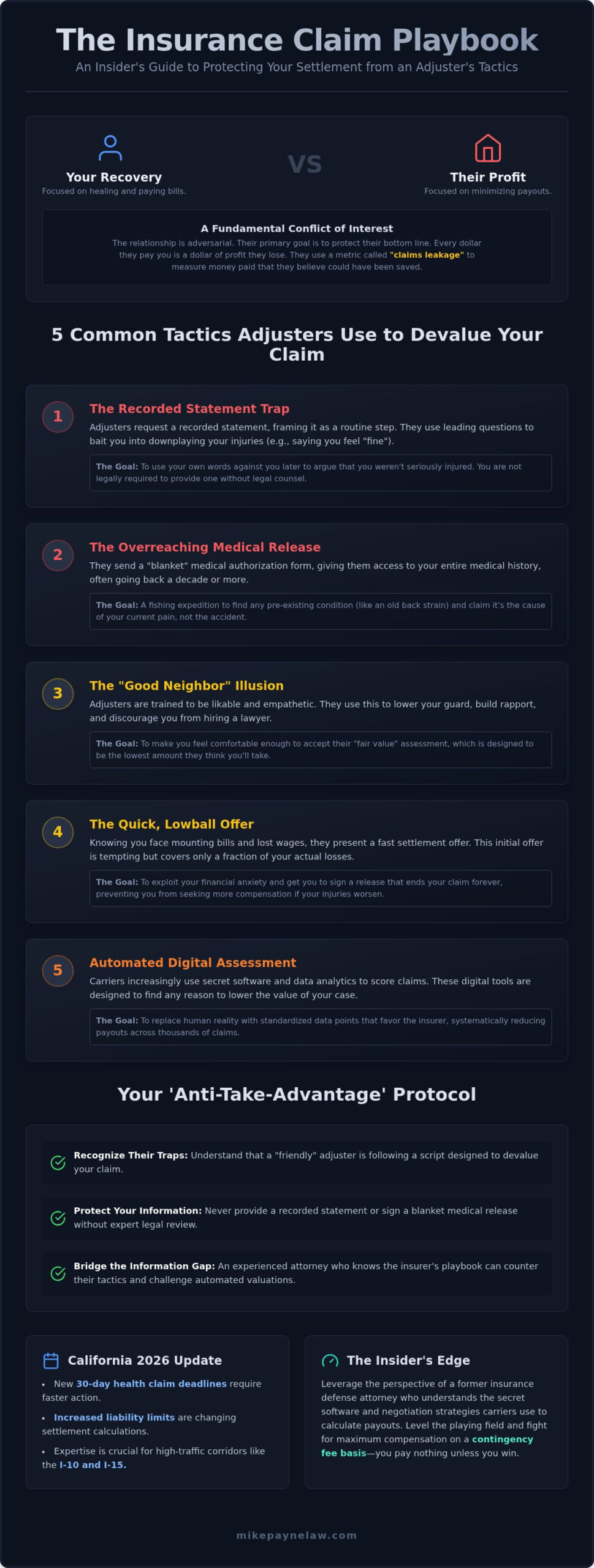
The relationship between you and an insurance carrier is inherently adversarial. When you file a claim after a car accident, you aren’t dealing with a helpful neighbor. You are entering a high-stakes negotiation with a multi-billion dollar corporation. Their primary goal is to protect their bottom line, not your physical recovery. This creates a direct conflict of interest. Every dollar they pay you is a dollar they lose in profit. To truly ensure you don’t get taken advantage of by insurance companies, you must recognize that they view your suffering as a line item to be minimized.
In the insurance industry, adjusters are evaluated on a metric called “claims leakage.” This is technical terminology for money paid out that the company believes could have been saved through more aggressive negotiation or denial. By 2026, many carriers have shifted toward automated claim scoring systems and data analytics. These digital tools are designed to find any excuse to lower the value of your case. They often ignore the human reality of your injuries in favor of standardized data points. If a company fails to meet its basic legal obligations, it may be guilty of insurance bad faith, but they will push the boundaries as far as possible to keep their money.
The ‘Good Neighbor’ Illusion
Adjusters are trained to be likable. They use empathy as a tactical weapon to lower your guard. When an adjuster calls to “check in” or tells you they are “accepting liability,” they are often trying to build rapport so you don’t hire a lawyer. Accepting liability sounds like a victory, but it’s frequently a trap. It’s a strategy used to settle your case quickly for a “fair value” that only covers a fraction of your actual losses. Never trust an adjuster’s assessment of what your claim is worth. Their “fair value” is almost always the lowest amount they think you will accept.
Why Your Lack of Legal Experience is Their Greatest Asset
There is a massive information gap between you and the insurance carrier. They have access to decades of historical data and teams of professional negotiators. You are likely dealing with the immediate pressure of mounting medical bills and lost wages. Carriers exploit this financial anxiety. They know that a “lowball” offer for a few thousand dollars looks tempting when you are out of work. However, that first check usually requires you to sign a release that ends your claim forever. Once that paper is signed, you cannot go back for more money if your injuries require future surgery. Professional personal injury representation is the only way to bridge this gap and protect your future.
5 Common Tactics Adjusters Use to Devalue Your Settlement
Insurance adjusters are professional negotiators who follow a specific playbook to protect their company’s assets. While they may sound helpful on the phone, their primary objective is to find a reason to pay you as little as possible. You need to recognize these maneuvers early so you don’t get taken advantage of by insurance companies. By understanding the mechanics of their strategy, you can avoid the common pitfalls that destroy the value of a claim before it even gets started.
The Recorded Statement: A Minefield for Victims
One of the first things an adjuster will ask for is a recorded statement. They often frame this as a routine step to “get your side of the story” and speed up the process. You are not legally required to provide a recorded statement immediately after an accident. In fact, doing so without legal counsel is dangerous. Adjusters use leading questions to bait you into saying you feel “okay” or “fine.” They then use those words to argue that you weren’t actually injured. Insurance companies use these statements as evidence to deny or diminish your claim in the future. If you are feeling pressured to provide one, it’s time to speak with a car accident attorney who can shield you from these maneuvers.
Medical Authorizations: The Privacy Invasion
Adjusters will often send you a “blanket” medical authorization form. They claim they need it to verify your injuries, but these forms are often fishing expeditions. They want access to your entire medical history, sometimes going back ten years or more. Their goal is to find a pre-existing condition, such as a back strain from five years ago, and claim that your current pain is unrelated to the accident. You should only provide records that are directly relevant to the injuries sustained in the crash. Never sign a medical release without having it reviewed by a professional who knows how to limit the scope of the search.
Beyond these traps, adjusters use artificial urgency to force a signature. They may present a “final offer” with a 24-hour deadline, hoping the pressure of medical bills will make you settle for pennies on the dollar. They also leverage California’s comparative negligence laws to shift blame onto you. Even if the other driver was clearly at fault, they might argue you were 20% responsible to slash your payout by that same percentage. Finally, be aware of your digital footprint. Carriers frequently monitor social media or even hire private investigators to watch your physical activity. A single photo of you smiling at a family dinner can be twisted into proof that you are not suffering. Staying silent and staying protected is your best defense.
Why Southern California Victims Face Unique Insurance Challenges
Southern California’s roads are legendary for their congestion and danger. If you have been injured on the I-10, I-15, or I-210, you are dealing with more than just physical pain. You are entering a legal arena where local geography dictates claim value. Adjusters in West Covina and Ontario aren’t just looking at your medical bills. They are calculating how a San Bernardino or Pomona jury might react to your story. To ensure you don’t get taken advantage of by insurance companies, you need an advocate who understands these regional nuances. Our local presence allows us to challenge adjusters who try to apply generic national standards to your unique SoCal incident.
California operates under a pure comparative fault system. This means your compensation is reduced by your percentage of fault. Insurance carriers know this. They will fight tooth and nail to assign even 10% of the blame to you. On a $100,000 claim, that is $10,000 they get to keep. In the 2026 legal landscape, with the new 30/60/15 liability minimums now fully integrated into California law, the pressure on adjusters to find “comparative negligence” has intensified. They are using more aggressive data tools to find any reason to shift the blame onto you, even when you were the victim of a clear traffic violation.
Local Court Dynamics in San Bernardino and Pomona
Insurance carriers keep detailed records on local attorneys. In San Bernardino and Pomona courts, they know which lawyers are willing to settle for less and which ones are ready for trial. The Law Offices of Michael D. Payne maintains a trial-ready reputation that forces carriers to take your claim seriously. When an adjuster knows your counsel isn’t afraid of a courtroom, their “final” offer often increases. They realize that trying to lowball a prepared local fighter will only lead to a more expensive litigation process for them.
The High Cost of Living in SoCal and Claim Value
Living in Southern California is expensive, and medical care in West Covina or the Inland Empire reflects that reality. Standardized settlement calculators used by national carriers often fail to account for the actual economic costs in our region. They might use national averages for physical therapy or diagnostic imaging that don’t cover the local rates. Our Personal Injury Attorney California guide explains how we calculate damages based on local economic data. We ensure your settlement covers the real-world costs of your recovery, not just a corporate estimate. We work on a contingency fee basis, so you can access this high-level advocacy without any upfront costs.
Protecting Your Rights: The ‘Anti-Take-Advantage’ Protocol
You are under no obligation to be the insurance company’s best witness. In the chaotic days following a crash, your priority is recovery, but the adjuster’s priority is gathering evidence to shut down your claim. To ensure you don’t get taken advantage of by insurance companies, you must implement a strict communication protocol. This starts with the “No Statement” rule. Politely but firmly decline to provide any recorded details about the incident during that first high-pressure phone call. Instead, redirect all inquiries to your legal advocate. This “Lawyer-First” strategy prevents you from making accidental admissions that could haunt your settlement negotiations later.
Documentation is your most powerful weapon in the 2026 legal landscape. You need more than just a memory of the event. Secure high-resolution photos of the scene, all vehicle damage, and your visible injuries. Collect contact information from every witness. Most importantly, obtain a copy of the Pomona or Ontario police report as soon as it becomes available. These official records provide a neutral foundation for your claim that adjusters find difficult to dispute. Along with this evidence, maintain perfect medical consistency. Insurance software is programmed to flag “gaps in treatment.” Skipping even one physical therapy appointment gives the carrier an opening to argue that your injuries aren’t serious or have already healed.
What to Say (and What NOT to Say) to an Adjuster
If you must speak with an adjuster before hiring counsel, limit the conversation to basic contact information. Never discuss the mechanics of the crash or who you think was at fault. Use the protective shield: “I am still seeking medical evaluation.” This phrase stops the adjuster from pinning you down to a specific injury list before you have seen a specialist. Avoid discussing your pain on a scale of 1 to 10. A “5” to you might be interpreted as “minor discomfort” by a corporate data tool, whereas a doctor uses clinical metrics to define your suffering accurately.
The Value of an Immediate Professional Evaluation
The first 72 hours are the most critical for the integrity of your claim. This is the window where evidence is fresh and insurance “pockets” are identified. A professional evaluation can uncover hidden coverage, such as Uninsured Motorist (UM) or Underinsured Motorist (UIM) policies, that you might not even know you have. Following a structured plan, like the 7 Steps to Take After a Car Accident, ensures no detail is overlooked. We handle all communication on a contingency fee basis, meaning you pay nothing unless we recover funds for you. To protect your future and secure the clarity you deserve, contact the Law Offices of Michael D. Payne today for a professional case review.
How Michael D. Payne Levels the Playing Field for You
Michael D. Payne has spent over 25 years fighting in the legal trenches. He is not just another personal injury lawyer; he is a former insurance defense attorney. This distinction is the most powerful tool in your arsenal. Because he once worked for the very companies you are now fighting, he knows exactly how they operate. He understands the secret metrics and internal valuation software carriers use to minimize your suffering. When you have an advocate who has seen the strategy from the inside, you ensure you don’t get taken advantage of by insurance companies. This level of professional integrity is what we provide here in California, just as Herron Law does for accident victims in the Oregon area. We don’t accept substandard resolutions because we know what your case is truly worth.
Insurance carriers use a “reserve” system to manage their finances. The moment a claim is filed, an adjuster sets aside a specific amount of money they expect to pay. Michael Payne knows how to decode this system and push adjusters to release the maximum possible funds. He anticipates their tricks, such as the statement traps and invasive records requests mentioned earlier, and blocks them before they can damage your case. A trial-ready attorney like Michael Payne forces higher settlements because carriers know that if they don’t pay fairly, they will face a formidable opponent in a courtroom. This readiness for high-stakes confrontation is our signature approach.
Your Shield Against Corporate Bullying
Dealing with an aggressive adjuster while recovering from a car accident is an exhausting burden. We step in as your primary shield, handling every 24/7 stressor the claim creates. You can find peace of mind with a Personal Injury Lawyer West Covina who is personally invested in your recovery. We serve victims throughout Ontario and Southern California with a “neighborly” grit that larger, detached firms cannot match. Our advocacy is built on a simple promise: we work on a contingency fee basis. This means you receive top-tier legal representation with zero upfront costs. If we don’t recover money for you, you don’t owe us a fee. Contact Michael D. Payne for a Free Consultation to start your path to justice.
Take Control of Your Financial Recovery Today
The insurance industry is built on a foundation of profit, not protection. By recognizing the tactics adjusters use, from the recorded statement trap to the exploitation of local court dynamics, you are already better prepared to defend your rights. Knowledge is your first line of defense, but true justice requires an aggressive advocate who understands the carrier’s internal playbook. You deserve a professional champion who will ensure you don’t get taken advantage of by insurance companies during this vulnerable time. While waiting for your case to resolve, managing your existing debts through payday loan consolidation can help you stay financially afloat so you aren’t pressured into accepting a low offer.
With over 25 years of Southern California personal injury experience, the Law Offices of Michael D. Payne provides the insider knowledge you need to secure maximum compensation. We operate on a contingency fee basis, so you pay nothing unless we win your case. Our background as former insurance defense counsel allows us to anticipate their next move and block it before it hurts your settlement. Don’t let them win; get a free case evaluation from a former insurance defense lawyer today. Your recovery is our priority, and we are ready to fight for the fairness you deserve.
Is the insurance adjuster really trying to help me?
No, the adjuster’s primary loyalty is to their employer’s profit margin. While they may sound compassionate, their job is to minimize claims leakage and protect the company’s bottom line. They use rapport as a strategic tool to gain information that can be used to devalue your settlement. To ensure you don’t get taken advantage of by insurance companies, you should treat every conversation as a formal negotiation where your words are being recorded.
Should I sign the medical authorization form the adjuster sent?
You should never sign a blanket medical authorization without having an attorney review it first. These forms often grant the insurance carrier unlimited access to your entire medical history, including records from years before the accident. They use this information to hunt for pre-existing conditions and shift blame away from the crash. Only provide records that are specifically relevant to the injuries you sustained in the current incident to protect your privacy and claim value.
What happens if I give a recorded statement and make a mistake?
If you make a mistake in a recorded statement, the insurance company will use that inconsistency to challenge your credibility. They look for any contradiction between your statement and the police report or medical records to deny your claim. Once a statement is recorded, it becomes permanent evidence. Correcting these errors later is difficult and often requires aggressive legal intervention to prove that the adjuster used leading or confusing questions to bait you.
How much is my car accident claim worth in Southern California?
Your claim’s value depends on a combination of economic damages, like medical bills and lost wages, and non-economic damages, like pain and suffering. In Southern California, factors like the cost of specialized care in West Covina and local jury trends also play a role. Because every case is unique, we cannot provide a specific dollar amount without a full review. We analyze every detail to ensure you receive the maximum compensation possible under current laws.
Can I change my mind after I’ve already signed a settlement release?
It is extremely difficult to reopen a case once you have signed a settlement release and accepted a check. These documents are legally binding contracts that usually waive your right to any future claims related to the accident. Unless there was clear fraud or extreme circumstances, the insurance company is no longer liable for your medical bills. This is why you must consult with a professional before signing any final documents or accepting a lowball offer.
Why does the insurance company say I don’t need a lawyer?
Insurance companies discourage you from hiring a lawyer because they know that represented victims statistically receive significantly higher settlements. They want to keep the process informal so they can use their superior legal resources to pressure you into a quick, cheap resolution. By telling you that a lawyer is unnecessary or will take all your money, they are trying to maintain their information advantage and settle your claim for a fraction of its true worth.
What is a contingency fee and how does it help me fight big insurance?
A contingency fee means that you pay no upfront legal costs and we only receive a fee if we successfully recover money for you. This system helps ensure you don’t get taken advantage of by insurance companies by allowing you to hire a former defense attorney without financial risk. It ensures that your lawyer is personally invested in your success. This model allows you to focus on your physical recovery while we handle the corporate fight.
How long do I have to file a claim in California before it’s too late?
In California, the general statute of limitations for most personal injury claims is two years from the date of the injury. However, if your claim involves a government entity, you must present a formal claim within only six months. Missing these deadlines will permanently bar you from seeking compensation. It is vital to act quickly to preserve evidence and ensure your legal rights remain protected under the Code of Civil Procedure section 335.1.