

Your trauma isn’t a “soft cost” or a line item for an insurance adjuster to ignore. It is a profound injury that deserves a real price tag. If you’re struggling with PTSD or anxiety after an accident, you’ve likely felt gaslit by insurance companies claiming your pain isn’t real because it doesn’t show up on an X-ray. This is a high-stakes legal battleground where your mental health has significant value. Securing emotional distress damages california requires more than just a sad story; it demands a tactical approach from an insider who knows exactly how the defense tries to devalue your suffering.
We understand that mounting therapy bills and the inability to return to work are just as devastating as a broken bone. You deserve a professional champion who treats you like a person, not a case number. This guide explains how California law values emotional trauma in 2026 and how to secure the full compensation you deserve for injuries no one can see. We’ll walk through the critical expiration of SB 447, the two-year statute of limitations, and the specific documentation needed to win. You’ll gain a clear roadmap to prove your distress and hold powerful entities accountable for the harm they’ve caused.
Key Takeaways
- Identify how “unseen” injuries like PTSD and loss of enjoyment qualify as non-economic damages under the California Civil Code.
- Discover the critical differences between Negligent and Intentional Infliction of Emotional Distress to find your strongest path to recovery.
- Learn why 2026 courts prioritize physical manifestations like tremors and weight loss when calculating emotional distress damages california.
- Master the “Multiplier” and “Per Diem” methods to ensure your settlement covers your mental suffering and doesn’t just pay for therapy.
- Gain the advantage of an insider’s perspective to dismantle the defense tactics used to devalue your emotional trauma.
What Qualifies as Emotional Distress in California Law?
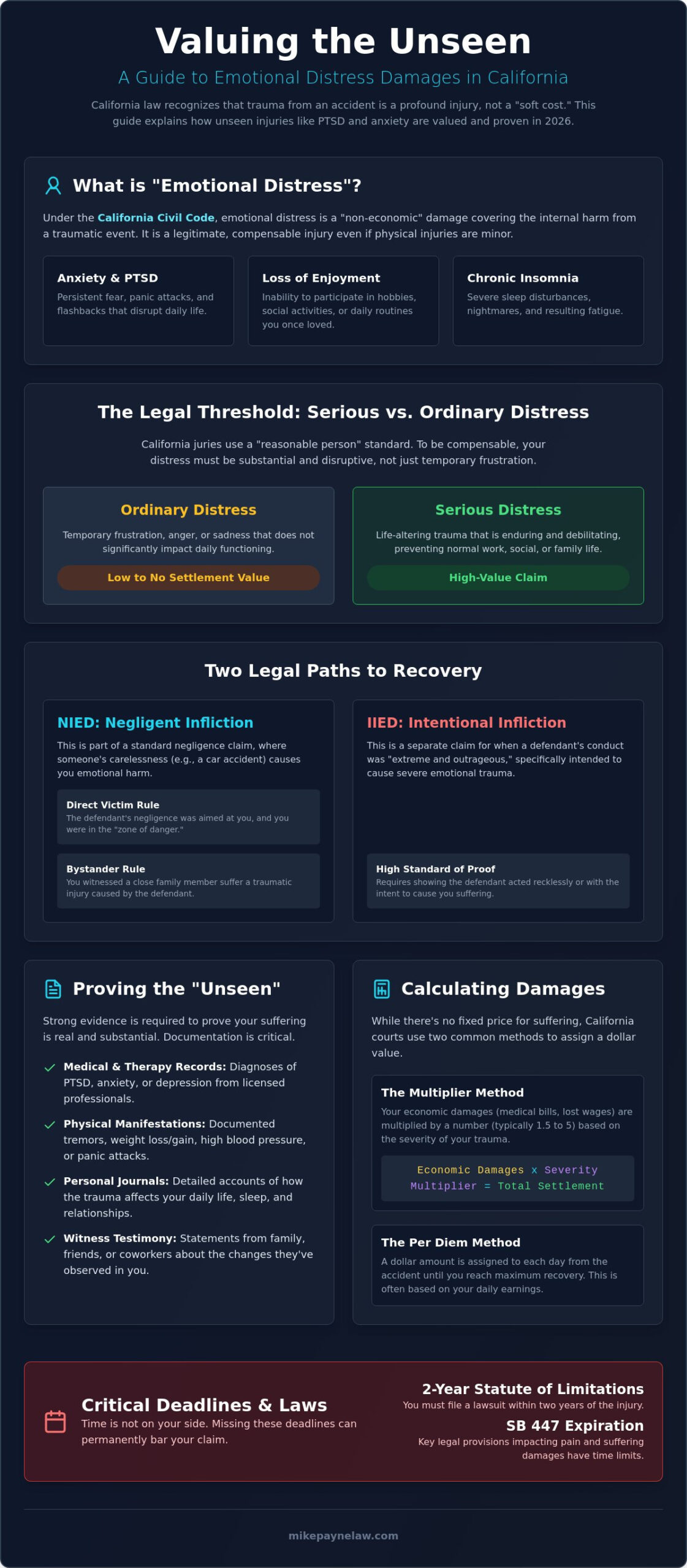
You can’t see a broken spirit on an MRI, but California law knows it’s there. Emotional distress is legally classified as a “non-economic” damage under the California Civil Code. It covers the internal wreckage left behind after a traumatic event. This wreckage often includes persistent anxiety, PTSD, chronic insomnia, and a total loss of enjoyment in the activities you once loved. By 2026, California courts have solidified the path for victims to recover emotional distress damages california even when physical injuries are relatively minor, provided the emotional impact is “serious.”
The legal framework for these claims relies heavily on California Civil Jury Instructions, specifically the CACI 1600 through 1620 series. These instructions act as the rulebook for juries. They define exactly what a plaintiff must prove to show that a defendant’s negligence or intentional act caused compensable mental suffering. We use these rules to build a wall of evidence that insurance adjusters cannot simply ignore or “gaslight” away.
Common Scenarios in Southern California Injury Cases
Trauma doesn’t happen in a vacuum; it happens on our roads and in our neighborhoods. We see these psychological injuries daily in several specific contexts:
- High-Speed Collisions: A violent crash on the 10 Freeway in West Covina can leave you with minor bruises but a paralyzing fear of driving that prevents you from going to work.
- Commercial Vehicle Wrecks: Witnessing or surviving a fatal trucking accident in Fontana or San Bernardino often results in severe PTSD that requires years of intensive therapy.
- Loss of a Loved One: In wrongful death claims, the emotional trauma is the core of the case. The law recognizes that the grief and mental suffering of survivors have immense legal value.
The Legal Threshold: ‘Serious’ vs. ‘Ordinary’ Distress
California juries use a “reasonable person” standard to evaluate your claim. They ask a simple but critical question: would a person of ordinary sensibilities suffer serious emotional distress under these same circumstances? There is a major difference between “ordinary” distress, like the temporary frustration of a fender bender, and “serious” distress that disrupts your ability to function. Ordinary upset rarely results in a significant settlement.
To cross the threshold into a high-value claim, your trauma must be substantial. It’s often categorized as Negligent Infliction of Emotional Distress (NIED), but if the defendant’s conduct was particularly “extreme and outrageous,” we may pursue a claim for Intentional Infliction of Emotional Distress (IIED). Insurance companies will fight to keep your case in the “ordinary” category. They want to treat your anxiety as a minor inconvenience. We don’t let them. We use professional documentation and clinical evidence to prove your distress is a life-altering injury that demands maximum compensation.
NIED vs. IIED: Your Legal Path to Recovery
Understanding the legal mechanism behind your claim is the first step toward justice. In California, most injury cases fall under Negligent Infliction of Emotional Distress (NIED). This isn’t a standalone lawsuit but a component of a negligence claim. On the other hand, Intentional Infliction of Emotional Distress (IIED) applies when someone targets you with “extreme and outrageous” behavior. Both paths allow you to recover emotional distress damages california, but the strategy for proving them differs significantly. You need an advocate who knows which lever to pull.
The California Civil Jury Instructions (CACI) provide two main ways to qualify for NIED. The “Direct Victim” rule applies if the defendant’s negligence was aimed specifically at you, such as a professional breaching a duty that directly caused you trauma. The “Bystander” rule is crucial for families in Pomona or Ontario who witnessed a loved one suffer a traumatic injury. If you were present and saw a family member get hit by a distracted driver, your own trauma is legally compensable. You don’t have to be physically struck to suffer a life-altering psychological wound. We fight for both.
Negligent Infliction (NIED) in Car Accident Claims
Most car accidents are the result of broken duties of care. When a driver ignores a red light, they breach their duty to everyone on the road. In pedestrian accidents, victims often experience the “Zone of Danger.” This means you were close enough to the impact to fear for your own safety, creating a deep-seated psychological scar. NIED exists as a legal theory within a negligence case rather than as an independent cause of action. It’s a powerful tool for securing the full value of your recovery.
Intentional Infliction (IIED): When Conduct is ‘Outrageous’
IIED is a different beast entirely. It requires proving the defendant acted with reckless disregard or intended to cause you mental anguish. We see this in severe road rage incidents where a driver uses their vehicle as a weapon to terrorize another. It also appears in egregious workplace injuries where safety protocols were intentionally ignored despite known risks. The burden of proof is much higher here. You must show the conduct was so “outrageous” that it exceeds all bounds of decency usually tolerated in a civilized community. Successfully litigating IIED can significantly increase the total emotional distress damages california awarded because it forces the court to acknowledge the defendant’s malice. If your trauma was caused by someone’s intentional cruelty, you don’t have to carry that burden alone. A quick review of your case can provide the clarity you need to move forward.
Proving the ‘Unseen’: Evidence Required in 2026
Proving a shattered mind is a tactical challenge that requires more than just your testimony. In 2026, the legal landscape for emotional distress damages california has become increasingly focused on the “physical manifestation” of trauma. While California law doesn’t strictly require physical contact to win a case, insurance companies use every tool available to devalue your experience. They often point to the recent shift in cases like Fiorentino v. Philadelphia Indemnity to argue that emotional distress doesn’t qualify as “bodily injury” under certain policy language. We counter this by turning your invisible pain into undeniable, documented facts.
To secure a high-value settlement, we must bridge the gap between your mental state and the physical world. This is where my background as a former insurance defense attorney becomes your greatest asset. I know exactly what boxes the adjusters are trying to uncheck. We don’t just tell them you’re depressed; we show them the clinical reality through expert witness testimony and a paper trail that links your symptoms directly to the incident. In 2026, California courts recognize emotional trauma without physical contact, but they demand a high threshold of “serious” distress supported by credible evidence.
Critical Evidence Checklist for SoCal Victims
Building a wall of evidence is the only way to stop the “gaslighting” from defense teams. We focus on gathering specific, local proof that resonates with Southern California juries:
- Medical Documentation: Records showing prescriptions for anxiety, beta-blockers for tremors, or sleep aids to combat insomnia.
- Local Testimony: Statements from friends, family members, or coworkers in West Covina or Pomona who can describe how your personality and lifestyle changed after the incident.
- Expert Reports: Comprehensive evaluations from psychologists or psychiatrists linking your PTSD or depression to the motor vehicle accident.
- Personal Logs: A daily journal documenting your “intangible” struggles, such as panic attacks or the inability to drive on the freeway.
The ‘Physical Manifestation’ Debate
Insurance adjusters love to hide behind narrow definitions of “bodily injury.” They’ll claim that if you weren’t bleeding, you weren’t hurt. We dismantle this argument by highlighting the physical toll that mental suffering takes on the body. Symptoms like chronic migraines, ulcers, sudden hair loss, or significant weight fluctuations are critical. These “manifestations” often force insurers to categorize your claim as a bodily injury, opening up higher policy limits. Documentation of these physical signs turns a subjective feeling into an objective, compensable fact. By 2026, the standard is clear: while physical impact isn’t a prerequisite for recovery, the presence of physical symptoms significantly bolsters the value of emotional distress damages california in the eyes of both insurers and juries.
Calculating Emotional Distress Damages: Multipliers and Tactics
Valuing your suffering requires a strategic calculation rather than a guessing game. We divide your claim into two distinct categories: economic and non-economic damages. Economic damages are straightforward; they cover your therapy bills, medication costs, and lost wages. Non-economic damages are where the real fight for emotional distress damages california happens. These address the intangible trauma, the fear, and the loss of your quality of life. To determine this value, attorneys typically use one of two methods: the Multiplier Method or the Per Diem method.
The Multiplier Method is the most common approach in Southern California. We take your total economic losses and multiply them by a factor, usually between 1.5 and 5. A higher multiplier is reserved for cases involving extreme trauma or permanent psychological scars. Alternatively, the Per Diem method assigns a specific dollar value to every single day you’ve lived with the distress since the accident. In 2026, San Bernardino and Los Angeles County juries have shown a trend of awarding higher non-economic figures for verified PTSD, but only when the evidence is presented with clinical precision.
You must be prepared for the defense to weaponize your past. If you’ve ever sought treatment for anxiety or depression before the incident, defense lawyers will try to claim your current trauma is a pre-existing condition. They want to pay for a “flare-up” rather than a new injury. We counter this by showing exactly how the accident fundamentally changed your baseline mental health. We don’t let them rewrite your history to save themselves money.
How Insurance Companies Devalue Your Distress
Insurance companies don’t use human empathy to value your claim. They use software like Colossus. This algorithm “grades” your suffering based on data points, not your actual pain. Adjusters look for any reason to lower your score. They’ll downplay your trauma if you didn’t seek therapy immediately after the crash. Because I spent years as an insurance defense lawyer, I know their playbook. I anticipate their moves before they make them. If you’re tired of being treated like a claim number, schedule a consultation today to get a fighter in your corner.
Factors That Increase Your Claim Value
Certain factors act as powerful accelerators for your settlement value. The violence of the initial event is a primary driver. For example, survivors of trucking accidents often secure higher awards due to the sheer scale of the wreckage and the high-stakes nature of the impact. Other critical factors include:
- The duration and permanence of your psychological symptoms.
- The clarity of the defendant’s liability, such as a DUI or a hit-and-run.
- The impact on your daily ability to work and maintain family relationships.
- The presence of physical manifestations like tremors, hair loss, or chronic migraines.
We focus on the long-term reality of your injury. If your anxiety prevents you from driving or working indefinitely, the “permanence” factor significantly increases the multiplier we demand. We don’t accept substandard resolutions. We pursue the most rigorous path to ensure you’re compensated for every day of suffering you’ve endured.
Securing Justice: The Michael D. Payne Advantage
Your mental well-being is not a negotiation point. It’s a fundamental part of your recovery. When you’re fighting for emotional distress damages california, you aren’t just up against a negligent driver; you’re up against an insurance industry designed to minimize your pain. Michael D. Payne provides the shield you need. With over 25 years of trial experience, he brings a level of grit and professional resolve that forces the “other side” to take your trauma seriously.
Experience matters, but insider knowledge is the game changer. Michael Payne is a former insurance defense attorney. He knows the playbook adjusters use to devalue psychological injuries. He understands the algorithms they run and the “soft cost” labels they try to apply to your PTSD or anxiety. We don’t accept substandard resolutions. We use our history to anticipate their moves, dismantling their defense before it even reaches a courtroom. This aggressive approach ensures your “unseen” injuries receive the maximum value they deserve. We treat you like a person, not a case number.
Trial-Ready Advocacy in West Covina
Insurance companies settle for more when they know your lawyer isn’t afraid of a jury. Many firms avoid the courtroom because it’s difficult and expensive. We embrace it. We are trial-ready advocates with deep roots in West Covina, Pomona, and the Inland Empire. We understand the regional values of our local juries. This local presence means we are your neighbors, not just your legal representatives. We pursue the most rigorous path to justice because we are personally invested in the well-being of our community. Learn more about our practice areas and how we fight for victims of negligence across Southern California.
Start Your Recovery Today
Time is a critical factor in your legal journey. In California, you generally have a two-year statute of limitations to file an injury claim. If you wait too long, you lose your right to seek compensation forever. Seeking medical and legal help immediately creates the documentation necessary to prove your emotional distress damages california are real and current. We remove the financial barriers to high-stakes litigation with our “No Recovery, No Fee” promise. You don’t pay us a dime unless we secure a settlement or verdict for you.
This contingency fee basis allows you to focus on healing while we handle the fight. You’ve been through enough. You shouldn’t have to worry about how to afford an elite protector. Let a professional champion take it from here. We move quickly from the details of your incident to the necessity of professional intervention, creating the momentum you need to win. Contact the Law Offices of Michael D. Payne for a Free Consultation and start your path to maximum recovery today.
Take Command of Your Recovery and Your Future
Your mental well-being is the foundation of your life. When that foundation is shaken by someone else’s negligence, the law provides a path to make it right. You’ve seen that emotional distress damages california are not just a legal theory; they are a high-stakes reality that demands clinical proof and a battle-tested strategy. Whether you’re navigating the “Zone of Danger” or the long-term weight of PTSD, you don’t have to carry this burden alone.
The insurance companies already have their defense ready. You need an advocate who has sat on their side of the table. Michael D. Payne uses over 25 years of Southern California trial experience and his background as a former insurance defense lawyer to shield you from lowball offers. We work on a contingency fee basis; you pay nothing unless we win your case. This is about more than just a settlement; it’s about validation and fairness.
Fight for the compensation you deserve; schedule your free consultation with Michael D. Payne today. You have the power to hold them accountable. We’re here to ensure you have the strength and the professional grit to do it.
Frequently Asked Questions
Can I sue for emotional distress if I wasn’t physically injured in California?
Yes, you can sue for emotional distress without a physical injury. California law recognizes that mental suffering is a real and compensable injury. If a defendant’s negligence or intentional act caused you “serious” distress, you have a right to pursue emotional distress damages california. You must prove the trauma is substantial and goes beyond temporary frustration or upset.
How much is the average settlement for emotional distress in California?
Settlement values vary based on the severity of the trauma and the quality of your evidence. General ranges typically start at $5,000 for mild, short term harm and can exceed $500,000 for severe, permanent psychological injuries. Workplace related cases often settle between $50,000 and $500,000. These figures depend heavily on professional documentation and the defendant’s level of liability.
What is the statute of limitations for filing an emotional distress claim in California?
You generally have two years from the date of the incident to file a claim for emotional distress. This timeline is strict and missing it will permanently bar you from seeking recovery. If your claim involves a government entity, you must act even faster. A formal tort claim must be filed within six months of the injury to preserve your legal rights.
Do I need a doctor’s note to prove emotional distress for a lawsuit?
A simple note is rarely enough to win a high value case. You need a comprehensive medical record from a mental health professional, such as a therapist or psychiatrist. These records act as clinical evidence of your diagnosis and treatment plan. Detailed expert reports are essential to link your trauma directly to the accident and explain its impact to an insurance adjuster or jury.
Can I sue for emotional distress if I witnessed a loved one get hurt in an accident?
Yes, this is legally known as a “bystander” claim under Negligent Infliction of Emotional Distress. To qualify, you must have been present at the scene and aware that the injury was occurring to a close family member. The law acknowledges that witnessing a loved one suffer a traumatic event creates a unique and compensable psychological scar that deserves justice.
Will my social media posts affect my emotional distress claim?
Your social media activity can absolutely destroy your claim. Insurance defense teams scour your profiles for any photo or post that suggests you are happy or active. They will use a picture of you smiling at a birthday party to argue that your trauma isn’t real. We strongly advise staying off social media entirely until your case is fully resolved to protect your recovery.
What is the difference between NIED and IIED in a car accident case?
NIED occurs when a defendant’s carelessness or negligence causes you mental anguish. IIED is much more severe and requires proving the defendant’s conduct was “extreme and outrageous.” While NIED is the standard for most car accidents, IIED might apply in cases of intentional road rage. IIED has a higher burden of proof but often results in significantly higher settlement values.
How do I prove emotional distress without a physical injury?
You prove it through “physical manifestations” and expert testimony. Symptoms like chronic insomnia, migraines, or significant weight loss provide the objective proof juries need to see. When we combine these physical signs with a daily journal and professional medical records, we create a powerful foundation for emotional distress damages california. This evidence turns your internal pain into an undeniable legal fact.