

What if the insurance company’s “final” determination of liability is actually just a calculated tactic to protect their bottom line? You know you weren’t the one who caused the crash, yet you’re now facing mounting medical bills while an adjuster tries to shift the blame onto you. It’s a chaotic situation that demands a definitive professional response. Proving fault in a california car accident isn’t just about telling your side of the story; it’s about using hard evidence to force a fair outcome.
We understand the stress of navigating the 2026 insurance landscape, especially with the higher SB 1107 minimum limits of $30,000 per person now in full effect. You deserve a clear path forward that doesn’t involve being bullied by corporate adjusters. This guide provides the legal roadmap you need to master California’s pure comparative negligence system and establish clear liability. You’ll learn how to gather ironclad evidence, meet DMV reporting thresholds, and navigate the two year statute of limitations. We’re going to break down the specific strategies required to dismantle defense tactics and secure the maximum compensation you need for your recovery.
Key Takeaways
- Understand how California’s updated SB 1107 insurance laws impact your recovery in an “at-fault” system.
- Learn the four critical elements of negligence required to hold a reckless driver financially responsible for your injuries.
- Master the strategies for proving fault in a california car accident by securing fleeting evidence during the “Golden Hour” after a crash.
- Discover how California’s “pure comparative negligence” rules allow you to secure compensation even if you are partially blamed for the incident.
- Gain an insider’s edge by learning how to dismantle the specific tactics insurance adjusters use to deny valid claims.
Understanding California’s Fault-Based System (SB 1107 Updates)
California operates under a strict “at-fault” or “tort” insurance system. This means the driver who caused the crash is financially responsible for every dollar of damage they leave behind. If you’ve been hit, proving fault in a california car accident is the master key that unlocks access to the other driver’s insurance policy. Without a clear determination of liability, your medical bills and lost wages remain your burden. It’s a high-stakes battle for justice where the winner is the one who can present the most compelling evidence of negligence. Establishing liability isn’t a suggestion; it’s a requirement. When you are proving fault in a california car accident, you are essentially building a case for your own financial survival.
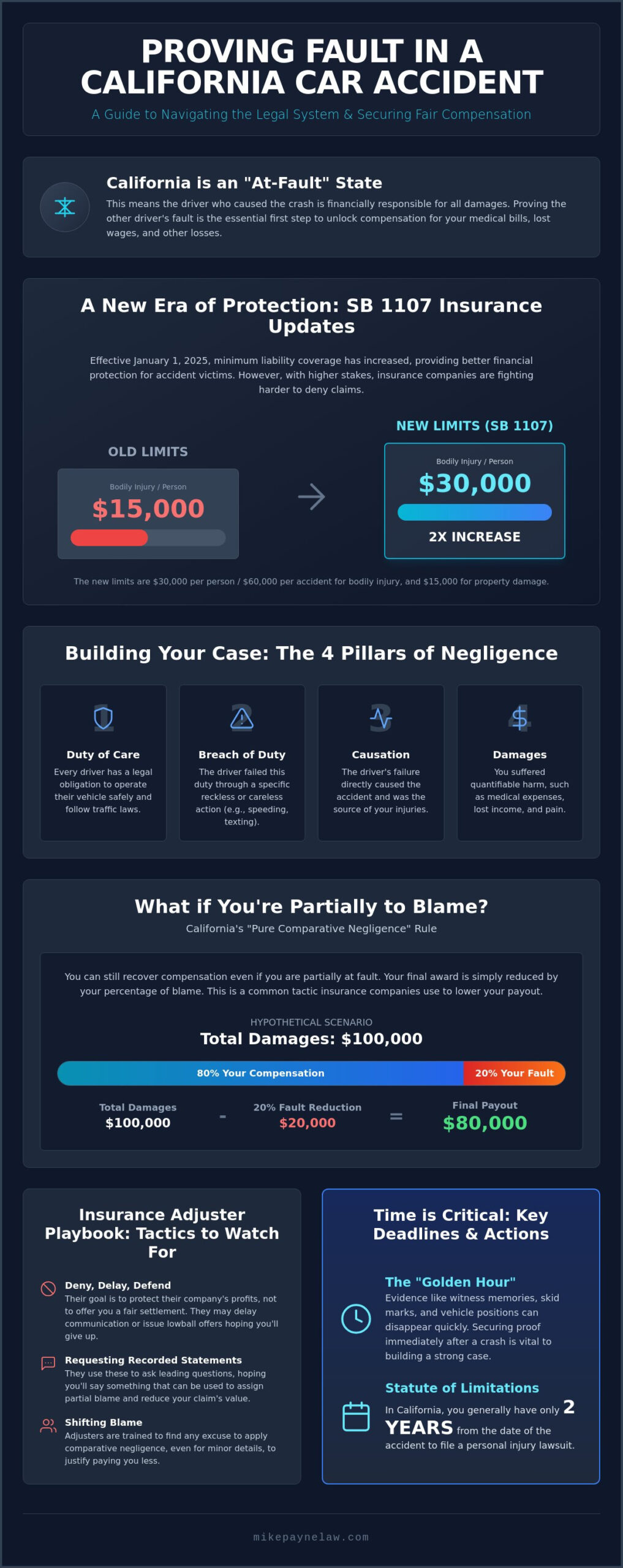
You need to understand the new rules of the game. Effective January 1, 2025, California law increased minimum liability coverage to $30,000/$60,000/$15,000. This update, known as SB 1107, ensures that victims have a better chance at full recovery than they did under the old, outdated limits. It marks a significant shift in how we approach every claim, ensuring our community is better protected against the financial ruins of a collision.
Why the 2025/2026 Insurance Limits Matter for Your Claim
For years, victims were stuck with a maximum of $15,000 for bodily injury. In 2026, that floor has finally risen. Higher minimums mean more available recovery for serious injuries, but they also mean insurance companies have more to lose. They’ll fight harder than ever to shift blame. For residents in West Covina and Pomona, where high-speed collisions on the 10 and 605 freeways are common, these increased limits are vital. A serious injury can easily surpass $30,000 in medical costs within the first week. Because the stakes are higher, insurance companies are deploying more aggressive investigators to the scene to find ways to discredit your claim. You need a protector who knows how to counter these maneuvers.
This aggressive defense by insurance companies is common nationwide; for a perspective on how a Personal Injury Attorney in Fort Lauderdale counters these tactics, read more about their experience with adjuster negotiations.
The Role of the Insurance Adjuster in Fault Determination
Don’t be fooled by a friendly voice on the phone. Insurance adjusters are not neutral parties; their primary goal is to protect their company’s bottom line. They often use high-pressure tactics or “recorded statements” to trick you into admitting partial blame. They are looking for any excuse to apply Pure Comparative Negligence to reduce your payout. If they can convince you to say you were “distracted” or “going a little fast,” they’ve already won. Dealing with insurance after a SoCal accident requires a professional shield to stop these predatory tactics before they ruin your case. They aren’t looking for the truth; they’re looking for a discount on your suffering. We stop them in their tracks with decisive action and professional resolve.
The Legal Framework: Proving the Four Elements of Negligence
In the eyes of the law, fault isn’t a feeling. It’s a formula. To successfully hold someone accountable, you must prove they were “negligent.” Negligence is the legal yardstick we use for proving fault in a california car accident. It measures whether a driver’s actions fell below the standard of what a “reasonably prudent person” would have done in the same situation. Under California Civil Code § 1714, everyone is responsible for injuries caused by their want of ordinary care or skill. If we can’t prove this lack of care, your claim dies before it even begins.
Think of your legal claim as a bridge supported by four pillars. If even one pillar is weak, the entire structure collapses. Insurance companies know this. They’ll hunt for the one element you can’t verify with hard evidence so they can issue a total claim denial. You don’t just need a story; you need a professional who can check every legal box with surgical precision. A successful claim requires checking all four legal boxes simultaneously. Missing even one gives the adjuster the opening they need to walk away without paying a cent.
Breaking Down the Four Elements
- Duty of Care: This is the baseline. Every driver on California roads has a legal obligation to operate their vehicle safely and follow all traffic laws. You don’t have to prove they liked you; you just have to prove they owed you safety by virtue of sharing the road.
- Breach of Duty: This is where the driver failed. It’s the specific moment they chose to ignore the rules. Common examples include speeding, texting, or running a red light. This is the active failure at the heart of proving fault in a california car accident.
- Causation: You must show a direct link between the breach and your injuries. It isn’t enough that they were speeding; we must prove that their speeding, and not some pre-existing condition or other factor, caused the crash.
- Damages: Without harm, there’s no case. You need documented proof of actual physical, emotional, or financial losses. This includes everything from ER bills to proof of lost income.
Common Breaches in Southern California Traffic
Driving in the San Gabriel Valley presents unique challenges. We see the same dangerous patterns every day. Whether it’s a driver weaving through heavy traffic on the I-10 or 60 freeways, or someone failing to yield at a congested West Covina intersection, these breaches lead to life-altering consequences. Distracted driving remains a leading cause of these incidents in 2026. If you’ve been hurt by a driver looking at their phone instead of the road, a Distracted Driving Accident Attorney in West Covina can help you pin down the evidence needed to prove that specific breach of duty. If you’re unsure if your situation meets all four criteria, you can reach out for a professional case review to see exactly where your claim stands.
Critical Evidence: Gathering Proof in West Covina & Pomona
Evidence is the fuel for your legal argument. Without it, your case stalls in the driveway of the insurance company. The first sixty minutes following a crash, often called the “Golden Hour,” is the most critical time to secure fleeting proof. Physical evidence at the scene tells a story that drivers often try to change once they’ve spoken to their adjusters. Skid marks fade. Debris is swept away. Memories blur. To succeed in proving fault in a california car accident, you must act with urgency to capture the reality of the impact before it disappears forever. We utilize professional investigators to lock down these details while they’re still fresh.
Local Police Reports and Official Records
If your accident happened on local streets, the report from the West Covina Police Department or Pomona PD is your first line of offense. These documents contain the responding officer’s observations and, crucially, their initial opinion on who violated the vehicle code. While an officer’s opinion isn’t the final word in court, it carries massive weight during insurance negotiations. If a “Traffic Officer’s Opinion” points the finger at the other driver, the insurance company’s ability to deny the claim shrinks significantly. When a report is inaccurate or incomplete, we don’t just accept it. We hunt for supplemental evidence to correct the record and ensure the truth is documented under California Civil Code § 1714.
Digital and Physical Proof
In 2026, technology is our greatest ally. Dashcam footage serves as an unbiased witness that doesn’t forget details or succumb to pressure. It provides an unfiltered view of the moments leading up to the collision. We also look for surveillance video from local businesses in Ontario or Fontana that may have captured the impact from a different angle. If we suspect the other driver was on their phone, we can subpoena cell phone records to prove distracted driving at the exact time of impact. This digital trail is often the smoking gun needed for proving fault in a california car accident when the other party is lying about their behavior.
Witness Testimony and Expert Analysis
Neutral third-party witnesses are worth their weight in gold. Unlike passengers, who an insurance company will claim are biased, a bystander has no “skin in the game.” Their statement can validate your version of events and dismantle the other driver’s excuses. For complex cases, especially those involving heavy vehicles, we bring in accident reconstruction experts. These professionals use physics and impact angles to prove exactly how a crash occurred. If you were hit by a commercial vehicle, a Truck Accident Lawyer in West Covina & Los Angeles can use this high-level data to overcome the aggressive defense teams that trucking companies always employ. We don’t guess; we prove.
Pure Comparative Negligence: What if You Are Partially to Blame?
California follows a “Pure Comparative Fault” rule. This system is a double edged sword for accident victims. It means you can recover damages even if you are 99% responsible for the crash. However, it also means the insurance company’s #1 goal is to shift as much percentage of blame to you as possible. They aren’t looking for a fair split. They are looking for a discount. Proving fault in a california car accident often becomes a high stakes negotiation over these specific percentages. Every point they successfully pin on you is money they get to keep in their own pockets.
Your final settlement is reduced by your assigned percentage of fault. If a jury or adjuster decides you were 10% responsible for the collision, your $100,000 award drops to $90,000 instantly. This is the primary tactic used by defense teams to protect their bottom line. They will scour your statement and the police report for any minor infraction to justify slashing your compensation. We don’t let them get away with it. We fight for every percentage point because we know it represents your ability to pay for future care and support your family.
How Comparative Fault Works in Practice
Consider a common scenario: you are hit by a driver who ran a red light, but you were traveling slightly over the speed limit. The insurance adjuster might claim your speed contributed to the severity of the impact, assigning you 20% of the fault. In this case, you would only receive 80% of your total damages. These disputes are common during lane changes on the 10 freeway or at busy intersections with yellow lights. This is exactly why you should never admit fault at the scene, even if you feel guilty or shaken. A simple apology can be weaponized against you later to prove “contributory negligence.”
Fighting Back Against Unfair Blame
We use forensic evidence to disprove these unfair “contributory” claims. We challenge the insurance company’s arbitrary percentage assignments by reconstructing the physics of the crash. We prove that the other driver’s actions were the primary cause of the harm. If you are facing unfair accusations from an adjuster, you need a Personal Injury Attorney California residents rely on to flip the script. We know the playbook they use to hide fault. If you’re being blamed for a crash you didn’t cause, reach out to us immediately for a professional case review to protect your right to full compensation.
The Payne Advantage: Dismantling Insurance Defense Tactics
Michael D. Payne didn’t just learn personal injury law from a textbook. He began his career defending the very insurance companies that are now trying to deny your claim. This background is our primary shield for clients. He knows the “playbook” adjusters use to hide fault and delay valid payments. While other firms might be surprised by a defense tactic, we’ve already anticipated it. We know how they think, how they evaluate risk, and exactly where they look for weaknesses in your story. This insider perspective is crucial for proving fault in a california car accident in 2026. We treat every case as if it’s heading to a California courtroom. This trial-ready mindset forces insurance companies to take us seriously from day one. They know we’re ready for high-stakes confrontation.
A Personalized, Aggressive Approach
You won’t be handed off to a case manager or a paralegal here. When you hire the Law Offices of Michael D. Payne, you get direct access to your attorney. We provide a steady, reassuring hand during a chaotic time. With over 25 years of experience fighting for Southern California victims, we’ve seen every trick in the book. We handle all communication with aggressive adjusters. This allows you to focus on your physical recovery while we manage the high-stakes legal battle. Our local presence in West Covina and Pomona means we understand the specific needs of our community. We aren’t a cold corporate entity. We are your local protectors and relatable fighters. We move quickly from the details of your incident to the professional intervention you need to secure justice.
No Fee Unless We Win
The financial stress of a crash is overwhelming. We believe fairness shouldn’t depend on your bank account balance. Our contingency fee model ensures that we are personally invested in your success. You don’t pay us a cent unless we win your case. We advance all necessary costs for accident reconstruction experts, private investigators, and court filing fees. This removes the financial barrier to justice. We take on the risk so you don’t have to. Proving fault in a california car accident requires resources, and we provide them upfront. Our signature financial assurance serves as a foundational trust-builder for every client we represent. If you’re ready to stop being a victim of insurance company tactics, Contact the Law Offices of Michael D. Payne for a Free Consultation. We are ready to be your voice and your champion.
Take Control of Your Legal Recovery
You don’t have to face the insurance giants alone. Proving fault in a california car accident requires more than just a police report; it demands a strategic dismantling of defense tactics designed to devalue your suffering. We’ve explored how the 2026 insurance limits under SB 1107 change the stakes and why California’s pure comparative negligence rules make every piece of evidence critical. You now have the roadmap to understand the four elements of negligence and the power of local investigative proof.
Michael D. Payne brings over 25 years of experience to your corner. As a former insurance defense attorney, he knows exactly how to anticipate and neutralize the adjusters’ next move. We provide a signature no recovery, no fee guarantee because we’re personally invested in your victory. Stop the uncertainty today. Secure Your Recovery—Schedule a Free Consultation with Michael D. Payne Today. Your path to justice starts with a single decisive action. We are ready to be your shield and your champion.
Frequently Asked Questions
How is fault determined in a California car accident?
Fault is determined by proving negligence through four specific legal elements: duty, breach, causation, and damages. Investigators and insurance adjusters analyze police reports, physical vehicle damage, and witness statements to assign liability. They look for violations of the California Vehicle Code to establish which driver failed to act with reasonable care.
Can I still get money if the accident was partially my fault?
Yes, you can still recover compensation under California’s pure comparative negligence system even if you’re 99% responsible. Your final financial recovery is simply reduced by your assigned percentage of fault. If you’re found 20% liable for a crash, you’ll still receive 80% of your total damages from the other party’s insurance.
What happens if the police report says I was at fault but I wasn’t?
A police report is a responding officer’s initial opinion, not a final legal judgment. We frequently challenge inaccurate reports by presenting superior evidence like dashcam footage or forensic data that the officer may have missed. We don’t just accept an officer’s mistake; we fight to correct the record with hard facts and expert analysis.
How long do I have to prove fault and file a claim in California?
You generally have two years from the date of the collision to file a lawsuit for personal injuries. If you’re only seeking recovery for property damage, the statute of limitations is three years. It’s vital to act quickly because evidence like skid marks and surveillance video can disappear within days of the incident.
What kind of evidence is most important for proving a car accident claim?
Objective digital evidence like dashcam video and nearby business surveillance footage is often the most persuasive proof available. Proving fault in a california car accident also relies heavily on neutral witness testimony and black box data from the vehicles. This physical proof prevents the other driver from changing their story later to avoid responsibility.
Will I have to go to court to prove the other driver was at fault?
Most cases are settled through aggressive negotiation before a trial ever begins. However, we prepare every case as if it’s going to a California courtroom to force the insurance company to offer a fair settlement. This trial-ready approach shows the defense that we aren’t afraid of a high-stakes confrontation if they refuse to pay.
What are the new California insurance limits for 2026?
As of 2026, the minimum liability limits under SB 1107 are $30,000 for bodily injury per person, $60,000 per accident, and $15,000 for property damage. These higher minimums ensure more funds are available for your medical bills and recovery. These updated rates reflect a significant shift toward better protection for victims on our local roads.
Does the driver who hit me from behind always have the fault?
While the rear driver is usually found negligent for following too closely, they aren’t automatically at fault in every scenario. Proving fault in a california car accident involving a rear-end collision can shift if the lead driver reversed suddenly or had broken brake lights. We investigate the specific physics of the impact to ensure the right party is held accountable.