

What if the biggest threat to your recovery isn’t the insurance company, but the calendar on your wall? Most people believe they have plenty of time to file a claim, but the clock starts ticking the moment you’re hurt. We understand the fear that a single missed date could cost you everything. You’re dealing with physical pain and mounting bills; you shouldn’t have to be a legal expert too. Understanding the statute of limitations for personal injury in california is the first step toward reclaiming your future and holding negligent parties accountable.
You deserve a clear roadmap to justice before your window of opportunity closes forever. In this guide, you’ll learn the critical legal deadlines for 2026 and how to protect your right to compensation. We’ll break down the standard two year filing rule, the much shorter six month deadline for government claims, and specific rules for medical malpractice. It’s time to move from uncertainty to action with a professional advocate who fights for your recovery.
Key Takeaways
- Secure your right to justice by understanding the standard two-year window and how it applies to your specific accident.
- Avoid the “6-month trap” by learning the strict notice requirements for claims involving government agencies and public entities.
- Learn how the statute of limitations for personal injury in california can be “tolled” or paused under specific legal circumstances to protect your claim.
- Discover why the date of passing, not the date of the accident, dictates the timeline for filing a wrongful death lawsuit.
- Understand why hiring a trial-ready advocate early prevents insurance companies from using an approaching deadline to pressure you into a lowball settlement.
What Is the Statute of Limitations for Personal Injury in California?
Think of the statute of limitations as a legal expiration date for your right to seek justice. It is a strict deadline set by state law that dictates exactly how long you have to file a lawsuit against the person or entity that caused your harm. In California, this window is governed primarily by California Code of Civil Procedure section 335.1. For most cases, you have a standard two-year window from the date of the incident to take action. If you fail to file your paperwork within this timeframe, your right to recover compensation is gone forever. No matter how clear the liability or how severe your injuries are, the court will refuse to hear your case.
The legislative intent behind these deadlines is rooted in the concept of fairness and the preservation of evidence. Over time, physical evidence can be lost or destroyed. Witnesses move away, their memories fade, and their reliability diminishes. The law seeks to ensure that legal disputes are decided based on the most accurate information available. While this protects the integrity of the judicial system, it places an immediate and heavy burden on you. You are forced to balance your physical recovery with the high-stakes pressure of a ticking legal clock. The statute of limitations for personal injury in california is not a suggestion; it is a boundary that insurance companies use as a shield to avoid paying what they owe.
Why the Clock Starts Ticking the Moment of Impact
For the vast majority of victims, the countdown begins the second the accident occurs. This is known as the date of incident. Many people make the dangerous mistake of waiting until their medical treatment is finished before thinking about a lawsuit. They want to see the “total cost” of their bills first. This delay can be fatal to your claim. Evidence like skid marks, surveillance footage, and witness statements can disappear in days, not years. Accrual is the specific point in time when the legal right to sue begins. You must secure your legal standing while the facts are fresh and the trail is still warm.
The Consequences of Filing a Day Late
The legal system is unforgiving when it comes to deadlines. If you attempt to file a lawsuit even one day after the window closes, the defense will move to dismiss your case. Judges have almost no discretion to grant extensions for simple oversight. This results in a “dismissal with prejudice,” meaning you are permanently barred from ever seeking damages for that incident again. Insurance adjusters are well aware of these dates. They may act friendly and keep you engaged in slow-moving negotiations, hoping you will let the deadline slip by. The moment the clock runs out, they will stop all communication and close your file without paying a cent. This is why you need a personal injury lawyer in West Covina to intervene and protect your interests before the leverage shifts to the insurance company.
California Filing Deadlines by Accident and Injury Type
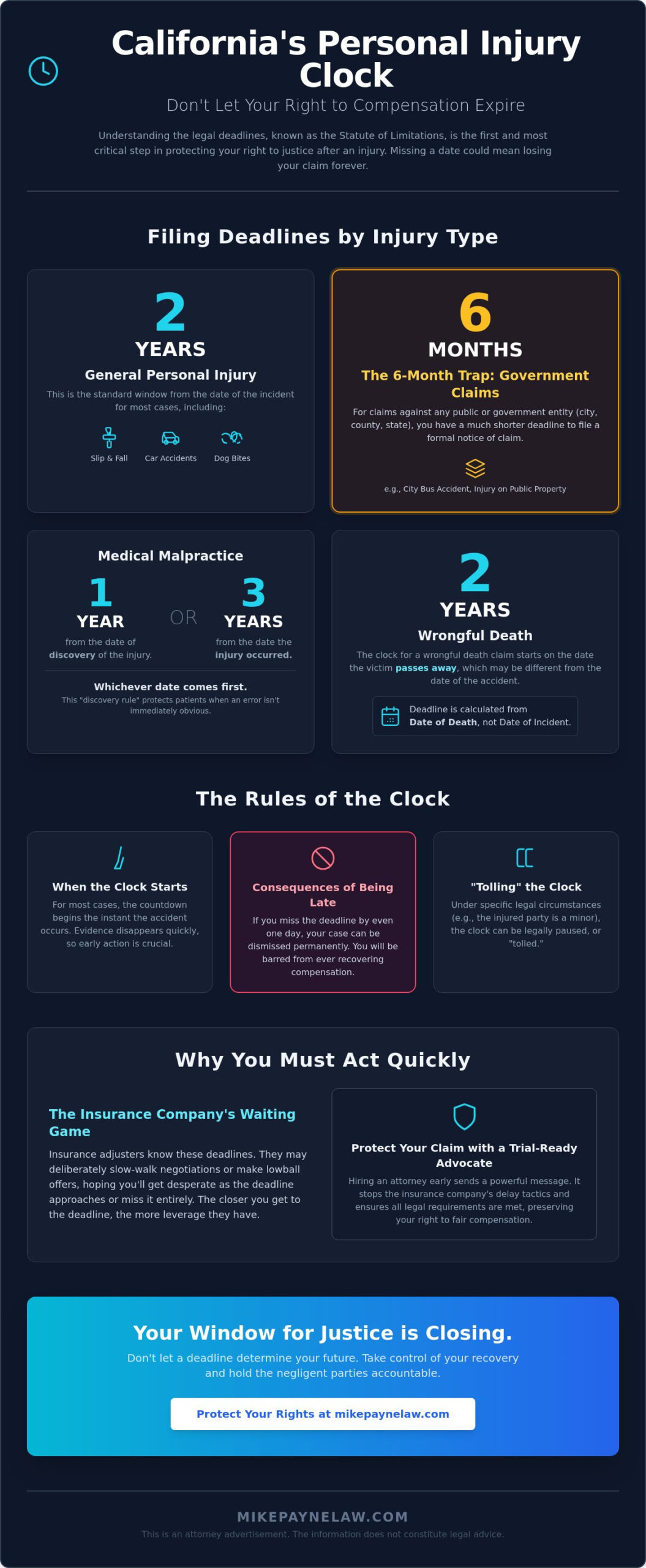
Not all injuries are treated equally by the law. While the general personal injury statute of limitations in California provides a standard two-year window, specific scenarios trigger different clocks. You must identify which category your claim falls into immediately to prevent a permanent loss of your rights. For car accidents, slip and falls, or dog bites, the two-year rule applies from the date of the crash or fall. Medical malpractice is more complex; you generally have one year from the date you discovered the injury or three years from the date the injury occurred, whichever comes first. This discovery rule is a vital protection when a surgical error or misdiagnosis isn’t immediately obvious.
Wrongful Death Deadlines in California
Losing a loved one is a devastating trauma that leaves families in a state of shock. The law provides a path for justice, but the timeline is very specific. In California, the two-year clock for a wrongful death representation claim starts on the date the victim passes away. This is often different from the date the accident happened. For example, if a victim survives a truck accident for several weeks before succumbing to their injuries, the filing deadline is two years from the date of death. You might also pursue a survival action to recover damages the deceased suffered before they passed. These are distinct legal paths that require precise timing and aggressive advocacy to manage correctly.
Property Damage vs. Bodily Injury Timelines
If your vehicle was totaled in a multi-car pileup in Pomona or Ontario, you actually have more time to sue for the car than for your physical pain. Under CCP § 338(c)(1), property damage claims have a three-year statute of limitations. This creates a dangerous trap for the unwary. You might successfully negotiate a car repair settlement in year three, only to realize your right to sue for back surgery or long-term therapy expired a year earlier. Splitting your claims without professional guidance is a massive risk. It often leads to a fragmented recovery that fails to cover your actual needs. Insurance companies love it when victims focus on their property and ignore their health until the legal window has slammed shut. If you are struggling with the aftermath of a crash, you can discuss your case with our team to ensure every deadline is met and your full recovery is protected.
The 6-Month Trap: Claims Against Government Entities
The standard two-year window is a luxury you don’t have if a government agency caused your injury. Under Government Code section 911.2, you must file a formal written “Notice of Claim” within six months of the date of injury. This is the 6-month trap that destroys thousands of valid claims every year. If you’re hit by a city bus or trip on a poorly maintained public sidewalk, your timeline for the statute of limitations for personal injury in california is cut by seventy-five percent. This administrative requirement is a hurdle designed to protect the government’s budget, not your recovery. Sometimes, an injury isn’t immediately obvious. The discovery rule may offer a lifeline if you couldn’t have reasonably known you were hurt right away; however, applying this to government claims is notoriously difficult. Once you file the claim, the agency has 45 days to respond. If they send a written rejection notice, you have exactly six months from the date that notice was mailed to file a lawsuit in court.
Local SoCal Entities That Trigger the 6-Month Rule
Identifying the responsible party is the first battle. In Southern California, this often involves entities like Foothill Transit, Caltrans, or San Bernardino County offices. You might think you’re dealing with a private contractor, but if they were performing work for a city agency, the shorter deadline likely applies. This is especially critical for slip and fall accidents on public sidewalks or in government buildings. We’ve seen cases where victims waited eight months to call a lawyer, only to find out their right to sue a local municipality had already expired. Immediate investigation is the only way to unmask the true defendant and protect your standing. We don’t wait for the government to admit fault; we move fast to pin it on them.
What if You Missed the 6-Month Government Deadline?
Missing this deadline feels like a dead end, but there is a narrow path forward. You can file an “Application for Leave to Present a Late Claim.” You must prove that the failure to file was due to mistake, inadvertence, surprise, or excusable neglect. The government will fight this application with everything they have. They don’t want to pay, and they’ll use your late filing as a reason to shut the door. It’s an uphill battle that requires a fierce advocate who knows how to navigate these technicalities. Even if you’re late, don’t give up. The statute of limitations for personal injury in california has complexities that only a trial-ready professional can navigate to find you a second chance at justice.
Exceptions to the Rule: When the Clock Pauses (Tolling)
The law recognizes that certain situations make it impossible for a victim to file a claim on time. In these specific instances, the court may allow for “tolling.” Tolling acts as a legal pause button on the clock, effectively freezing the deadline for a set period. While this sounds like a convenient safety net, it is exceptionally difficult to prove in a courtroom. You cannot simply claim you were too busy or unaware of the law to justify a delay. To successfully toll the statute of limitations for personal injury in california, you must meet very narrow legal criteria. Judges are protective of deadlines and rarely grant these exceptions without undeniable evidence of necessity.
There are three primary reasons the court might toll your claim: the victim is a minor, the victim is mentally incapacitated, or the “discovery rule” applies. These exceptions are designed to ensure fairness when a victim is physically or legally unable to act. However, the burden of proof rests entirely on your shoulders. Insurance companies will fight tolling tooth and nail because it is often the only thing keeping your case alive. If you believe your deadline should be paused, you need a professional champion who understands the technicalities of California tolling provisions.
Tolling for Minors and Mental Incapacity
Protecting vulnerable victims in West Covina and Ontario is a cornerstone of our justice system. For children, the clock usually doesn’t start until they turn 18. This gives them until their 20th birthday to file a lawsuit for an injury sustained as a minor. Similarly, if a victim is mentally incapacitated or “insane” at the time of the accident, the clock may pause until their capacity is restored. These provisions ensure that those who cannot represent themselves aren’t permanently barred from recovery. You should be aware that these rules often have different applications for medical malpractice or government claims, making early consultation vital.
The Discovery Rule: When Injuries Are Hidden
Some injuries don’t reveal themselves at the moment of impact. The “delayed discovery” doctrine applies when a victim has a latent medical issue that isn’t immediately apparent. This is common in complex workplace injury cases involving toxic exposure or repetitive stress that builds over years. The clock starts ticking the moment you knew or reasonably should have known of both the injury and its negligent cause. Proving exactly when you “should have known” is a high-stakes legal battle that requires expert testimony and medical records. You need a fighter who can link your current suffering to a past incident with medical precision.
If you suspect your deadline has passed but believe an exception applies, don’t guess with your future. You need a definitive professional action to save your case before it’s too late. Contact our legal team today to review your timeline and determine if tolling can protect your right to compensation.
Why You Need a Trial-Ready Advocate Before the Clock Runs Out
Insurance companies are not in the business of fairness. They are in the business of profit. Every day you wait to file a claim is a day they use to build a wall between you and the compensation you deserve. They view the statute of limitations for personal injury in california as a countdown to their own victory. If they can delay your progress until that window slams shut, they win by default. You need a protector who understands that filing a lawsuit is not just a procedural step; it is a strategic strike. We don’t just fill out forms. We build cases that are designed to withstand the most aggressive defense tactics in the courtroom.
Michael D. Payne brings a unique advantage to your fight. He spent years inside the insurance industry as a defense attorney. He knows exactly how adjusters prioritize files and which red flags trigger a settlement offer versus a denial. This “insider” perspective allows us to anticipate delay tactics before they happen. We understand that a lawyer needs significant time to investigate the scene, secure medical experts, and draft a comprehensive complaint. Waiting until the last month to seek help is a recipe for disaster. We move with a sense of urgency because your future depends on the actions we take today.
The Defensive Strategy: How Insurers Exploit Your Delay
Adjusters in Pomona and San Bernardino often employ a “wait and see” tactic. They will act helpful and keep you engaged in endless requests for “one more document.” Their goal is to lull you into a false sense of security while the clock runs out. A car accident lawyer in West Covina must file your case early to preserve your leverage. When the defense knows we are trial-ready from day one, their willingness to negotiate increases. We don’t accept substandard resolutions because we are never afraid to take a case to a jury. Our aggressive approach is your best shield against insurance company greed.
Taking Action: Your Next Steps with Michael D. Payne
The path from uncertainty to justice begins with a single decisive action. We offer a free, no-obligation consultation to review the specific facts of your incident and calculate your exact deadline. Our firm takes the entire burden off your shoulders. We handle the complex “Notice of Claim” requirements for government entities and manage every filing detail with precision. You focus on your physical recovery; we focus on your financial survival. We work on a contingency fee basis, which means there is no recovery unless we win your case. You have nothing to lose by acting now, but you have everything to lose by waiting. Contact the Law Offices of Michael D. Payne today to protect your claim and secure the professional advocacy you need before time runs out.
Secure Your Future Before Time Runs Out
The law waits for no one. Whether you are facing a standard two-year deadline or the aggressive six-month government claim window, every second counts. Missing the statute of limitations for personal injury in california means losing your voice and your right to recovery forever. Insurance companies count on your hesitation to protect their bottom line. Don’t let them win by default.
You need a fighter who knows the enemy’s playbook from the inside. With over 25 years of experience and a background as a Former Insurance Defense Attorney, Michael D. Payne provides the strategic shield your case requires. We handle the complex technical filings and investigation while you focus on healing. Our commitment is clear: there are no fees unless we win your case.
Protect your right to compensation; Schedule a Free Consultation with Michael D. Payne.
Your path to justice is still open, but the window is closing. Take the first step toward reclaiming your life today. We are ready to stand by your side and fight for the full, fair recovery you deserve.
Frequently Asked Questions
Is the statute of limitations different for car accidents and slip and fall cases in California?
No, the general deadline is the same for both car accidents and slip and fall incidents. Under California law, you typically have two years from the date of the injury to file a lawsuit for bodily harm. This standard applies to most negligence-based claims involving private parties. However, if your accident involved a city bus or occurred on public property, a much shorter six-month government deadline takes priority regardless of the accident type.
Can I still file a personal injury claim after 2 years if I just found out I was injured?
You may still have a path to justice if you discovered the injury after the standard window closed. The “Discovery Rule” allows the clock to start on the date you knew, or should have known, about the harm. This exception is common in complex medical cases or toxic exposure where damage isn’t immediately visible. You generally have one year from the date of discovery to take legal action before your rights expire permanently.
How long do I have to sue a city or county in California for an injury?
You have exactly six months to file a formal administrative claim against a city, county, or state agency. This is a non-negotiable requirement under Government Code section 911.2. If the agency rejects your claim, you then have an additional six months from the date of their notice to file a lawsuit in court. Missing that initial six-month window usually results in an immediate loss of your right to seek any compensation.
What happens to the statute of limitations if the defendant leaves the state?
The clock pauses, or “tolls,” if the person who caused your injury leaves California before you can file your lawsuit. State law prevents defendants from escaping liability by simply hiding across state lines. The time they spend outside of California typically doesn’t count toward your filing deadline. This ensures that the statute of limitations for personal injury in california remains fair for victims pursuing justice against defendants who try to flee their responsibilities.
Does the statute of limitations apply to insurance claims or just lawsuits?
The statute of limitations technically applies only to the filing of a lawsuit in a court of law. However, insurance companies use this deadline as their primary leverage during settlement negotiations. If your filing window closes, the insurer has no legal obligation to pay your claim. They will stop all settlement talks the moment the deadline passes because you can no longer threaten them with a trial or a jury verdict.
Can a minor file a personal injury lawsuit on their own in California?
Minors cannot file a lawsuit on their own; an adult must be appointed as a “guardian ad litem” to represent their legal interests. In most cases, the clock for a child’s injury is paused until they reach the age of 18. Once they turn 18, they typically have two years to file a claim. This protection ensures children don’t lose their rights due to a parent’s delay or a lack of legal capacity.
What is the “Discovery Rule” in California personal injury law?
The Discovery Rule is a legal doctrine that delays the start of the statute of limitations until the victim actually discovers the injury. It applies when an injury is latent, such as internal damage that doesn’t show symptoms for months. The clock starts when a reasonable person would have realized they were hurt and that someone else was at fault. Proving this requires meticulous medical evidence and a lawyer who can challenge the defense’s timeline.
Do I need a lawyer to file a lawsuit before the statute of limitations expires?
While you aren’t legally required to hire a lawyer, filing a lawsuit alone is a massive risk to your recovery. A single technical error in your complaint or a missed filing fee can lead to a permanent dismissal of your case. A professional advocate ensures that every document is filed correctly and that all potential defendants are identified. We handle the high-stakes pressure of the statute of limitations for personal injury in california so you can focus on your recovery.