

The “friendly” insurance adjuster calling you today isn’t your neighbor; they are a trained negotiator tasked with saving their company money at your expense. If you’re currently dealing with insurance adjusters in California, you’ve likely felt the intense pressure to provide a recorded statement or sign broad medical authorization forms while your bills keep mounting. It’s a chaotic situation where one wrong word can slash the value of your claim. You feel vulnerable. You need a shield. We’re here to provide that professional grit and ensure you aren’t silenced by a corporate giant.
We understand the fear of being lowballed while you’re recovering from a car accident or workplace injury. This guide empowers you to fight back by revealing the high-stakes tactics adjusters use and how to protect your rights under current 2026 California law. You’ll learn how to handle aggressive settlement offers, navigate the implications of proposed legislation like SB 876, and secure the maximum compensation for your medical bills and pain and suffering. We’ll show you exactly how to move from a state of uncertainty to a state of professional resolve. It’s time to level the playing field and get the justice you deserve.
Key Takeaways
- Understand that insurance adjusters prioritize their company’s bottom line; you must treat every “friendly” conversation as a high-stakes negotiation.
- Learn to spot and avoid common traps like overbroad medical releases and recorded statements that adjusters use to devalue your claim.
- Discover how California’s Fair Claims Settlement Practices regulations protect you by mandating specific response times and fair handling of your case.
- Identify the essential “Do’s and Don’ts” for dealing with insurance adjusters in california to ensure you don’t accidentally sabotage your settlement.
- See how Michael D. Payne serves as your professional champion, taking over all communications to stop adjuster harassment and secure the compensation you deserve.
The Insurance Adjuster’s Role: Why They Aren’t on Your Side
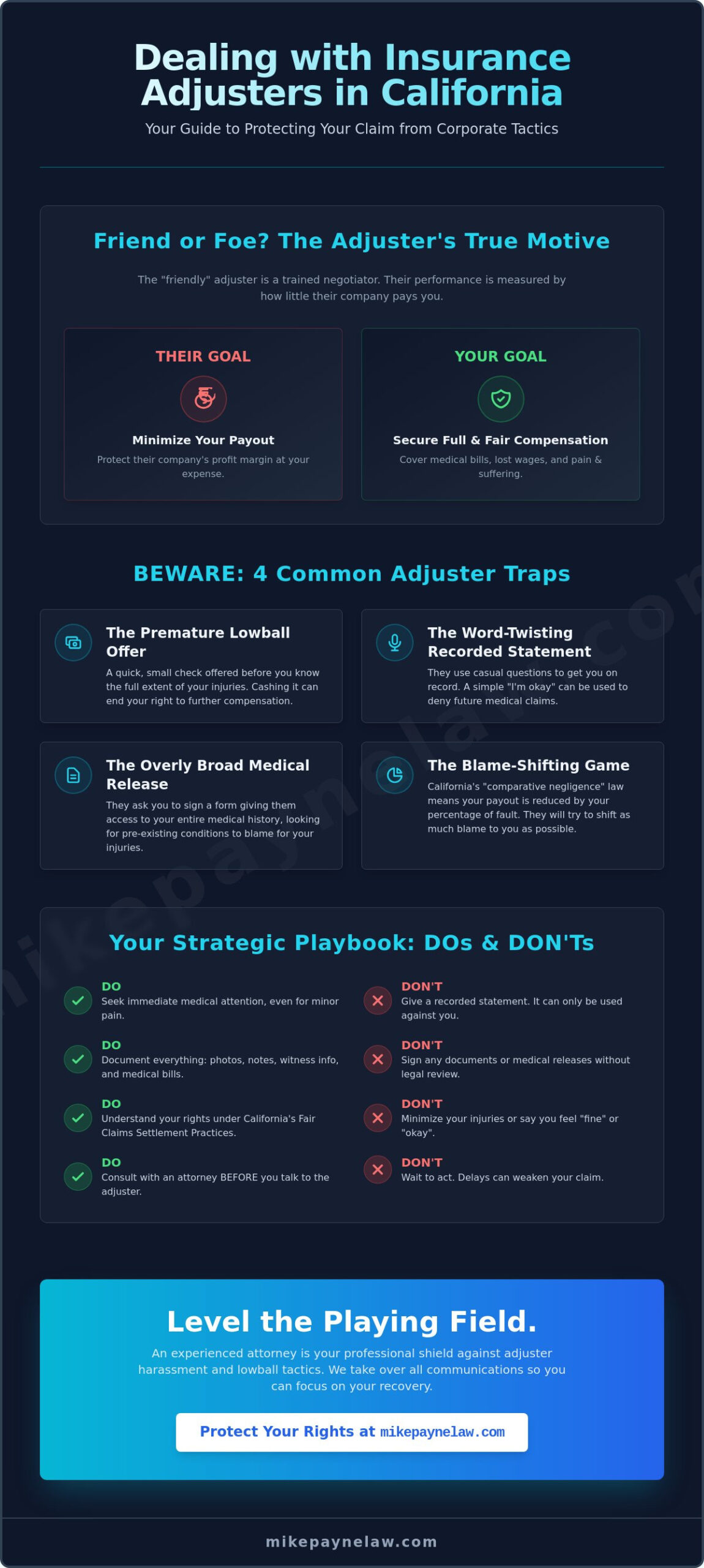
You just hung up the phone with a claims specialist who sounded genuinely concerned about your recovery. They were polite. They were patient. They might have even offered a small settlement check to “help with the immediate bills.” Don’t be misled. When you are dealing with insurance adjusters in california, you must remember that their primary loyalty is to the insurance company’s profit margin, not your physical or financial well-being. They are professional negotiators. Their performance is measured by how little of the company’s money they pay out to people like you.
Every adjuster has a specific role, but their goals are remarkably similar. You will likely encounter one of three types during your claim:
- Staff Adjusters: These are full-time employees of major carriers like State Farm or Geico. Their career advancement depends on how effectively they minimize payouts.
- Independent Adjusters: These are third-party contractors hired during high-volume periods, such as after the 2025 wildfires. While they aren’t direct employees, they are paid by the insurer to produce the same cost-saving results.
- Public Adjusters: These professionals are hired by policyholders, usually for property damage. In personal injury cases, however, a lawyer is your most effective shield.
The first call you receive is rarely about “helping” you. It is a calculated fact-finding mission. They want to catch you off guard before you’ve spoken to a lawyer. If you say you feel “okay” because you’re in shock or on pain medication, they will use that statement to deny your future medical claims. If they can find any reason to shift blame onto you, they will. If they cross the line into deceptive or illegal tactics, they may be venturing into the territory of Insurance Bad Faith, but you shouldn’t wait for things to go that far to protect yourself.
The Difference Between Staff and Independent Adjusters
Staff adjusters are the “company men” of the industry. They know the internal software and the specific corporate mandates designed to keep settlements low. Independent adjusters are often brought in when local offices are overwhelmed. Many people mistakenly believe an independent adjuster might be more objective. This is a dangerous assumption. They are contractors who want to keep getting work from the insurance company. To do that, they must prove they can save the company money just as effectively as a staff employee. Both are paid to protect the insurer, not you.
Why ‘Nice’ Adjusters Are Often the Most Dangerous
The “friendly” adjuster is a tactical tool. They use rapport building to lower your guard, making you more likely to share details they can later use against you. They might act like your advocate, suggesting that “we’re in this together” to resolve the claim quickly. This is a myth. Early settlement offers are designed to close your file before you understand the full extent of your injuries. If you’ve been injured in a motor vehicle accident, you need to know that once you sign a release, you can’t go back for more money if you discover you need surgery months later. We stop this harassment. If you’re feeling pressured, contact our team immediately to ensure your recovery is protected by a professional champion.
Common Tactics and ‘Tricks’ Used by California Adjusters
Adjusters operate from a sophisticated playbook designed to protect corporate assets. When you’re dealing with insurance adjusters in california, you aren’t just having a conversation; you’re participating in a legal maneuver. The first tactic they often deploy is the lowball offer. This initial check is a test of your financial desperation. They hope you’ll take a quick, small amount before the full extent of your injuries, like those from a car accident, becomes clear. Once you cash that check, your right to seek further compensation usually vanishes.
Another common strategy is shifting fault. California law allows for comparative negligence, which means your settlement is reduced by your percentage of fault. Adjusters will twist your words to suggest you were distracted or speeding. Even a 10% shift in liability saves the insurance company thousands of dollars. While the California Department of Insurance sets standards for licensing, it doesn’t stop adjusters from using these aggressive psychological tactics to devalue your recovery. Protecting your claim while dealing with insurance adjusters in california requires a professional who understands these high-stakes tricks.
The Danger of Recorded Statements
The adjuster will ask for a recorded statement early on, often claiming it’s “just to get your side of the story.” This is a trap. They use innocent-sounding questions to lock you into details before you’ve fully processed the trauma or seen a specialist. If you’re on pain medication or in shock, you might misremember a speed or a distance. They will later use these inconsistencies to destroy your credibility. Your response should always be firm: “I will provide a written statement after consulting with my attorney.”
Medical Records and the ‘Pre-existing’ Defense
You’ll likely be asked to sign a “Medical Authorization” form. These are frequently overbroad “blanket” releases. If you sign, the adjuster gains access to your entire medical history. They aren’t looking for your current injuries; they’re looking for a reason to blame a 10-year-old back strain for your current herniated disc. They want to claim your pain is “pre-existing” to avoid paying for your treatment. California personal injury victims have HIPAA protections, and you aren’t required to hand over your life’s history. We ensure they only see what’s relevant to your current claim, shielding you from these invasive and devaluing “fishing expeditions.”
Navigating California’s Fair Claims Settlement Practices Regulations
California law provides powerful protections that most claimants never hear about from their insurance company. The Fair Claims Settlement Practices Act, found in Sections 2695.1 through 2695.14 of the California Code of Regulations, dictates exactly how an insurer must behave. When dealing with insurance adjusters in california, you aren’t at their mercy. These regulations exist to prevent predatory behavior and ensure transparency. They turn the “suggestions” of fair play into legal mandates. If an adjuster ignores these rules, they aren’t just being difficult. They’re violating state law. You deserve a professional champion who knows how to hold them accountable to these standards.
One of the most critical protections is the requirement for a “reasonable explanation.” An insurance company cannot simply say “no” to your claim. If they deny any part of your recovery, they must provide a written statement citing the specific policy provisions or legal basis for that decision. This prevents them from using vague excuses to protect their bottom line. In 2026, with new scrutiny following recent disasters, these protections are more important than ever. If you feel an adjuster is hiding behind fine print, it is time to bring in a protector who can translate that jargon into justice.
Timelines the Adjuster Must Follow
The law sets a strict clock to prevent insurers from stalling your recovery. Once you notify an insurer of your claim, they have 15 calendar days to acknowledge receipt. They can’t leave you in limbo while your bills pile up. After they receive your proof of loss, they have 40 calendar days to either accept or deny the claim. If they need more time, they must tell you exactly why every 30 days. In a declared state of emergency, insurers must also provide a copy of the Department of Insurance Notice within 15 days. These deadlines are your leverage. When dealing with insurance adjusters in california, pointing out a missed deadline can often jumpstart a stalled negotiation.
Signs Your Adjuster Is Acting in ‘Bad Faith’
If an adjuster intentionally misses deadlines, misrepresents policy facts, or refuses to pay an undisputed claim, they may be acting in “Bad Faith.” This is a legal term for dishonest dealings that violate the covenant of fair dealing. Some people consider hiring a private professional for property issues, so it helps to understand What Is A Public Adjuster before signing any contracts. However, for personal injury or liability, you need a fighter who understands the courtroom. Unreasonable delays in communication are a major red flag. If liability is clear and they still refuse to pay, they are testing your resolve. Learn more about your rights in motor vehicle accidents to ensure you aren’t being exploited by these high-stakes stalling tactics.
The Essential ‘Do’s and Don’ts’ When Speaking to an Adjuster
The moments following an accident are a whirlwind of stress and physical pain. When you are dealing with insurance adjusters in california, your words are your greatest liability or your strongest shield. They want you to slip up. Don’t. You need a clear communication framework to survive the first 48 hours without sabotaging your recovery. Some generic sources suggest settling directly to avoid “hassle,” but this is a dangerous path that leads to pennies on the dollar. We are here to ensure that doesn’t happen. By following a strict protocol, you protect your right to a full financial recovery.
- Do: Record the adjuster’s full name, their insurance company, and your specific claim number immediately.
- Don’t: Discuss your physical condition in detail. You aren’t a doctor, and you haven’t finished healing.
- Do: Keep a dedicated log of every interaction. Write down the date, time, and a summary of what was said.
- Don’t: Accept any check marked “Final Release” or “Full Settlement” unless you have reached maximum medical improvement and a professional has reviewed the offer.
- Do: Redirect every high-stakes question about fault or the value of your claim to your legal representative.
What You SHOULD Say During the First Call
Keep the initial conversation strictly limited to administrative facts. Provide your contact information and the date and location of the incident. That’s it. If they ask how you’re feeling, use this specific script: “I am still receiving medical treatment and cannot discuss my injuries yet.” This prevents them from locking you into a “minor injury” narrative before your doctor has even seen your MRI results. Always ask for their direct phone number and email address so your protector can handle all future correspondence. Dealing with insurance adjusters in california requires this level of discipline to avoid devaluing your case.
The ‘Forbidden’ Topics to Avoid
Politeness can be your enemy here. Never say “I’m fine” as a greeting. This is a common reflex, but adjusters will note it as an admission of health. Avoid phrases like “I think” or “maybe.” If you are unsure about speeds, distances, or times, “I don’t know” is the only safe answer. Guessing gives them ammunition to prove you were at fault. Finally, keep your daily activities and social media posts private. Adjusters frequently monitor your public profiles to find photos that contradict your claims of pain or disability. If the pressure feels overwhelming, contact us today so we can step in and handle the adjuster for you.
Leveling the Playing Field: How Michael D. Payne Protects Your Recovery
You’ve seen the tactics and you’ve recognized the traps. Now, you need a protector who can stop the corporate games. Dealing with insurance adjusters in california isn’t a fair fight when you’re standing alone. These companies use billion-dollar legal budgets and decades of data to minimize your pain. We level that playing field immediately. Michael D. Payne isn’t just another attorney; he’s a formidable opponent for insurance companies and a steady, reassuring hand for you. We move with urgency because we know your medical bills and daily stresses won’t wait for a slow-moving bureaucracy.
Our approach is rooted in the concept of fairness and a refusal to accept substandard resolutions. We don’t just ask for a settlement; we demand justice. If an insurance company refuses to offer what you truly deserve for your truck accident or injury claim, we’re prepared for high-stakes confrontation. This readiness for trial is our signature. It sends a clear message to the adjuster: pay fairly now or face us in front of a jury. This reputation for grit is often the only thing that forces a carrier to stop stalling and start paying.
The Advantage of Knowing the ‘Other Side’
Mr. Payne brings over 25 years of experience to your case. This career includes seeing how insurance companies evaluate claims from the inside. He understands their software, their internal settlement ranges, and the specific pressure points they use to devalue your recovery. We anticipate their defenses before they even raise them. This proactive strategy is exactly why choosing a trial-ready personal injury lawyer matters. When we step in, the adjuster knows their typical “tricks” won’t work. We speak their language, but we use it to protect your interests, not theirs.
Taking the Burden Off Your Shoulders
The harassment stops the moment we take your case. We handle every phone call, every piece of paperwork, and every aggressive negotiation. You shouldn’t have to argue about liability while you’re trying to heal from a premises liability incident or a car crash. Our focus is your financial recovery so you can focus entirely on physical healing. We work on a contingency fee basis, which means you pay nothing unless we win your case. This is our foundational trust-builder and your guarantee of our personal investment in your well-being. If you’re tired of dealing with insurance adjusters in california and want a “boots-on-the-ground” advocate, we’re here for you. Protect your claim—contact the Law Offices of Michael D. Payne today to schedule a consultation in West Covina, Ontario, or San Bernardino.
Take Control of Your Recovery Today
You now have the tools to spot common traps and navigate the complex timelines set by California law. Remember that the “friendly” voice on the other end of the phone belongs to a professional negotiator aiming to minimize your recovery. By refusing to give recorded statements and redirecting high-stakes questions to a legal protector, you safeguard your future. You’ve learned that the law is on your side, but you must be proactive to ensure those protections are enforced.
Dealing with insurance adjusters in california shouldn’t be a burden you carry alone while recovering from an injury. Michael D. Payne provides a formidable shield, leveraging 25+ years of experience and his background as a former insurance defense attorney to anticipate every corporate tactic. We operate on a contingency basis, meaning there is no fee unless we win your case. This financial assurance is our promise to you. It ensures you have a professional champion who is personally invested in your success.
You have the power to challenge powerful entities and demand fairness. Let us handle the aggressive negotiations and complex paperwork so you can focus on your health. Get a Free Consultation with a California Injury Advocate today. We are ready to fight for the maximum compensation you deserve. Your path to justice starts with one definitive action. You aren’t alone in this fight.
Frequently Asked Questions
Do I have to give a recorded statement to the other driver’s insurance company?
No, you are not legally required to provide a recorded statement to the other driver’s insurance company. They use these recordings to find inconsistencies in your story or catch you while you’re in shock. Declining the request is your right and a necessary step to protect your recovery. Simply state that you will provide a written statement through your legal representative once your medical treatment is further along.
What happens if the insurance adjuster offers me a settlement right away?
An immediate settlement offer is almost always an attempt to underpay you. Insurance companies want to close your file before you realize the true cost of your medical care or long-term pain. Cashing that check usually ends your right to seek more money later. You shouldn’t sign anything until you’ve reached maximum medical improvement and had a professional evaluate the offer’s fairness.
Can an insurance adjuster deny my claim even if the other driver was at fault?
Yes, an adjuster can deny your claim even if the other driver was clearly at fault. They might claim the policy was inactive, the driver wasn’t covered, or that your injuries didn’t happen during the crash. Dealing with insurance adjusters in california often involves fighting these baseless denials. A professional champion will force them to provide the specific legal or policy-based reason for any denial.
Should I sign the medical authorization form the insurance company sent me?
You should never sign a blanket medical authorization form without a professional review. These forms often give the insurer access to your entire medical history, not just the records relevant to your accident. They use this “fishing expedition” to blame your current pain on old injuries. We ensure they only see what they are legally entitled to see, protecting your privacy and your claim’s value.
What is the statute of limitations for car accident claims in California?
In California, the statute of limitations for personal injury claims is generally two years from the date of the accident. For property damage only, you typically have three years. However, claims against government entities have much shorter deadlines, sometimes as little as six months. It’s vital to act quickly to ensure you don’t lose your right to pursue justice and compensation.
What if the adjuster says the accident was partially my fault?
California follows “pure comparative negligence” rules, which means you can still recover compensation even if you were partially at fault. Your final settlement will be reduced by your percentage of responsibility. Adjusters frequently inflate your fault percentage to save money. We fight back against these unfair assessments by gathering evidence that proves the other party’s negligence was the primary cause of the incident.
How long does an insurance company have to respond to my claim in California?
Under the Fair Claims Settlement Practices Act, insurers have 15 days to acknowledge your claim. Once they receive your proof of loss, they generally have 40 days to accept or deny it. If they need more time, they must provide a written update every 30 days. Dealing with insurance adjusters in california requires holding them to these strict regulatory timelines to prevent them from stalling your recovery.
Why should I hire a lawyer instead of dealing with the adjuster myself?
Hiring a lawyer levels the playing field against billion-dollar insurance corporations. We stop the adjuster’s harassment and take over all high-stakes communication. Our team understands the technical language adjusters use and the “Trial-Ready” reputation needed to force higher offers. You focus on physical healing while we focus on securing the maximum compensation for your medical bills and pain and suffering.