

What if you could be found 99% at fault for an accident and still legally recover compensation for your injuries? Most people believe that even a small mistake bars them from a settlement, leaving them to face mounting medical debt alone. You might feel a heavy sense of guilt while insurance adjusters use aggressive tactics to shift every ounce of blame onto your shoulders. Having the california comparative fault law explained is the first step in realizing that the law doesn’t abandon you just because a situation was complicated.
We know you’re under immense physical and emotional stress, and you need a formidable advocate to stand between you and the insurance companies. This article will show you how California’s “pure” comparative negligence rules work in your favor to protect your financial future. You’ll learn how to minimize your fault percentage, understand the impact of joint and several liability on your economic damages, and discover a clear strategy to secure a professional champion for your case. We’re here to turn your uncertainty into a decisive plan for justice.
Key Takeaways
- Stop fearing the “blame the victim” strategy; California law ensures you can recover damages even if you are 99% at fault for an accident.
- Discover how a professional advocate uses black box data and dashcam footage to challenge the “fact-finder” and tilt the scales in your favor.
- Get the california comparative fault law explained so you can debunk the myth that rear-end drivers are always 100% liable in Southern California pileups.
- Learn to identify and shut down common insurance adjuster tricks designed to force admissions of guilt on recorded lines.
- Understand why “settlement mills” leave money on the table and how a trial-ready champion fights for the maximum recovery you deserve.
What is California’s Pure Comparative Fault Law?
California’s legal system refuses to abandon you just because you made a mistake. If you’ve been injured in a car accident or a slip and fall, the insurance company will try to use your guilt against you. Don’t let them. California Civil Code Section 1714(a) establishes that everyone is responsible for their own negligence. This is why having the california comparative fault law explained is vital for your survival. It means your right to compensation exists regardless of the percentage of blame assigned to you. We act as your shield against corporations that want to pay you nothing.
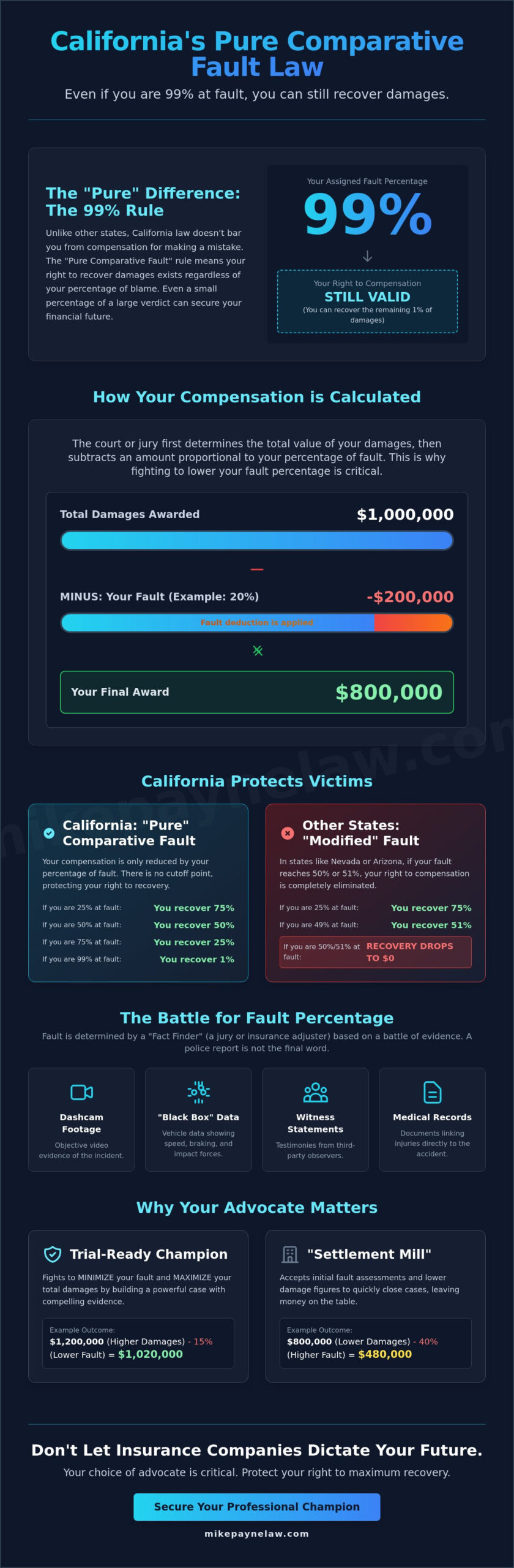
The concept of Comparative responsibility ensures fairness by replacing the old, harsh “contributory negligence” rules. In the past, if a victim contributed even 1% to an accident, they were barred from recovering a single dime. California changed that. Today, we follow the 99% rule. You can be 99% responsible for a collision and still legally pursue the remaining 1% of your damages. Having the california comparative fault law explained means you can ignore the threats of adjusters who claim you have no case. In a catastrophic injury claim, even a small percentage of a large verdict can be the difference between bankruptcy and recovery.
The ‘Pure’ Difference: Why California is Pro-Victim
Many neighboring states like Nevada or Arizona use “modified” systems that protect insurance companies. In those jurisdictions, if a jury finds you 50% or 51% at fault, your recovery drops to zero instantly. California rejected this approach in the landmark 1975 Supreme Court case Li v. Yellow Cab Co. The court decided that a “pure” system is the only way to achieve true justice. This protects you from aggressive tactics where adjusters try to push your fault percentage just high enough to kill your claim. In California, they can’t kill your claim; they can only reduce it. We fight to keep that reduction as small as possible.
Calculating the Math of Your Recovery
The math is straightforward but the stakes are high. The court determines your total damages first, including medical bills and lost wages. Then, they subtract your percentage of fault from that total. Consider this hypothetical example of a high-stakes case:
- Total Damages: $1,000,000
- Plaintiff Fault: 20%
- Final Award: $800,000
This formula highlights why your choice of attorney is critical. A “settlement mill” might accept a 40% fault percentage just to finish the paperwork and move to the next file. A trial-ready advocate fights to lower that percentage while simultaneously driving up the “Total Damages” figure. When the gross award is high, your net recovery stays significant even after the fault deduction. We focus on the bottom line because we know it’s what keeps your family afloat during a vulnerable time.
How is Percentage of Fault Actually Determined?
Determining fault isn’t a science; it’s a battle of evidence. In the chaotic aftermath of a crash, you might think the police officer’s report is the final word. It isn’t. In a civil courtroom, a police officer’s opinion on fault is often inadmissible or, at the very least, contestable. The real “Fact Finder” is either an insurance adjuster during settlement talks or a jury at trial. When a case goes to court, the California Civil Jury Instructions (CACI) on comparative fault guide jurors on how to weigh each party’s negligence. This is where having the california comparative fault law explained through the lens of a veteran trial lawyer becomes your greatest advantage.
Insurance companies use a “Defense Lawyer’s Playbook” to shift blame. They look for any reason to claim you were distracted, speeding, or failing to yield. Michael D. Payne spent years seeing these tactics from the inside. He knows exactly how adjusters manipulate data to protect their bottom line. We use their own strategies against them to ensure you aren’t unfairly burdened with a high fault percentage. Our goal is to protect your recovery from being dismantled by corporate interests.
The Investigation Phase: Building Your Shield
We move fast to secure evidence before it disappears. Witness statements are fragile; memories fade or change under pressure from insurance investigators. Our team secures dashcam footage and downloads “black box” data from vehicles to establish the cold, hard physics of the impact. Sometimes, even your medical records help. They can show that your injuries are consistent with a specific type of impact, proving you weren’t the primary cause of the collision. If you’ve been hurt, reaching out for a professional case review can stop the insurance company from controlling the narrative.
Negotiating with Insurance Giants
The “Initial Offer” trap is a common hurdle. Adjusters often start with an arbitrarily high fault percentage for the victim, hoping you’ll accept a low-ball settlement out of fear. They might tell you that 40% fault is “standard” for your type of accident. That is a lie. With over 25 years of experience, Michael Payne knows that fault is often a subjective negotiation rather than a mathematical certainty. We don’t accept their “standard” ratios. We fight for a percentage that reflects the truth of what happened on the road. Having the california comparative fault law explained by a local fighter ensures you don’t leave money on the table.
Comparative Fault in Common Southern California Accidents
The I-10 and I-210 are often scenes of chaos. When a multi-car pileup occurs, insurance companies love to play the blame game. They want to pin the entire financial burden on one person to save their own bottom line. Understanding the california comparative fault law explained in this context is vital because it recognizes that multiple people can be “a little” at fault. Whether you were caught in a chain reaction or a high-speed merge, we fight to ensure you aren’t the scapegoat for everyone else’s mistakes.
Many drivers believe the myth that the rear driver in a collision is always 100% liable. This is false. If the lead driver had faulty brake lights or slammed on their brakes without cause, they share the negligence. We use the legal doctrine of comparative negligence to prove that fault is a spectrum. In West Covina, pedestrian accidents often involve complex fault splits. Even if you were jaywalking, the driver still had a duty to exercise care. We don’t let a minor infraction on your part erase the driver’s massive responsibility.
Motor Vehicle Accidents and Comparative Negligence
Left-turn accidents are rarely black and white. Even if you had the right-of-way, an aggressive adjuster might claim you were speeding or distracted. If you were on your phone but the other driver blew a red light, you still have a right to recover damages. Our rear-end collision fault analysis shows that even minor details can tilt the scales in your favor. We act as your professional shield against these blame-shifting tactics.
Premises Liability: Slip, Trip, and Fall Scenarios
Property owners in Southern California often use the “Open and Obvious” defense. They claim that if a hazard was visible, you shouldn’t have stepped in it. We push back hard. Just because a spill was “obvious” doesn’t excuse a shopping center’s failure to maintain a safe environment. Proving the owner had “notice” of the danger is key. We demonstrate that their negligence in leaving the hazard was far greater than your momentary inattention. If you were hurt at a local business, our slip and fall representation focuses on maximizing your recovery by minimizing your fault.
Countering the ‘Blame the Victim’ Strategy
Insurance companies don’t want you to have the california comparative fault law explained by a trial attorney. They want to explain it to you themselves, usually while you’re still in a hospital bed or reeling from the shock of a crash. They rely on the psychological toll of the incident. Most decent people feel a sense of regret after a collision, even if they weren’t the primary cause. If you say “I’m sorry” at the scene, the adjuster will twist that neighborly kindness into a legal admission of 100% liability. We stop that narrative in its tracks and remind the opposition that your compassion isn’t a confession.
We use the “Last Clear Chance” doctrine to put the burden back where it belongs. This legal principle is a powerful tool in our arsenal. It argues that even if you were in a position of peril due to your own negligence, the defendant is still liable if they saw the danger and had a clear chance to avoid the collision but failed to act. Having the california comparative fault law explained correctly means recognizing that your minor error doesn’t excuse their major violation. Our team turns the tables by highlighting the defendant’s own reckless behavior. Speeding, distracted driving, or DUI violations can dwarf any minor mistake you might have made. We make sure the “Fact Finder” sees the true hierarchy of fault.
The Recorded Statement Trap
An insurance adjuster is a professional negotiator whose goal is to minimize your payout. They will call you under the guise of “helping” with your claim, asking for a recorded statement. Do not give one. They are trained to lead you into admitting “a little bit” of fault through carefully phrased questions. They know that in California, every percentage point they pin on you is money they keep in their pockets. You should never give a statement without Michael D. Payne on the line to act as your shield. We handle the talking so you can handle your recovery.
Proving Gross Negligence
In Pomona and Ontario courts, the impact of egregious behavior like a DUI cannot be overstated. When a defendant acts with gross negligence, your minor fault often becomes legally irrelevant in the eyes of a jury. We aggressively pursue drunk driving accident legal options to ensure the responsible party is held fully accountable. By exposing their reckless disregard for safety, we minimize the weight given to your own actions. If you’re being blamed for a crash you didn’t start, contact us immediately to take control of your case and protect your future.
Why You Need a Trial-Ready Advocate to Maximize Your Recovery
Choosing the wrong law firm can be as damaging as the accident itself. Many large “settlement mills” operate on volume, focusing on how many cases they can close each month rather than the quality of each result. Because they avoid the courtroom, these firms often accept high fault percentages just to move a file along. They won’t fight the insurance company’s claim that you were 30% or 40% responsible if it means getting a quick check. When you have the california comparative fault law explained by a boutique firm like ours, you see that every percentage point of fault we shave off puts more money directly into your pocket. We treat you like a neighbor in West Covina or Pomona, not a file number in a database.
Our approach is rooted in the concept of fairness and aggressive representation. We understand the Inland Empire and the specific challenges of local traffic and local courts. Our Contingency Fee Promise is a foundational trust-builder for our clients. It means you pay absolutely nothing unless we win your case. This financial assurance allows you to focus on your recovery while we handle the high-stakes confrontation with insurance giants. We are personally invested in your well-being and your future.
From Defense to Offense: The Michael D. Payne Edge
Michael D. Payne’s background gives our clients a definitive professional advantage. Having spent years seeing how the other side operates, he can anticipate and block fault-shifting tactics before they take root. We know the specific evidence adjusters look for to devalue your claim. By knowing “how the other side thinks,” we move quickly from the details of your incident to a state of decisive action. We are committed to taking cases to trial if the insurance company refuses to offer a fair settlement. You can learn more about Choosing a Trial-Ready Advocate in 2026 to see why this distinction is critical for your recovery.
Take Action Today: Secure Your Future
Time is a critical factor in any injury claim. The Statute of Limitations in California is strict, and waiting too long can bar you from seeking justice entirely. Evidence disappears, and witness memories fade. Having the california comparative fault law explained is only useful if you act while the window of opportunity is still open. We provide a path from uncertainty to professional resolve. You don’t have to face aggressive adjusters or rising medical debt alone. Contact the Law Offices of Michael D. Payne for a Free Consultation right now to secure a professional champion for your case.
Take Control of Your Case and Your Recovery
California law is on your side even when a situation feels chaotic. Now that you’ve had the california comparative fault law explained, you understand that your right to compensation is protected regardless of the initial blame. You don’t have to carry the burden of an accident alone while insurance companies try to protect their profits. We’ve shown how the right evidence can dismantle their tactics and tilt the scales of justice back in your favor.
Michael D. Payne brings over 25 years of experience to your corner. As a former insurance defense attorney, he knows the exact strategies the other side uses to devalue your claim. We serve West Covina and the Inland Empire with a boutique approach that prioritizes your specific recovery. Our firm operates on a contingency basis, meaning you pay no fee unless we win your case. You deserve a professional champion who treats you like a neighbor and fights like a warrior.
Fight Back Against Blame—Get Your Free Case Evaluation with Michael D. Payne
Justice doesn’t happen by accident. It requires decisive action and a shield against corporate interests. We’re ready to stand with you and secure the future you deserve.
Frequently Asked Questions
Can I still sue if the police report says the accident was my fault?
Yes, you can still pursue a claim. Police reports are the officer’s initial opinion and are often inadmissible as evidence in a civil trial. Having the california comparative fault law explained by a trial lawyer helps you understand that a jury makes the final determination, not the responding officer. We conduct our own investigation to uncover evidence the police may have missed or misinterpreted at the scene.
What happens if I am found 50% at fault in California?
You still recover exactly 50% of your total damages. California follows a “pure” comparative negligence model, meaning there is no 50% or 51% bar that stops you from collecting a settlement. If your medical bills and lost wages total $200,000, you are still entitled to $100,000. Our goal is to aggressively challenge the evidence to push that fault percentage as low as possible for you.
How does the insurance company decide my percentage of fault?
Adjusters use internal software and subjective “standard” ratios to assign blame, but these numbers are rarely set in stone. They weigh traffic citations, witness statements, and vehicle point-of-impact data to protect their company’s profits. Because this process is a negotiation rather than a mathematical certainty, you need a professional shield to push back against their biased calculations. We use hard data to force them into a fairer assessment.
Does my insurance go up if I’m found partially at fault in a claim I win?
In many cases, yes. California law generally allows insurance companies to increase premiums if you are found more than 50% at fault in an accident. If your fault is determined to be a lower percentage, your rates might stay stable. You should check your specific policy details or consult with a professional to understand how your carrier handles partial fault determinations.
Can I recover money if I wasn’t wearing a seatbelt during the crash?
You can still recover compensation from the at-fault driver. The defense may use the “seatbelt defense” to argue that your injuries were more severe because you weren’t restrained, which might increase your percentage of fault for the physical damages. It does not excuse the other driver’s negligence in causing the collision. We fight to ensure the focus remains on the person who actually caused the impact.
Is there a limit to how much I can recover if I am partially responsible?
There is no specific dollar cap under the law, but your final check is limited by your percentage of fault. If a jury awards you $500,000 but finds you 20% responsible, your recovery is limited to $400,000. Your total recovery is also impacted by the defendant’s insurance policy limits. We work to maximize the “total damages” figure so your net recovery remains substantial even after any fault deductions.
How long do I have to file a comparative fault claim in California?
You generally have two years from the date of the injury to file a lawsuit in California. If your claim involves a government vehicle or entity, that window is much shorter, often requiring a formal claim within just six months. Missing these deadlines permanently bars you from seeking justice. You must act with urgency to preserve evidence and secure your right to compensation.
Do I need a lawyer if the insurance company already admitted their driver was 80% at fault?
Yes, because that remaining 20% of fault could cost you tens of thousands of dollars. Adjusters often admit partial fault as a tactic to make you feel like you’ve already won, hoping you’ll accept a low-ball settlement for your “total” damages. A lawyer ensures that the 100% value of your case is calculated correctly. We make sure they pay for future medical care and pain and suffering, not just the immediate bills.